Introduction
Digital‑first businesses are under intense pressure to ship faster, stay secure, and scale reliably across complex multi‑cloud environments. Traditional ways of building and operating software cannot keep up with this pace. An experienced DevOps consulting company helps you modernize delivery, align teams, and create a resilient platform that supports continuous change. By combining DevOps consulting services, cloud consulting services, Kubernetes consulting services, and DevOps corporate training, enterprises can turn fragmented initiatives into a coherent transformation strategy. This article walks you through a practical playbook that technology leaders can use to evaluate partners, design a roadmap, and generate measurable outcomes—while building in‑house capabilities through DevOps training for companies and Kubernetes corporate training.
What a Modern DevOps Consulting Company Really Does
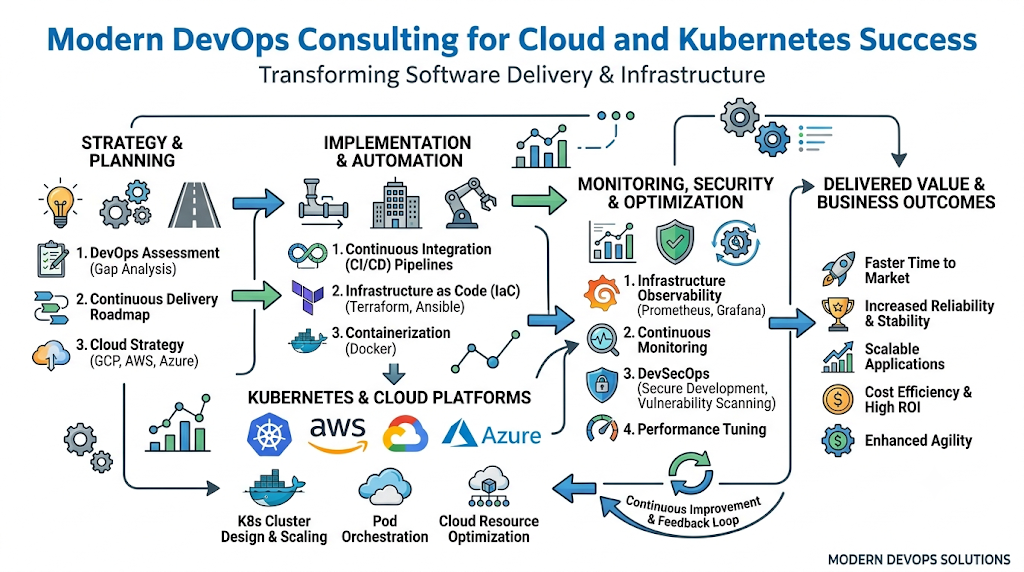
A modern DevOps consulting company goes far beyond tooling setup or one‑off automation scripts. It acts as a strategic partner that diagnoses your current delivery bottlenecks, designs a target operating model, and orchestrates the technology and people changes needed to get there. DevOps consulting services typically span assessment, architecture, implementation, coaching, and ongoing optimization across your entire software lifecycle.
These services often include cloud migration services, cloud consulting services, CI/CD pipeline consulting, infrastructure automation consulting, and Kubernetes consulting services integrated into a single transformation program. To sustain the change, DevOps corporate training, DevSecOps corporate training, Kubernetes corporate training, and role‑based upskilling tracks are embedded alongside projects so internal teams can own and evolve the platform. This blend of consulting and learning creates a repeatable way to modernize multiple products and business units over time.
Why Enterprises Need DevOps Consulting Services
Large organizations face tangled legacy systems, siloed teams, manual operations, and growing regulatory demands. These conditions make it hard to deliver features quickly without increasing incidents, outages, or security risks. DevOps consulting services provide an external, experience‑driven perspective to identify high‑leverage improvements and sequence them into achievable milestones. Instead of trying to “boil the ocean,” you get a prioritized roadmap aligned with business value.
For example, an enterprise might start with CI/CD pipeline consulting to remove release friction, then layer infrastructure automation consulting to standardize environments, followed by DevSecOps consulting services and Site Reliability Engineering consulting to improve resilience and compliance. At each step, DevOps corporate training and DevOps training for companies ensure your teams understand why changes are happening and how to work in the new model. This guidance shortens the learning curve, reduces change resistance, and helps you realize ROI faster.
Key Pillars of High‑Impact DevOps Consulting
1. Strategy and Assessment
The first pillar is a clear, data‑driven understanding of where you are today. A DevOps consulting company usually begins with discovery workshops, tooling and process audits, and a review of delivery metrics such as deployment frequency, lead time, and change failure rate. The goal is to map pain points to business outcomes rather than just listing technical issues.
From this assessment, you get a target operating model that spans architecture, automation, security, observability, and team topology. It may also recommend SRE consulting services and Site Reliability Engineering consulting to handle reliability systematically instead of reactively. This stage produces a prioritized backlog of initiatives with clear owners and success metrics.
2. Platform, Cloud, and Kubernetes Engineering
The second pillar focuses on building a robust platform that development teams can consume as a product. Cloud consulting services and cloud migration services help you choose the right landing zones, networking patterns, and governance model across AWS, Azure, or Google Cloud. Kubernetes consulting services and platform engineering consulting then design and implement a unified container platform that abstracts infrastructure complexity.
This platform often includes GitOps consulting services, CI/CD pipeline consulting, infrastructure automation consulting, and integrated observability as core capabilities. Together, they provide self‑service environments, standardized deployment pipelines, and consistent security controls, enabling teams to move quickly without sacrificing compliance.
3. Security, Reliability, and Compliance by Design
The third pillar is baking security and reliability into every layer of your delivery stack. DevSecOps consulting services align security controls with development and operations workflows instead of treating them as a separate gate at the end. This usually includes shift‑left security practices, automated policy checks, secrets management, and continuous compliance reporting.
In parallel, SRE consulting services and Site Reliability Engineering consulting introduce error budgets, service level objectives, incident response runbooks, and game days to build operational excellence. By combining DevSecOps and SRE, organizations reduce unplanned downtime, address vulnerabilities earlier, and provide more predictable service quality to customers and internal stakeholders.
4. Data‑Driven Operations: AIOps, MLOps, and DataOps
The final pillar focuses on extracting value from telemetry and data. AIOps consulting services help enterprises correlate logs, metrics, and traces at scale to surface anomalies and probable root causes faster than traditional monitoring alone. MLOps consulting services bring discipline to the lifecycle of machine learning models, ensuring they are deployed, monitored, and retrained reliably.
DataOps consulting services create consistent, automated pipelines for data ingestion, transformation, and delivery to analytics and AI systems. When combined, these capabilities transform your platform into an intelligence‑driven engine where insights from production continuously improve both operations and product decisions.
Table 1: Traditional IT vs Modern DevOps & SRE Approach
| Aspect | Traditional IT Operations | Modern DevOps & SRE Approach | Best Choice |
|---|---|---|---|
| Delivery frequency | Infrequent, batch releases, heavy change windows | Frequent, incremental releases via CI/CD | DevOps & SRE for faster value delivery |
| Collaboration | Separated dev, ops, and security teams | Cross‑functional product and platform teams | DevOps & SRE for shared ownership |
| Environment management | Manual provisioning and configuration | Infrastructure automation consulting with IaC | DevOps & SRE for consistency and speed |
| Reliability management | Reactive firefighting and ad‑hoc fixes | SRE consulting services with SLOs, error budgets, and runbooks | DevOps & SRE for predictable reliability |
| Security posture | Late‑stage reviews and manual audits | DevSecOps consulting services integrated into pipelines | DevSecOps for continuous, automated security |
| Observability & insights | Fragmented monitoring tools, limited analytics | AIOps consulting services and centralized observability | AIOps‑enabled DevOps for intelligent operations |
| Skills & enablement | Sporadic training, tool‑centric workshops | Structured DevOps corporate training and Kubernetes corporate training | DevOps training for continuous capability building |
Business Benefits of Engaging a DevOps Consulting Company
A well‑structured engagement with a DevOps consulting company delivers both technical and business outcomes. On the technical side, you gain standardized CI/CD pipelines, automated infrastructure, stronger security controls, and a unified platform across on‑prem and cloud environments. On the business side, you see faster time‑to‑market, reduced incidents, lower operational overhead, and better alignment between IT and product teams.
Because DevOps consulting services are paired with DevOps corporate training and DevOps training for companies, improvements are sustainable rather than dependent on a few external experts. Teams become comfortable with new ways of working, while leaders get clear visibility into progress through agreed‑upon metrics and governance. This combination makes DevOps and digital transformation more predictable and less risky.
Table 2: DevOps Consulting Company vs Building Only In‑House Capability
| Dimension | DevOps Consulting Company | In‑House Only Approach | Best Choice |
|---|---|---|---|
| Time to expertise | Rapid access to deep, cross‑industry experience | Slow, depends on hiring and self‑learning | Consulting company for faster outcomes |
| Breadth of services | End‑to‑end DevOps, cloud, SRE, DevSecOps, AIOps, training | Often limited to current team’s skills | Consulting for broader capability |
| Implementation risk | Proven patterns and accelerators reduce transformation risk | Higher risk of trial‑and‑error experiments | Consulting to de‑risk key initiatives |
| Change management | Structured coaching and corporate training programs | Ad‑hoc knowledge transfer, variable training quality | Consulting for sustainable adoption |
| Cost profile | Project‑based investment tied to outcomes | Long‑term fixed costs for hiring and ramp‑up | Hybrid: consulting + strategic hiring |
| Innovation pace | Continuous exposure to new tools, patterns, and industry trends | Risk of stagnation if teams cannot explore beyond daily duties | Consulting for innovation injection |
Enterprise Use Cases Across the DevOps Value Chain
Cloud Migration and Modernization
Enterprises with large on‑prem estates often struggle with multi‑year, high‑risk migration programs. Cloud migration services and cloud consulting services from an experienced partner decompose this into phased waves with clear guardrails. A DevOps consulting company can design landing zones, define reference architectures, and automate environment provisioning to reduce manual effort.
At the same time, infrastructure automation consulting and CI/CD pipeline consulting lay the groundwork for modern software delivery on the new platforms. This means teams do not just “lift and shift” but also improve deployment practices, observability, and security as part of the move.
Kubernetes and Platform Engineering
As organizations adopt containers, Kubernetes consulting services and platform engineering consulting help them avoid building fragile, one‑off clusters. Instead, they create a standardized internal developer platform with opinionated templates, policies, and self‑service capabilities. This reduces cognitive load on development teams and prevents configuration drift across environments.
Kubernetes corporate training and DevOps corporate training reinforce the platform by teaching teams how to design cloud‑native applications, troubleshoot workloads, and work with GitOps workflows. The result is a more reliable, scalable, and secure foundation that can support dozens or hundreds of services.
Secure, Reliable SaaS and Enterprise Products
For software vendors and internal product teams, DevSecOps consulting services and SRE consulting services are critical to meeting customer expectations. Site Reliability Engineering consulting formalizes reliability targets, while DevSecOps consulting embeds security into build, test, and deploy pipelines. Teams learn to treat reliability and security as shared responsibilities, not afterthoughts.
DevOps training for companies and DevSecOps corporate training help product, platform, and security teams develop a common language. This alignment reduces friction during audits, customer reviews, and major releases, allowing organizations to scale their products without sacrificing trust.
Table 3: DevOps Tooling Approaches – Ad‑Hoc Tools vs Integrated Platform
| Aspect | Ad‑Hoc Tool Selection | Integrated Platform via Consulting Partner | Best Choice |
|---|---|---|---|
| Tool landscape | Many disconnected tools per team | Curated, integrated toolchain aligned to use cases | Integrated platform for consistency |
| Implementation effort | Each team reinvents patterns and pipelines | Reusable templates, reference architectures, and accelerators | Consulting‑led platform for faster rollout |
| Governance & security | Inconsistent policies and access controls | Central governance, policy‑as‑code, and standardized controls | Integrated platform for compliance at scale |
| Developer experience | Context switching, manual scripts, varying workflows | Self‑service portals and standardized workflows | Integrated platform for productivity |
| Long‑term maintainance | High overhead, difficult upgrades | Shared roadmap managed with a platform engineering consulting | Platform approach for sustainable evolution |
Common Implementation Mistakes and How to Avoid Them
One frequent mistake is treating DevOps as a tool rollout instead of an operating model change. Organizations may invest heavily in CI/CD tools, cloud migration services, or Kubernetes without redefining ownership, processes, and incentives. This leads to underused platforms and frustrated teams. Working with a DevOps consulting company ensures operating model design is part of the transformation blueprint, not an afterthought.
Another mistake is ignoring skills and culture. Without DevOps corporate training, DevSecOps corporate training, and Kubernetes corporate training, teams often revert to old habits under pressure. Finally, many enterprises underestimate the importance of observability and data‑driven operations, delaying AIOps consulting services or SRE consulting services until incidents become unmanageable. Proactively investing in these capabilities creates resilience from day one instead of reacting to crises later.
Best Practices for Successful DevOps and Cloud Transformation
Align transformation goals to concrete business outcomes such as release frequency, defect escape rate, customer adoption, or compliance audit time. Start with a baseline assessment and use DevOps consulting services to build a phased roadmap, focusing first on CI/CD pipeline consulting, infrastructure automation consulting, and cloud consulting services that unlock quick wins. Pair every major implementation with targeted DevOps training for companies so teams can operate new platforms confidently.
Adopt platform engineering consulting to create a reusable, internal developer platform that encapsulates best practices and governance. Bake in security from the start through DevSecOps consulting services and continuous compliance, then strengthen reliability via SRE consulting services and Site Reliability Engineering consulting. Finally, close the loop using AIOps consulting services, MLOps consulting services, and DataOps consulting services to drive continuous improvement based on real production data.
Expert Tips from the Field
- Start small, scale fast. Pick one or two representative products or business units and use them as lighthouse projects to validate your DevOps operating model before scaling it across the enterprise.
- Invest in platform thinking. Use platform engineering consulting to treat your cloud, Kubernetes, and CI/CD capabilities as products with roadmaps, SLAs, and clear onboarding journeys.
- Make security and reliability visible. Tie DevSecOps and SRE metrics to leadership dashboards so trade‑offs are explicit, not hidden.
- Prioritize learning paths. Combine DevOps corporate training, Kubernetes corporate training, and DevSecOps corporate training into role‑based curricula for developers, platform engineers, and SREs.
- Measure outcomes, not activity. Focus on cycle time, change failure rate, MTTR, and customer‑facing KPIs rather than just counting automation scripts or training hours.
Digital Transformation Consulting Company Perspective
A digital transformation consulting company that offers DevOps consulting services, cloud migration services, AIOps consulting services, MLOps consulting services, and DataOps consulting services can connect technology change with broader business reinvention. Instead of isolated projects, you get an integrated roadmap that touches products, platforms, data, and people. This is especially important in enterprises where multiple programs—cloud, analytics, security, and customer experience—are running concurrently.
When DevOps, cloud, security, and data transformations are handled in silos, organizations experience duplicated work, conflicting patterns, and governance gaps. A unified digital transformation consulting approach aligns architecture decisions, platform investments, and training plans across these streams. The result is a cohesive foundation where new products, AI features, and business models can be launched quickly, safely, and repeatedly.
Why Choose a Partner Like Cotocus
A partner like Cotocus combines DevOps consulting services, cloud consulting services, Kubernetes consulting services, and DevOps corporate training into an integrated offering tailored to enterprise needs. Their teams bring experience across banking, healthcare, technology, aviation, education, and professional services, which helps them recognize patterns and anti‑patterns quickly. This cross‑industry insight is valuable when designing platforms and processes that must work in regulated and high‑growth environments.
Cotocus also emphasizes hands‑on, scenario‑driven DevOps training for companies, Kubernetes corporate training, and DevSecOps corporate training, ensuring internal teams do not just “watch slides” but practice real workflows. Combined with AIOps consulting services, MLOps consulting services, DataOps consulting services, and Site Reliability Engineering consulting, this creates an end‑to‑end capability for continuous delivery and continuous learning. For enterprises and digital‑first organizations, that combination is a strong foundation for long‑term success.
Frequently Asked Questions
1. What does a DevOps consulting company actually do?
A DevOps consulting company helps organizations redesign how they build, test, release, and operate software. It assesses current practices, defines a target operating model, and implements CI/CD, infrastructure automation, security, and observability improvements. Many also provide DevOps corporate training and DevOps training for companies so teams can adopt new ways of working sustainably.
2. How is DevOps consulting different from traditional IT consulting?
Traditional IT consulting often focuses on discrete projects, tools, or infrastructure upgrades. DevOps consulting services focus on the entire value stream from idea to production, aligning culture, processes, and platforms. It emphasizes continuous delivery, feedback loops, and shared responsibility between development, operations, and security rather than one‑time handovers.
3. Why do enterprises need DevOps corporate training?
DevOps corporate training ensures teams understand not just tools but the principles behind them. Without structured learning, people revert to old habits when under pressure, undermining transformation efforts. Tailored training builds confidence with CI/CD, cloud platforms, Kubernetes, and DevSecOps practices, reducing resistance and speeding up adoption across multiple teams.
4. What are the benefits of Kubernetes consulting services?
Kubernetes consulting services help organizations design secure, scalable clusters, choose the right ecosystem components, and establish standard deployment patterns. This avoids common pitfalls like misconfigured networking, insecure access, and inconsistent environments. Consultants also help set up GitOps workflows and observability, enabling teams to operate Kubernetes at scale with confidence.
5. When should we consider SRE consulting services?
You should consider SRE consulting services when incidents, downtime, or performance issues are affecting customer experience or internal operations. SRE and Site Reliability Engineering consulting introduce structured practices such as SLOs, error budgets, and incident playbooks. This moves reliability from best‑effort heroics to measurable, managed engineering work that leadership can prioritize and track.
6. How do DevSecOps consulting services improve security?
DevSecOps consulting services integrate security into the development and delivery pipeline rather than treating it as a final checkpoint. Consultants help implement automated security scans, policy‑as‑code, secrets management, and secure SDLC practices. This reduces vulnerabilities, shortens remediation cycles, and improves audit readiness without blocking development teams.
7. What is the role of platform engineering consulting?
Platform engineering consulting helps organizations build internal platforms that provide standardized, self‑service capabilities such as environments, pipelines, and observability. Instead of each team assembling its own toolchain, they consume curated “golden paths” that encode best practices. This improves developer experience, governance, and maintainability across the portfolio.
8. How do AIOps, MLOps, and DataOps fit into DevOps?
AIOps consulting services apply machine learning to operations data to detect anomalies and accelerate root cause analysis. MLOps consulting services bring DevOps‑style discipline to machine learning models, ensuring reliable deployment and monitoring. DataOps consulting services standardize and automate data pipelines, making analytics and AI more dependable and repeatable. Together they extend DevOps into data‑driven operations.
9. Can a DevOps consulting company help with regulated industries?
Yes. A mature DevOps consulting company understands regulatory requirements in sectors like finance, healthcare, and aviation. They design CI/CD, infrastructure automation, and observability patterns that meet compliance needs while preserving agility. DevSecOps consulting services and Site Reliability Engineering consulting help embed audit‑friendly controls into everyday workflows.
10. How long does a typical DevOps consulting engagement last?
Engagement length varies with scope, but many enterprises start with a 8–12 week assessment and pilot implementation, followed by multi‑quarter rollout phases. Some organizations maintain longer‑term partnerships for platform evolution, SRE coaching, and ongoing DevOps training for companies as new teams are onboarded or products are launched.
11. What internal roles should be involved in DevOps transformation?
Successful DevOps transformation requires participation from CTOs, CIOs, product owners, engineering managers, security leaders, operations teams, and HR or L&D for training. A DevOps consulting company helps align these stakeholders around shared goals, governance models, and metrics, reducing conflicting priorities and siloed initiatives.
12. How do we measure ROI from DevOps consulting services?
ROI can be tracked through improved deployment frequency, reduced lead time for changes, lower change failure rates, and shorter incident resolution times. Business metrics such as revenue impact, customer satisfaction, and compliance costs also matter. A good consulting partner defines baseline metrics and target improvements up front.
13. Is DevOps consulting relevant for startups?
Yes. Startups benefit from setting solid foundations early: cloud‑ready architectures, CI/CD pipelines, and basic SRE practices. DevOps consulting services help avoid future rework and scale bottlenecks. Engagements are typically lighter‑weight, focusing on pragmatic patterns and coaching rather than large transformation programs.
14. How does corporate training differ from public DevOps courses?
DevOps corporate training, Kubernetes corporate training, and DevSecOps corporate training are tailored to your tools, environments, and real scenarios. Public courses are generic by design. Corporate programs integrate with your roadmap, runbooks, and pipelines, enabling teams to practice workflows they will use in daily work.
15. What should we look for when selecting a DevOps consulting company?
Look for a partner with proven experience across DevOps consulting services, cloud consulting services, Kubernetes consulting services, and DevOps corporate training. Check client references, case studies, and the depth of their SRE, DevSecOps, AIOps, MLOps, and DataOps capabilities. Equally important is cultural fit and their ability to transfer knowledge, not just deploy tools.
Conclusion
DevOps, cloud, and data transformations are no longer optional for enterprises that want to stay competitive. A capable DevOps consulting company helps you move beyond isolated tools and projects toward an integrated operating model that combines CI/CD pipeline consulting, infrastructure automation consulting, DevSecOps consulting services, SRE consulting services, and platform engineering consulting. When paired with DevOps corporate training, Kubernetes corporate training, and DevSecOps corporate training, these initiatives become sustainable capabilities rather than temporary improvements.
By approaching transformation as a structured, measurable program, organizations can accelerate delivery, reduce risk, and create a resilient foundation for innovation. The result is a modern digital platform that supports new products, AI‑driven features, and evolving customer expectations.
