Introduction
Running a modern software environment involves much more than writing code and releasing applications. Engineering teams must continuously manage cloud resources, deployment pipelines, containers, security controls, monitoring systems, infrastructure changes, and production incidents. As systems grow, these responsibilities can become difficult to handle alongside normal product development. A failed CI/CD pipeline can interrupt a release. An incorrect configuration can create unexpected production behavior. A Kubernetes issue may require specialist knowledge, while cloud environments can generate a steady stream of operational tasks. At the same time, teams are expected to respond quickly when customers or internal users experience problems. This is why DevOps support has become an important part of modern IT operations. Instead of treating DevOps as a one-time implementation project, organizations can establish ongoing operational practices covering infrastructure, automation, monitoring, deployments, security, and reliability.
What Are DevOps Support Services?
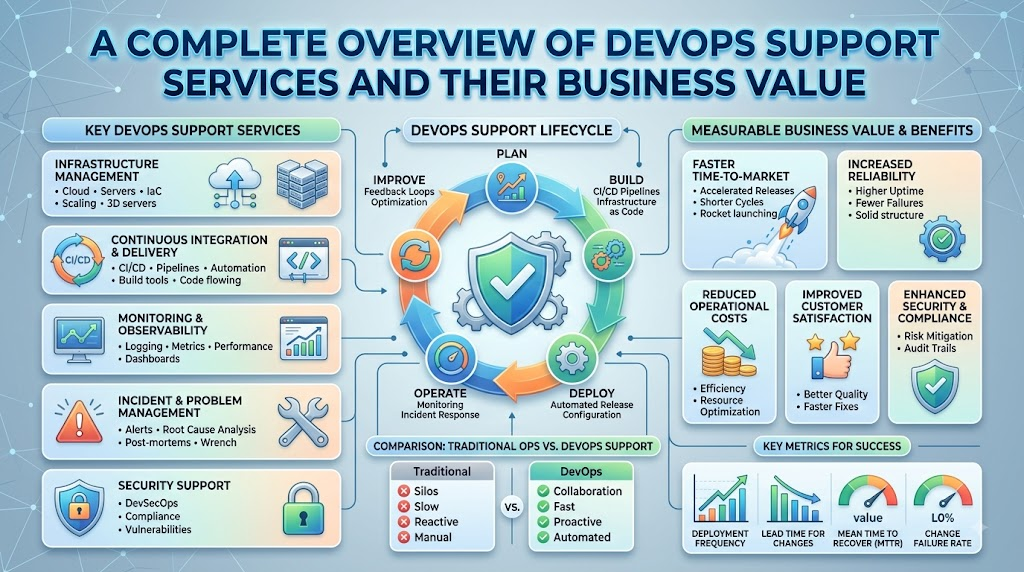
DevOps Support Services refer to continuous technical assistance for maintaining and improving software delivery environments and production infrastructure.
The scope can vary considerably between organizations. A small startup may primarily need help with CI/CD pipelines, cloud infrastructure, and monitoring. A larger enterprise may require assistance across Kubernetes, infrastructure as code, security automation, production incidents, and multi-cloud operations.
Common areas include:
- Infrastructure administration
- CI/CD pipeline maintenance
- Cloud operations
- Deployment assistance
- Monitoring and observability
- Incident troubleshooting
- Infrastructure as Code
- Automation
- Configuration management
- Production support
- Performance optimization
There is an important difference between implementation and ongoing support. During implementation, an engineering team may create a pipeline, establish infrastructure, or deploy a container platform. Afterward, someone still needs to maintain those systems, investigate failures, update configurations, and support future changes.
Ongoing DevOps support fills this operational gap.
Why Continuous DevOps Support Matters
Technology environments change constantly. Applications receive new releases, infrastructure requirements shift, cloud resources grow, dependencies are updated, and security controls need regular attention.
Even a well-designed platform can become difficult to operate when maintenance is postponed. Small configuration problems may accumulate, monitoring rules may become outdated, and manual processes can gradually become part of everyday operations.
Internal teams often face another challenge: limited time. Developers need to focus on application features, while platform engineers may already be responsible for multiple environments. During busy release periods, routine infrastructure work can easily compete with important engineering projects.
Ongoing support can provide additional operational capacity without removing internal ownership.
For example, an internal platform team may remain responsible for architecture and major decisions while a support team handles agreed activities such as pipeline troubleshooting, infrastructure monitoring, routine maintenance, and incident assistance.
The key is to establish clear responsibilities from the beginning.
24/7 DevOps Support Services
Applications serving customers across different regions may generate operational events at any hour. In such environments, waiting until the next business day to investigate an important alert may not be practical.
24/7 DevOps Support Services can provide continuous operational coverage through monitoring, alert investigation, incident response, escalation, and production troubleshooting.
A useful round-the-clock support model normally includes:
- Continuous monitoring
- Alert classification
- Incident response
- Production troubleshooting
- Deployment assistance
- Escalation procedures
- Availability monitoring
- Emergency technical assistance
- Shift handovers
Monitoring alone is not enough. Alerts need appropriate priorities and clear response procedures. A critical production alert should follow a different path from a low-priority notification.
Runbooks can also improve consistency. When a known problem occurs, engineers can follow documented procedures instead of developing a response from scratch.
24/7 support can be especially relevant for global SaaS platforms, customer-facing applications, and business systems where operational issues may occur outside standard working hours. Organizations should carefully evaluate coverage, escalation responsibilities, communication methods, and response expectations rather than assuming every provider offers the same model.
Managed DevOps Services
Managed DevOps Services take the idea of ongoing support a step further. Under a managed model, an external technical team may take responsibility for a defined group of recurring operational activities.
Depending on the arrangement, this can include:
- CI/CD management
- Cloud administration
- Infrastructure automation
- Infrastructure maintenance
- Configuration management
- Monitoring
- Release support
- Backup-related operations
- Security activities
- Production maintenance
The distinction from traditional consulting is mainly the continuity of responsibility. Consulting often focuses on recommendations, architecture, or a specific implementation. Managed services are more focused on recurring operational execution.
This approach can be useful for organizations that do not want to build a large internal operations team or need additional support while their internal capabilities develop.
However, managed DevOps is not automatically the best option for every organization. A company with a mature platform engineering function may prefer to retain most responsibilities internally and use external specialists only for selected areas.
The decision should depend on operational complexity, internal expertise, business requirements, and the level of control the organization wants to maintain.
Kubernetes Support Services
Kubernetes can provide a strong foundation for containerized applications, but production Kubernetes environments require careful operational management.
Teams may need to manage cluster upgrades, workloads, resource consumption, networking, access controls, monitoring, scaling, and application troubleshooting. Problems can become difficult to diagnose when multiple services depend on the same cluster.
Kubernetes Support Services can assist with activities such as:
- Cluster administration
- Kubernetes upgrades
- Workload management
- Scaling
- Networking troubleshooting
- Security configuration
- Monitoring
- Resource management
- Production troubleshooting
- Performance optimization
Consider a production cluster experiencing resource pressure. The issue may not simply be that the cluster needs more capacity. Engineers may need to investigate workload requests and limits, scheduling behavior, application consumption, and scaling policies.
Similarly, an upgrade should not be treated as a simple version change. Compatibility, workloads, add-ons, networking, storage, and rollback planning may all need consideration.
Kubernetes support can therefore be valuable when internal teams need additional expertise or operational capacity.
These practices can apply to managed Kubernetes services such as AWS EKS, Azure AKS, and Google GKE, although the exact operational responsibilities differ by platform.
AWS DevOps Support Services
AWS environments can contain a wide range of infrastructure and application services. Organizations may use EC2 for compute, EKS or ECS for containers, Lambda for serverless workloads, and infrastructure-as-code tools for repeatable provisioning.
AWS DevOps Support Services can cover areas such as:
- EC2 infrastructure
- EKS
- ECS
- Lambda
- Terraform
- CloudFormation
- CI/CD pipelines
- Cloud monitoring
- Infrastructure automation
- Deployment operations
Operational support may involve investigating failed deployments, reviewing infrastructure changes, maintaining automation, monitoring cloud resources, or troubleshooting application environments.
Architecture decisions should always be based on workload requirements. A serverless application does not necessarily need the same operational model as a large container platform. Likewise, a simple application may not require the same infrastructure complexity as a distributed enterprise system.
Good AWS support therefore focuses not only on individual services but also on how infrastructure, applications, automation, security, and monitoring work together.
Azure DevOps Support Services
Azure-based organizations face many of the same operational challenges, although their tooling and infrastructure may be centered around the Microsoft ecosystem.
Azure DevOps support can involve Azure Pipelines, AKS, infrastructure automation, release management, monitoring, deployment workflows, and production operations.
Typical responsibilities may include:
- Azure infrastructure management
- Azure Pipelines support
- AKS operations
- Deployment automation
- Release management
- CI/CD troubleshooting
- Monitoring
- Production support
- Infrastructure maintenance
For example, an engineering team may have a working pipeline but still need assistance when deployments fail because of environment-specific configurations. In another situation, a team may need help maintaining an AKS environment while application developers focus on product releases.
The value of ongoing support comes from handling these recurring operational requirements in a structured way.
DevSecOps Support Services
Security should not be treated as an isolated activity that happens only before an application reaches production. Modern delivery processes work better when security controls are included throughout development and deployment.
DevSecOps Support Services can help organizations integrate practices such as:
- SAST
- DAST
- Dependency scanning
- Container security
- Secrets management
- Vulnerability management
- Secure CI/CD
- Security automation
- Compliance-related controls
For example, dependency scanning can identify vulnerable packages, while container scanning can highlight issues within container images. Secrets management helps prevent sensitive credentials from being stored directly in application code or configuration.
These tools do not eliminate security risk by themselves. Teams still need processes for reviewing findings, deciding priorities, applying fixes, and documenting exceptions.
A mature DevSecOps approach makes security part of normal engineering work rather than treating it as a final inspection step.
SRE Support Services
Site Reliability Engineering focuses on building reliable systems through engineering practices, automation, measurement, and disciplined incident management.
SRE Support Services can help teams work with concepts such as:
- Service-level indicators
- Service-level objectives
- Service-level agreements
- Error budgets
- Observability
- Incident management
- Capacity planning
- Performance engineering
- Reliability automation
- Root-cause analysis
An SLI measures a particular aspect of service performance, such as availability or latency. An SLO establishes a target for that measurement. An SLA may represent a formal commitment to customers or other stakeholders.
Error budgets can help teams balance reliability and delivery. If a service is consistently meeting its reliability objectives, teams may have more flexibility to introduce changes. If reliability is deteriorating, additional engineering attention may be needed.
Incident reviews are another important part of SRE. Instead of simply restoring service, teams can investigate why an incident occurred and identify changes that could reduce the chance of recurrence.
MLOps Support Services
Machine-learning applications introduce operational requirements that continue after a model has been developed.
A model must eventually be integrated into a production environment, and teams need repeatable processes for deployment, version management, infrastructure, monitoring, and updates.
MLOps Support Services can cover:
- Model deployment
- ML infrastructure
- ML pipelines
- Model monitoring
- Version management
- Automation
- Resource management
- Production operations
- Scalable ML environments
For example, a team may successfully train a model but still need a reliable mechanism for moving approved model versions into production. Monitoring also becomes important because the operational behavior of an ML system can involve more than conventional application health.
MLOps connects data science and machine learning workflows with software engineering, infrastructure, automation, and production operations.
DevOps Support Technology Areas
| Area | Common Technologies / Practices | Primary Purpose |
|---|---|---|
| CI/CD | Jenkins, GitHub Actions, GitLab CI/CD, Azure Pipelines | Automated delivery |
| Cloud | AWS, Azure, Google Cloud | Infrastructure operations |
| Containers | Docker, Kubernetes | Application consistency |
| Infrastructure as Code | Terraform, CloudFormation | Repeatable infrastructure |
| Monitoring | Metrics, logs, traces | Operational visibility |
| Security | SAST, DAST, secrets management | Secure delivery |
| SRE | SLI, SLO, error budgets | Reliability |
| MLOps | ML pipelines, model monitoring | Production ML operations |
The technologies shown above are examples, not a mandatory technology stack. Tool choices should consider existing infrastructure, technical skills, workload requirements, security needs, and organizational standards.
Benefits of Continuous DevOps Support
A structured support model can provide several practical advantages.
Faster troubleshooting: Experienced support engineers can investigate recurring operational problems without requiring application developers to handle every infrastructure issue.
Less manual work: Automation can replace repetitive deployment and infrastructure tasks, improving consistency.
Better visibility: Monitoring, logs, and traces can help teams understand application and infrastructure behavior.
More consistent releases: Standardized deployment processes can reduce avoidable configuration differences.
Stronger incident response: Defined escalation and response procedures can improve coordination during production events.
Improved security practices: Security checks can be integrated into development and operational workflows.
Better reliability: Observability, incident reviews, capacity planning, and automation can support more disciplined reliability practices.
The actual impact depends on the organization’s starting point, support scope, architecture, and internal processes.
Common DevOps Support Challenges
Even a well-planned support arrangement can encounter operational difficulties.
- Poor documentation: Outdated runbooks make troubleshooting unnecessarily difficult.
- Unclear ownership: Problems take longer to resolve when responsibilities are not clearly assigned.
- Weak escalation procedures: Complex incidents need defined paths to specialists and decision-makers.
- Limited observability: Missing metrics, logs, and traces make diagnosis harder.
- Too much manual work: Repetitive manual processes increase operational effort and inconsistency.
- Configuration differences: Environment drift can produce problems that are difficult to reproduce.
- Poor communication: Incomplete incident updates can create confusion between teams.
- Limited knowledge transfer: Internal engineers need sufficient understanding of systems supported externally.
- External dependency: Organizations should avoid allowing critical operational knowledge to exist only with a third party.
- Weak security processes: Poor secrets handling, delayed vulnerability remediation, and excessive access can introduce unnecessary risk.
These challenges should be addressed through documentation, clear ownership, automation, communication, and regular operational reviews.
How to Choose a DevOps Support Company
Selecting a DevOps support provider requires more than checking a list of technologies. Organizations should first determine what they actually need help with.
Consider the following areas:
- Experience with the required cloud platforms
- Kubernetes expertise
- CI/CD knowledge
- Infrastructure as Code capabilities
- Security understanding
- SRE practices
- MLOps awareness where relevant
- Monitoring and observability
- Incident response
- Documentation
- Communication processes
- Support coverage
- Escalation procedures
- SLA structure
- Knowledge transfer
- Security controls
- Compatibility with internal engineering teams
It is useful to ask potential providers how they handle production incidents, emergency changes, documentation, access management, and handovers.
Organizations should also understand which responsibilities remain internal. For example, an external team might troubleshoot infrastructure while the internal team retains final approval for production changes.
Knowledge transfer deserves particular attention. A healthy support relationship should help internal engineers understand the environment instead of creating permanent dependence on an outside team.
DevOps Support Area and Business Need
| Support Area | Typical Business Need |
| DevOps Support | Ongoing infrastructure and delivery assistance |
| 24/7 DevOps Support | Continuous operational monitoring and incident response |
| Managed DevOps | Reduce recurring operational workload |
| Kubernetes Support | Manage containerized production environments |
| AWS DevOps Support | Support AWS infrastructure and deployments |
| Azure DevOps Support | Manage Azure-based DevOps operations |
| DevSecOps Support | Integrate security into delivery and operations |
| SRE Support | Improve reliability and operational practices |
| MLOps Support | Operate ML systems in production |
Frequently Asked Questions
1. What are DevOps Support Services?
DevOps Support Services provide ongoing assistance with infrastructure, CI/CD, cloud operations, automation, monitoring, deployments, troubleshooting, and production environments.
2. Why do companies need ongoing DevOps support?
Infrastructure and applications change continuously. Ongoing support helps organizations handle operational maintenance, incidents, deployments, monitoring, and infrastructure changes without placing every responsibility on internal developers.
3. What do 24/7 DevOps Support Services include?
They may include continuous monitoring, alert investigation, production troubleshooting, incident response, deployment assistance, escalation, and operational handovers. Exact responsibilities depend on the agreed support scope.
4. How are managed DevOps services different from regular DevOps support?
Managed DevOps usually involves an external team taking responsibility for a defined set of recurring operational activities. General DevOps support can be narrower and may focus on specific assistance or technical responsibilities.
5. When should a company consider Kubernetes support?
Kubernetes support can be useful when teams face cluster administration, upgrade, scaling, networking, monitoring, security, resource, or production troubleshooting challenges.
6. What is included in AWS DevOps support?
AWS support can involve EC2, EKS, ECS, Lambda, Terraform, CloudFormation, CI/CD pipelines, monitoring, infrastructure automation, and deployment operations.
7. How does DevSecOps support help engineering teams?
It integrates security into development and delivery through practices such as code scanning, dependency analysis, container security, secrets management, vulnerability management, and security automation.
8. How do SRE and MLOps fit into DevOps support?
SRE focuses on reliability, observability, incident response, capacity, and performance. MLOps extends operational practices to machine-learning systems, including model deployment, pipelines, infrastructure, monitoring, and version management.
Conclusion
DevOps support is increasingly about maintaining an operational system rather than simply fixing isolated technical problems. As organizations adopt cloud platforms, containers, automation, security controls, and machine-learning workloads, the number of interconnected operational responsibilities also increases. A well-defined support model can bring together cloud administration, CI/CD, infrastructure automation, Kubernetes operations, monitoring, DevSecOps, SRE practices, and MLOps. The goal is not to add complexity but to create clearer ownership and more predictable ways of managing technical environments. There is no single support structure that fits every business. A startup with a small engineering team may need broad operational assistance, while an enterprise with a mature platform team may only require specialist support for Kubernetes, cloud, security, or reliability engineering.
