Introduction
DevOps has changed considerably from being mainly associated with deployment automation and collaboration between development and operations teams. Today, engineering organizations work across cloud platforms, containers, Infrastructure as Code, CI/CD pipelines, observability, security automation, reliability engineering, and machine-learning workloads. As these technologies become part of everyday engineering, teams also need the right skills to use them effectively. This creates a common challenge: having access to modern tools does not automatically mean that employees know how to operate them correctly. Teams may have cloud accounts, Kubernetes clusters, automated pipelines, or monitoring platforms but still struggle with configuration, troubleshooting, security, and production operations. DevOps training can help close this gap by combining concepts with practical exercises. The quality of that learning depends heavily on the trainer, curriculum, lab environment, and relevance of the examples being used.
What Is the Role of a DevOps Trainer?
A DevOps Trainer acts as both an instructor and a technical guide. The role involves explaining engineering practices while helping learners understand how different technologies fit into an end-to-end workflow.
A training session might begin with source control and CI/CD concepts and then move toward automated testing, containerization, cloud deployment, Infrastructure as Code, monitoring, and troubleshooting. Instead of treating every technology as a separate subject, a good learning path shows the relationship between them.
For example, learners could build an application, create a pipeline, package the application into a container, provision infrastructure, deploy the workload, and monitor its behavior. They can then intentionally introduce a configuration problem and investigate the failure.
This practical approach is different from training that concentrates mainly on presentations and definitions. DevOps involves frequent decision-making and troubleshooting, so learners benefit from environments where they can experiment safely.
A trainer may also need to adjust the teaching method according to the audience. A beginner may need fundamental explanations, whereas an experienced engineer may benefit more from architecture discussions, production scenarios, and troubleshooting exercises.
Why Organizations Need Structured DevOps Learning
Technology teams frequently adopt new platforms faster than they can develop expertise around them. A company might move workloads to the cloud, introduce containers, automate infrastructure, or redesign its release process within a relatively short period.
Without structured learning, engineers may learn through trial and error. While practical experience is valuable, relying exclusively on it can lead to inconsistent practices and repeated mistakes.
Organized DevOps education can establish a common foundation across different roles. Developers can understand deployment processes, infrastructure engineers can learn application delivery requirements, and security professionals can see where controls fit into CI/CD.
Training can also support broader technology initiatives by helping employees understand the reasons behind new engineering practices. However, it should not be viewed as a substitute for production experience. Real systems contain business constraints, legacy dependencies, traffic variations, operational risks, and organizational processes that cannot be completely reproduced in a classroom.
The most useful approach combines formal learning with projects, experimentation, documentation, code reviews, incident analysis, and ongoing engineering work.
Corporate DevOps Training: Why Customization Matters
Corporate DevOps Training is different from a general course designed for individual learners. An organization usually has an existing technology environment, specific business objectives, different levels of employee experience, and established development processes.
A generic syllabus may introduce useful concepts, but it may spend too much time on technologies that the team does not use while overlooking areas that are directly relevant to its environment.
A customized corporate program can instead concentrate on practical needs. For example, one team may need to improve CI/CD pipelines, another may be preparing for Kubernetes adoption, and another may need better Infrastructure as Code practices.
Customization can cover:
- Existing technology stacks
- Team experience levels
- Business objectives
- Internal development workflows
- Cloud platforms
- Security requirements
- Operational challenges
- Desired learning outcomes
Workshops can also include team exercises and assessments. These activities help identify areas where additional learning may be necessary.
The objective is not to make every employee an expert in every DevOps technology. It is to build the right capabilities for the organization’s actual engineering environment.
Learning With an Online DevOps Trainer
Remote work has made online technical training a practical option for individuals and distributed teams. An Online DevOps Trainer can conduct live sessions through virtual classrooms while using screen sharing, demonstrations, remote labs, and interactive exercises.
Online learning provides several conveniences. Employees in different cities or countries can participate in the same program, and organizations do not need to arrange a physical classroom. Learners can also access digital documentation and recorded material when those resources are included in the program.
However, online delivery has challenges. Participants may have different computer configurations, network conditions, or levels of familiarity with development tools. Long lectures can also become difficult to follow when learners are not actively involved.
For that reason, effective online DevOps education should include frequent practical activities. Learners should have opportunities to perform tasks themselves, ask questions, examine failures, and discuss possible solutions.
The important factor is not whether training happens online or in person. The stronger consideration is whether the learning format supports interaction, practice, feedback, and the intended technical outcomes.
Selecting a DevOps Trainer in India
Choosing a DevOps Trainer in India requires a balanced evaluation of technical expertise and teaching ability. A person with extensive production experience is not automatically an effective instructor, just as a good presenter may not necessarily have enough practical engineering depth.
Organizations should examine several areas before making a decision.
First, look at technical coverage. Depending on the training objective, the trainer should understand areas such as CI/CD, cloud infrastructure, containers, Infrastructure as Code, automation, observability, and production troubleshooting.
Second, examine how the training is delivered. Are there practical labs? Do learners build something themselves? Are troubleshooting exercises included? Can the trainer explain complex subjects using simple examples?
Third, consider whether the curriculum can be adapted. A team using Azure may require a different focus from one working primarily with AWS. Similarly, a platform engineering group may need deeper Kubernetes and Infrastructure as Code coverage than a development team.
Communication skills are also important. Technical training becomes much more useful when learners can comfortably ask questions and receive explanations appropriate to their experience level.
What to Expect From a Kubernetes Trainer
Kubernetes training should move beyond basic commands and resource definitions. Learners need to understand how Kubernetes components interact and how those components behave during real operational situations.
A practical Kubernetes curriculum can include:
- Kubernetes architecture
- Pods and Deployments
- Services and networking
- ConfigMaps and Secrets
- Storage
- Scaling
- Helm
- Monitoring
- Access and security
- Cluster administration
- Application troubleshooting
- Production operations
Hands-on exercises can make these topics easier to understand. Instead of only reading about Deployments, learners can create one, update it, observe a rollout, investigate a failed configuration, and recover the workload.
Cloud-managed Kubernetes platforms can provide additional context. AWS EKS, Azure AKS, and Google GKE demonstrate how Kubernetes is used in different cloud environments.
The goal should be operational understanding rather than memorizing configuration files.
What AWS DevOps Training Should Cover
An AWS DevOps Trainer can help learners connect AWS services with development and delivery processes. Training may involve EC2, EKS, ECS, Lambda, Terraform, CloudFormation, CI/CD, monitoring, and automation.
However, simply listing AWS services does not create strong DevOps knowledge. Learners should understand how services can be selected and combined for particular requirements.
For example, containerized workloads may require a comparison of different deployment approaches. Infrastructure as Code can demonstrate how environments become repeatable and manageable. CI/CD exercises can show how application changes move through testing and deployment.
AWS training should also include operational considerations such as permissions, monitoring, failure handling, environment separation, and deployment strategies.
Different AWS architectures solve different problems, so training should teach learners how to evaluate options instead of presenting a single service as universally appropriate.
Azure DevOps Training and Delivery Workflows
An Azure DevOps Trainer can introduce teams to delivery and automation practices within Microsoft Azure environments. Areas may include Azure Pipelines, AKS, infrastructure management, Infrastructure as Code, monitoring, release automation, and CI/CD.
A useful exercise might follow a complete workflow: source code is committed, automated checks run, an artifact is created, infrastructure is prepared, and the application is deployed. Learners can then examine logs and monitoring data to understand what happens after deployment.
Azure training should also address operational discipline. Release approvals, rollback planning, environment management, access control, monitoring, and troubleshooting are all part of maintaining a reliable delivery process.
The value of training increases when cloud services are presented as components of an engineering workflow rather than as isolated features.
Why DevSecOps Training Belongs in the Learning Path
Security is increasingly connected with development and operations. Waiting until the end of the software lifecycle to identify security issues can make remediation more difficult.
A DevSecOps Trainer can explain how security practices can be integrated throughout development and delivery. Topics may include:
- SAST
- DAST
- Dependency scanning
- Container security
- Secrets management
- Vulnerability management
- Secure CI/CD
- Security automation
- Compliance automation
Practical training can show where security checks fit into a pipeline and how teams respond when a scan identifies a problem.
It is also important to explain that security tools do not remove the need for human judgment. Findings need to be reviewed, prioritized, investigated, and resolved according to risk and organizational requirements.
This makes DevSecOps learning more useful than simply adding security tools to an existing syllabus.
SRE Training and Reliability Engineering
DevOps focuses strongly on delivery and operational collaboration, while SRE places particular emphasis on measurable service reliability and engineering practices.
An SRE Trainer may cover:
- Service Level Indicators
- Service Level Objectives
- Service Level Agreements
- Error budgets
- Observability
- Incident management
- Root-cause analysis
- Capacity planning
- Performance engineering
- Reliability automation
Learners should understand how reliability objectives influence engineering decisions. For example, monitoring should provide information that helps teams determine whether a service is meeting its objectives rather than simply generating large volumes of metrics.
Incident simulations can also be valuable. Teams can practice identifying an issue, assessing impact, communicating during an incident, mitigating the problem, and reviewing what happened afterward.
This helps position reliability as an engineering responsibility rather than simply an operations task.
MLOps Training for Machine-Learning Operations
Machine-learning systems introduce operational requirements that traditional application delivery does not always address in the same way. Models need to be versioned, deployed, monitored, and maintained as their surrounding systems change.
An MLOps Trainer can introduce topics such as:
- ML pipelines
- Model deployment
- Model monitoring
- Version management
- Automation
- ML infrastructure
- Cloud environments
- Production operations
- Scalability
MLOps connects development practices with the operational lifecycle of machine-learning workloads. Learners can explore how models move from development environments toward controlled production processes.
Training should also make clear that operating ML systems involves more than deploying a model. Monitoring, reproducibility, infrastructure management, and lifecycle processes are important parts of maintaining an operational ML environment.
DevOps Training Technology Areas
| Training Area | Common Technologies / Practices | Learning Focus |
|---|---|---|
| CI/CD | Jenkins, GitHub Actions, GitLab CI/CD, Azure Pipelines | Automated delivery |
| Cloud | AWS, Azure, Google Cloud | Cloud operations |
| Containers | Docker, Kubernetes | Containerized workloads |
| Infrastructure as Code | Terraform, CloudFormation | Automated infrastructure |
| Security | SAST, DAST, secrets management | Secure delivery |
| Monitoring | Metrics, logs, traces | Observability |
| SRE | SLI, SLO, error budgets | Reliability |
| MLOps | ML pipelines, model monitoring | Production ML |
The technologies above are examples rather than a mandatory toolset. The right choices depend on the organization, application architecture, cloud environment, and learning objectives.
Benefits of Hands-On DevOps Training
Practical training gives learners an opportunity to apply concepts rather than simply remember definitions. This can make difficult subjects such as CI/CD, networking, infrastructure automation, and troubleshooting easier to understand.
Potential benefits include:
- Stronger understanding of delivery workflows
- Improved automation knowledge
- Better cloud familiarity
- More confidence with CI/CD
- Improved troubleshooting skills
- Greater infrastructure awareness
- Better understanding of security practices
- Stronger reliability concepts
- Better collaboration between technical teams
Hands-on learning also exposes learners to mistakes. A failed deployment or broken configuration can often teach more about system behavior than a successful demonstration alone.
Common Problems With DevOps Training
1. Too Much Theory
When training consists mostly of presentations, learners may understand terminology without knowing how to apply it.
2. Too Many Tools
Introducing dozens of tools can create confusion when learners do not understand their purpose or relationship to one another.
3. Limited Practical Work
Without labs, learners have fewer opportunities to develop operational confidence.
4. Outdated Examples
DevOps practices change continuously. Training examples should remain relevant to current engineering environments.
5. Ignoring Different Skill Levels
A single teaching pace may not work for beginners, developers, administrators, and experienced engineers simultaneously.
6. Treating Security as an Afterthought
Security should be connected with development and delivery rather than introduced only at the end.
7. Skipping Failure Scenarios
Successful deployments are only part of DevOps. Troubleshooting and recovery should also be practiced.
8. Lack of Realistic Context
Tool demonstrations become more useful when learners understand the engineering problem being solved.
9. Overloading Learners
Trying to cover every technology in a short course can reduce depth and retention.
10. No Follow-Up Learning
DevOps skills require continued practice. Documentation, projects, assessments, and internal knowledge sharing can help reinforce training.
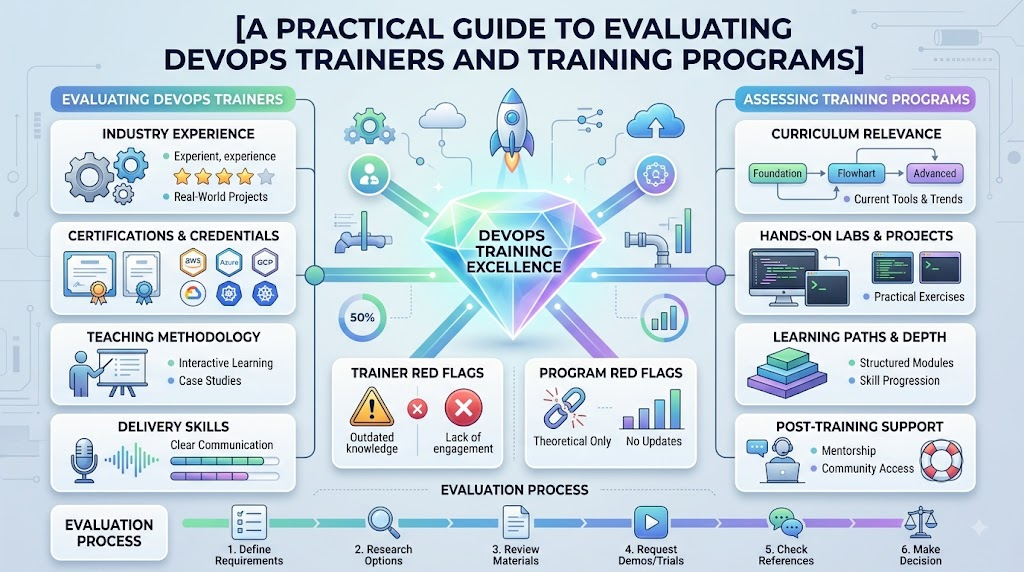
How Organizations Can Evaluate a DevOps Training Program
Before selecting a program, organizations can use a structured checklist.
Start by examining trainer experience and teaching style. Then review the curriculum against the organization’s technology environment and goals.
Practical work should receive significant attention. Ask whether participants will create pipelines, deploy workloads, configure infrastructure, analyze monitoring data, and troubleshoot failures.
Organizations should also consider whether the program addresses relevant areas such as cloud, Kubernetes, Infrastructure as Code, security, SRE, or MLOps.
Other evaluation points include:
- Course organization
- Lab quality
- Documentation
- Assessments
- Technical depth
- Troubleshooting exercises
- Cloud coverage
- CI/CD coverage
- Security coverage
- Learning resources
- Post-training support
For corporate programs, managers should also consider how learning will transfer into normal engineering work.
Training Area and Learning Need
| Training Area | Typical Learning Need |
| DevOps Training | Understand automation and delivery practices |
| Corporate DevOps Training | Build team-wide DevOps capabilities |
| Online DevOps Training | Learn remotely with flexible access |
| Kubernetes Training | Manage container orchestration environments |
| AWS DevOps Training | Learn AWS-based DevOps workflows |
| Azure DevOps Training | Understand Azure delivery and automation |
| DevSecOps Training | Integrate security into software delivery |
| SRE Training | Learn reliability engineering practices |
| MLOps Training | Operate machine-learning systems in production |
FAQ
What does a DevOps Trainer actually teach?
A DevOps Trainer can teach automation, CI/CD, cloud infrastructure, containers, Infrastructure as Code, monitoring, troubleshooting, and operational practices. The exact topics should match the learner’s objectives.
Why is Corporate DevOps Training different from regular training?
Corporate programs are generally designed around team requirements, existing technologies, employee experience levels, and organizational goals. This allows training to be more relevant to the working environment.
What should I look for when choosing a DevOps Trainer in India?
Consider technical experience, teaching ability, practical exercises, curriculum quality, communication, and knowledge of the technologies relevant to your environment.
Can an Online DevOps Trainer teach an entire engineering team?
Online delivery can be effective for distributed teams when sessions include live interaction, demonstrations, remote labs, and troubleshooting activities. The quality of the learning design matters more than delivery format alone.
What should practical Kubernetes training include?
It should cover Kubernetes architecture, workloads, services, networking, storage, security, Helm, scaling, monitoring, administration, and troubleshooting.
What topics are normally covered by an AWS DevOps Trainer?
Topics may include AWS infrastructure, EC2, EKS, ECS, Lambda, CI/CD, Terraform, CloudFormation, monitoring, and automation. The exact coverage should depend on the organization’s AWS architecture.
Why should security be included in DevOps training?
Security controls are increasingly integrated into development and delivery processes. DevSecOps training helps learners understand how security scanning, secrets management, vulnerability handling, and automation fit into CI/CD.
How are DevOps, SRE, and MLOps training different?
DevOps generally emphasizes delivery, automation, and collaboration. SRE concentrates on reliability and operational engineering. MLOps focuses on managing machine-learning systems through deployment, monitoring, automation, and production operations.
Conclusion
The value of DevOps training depends less on the number of tools included in a syllabus and more on how effectively learners understand and apply engineering practices. Cloud platforms, CI/CD, Kubernetes, Infrastructure as Code, security, observability, SRE, and MLOps all contribute to modern technology operations, but they should be taught in a meaningful context. For organizations, the right learning program should reflect the current technology stack, team maturity, business requirements, and future engineering direction. A startup may need foundational automation and cloud knowledge, while a larger enterprise may need specialized training around Kubernetes, secure delivery, reliability, or platform engineering.
