Introduction
Cloud security has shifted from being a final checklist to a foundational requirement for every deployment. In my decades of navigating data centers and multi-cloud architectures, I’ve seen that the most successful engineers are those who treat security as an enabler of speed, not a barrier to it. This guide provides a deep dive into the Azure Security Engineer Associate (AZ-500) certification, a credential that proves you can architect, implement, and manage security in a complex Microsoft cloud environment.
Understanding the AZ-500 Certification
| Feature | Details |
| Certification Name | Azure Security Engineer Associate (AZ-500) |
| Track | Security |
| Level | Associate |
| Who it’s for | Security engineers, Cloud architects, DevOps professionals, and System admins. |
| Prerequisites | Strong familiarity with Azure services and core networking. |
| Skills Covered | Identity management, Platform protection, Security operations, and Data/Application security. |
| Recommended Order | Take after AZ-900 (Fundamentals) or AZ-104 (Administrator). |
Deep Dive: Azure Security Engineer Associate (AZ-500)
What it is
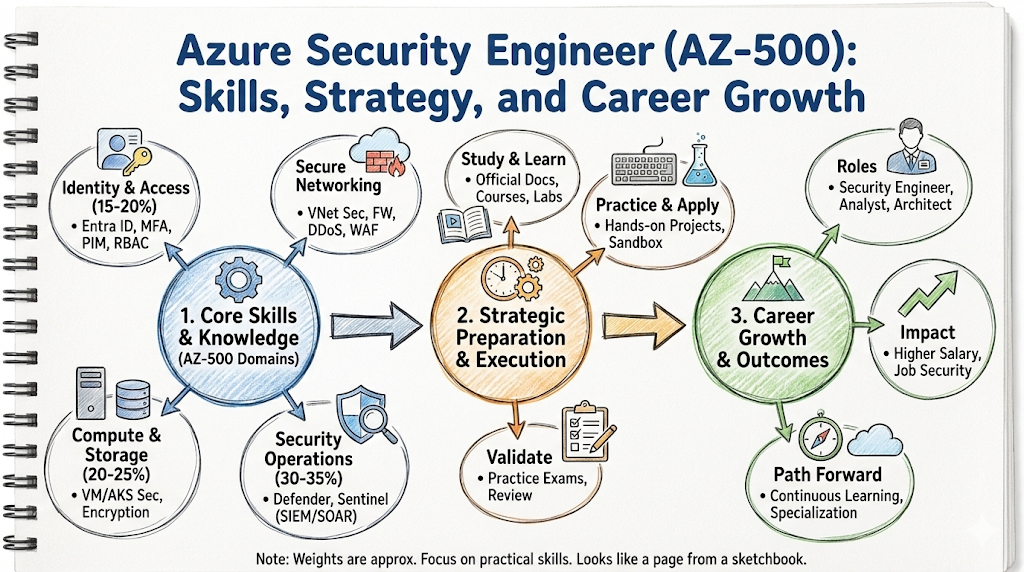
The AZ-500 is a specialized technical certification that focuses on implementing security controls and threat protection within Microsoft Azure. It is designed to validate your ability to manage identities, protect networks, and secure data and applications across the entire cloud stack. This certification is a benchmark for professionals who need to demonstrate a deep understanding of Azure-specific security tools and governance strategies.
Who should take it
This program is ideal for IT professionals who are already familiar with Azure administration but want to specialize in the security domain. It is highly recommended for Security Engineers, Cloud Architects, and DevOps specialists who are responsible for maintaining a secure cloud posture. If you are looking to pivot into a DevSecOps role or manage enterprise-level security for global organizations, this is your primary credential.
Skills you’ll gain
- Identity and Access Management: Master Microsoft Entra ID (Azure AD), Privileged Identity Management (PIM), and Conditional Access policies.
- Platform Protection: Implement advanced network security using Azure Firewall, Network Security Groups (NSGs), and DDoS protection.
- Security Operations: Configure and manage security alerts, incident response, and threat hunting using Microsoft Sentinel and Microsoft Defender for Cloud.
- Data and Application Security: Learn to secure data at rest and in transit using Azure Key Vault, SQL encryption, and Web Application Firewalls (WAF).
- Governance and Compliance: Utilize Azure Policy and Blueprints to ensure your infrastructure meets strict regulatory and organizational standards.
Real-world projects you should be able to do after it
- Zero-Trust Implementation: Design and deploy a Zero-Trust architecture that secures identity, devices, and applications across a distributed workforce.
- Automated Threat Remediation: Build automated workflows using Azure Logic Apps to respond to security incidents in real-time without human intervention.
- Secure Hybrid Connectivity: Setup and secure ExpressRoute or VPN connections between on-premise data centers and Azure while maintaining strict traffic isolation.
- Log Analytics Consolidation: Centralize logging from multiple subscriptions into a single workspace for comprehensive auditing and compliance reporting.
Preparation Plans
The 14-Day “Sprint” (For Experienced Engineers)
This intensive plan is for those who already have a strong background in Azure administration and need a focused push to pass the exam. You will spend the first four days mastering Identity and Access, followed by four days on Infrastructure security including VNets and Container hardening. The remaining time is dedicated to Security Operations and high-stakes practice exams to sharpen your decision-making under time pressure.
The 30-Day “Standard” (For Cloud Engineers)
This is the most balanced approach, allowing you to digest complex security concepts while maintaining your daily work responsibilities. You will dedicate one week to each of the four major domains: Identity, Platform Protection, Security Operations, and Data/App Security. This pace ensures you have enough time to complete all relevant Microsoft Learn modules and perform hands-on labs for every service.
The 60-Day “Foundation” (For Beginners/Career Switchers)
If you are moving into cloud security from a different field, this plan provides the necessary groundwork to succeed. The first 20 days are spent mastering Azure Administrator (AZ-104) fundamentals, which are crucial for understanding how the underlying services work. The final 40 days involve a deep dive into security-specific configurations, repeated lab exercises, and a thorough review of exam case studies.
Common Mistakes
- Underestimating Identity: Many candidates focus on networking but fail because they didn’t master the nuances of Microsoft Entra ID and PIM.
- Skipping Hands-on Labs: The exam often includes scenario-based questions that require you to know the exact path in the Azure Portal to fix a security flaw.
- Ignoring PowerShell and CLI: You must be comfortable identifying the correct command-line syntax for rotating keys or managing identity permissions.
- Overlooking Governance: Failing to understand how Azure Policy and RBAC interact can lead to incorrect answers regarding complex enterprise environments.
Best next certification after this
1. The Same Track (Deep Specialization)
Certification: SC-200 (Microsoft Security Operations Analyst) If you enjoyed the “Security Operations” domain of the AZ-500—specifically threat hunting and incident response—this is your next step. While AZ-500 teaches you how to build the walls, SC-200 teaches you how to watch them.
- Focus: Mastering Microsoft Sentinel, Microsoft Defender for Cloud, and Microsoft 365 Defender.
- Goal: Moving into a Senior SOC Analyst or Threat Hunter role.
- Why take it: It turns your engineering knowledge into “active defense” capabilities.
2. The Cross-Track (Broadening Expertise)
Certification: AZ-305 (Azure Solutions Architect Expert) In my experience, the best security engineers are those who understand the “Big Picture.” If you want to understand how security impacts scalability, cost, and global performance, this is the path for you.
- Focus: Designing infrastructure, data storage, and business continuity.
- Goal: Becoming a Lead Cloud Architect who can design secure-by-default systems.
- Why take it: It completes your profile, proving you can not only secure a system but architect the entire ecosystem from the ground up.
3. The Leadership Track (Strategic Growth)
Certification: SC-100 (Microsoft Cybersecurity Architect Expert) This is the pinnacle for Microsoft security professionals. It is not an engineering exam; it is a “Design and Strategy” exam. It’s designed for those who want to bridge the gap between technical teams and business stakeholders.
- Focus: Zero Trust principles, Governance Risk and Compliance (GRC), and designing a holistic security strategy.
- Goal: Aiming for Chief Information Security Officer (CISO) or Cybersecurity Architect roles.
- Why take it: It moves you away from “fixing tickets” and into the room where high-level security decisions and budgets are made.
Choose Your Path: 6 Specialized Learning Tracks
Security is the thread that ties every modern tech discipline together. Depending on your current role or future aspirations, you should align your AZ-500 training with one of these paths:
- DevOps Path: Focus on integrating AZ-500 security controls into automated CI/CD pipelines to ensure code is secure from commit to production.
- DevSecOps Path: This is the ultimate technical evolution, where you combine security engineering with automation and compliance-as-code principles.
- SRE Path: Focus on the “Security Operations” domain to build resilient systems that can withstand and recover from cyber-attacks without downtime.
- AIOps/MLOps Path: Learn to secure the massive data lakes and high-performance compute clusters required for training and deploying AI models.
- DataOps Path: Concentrate on the Data Security domain, mastering the protection of SQL databases, Cosmos DB, and sensitive data pipelines.
- FinOps Path: Use security governance tools like Azure Advisor to ensure that your security measures are cost-effective and don’t lead to cloud waste.
Role → Recommended Certifications Mapping
| Your Current/Target Role | Recommended Certification Sequence |
| DevOps Engineer | AZ-104 → AZ-400 → AZ-500 |
| SRE | AZ-104 → AZ-500 → AZ-305 |
| Platform Engineer | AZ-104 → AZ-700 → AZ-500 |
| Cloud Engineer | AZ-900 → AZ-104 → AZ-500 |
| Security Engineer | SC-900 → AZ-500 → SC-100 |
| Data Engineer | DP-900 → DP-203 → AZ-500 |
| FinOps Practitioner | AZ-900 → AZ-104 → AZ-500 (for governance) |
| Engineering Manager | AZ-900 → AZ-500 → SC-100 |
Where to Get Trained
Navigating the complexities of Azure security requires more than just reading a book; it requires mentorship from people who have handled live security breaches. Here are the top institutions that provide specialized training for the AZ-500:
- DevOpsSchool: This institution is a leader in technical upskilling, providing comprehensive AZ-500 training that focuses on real-world scenarios. Their curriculum goes beyond the exam objectives, offering deep-dive labs and recorded sessions led by industry veterans. It is an excellent choice for those who want to master the “how” and “why” of cloud security.
- Cotocus: Known for its highly practical and hands-on training methodology, Cotocus is ideal for working professionals who need to gain skills quickly. Their programs are designed to be immersive, ensuring that students can immediately apply what they learn to their professional roles. The focus here is on achieving technical mastery through rigorous lab work and expert guidance.
- Scmgalaxy: A vibrant community-driven platform that provides a wealth of resources, including technical blogs, forums, and structured training for the Azure ecosystem. They excel at keeping their content updated with the latest cloud trends and security threats. For engineers who prefer a community-supported learning environment, Scmgalaxy is a top-tier resource.
- BestDevOps: This provider focuses on the seamless integration of Azure tools within the DevOps lifecycle, making them a great fit for modern engineers. Their training emphasizes the practical application of security controls to maintain both speed and safety in production environments. They are well-regarded for their clear, direct teaching style and relevant case studies.
- devsecopsschool.com: Dedicated entirely to the intersection of development, security, and operations, this school is perfect for those aiming for DevSecOps roles. Their AZ-500 training is infused with security-first principles, teaching students how to automate security within the software development lifecycle.
- sreschool.com: Tailored for Site Reliability Engineers, this institution teaches how security contributes to overall system uptime and resilience. Their courses focus on the monitoring and incident response aspects of the AZ-500, ensuring your systems are both secure and highly available.
- aiopsschool.com: As AI becomes central to enterprise operations, this school provides niche training on securing AI workloads and using AI for automated security. Their insights into the security domain of the AZ-500 are uniquely positioned for the future of automated operations.
- dataopsschool.com: For data professionals, this school offers a specialized focus on the data protection and encryption domains of the AZ-500. They provide the technical depth needed to secure large-scale data platforms and ensure compliance across the data lifecycle.
- finopsschool.com: This institution bridges the gap between cloud security and financial management, showing how governance can prevent both data breaches and budget overruns. Their training helps you implement security controls that are as efficient as they are effective.
Next Certifications to Take
- Same Track (Specialization): SC-200 (Microsoft Security Operations Analyst). This certification is perfect if you want to double down on threat hunting, incident response, and the daily management of Microsoft Sentinel and Defender.
- Cross-Track (Broadening): AZ-305 (Azure Solutions Architect Expert). Mastering architectural design allows you to understand the broader context of security, ensuring that your security controls don’t hinder scalability or performance.
- Leadership (Career Growth): SC-100 (Cybersecurity Architect Expert). For those aiming for CISO or Lead Architect roles, the SC-100 provides the strategic framework needed to lead large teams and define enterprise-wide security policies.
FAQs for Azure Security Engineer Associate (AZ-500)
1. How difficult is the AZ-500 compared to AZ-104?
The AZ-500 is generally considered a step up in difficulty because it requires a more granular understanding of service configurations. While AZ-104 is about managing the services, AZ-500 is about hardening them against sophisticated attacks.
2. How much time do I need to prepare?
For an engineer with two years of hands-on cloud experience, 30 days of consistent study is usually the sweet spot. If you are starting from scratch, you should plan for at least 60 to 90 days to master both the fundamentals and the security specifics.
3. Are there any formal prerequisites for the exam?
Microsoft does not require any prior certifications to sit for the AZ-500, but they strongly recommend having the knowledge equivalent to an Azure Administrator. Jumping straight into security without understanding basic cloud management can be very challenging.
4. Should I take AZ-500 or SC-200 first?
AZ-500 is a broader engineering certification that covers the entire Azure platform, whereas SC-200 is more focused on the operations side and threat hunting. Most engineers find it more beneficial to get the broad foundation of AZ-500 before specializing with SC-200.
5. What is the value of this certification in the Indian market?
India is a major hub for global cloud operations, and firms are increasingly desperate for certified security talent to protect their data. Holding an AZ-500 often opens doors to senior roles and can significantly increase your bargaining power during salary negotiations.
6. Does the certification expire?
Yes, like most Microsoft Associate-level certifications, it is valid for one year. However, Microsoft provides a free, unproctored online renewal assessment every year to help you keep your skills current without paying for a new exam.
7. Is the exam all multiple-choice?
No, you should prepare for a variety of question types, including drag-and-drop, matching, and case studies. Some versions of the exam also include “performance-based” labs where you must log into a live Azure environment to complete specific security tasks.
8. Can I pass AZ-500 without prior security experience?
It is possible, but you will need to supplement your Azure study with foundational security knowledge. You’ll need to understand concepts like Public Key Infrastructure (PKI), TLS/SSL, and the principles of the Zero-Trust security model.
Comprehensive FAQ: Mastering the Azure Security Engineer Associate (AZ-500)
1. How difficult is the AZ-500 compared to other Azure certifications?
The AZ-500 is widely considered one of the more challenging Associate-level exams. Unlike the AZ-104 (Administrator), which focuses on operational breadth, the AZ-500 requires a deep, granular understanding of how to harden services. You aren’t just managing resources; you are configuring complex identity policies, network filters, and encryption standards that leave little room for error.
2. How much time should I realistically set aside for preparation?
For a working engineer with about two years of cloud experience, 30 to 45 days of consistent study (1-2 hours a day) is usually the “sweet spot.” If you are pivoting from a non-cloud background, you should plan for at least 60 to 90 days. This allows enough time to not just read the theory but to actually break and fix things in a lab environment.
3. Are there any hard prerequisites I need to meet before taking the exam?
Technically, there are no formal prerequisites required by Microsoft to sit for the AZ-500. However, from a practical standpoint, attempting this without the knowledge equivalent to the AZ-104 (Azure Administrator) is incredibly difficult. You need to understand how the plumbing of Azure works—VNets, Subnets, and Virtual Machines—before you can effectively secure them.
4. What is the best sequence to follow for Azure security certifications?
The most logical path is to start with the basics and layer your knowledge. Begin with AZ-900 (Fundamentals) for the terminology, move to AZ-104 (Administrator) to learn how to build, and then tackle AZ-500 to learn how to protect. After AZ-500, many professionals specialize further with SC-200 for operations or SC-100 for high-level architecture.
5. Is the AZ-500 certification worth the investment in today’s market?
Absolutely. Security is currently the highest priority for enterprise organizations moving to the cloud. Having “Security Engineer Associate” on your profile isn’t just a badge; it’s a signal to employers that you can be trusted with their most sensitive data. It often serves as a key differentiator during technical screenings for high-paying roles.
6. What are the primary career outcomes after earning this credential?
This certification opens doors to several high-demand roles, including Cloud Security Engineer, DevSecOps Architect, and Cybersecurity Analyst. Beyond just job titles, it positions you as a “Security-First” engineer, which is a mindset that leads to faster promotions and more leadership opportunities in engineering teams.
7. Does the exam include hands-on labs?
Microsoft periodically rotates labs in and out of the exam. You should always prepare as if there will be a live lab section where you are required to perform tasks in a real Azure Portal environment. Even if your specific exam version doesn’t have a live lab, the “Performance-Based” questions will test your knowledge of the portal’s UI and navigation.
8. How does the AZ-500 help a Software Engineer?
Software Engineers benefit by learning how to implement “Shift Left” security. Understanding Entra ID (Azure AD), Key Vault, and Web Application Firewalls (WAF) allows you to write more secure code and design applications that are inherently protected against common vulnerabilities like SQL injection or unauthorized access.
9. What is the passing score, and how is the exam structured?
You need a score of 700 out of 1000 to pass. The exam typically consists of 40-60 questions, which can include multiple-choice, drag-and-drop, hot areas, and case studies. Case studies are particularly important as they require you to synthesize information from a business scenario to provide a technical security solution.
10. How often do I need to renew this certification?
Microsoft certifications at the Associate level are valid for one year. The good news is that renewal is free and can be done through a non-proctored online assessment on the Microsoft Learn platform. This ensures that your skills remain current as Azure continues to release new security features and updates.
11. Can I pass the AZ-500 using only theoretical study materials?
It is highly unlikely. The AZ-500 is a “practitioner’s exam.” Many questions describe a specific technical failure or a security gap that you must solve. Without hands-on experience in the Azure Portal or using the CLI/PowerShell, it is very difficult to visualize the correct configuration under the pressure of the exam clock.
12. Why is there such a strong focus on Identity (Entra ID) in this exam?
In the cloud, identity is the new security perimeter. Traditional firewalls aren’t enough when users are accessing data from everywhere. The AZ-500 places heavy emphasis on Microsoft Entra ID because mastering Conditional Access, RBAC, and Privileged Identity Management is the most effective way to prevent modern data breaches.
Testimonials
“After a decade in traditional IT, I knew I needed to pivot. The AZ-500 training at DevOpsSchool gave me the technical edge I needed to transition into cloud security. The instructors didn’t just teach the exam; they taught me how to solve real-world problems, which helped me land my current role as a Senior Security Engineer.” — Amit S., Cloud Security Architect
“The depth of the AZ-500 exam was intimidating at first, but having access to structured labs made all the difference. I was able to practice complex network security configurations in a safe environment before taking the actual test. I’m now much more confident in securing our company’s production workloads.” — Priya R., Senior DevOps Engineer
Conclusion
The Azure Security Engineer Associate (AZ-500) is not just another badge for your LinkedIn profile; it is a testament to your ability to protect an organization’s most valuable digital assets. In a world where threats are constantly evolving, your expertise is the first line of defense. By mastering these tools and strategies, you are ensuring that the cloud remains a safe place for innovation. Whether you are looking to advance your current career or pivot into a high-demand specialty, the AZ-500 provides the technical and strategic foundation you need to succeed.