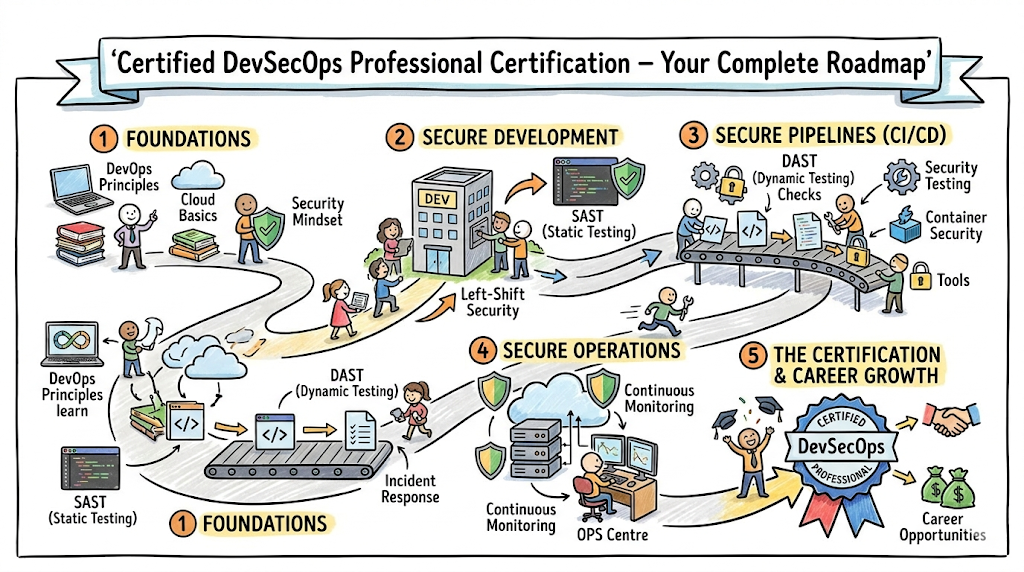
The Certified DevSecOps Professional is an essential credential for modern engineers who want to bridge the gap between rapid development and robust security. This guide is crafted for professionals who recognize that security is no longer a separate department but a core technical responsibility within the pipeline. By following this roadmap, you will understand how to transition from a traditional operations role into a highly sought-after security engineering specialist. As a career mentor, I recommend this path to anyone working in DevOps, cloud-native environments, or platform engineering because it addresses the most critical bottleneck in the delivery lifecycle. This guide helps professionals make better career decisions by stripping away the marketing noise and focusing on the actual technical competencies required. Whether you are based in India or working for a global enterprise, the skills validated here are the gold standard for modern infrastructure. Learning through DevSecOpsSchool ensures that you are gaining knowledge that is grounded in industry reality rather than just theoretical academic concepts. The program focuses on the practical application of security tools and cultural shifts that allow teams to ship code faster without increasing risk. This introduction serves as your starting point for understanding how to elevate your professional standing in an increasingly complex and threat-heavy digital landscape.
What is the Certified DevSecOps Professional?
The Certified DevSecOps Professional is a validation of an engineer’s ability to integrate security practices into every phase of the software development lifecycle. It exists to solve the fundamental conflict between the need for speed in CI/CD and the need for rigorous security compliance in production. Rather than viewing security as a final gate, this certification emphasizes the “shift-left” philosophy where security is automated from the very first line of code.
This program represents a move toward production-focused learning, where candidates must demonstrate they can configure real tools in real environments. It aligns with modern engineering workflows by treating security as code, allowing it to be versioned, tested, and deployed alongside application features. For enterprise practices, this means creating a repeatable and auditable process that satisfies both developers and security auditors.
In the current landscape, this certification signifies that a professional understands the nuances of cloud-native security and automated governance. It bridges the technical divide between software engineering and information security, creating a hybrid role that is critical for any organization. It is not just about learning a specific tool, but about mastering the methodology of building resilient, self-healing systems that can withstand modern cyber threats.
Who Should Pursue Certified DevSecOps Professional?
This certification is designed for software engineers who want to take ownership of the security posture of their applications and infrastructure. Site Reliability Engineers and platform engineers will find it particularly useful as they build the underlying frameworks that support thousands of deployments. It is also an ideal transition path for traditional security analysts who want to move into a more automated, code-driven way of working.
For beginners, the certification provides a structured learning path that demystifies the complex world of application security and cloud infrastructure. Experienced engineers can use it to formalize their knowledge and prove their expertise in high-stakes enterprise environments. Technical leaders and managers should pursue it to gain a strategic understanding of how to lead teams through a successful DevSecOps transformation.
In the Indian tech sector, specifically within Global Capability Centers (GCCs), there is a massive demand for professionals who can handle security at scale. Globally, the certification is relevant for any industry that handles sensitive data, including fintech, healthcare, and e-commerce. It provides a universal technical language that allows engineers to move between different sectors and geographical regions with a high degree of professional credibility.
Why Certified DevSecOps Professional is Valuable and Beyond
The value of this certification lies in its focus on long-term engineering principles rather than fleeting tool trends. As organizations continue to move toward cloud-native architectures, the demand for integrated security will only increase, ensuring high job security for those with these skills. It allows professionals to stay relevant even as the specific tools they use change, by teaching them the core logic of automated security.
Enterprise adoption of DevSecOps is no longer optional; it is a business requirement driven by the need for rapid updates and strict regulatory compliance. Professionals who hold this certification are seen as high-value assets because they help companies avoid the massive costs and reputational damage associated with data breaches. The return on investment for this certification is realized through higher salary brackets and faster career progression into senior leadership roles.
Furthermore, the longevity of these skills is guaranteed by the constant evolution of the threat landscape, which requires a proactive rather than reactive approach. By mastering the ability to automate security gates, you become a “force multiplier” for your engineering team, enabling others to work safely and efficiently. This certification ensures that you are prepared for the future of engineering, where security, performance, and reliability are inextricably linked.
Certified DevSecOps Professional Certification Overview
The program is delivered via the official course URL Certified DevSecOps Professional and is hosted on the DevSecOpsSchool website. It offers a structured approach to learning that includes different levels of expertise, ranging from foundational concepts to advanced technical implementation. The ownership of the certification ensures that the curriculum is always aligned with the latest industry standards and open-source tool updates.
The assessment approach is rigorously hands-on, requiring candidates to complete practical labs and solve real-world security challenges in a sandbox environment. This ensures that anyone who earns the certification has actually performed the tasks required in a production setting, not just memorized answers. The structure is designed to be modular, allowing professionals to learn at their own pace while gradually building a comprehensive portfolio of security skills.
In practical terms, the certification covers the entire spectrum of the DevSecOps lifecycle, including plan, code, build, test, release, and monitor phases. It places a heavy emphasis on the integration of security tools within the CI/CD pipeline, such as automated vulnerability scanners and secret management systems. This comprehensive overview ensures that every candidate leaves with a deep, holistic understanding of what it takes to secure a modern software factory.
Certified DevSecOps Professional Certification Tracks & Levels
The certification is organized into three distinct levels: Foundation, Professional, and Advanced, to cater to different stages of a professional’s career. The Foundation level is focused on the cultural and conceptual aspects of DevSecOps, making it perfect for those just entering the field or for non-technical managers. It establishes the baseline knowledge required to understand how security fits into the modern development world.
The Professional level is where the deep technical work happens, focusing on the implementation of security tools and automated workflows. This level is designed for hands-on engineers who are responsible for building and maintaining delivery pipelines in a production environment. It covers the specific details of tool configuration, policy creation, and the technical “how-to” of shifting security to the left.
The Advanced level is aimed at architects and senior leaders who need to design enterprise-wide security strategies and governance frameworks. It moves beyond individual pipelines to look at how security can be managed across hundreds of teams and thousands of microservices. These levels are designed to align with a natural career progression, taking an engineer from a practitioner to a strategic leader in the space.
Complete Certified DevSecOps Professional Certification Table
| Track | Level | Who it’s for | Prerequisites | Skills Covered | Recommended Order |
| Core Security | Foundation | New Engineers | Basic IT Literacy | DevSecOps Culture, Lifecycle | 1 |
| Engineering | Professional | DevOps Engineers | CI/CD Basics | SAST, DAST, SCA, Vault | 2 |
| Architecture | Advanced | Senior Architects | Professional Level | OPA, Compliance as Code | 3 |
| Cloud-Native | Professional | Cloud Engineers | AWS/Azure Basics | IAM Security, VPC Auditing | 2 |
| Container Ops | Professional | SREs | Docker Basics | Image Signing, K8s Security | 2 |
Detailed Guide for Each Certified DevSecOps Professional Certification
Certified DevSecOps Professional – Foundation
What it is
This level validates a fundamental understanding of why security must be integrated into the DevOps lifecycle. It confirms that the candidate can speak the language of both developers and security professionals fluently.
Who should take it
This is ideal for junior developers, project managers, and scrum masters who want to understand the impact of security on their delivery timelines. It is for those who need to build a mental framework before touching the tools.
Skills you’ll gain
- Deep understanding of the DevSecOps manifesto and core pillars.
- Ability to identify where security fits into a standard CI/CD pipeline.
- Knowledge of common security terminology and threat landscapes.
- Understanding the cultural barriers to DevSecOps and how to overcome them.
Real-world projects you should be able to do
- Draft a DevSecOps implementation roadmap for a small development team.
- Perform a basic risk assessment of a standard software delivery process.
- Conduct a “security awareness” session for a group of software developers.
Preparation plan
- 7–14 days: Focus on the theoretical modules and the history of DevOps evolution.
- 30 days: Engage with community forums and read case studies on security cultural shifts.
- 60 days: Not usually required for this foundational level of certification.
Common mistakes
- Underestimating the importance of the cultural and organizational change modules.
- Trying to jump into advanced tools before understanding the basic lifecycle.
Best next certification after this
- Same-track option: Certified DevSecOps Professional.
- Cross-track option: SRE Foundation Certification.
- Leadership option: Certified DevOps Leader.
Certified DevSecOps Professional – Professional
What it is
The Professional level is the core technical certification that proves your ability to build and secure automated pipelines. It validates that you can use modern tools to find and fix vulnerabilities without manual intervention.
Who should take it
This is designed for DevOps engineers, SREs, and security engineers who are working in the trenches of production environments. It is for those who want to be the technical authority for security in their teams.
Skills you’ll gain
- Implementing and tuning Static Application Security Testing (SAST) tools.
- Automating Dynamic Application Security Testing (DAST) in a pipeline.
- Managing third-party library risks through Software Composition Analysis (SCA).
- Securely managing secrets and environment variables using enterprise-grade vaults.
Real-world projects you should be able to do
- Configure a Jenkins or GitLab pipeline with automated security failure gates.
- Implement a container scanning solution that blocks insecure images from running.
- Set up an automated secrets rotation system for a cloud-native application.
Preparation plan
- 7–14 days: Intensive lab work focusing on tool integration and script writing.
- 30 days: Build a mock project that includes a full security-integrated CI/CD pipeline.
- 60 days: Review advanced security policies and practice remediation of complex vulnerabilities.
Common mistakes
- Ignoring the “false positive” management aspect of automated security tools.
- Failing to understand the developer’s experience when security gates are added.
Best next certification after this
- Same-track option: Certified DevSecOps Expert.
- Cross-track option: Certified Cloud Security Professional.
- Leadership option: DevSecOps Manager Certification.
Certified DevSecOps Professional – Advanced / Expert
What it is
This is the highest level of certification, focusing on the architectural and governance aspects of DevSecOps at scale. It validates your ability to lead a complete organizational transformation and manage complex risk profiles.
Who should take it
This is for principal engineers, chief architects, and aspiring CISOs who need to govern security across multiple business units. It requires a high level of technical maturity and strategic thinking.
Skills you’ll gain
- Designing and implementing Policy as Code using Open Policy Agent (OPA).
- Advanced threat modeling for complex, distributed microservices architectures.
- Automating continuous compliance for standards like SOC2, ISO27001, or GDPR.
- Building custom security monitoring and alerting dashboards for the entire enterprise.
Real-world projects you should be able to do
- Create a centralized “Compliance as Code” repository that governs all cloud resources.
- Lead a threat modeling workshop for a new, high-stakes financial product.
- Design an automated incident response system that triggers on security anomalies.
Preparation plan
- 7–14 days: Focus on high-level architectural patterns and security governance models.
- 30 days: Practice writing complex Rego policies and infrastructure auditing scripts.
- 60 days: Conduct a mock enterprise-wide security audit and design a remediation plan.
Common mistakes
- Focusing too much on individual tools and not enough on broad governance.
- Forgetting to align security policies with the actual business goals of the company.
Best next certification after this
- Same-track option: Specialized niche certifications like eBPF or Service Mesh security.
- Cross-track option: FinOps Certified Practitioner to manage security costs.
- Leadership option: Chief Information Security Officer (CISO) executive track.
Choose Your Learning Path
DevOps Path
The DevOps path focuses on the speed and reliability of software delivery, where security is treated as a component of quality. Professionals on this path use the certification to learn how to add security checks into their existing pipelines without causing delays. It is about creating a “frictionless” security experience for the development team. You will master the balance between keeping the pipeline moving and keeping the application safe from common exploits.
DevSecOps Path
The dedicated DevSecOps path is for those who want to become specialists in the intersection of security and engineering. This path is deep and technical, focusing on every aspect of the “software factory” from source code to production monitoring. You will learn to be the primary architect of automated security systems and the main advocate for secure coding practices. This is the most direct route to high-paying, specialized roles in the current technology market.
SRE Path
Site Reliability Engineers view security through the lens of system availability and resilience. On this path, you will learn how security vulnerabilities can lead to system outages and how to use DevSecOps to prevent them. The certification helps SREs build platforms that are “secure by default,” reducing the operational burden of managing security patches and incidents. It is an ideal path for those who enjoy building stable, large-scale systems that are resistant to attacks.
AIOps Path
The AIOps path is where artificial intelligence meets IT operations and security. By taking this certification, you learn the foundational security principles needed to build and protect AI-driven operational systems. You will explore how to use machine learning to detect security anomalies in vast amounts of log data that human eyes could never process. It is a forward-looking path for those who want to automate the next generation of security operations.
MLOps Path
The MLOps path is specifically tailored for those securing the machine learning development lifecycle. Security here involves protecting the integrity of training data, the privacy of the models, and the security of the inference APIs. This certification provides the necessary framework to apply DevSecOps concepts to the unique world of data science and model deployment. It is essential for ensuring that AI initiatives are both innovative and compliant with security standards.
DataOps Path
The DataOps path focuses on the secure orchestration of data pipelines and the protection of sensitive information. Professionals on this path use the certification to learn about data encryption, access control as code, and automated privacy checks. You will learn how to integrate security into the tools that move and transform data across the enterprise. This ensures that data remains a strategic asset without becoming a legal or security liability for the organization.
FinOps Path
The FinOps path explores the financial side of security engineering and cloud operations. This certification helps you understand how security decisions—like where to store data or how to run scanners—impact the monthly cloud bill. You will learn to justify security spending by showing the potential cost savings of early vulnerability detection and optimized resource usage. This path is for the “business-minded” engineer who wants to manage both risk and budget effectively.
Role → Recommended Certified DevSecOps Professional Certifications
| Role | Recommended Certifications |
| DevOps Engineer | Certified DevSecOps Professional, Container Security |
| SRE | Certified DevSecOps Professional, SRE Foundation |
| Platform Engineer | Certified DevSecOps Professional (Expert), Kubernetes Security |
| Cloud Engineer | Cloud Security Track, Infrastructure as Code Security |
| Security Engineer | Certified DevSecOps Professional (All Levels), Threat Modeling |
| Data Engineer | DataOps Security, Certified DevSecOps Professional |
| FinOps Practitioner | DevSecOps Foundation, FinOps Certified Practitioner |
| Engineering Manager | DevSecOps Foundation, DevOps Leader Certification |
Next Certifications to Take After Certified DevSecOps Professional
Same Track Progression
After achieving the professional level, the most logical step is to move toward the Expert or Advanced levels to solidify your architectural skills. This progression allows you to move from being someone who “does” DevSecOps to someone who “designs” the entire system. You might also choose to specialize in specific areas like Advanced Kubernetes Security or Cloud-Specific Security for AWS or Azure. This path ensures you remain at the absolute top of your technical field.
Cross-Track Expansion
In a complex modern environment, knowing only security is often not enough to lead major projects. Expanding your skills into SRE allows you to understand the reliability implications of your security decisions, which is highly valued. Moving into FinOps or DataOps provides a broader perspective on the business and data challenges that modern companies face. This cross-training makes you a more versatile leader and a much more valuable asset to any executive team.
Leadership & Management Track
For those who want to eventually step away from the keyboard and lead organizations, the management track is the next phase. This involves moving into certifications focused on engineering management, strategic leadership, and project governance. Your technical background in DevSecOps gives you the “street cred” needed to lead engineers, while management training gives you the tools to lead a business. This is the traditional path toward becoming a CTO or a VP of Engineering.
Training & Certification Support Providers for Certified DevSecOps Professional
DevOpsSchool is a globally recognized leader in the field of technical training, specifically focusing on the intersection of development, operations, and security. They offer an extensive range of hands-on courses that are designed to bridge the skills gap in the modern IT industry. Their approach combines expert-led instruction with practical, lab-based learning, ensuring that students can apply their knowledge to real-world scenarios immediately. The organization is known for its commitment to staying ahead of the curve, constantly updating its curriculum to reflect the latest tools and best practices. Whether you are an individual looking to upskill or an enterprise seeking to transform your team, they provide the resources and support needed to succeed in a competitive landscape.
Cotocus provides high-end consulting and training services that focus on cloud-native technologies and the automation of infrastructure. Their mission is to help organizations and individuals achieve digital transformation through a deep understanding of modern engineering principles. They offer specialized training in DevSecOps that is tailored to meet the specific needs of different industries and technical backgrounds. Their trainers are seasoned professionals who bring years of industry experience to the classroom, offering insights that go far beyond standard textbooks. Cotocus is particularly well-regarded for its focus on practical implementation and its ability to simplify complex technical concepts for a wide variety of audiences.
Scmgalaxy is a vibrant community and resource hub that has been supporting DevOps and SCM professionals for over a decade. They offer a wealth of free tutorials, videos, and articles, alongside their formal certification programs. Their DevSecOps training is designed to be accessible yet rigorous, providing a clear path for engineers to master the complexities of automated security. The platform fosters a collaborative environment where learners can interact with experts and peers from around the world. Scmgalaxy is an excellent choice for those who value community support and a wide range of learning materials as they progress through their certification journey.
BestDevOps is a dedicated training provider that prides itself on delivering high-quality, outcome-oriented education in the field of DevOps and security. They offer a curated selection of certifications that are designed to meet the highest industry standards. Their focus is on empowering engineers with the skills they need to excel in high-stakes production environments. The training programs at BestDevOps are known for their practical focus, with a heavy emphasis on labs and real-world project simulations. They provide a supportive learning environment that helps students overcome technical challenges and achieve their professional goals in a timely and efficient manner.
devsecopsschool.com serves as the primary gateway for those looking to specialize in the field of DevSecOps. The site offers a comprehensive suite of certifications, tool guides, and best practice frameworks that are essential for any modern engineer. It is designed to be a one-stop-shop for all things related to secure engineering, providing a clear and structured roadmap for career advancement. The certifications offered here are highly respected by employers and are recognized as a valid measure of technical competency. The site also provides a range of resources for continuous learning, helping professionals stay up-to-date with the ever-changing security landscape.
sreschool.com is the premier destination for learning the art and science of Site Reliability Engineering. They offer specialized training that helps engineers build systems that are not only secure but also highly reliable and scalable. Their curriculum covers the fundamental principles of SRE, including error budgets, incident response, and the automation of operational tasks. By integrating security into the SRE framework, they provide a holistic view of what it takes to run successful production systems. The school is ideal for those who want to move into high-impact roles that require a deep understanding of both software engineering and systems operations.
aiopsschool.com focuses on the cutting-edge intersection of artificial intelligence and IT operations. They provide the training and certifications needed to navigate the complex world of AIOps, where machine learning is used to enhance the performance and security of systems. Their programs teach engineers how to use AI to automate root cause analysis, predict potential failures, and identify security threats in real-time. This is an essential resource for those looking to stay at the forefront of the technology curve. The school offers a range of courses that cater to different levels of expertise, from foundational concepts to advanced technical implementation.
dataopsschool.com is dedicated to the emerging field of DataOps, providing the skills needed to manage data pipelines with the same rigor as software development. Their training focuses on the security, quality, and speed of data delivery, which are critical for any data-driven organization. They offer certifications that cover the entire data lifecycle, from ingestion and transformation to analysis and storage. By teaching engineers how to apply DevOps principles to data, they help organizations unlock the full value of their information assets. The school is a vital resource for data engineers, architects, and analysts who want to excel in the modern data economy.
finopsschool.com addresses the critical need for financial management in the cloud-native world. They offer certifications that help professionals understand and optimize the costs associated with cloud infrastructure and security. Their curriculum provides practical strategies for cost allocation, budgeting, and the implementation of financial accountability within engineering teams. As cloud costs continue to rise, the skills taught at this school are becoming increasingly valuable to both technical and business leaders. The school provides a clear and practical roadmap for achieving financial transparency and efficiency in the cloud, helping organizations maximize their return on investment.
Frequently Asked Questions (General)
1. What is the difficulty level of the Certified DevSecOps Professional exam?
The exam is considered moderately difficult because it requires practical, hands-on knowledge of tools rather than just theoretical understanding.
2. How much time should I dedicate to study every day?
I recommend spending 1-2 hours daily to maintain consistency, especially when working through the technical lab modules.
3. Are there any specific coding languages I need to know?
While you don’t need to be an expert, a basic understanding of Python, Bash, or Go is very helpful for automation tasks.
4. Does this certification help in getting a job in India?
Yes, it is highly valued in the Indian market, especially by major IT firms and global companies operating in Bangalore, Pune, and Hyderabad.
5. Is there a practical component to the exam?
Yes, most levels of the certification include lab-based assessments where you must solve real security problems in a sandbox environment.
6. How do I keep my certification active?
You will need to engage in continuous learning or pass a renewal exam every few years to ensure your skills stay current.
7. Can I take this course if I am from a non-technical background?
The Foundation level is designed for non-technical roles, but the Professional level requires a solid IT background.
8. What are the primary tools I will learn?
The curriculum typically covers tools like Jenkins, SonarQube, Snyk, Docker, Kubernetes, and various cloud-native security scanners.
9. How does this certification compare to CISSP?
CISSP is focused on high-level management and policy, while this certification is focused on the actual engineering and automation of security.
10. Is it possible to complete the certification while working a full-time job?
Yes, the program is designed for working professionals and can be completed at your own pace over several weeks or months.
11. Are there any group discounts for enterprise teams?
Most training providers like DevOpsSchool offer bulk enrollment options for companies looking to upskill their entire engineering department.
12. What is the passing score for the exam?
The passing score varies depending on the level, but it generally requires demonstrating competency in at least 70% of the practical tasks.
FAQs on Certified DevSecOps Professional
1. Is this certification specific to one cloud provider like AWS or Azure?
No, it is cloud-agnostic and focuses on tools and principles that can be applied to any cloud environment or on-premises infrastructure.
2. How many hours of lab practice are included?
The program usually includes 40-60 hours of hands-on labs, which are the most important part of the learning experience.
3. Will I learn about container security?
Yes, securing Docker images and Kubernetes clusters is a major focus area of the technical levels of this certification.
4. Is there an emphasis on Open Source tools?
Yes, the certification focuses heavily on popular open-source security tools that are widely used in the industry today.
5. Does it cover secret management?
Yes, learning to use tools like HashiCorp Vault for managing sensitive credentials is a core part of the professional track.
6. Can I attend live instructor-led sessions?
Many providers offer both self-paced and instructor-led options to suit different learning preferences and time zones.
7. What kind of support is available if I get stuck in a lab?
Training providers typically offer community forums, Slack channels, or mentor support to help you through technical challenges.
8. Is there a mock exam available?
Yes, most tracks provide practice tests and mock scenarios to help you prepare for the final certification assessment.
Conclusion
In my two decades of experience, I have seen many certifications come and go, but the need for security in engineering is here to stay. This is not a “hype” certification; it is a practical deep dive into the skills that are currently missing in most engineering teams. If you are looking to distinguish yourself from the thousands of other DevOps engineers in the market, this is the most effective way to do it.
From a mentor’s perspective, the investment you make in this certification will pay for itself many times over in terms of both salary and job satisfaction. You will move away from the stress of manual security audits and toward a world where you can trust your automated systems. It gives you the technical authority to lead, the skills to build, and the security of a long-term career path.