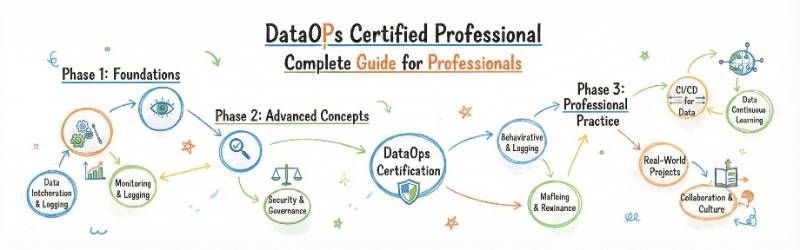
Introduction
Data is the engine of the modern economy. But having data is not enough; you must be able to move it, clean it, and trust it at the speed of business. Over my long career in this industry, I have seen brilliant data models fail because the underlying pipeline was brittle or the data itself was “dirty.” We spent years solving these problems for software with DevOps, and now, it is time to do the same for data.The DataOps Certified Professional (DOCP) is the benchmark for this new era. It represents a shift from manual data handling to an automated, “factory-like” approach to data analytics. This guide explores everything you need to know about the DOCP program and how it can transform your career and your organization.
Global Certification Landscape
If you are a working engineer or a manager, you know that specialization is the key to growth. Here is a comprehensive look at how the DataOps track fits into the broader ecosystem of professional certifications.
| Track | Level | Who it’s for | Prerequisites | Skills Covered | Recommended Order |
| DataOps | Professional | Data Engineers, SREs, Analysts | Basic Data Knowledge | Pipeline Automation, Data Quality, CI/CD, Orchestration | Start here for Data focus |
| DevOps | Professional | Software Engineers, SysAdmins | Linux & Git | CI/CD, Infrastructure as Code, Docker, Jenkins | Foundation for all engineers |
| DevSecOps | Professional | Security Engineers, DevOps | DevOps Knowledge | Security Automation, Compliance, Vulnerability Scanning | After DevOps Foundation |
| SRE | Professional | SREs, Platform Engineers | System Admin Skills | Observability, Error Budgets, Incident Management | After 1 year in Ops role |
| MLOps | Professional | ML Engineers, Data Scientists | Python & Data Eng | Model Registry, Model Monitoring, Deployment | Follows DataOps mastery |
| AIOps | Professional | IT Ops, System Architects | Monitoring basics | AI-driven Monitoring, Predictive Analytics | After SRE or DataOps |
| FinOps | Professional | Finance, Engineering Leads | Cloud Basics | Cloud Cost Optimization, Budgeting, Unit Metrics | Parallel to any track |
Deep Dive: DataOps Certified Professional (DOCP)
What it is
The DataOps Certified Professional (DOCP) is an industry-recognized program designed to bridge the gap between data engineering and operations. It applies the principles of Agile development, DevOps, and Lean manufacturing to the data lifecycle. Its primary goal is to increase the quality of data analytics while significantly reducing the cycle time from data ingestion to business insight.
Who should take it
This program is perfect for Data Engineers who want to stop “firefighting” and start automating. It is also ideal for Software Engineers looking to specialize in data platforms, SREs who want to manage data reliability, and Engineering Managers who need a proven framework to lead high-performing data teams.
Skills you’ll gain
- Pipeline Automation: Mastering tools like Airflow and Kafka to orchestrate complex data flows.
- Data Quality Testing: Implementing automated “circuit breakers” using Great Expectations to catch bad data.
- Infrastructure as Code (IaC): Using Terraform and Docker to build repeatable, version-controlled data environments.
- Observability & Monitoring: Setting up real-time dashboards with Grafana to track pipeline health and data freshness.
- Data Governance: Automating compliance, lineage tracing, and access control across the entire lifecycle.
- Collaborative Workflows: Learning how to align data producers and consumers using Agile and Lean methodologies.
Real-world projects you should be able to do
- Automated ELT Pipeline: Build a system that pulls raw data from APIs, transforms it using dbt, and loads it into a warehouse with zero manual intervention.
- Self-Healing Data Stream: Design a Kafka-based pipeline that automatically triggers alerts and recovery scripts when data drift is detected.
- Cloud Data Sandbox: Deploy on-demand, containerized environments for data scientists to experiment without breaking production data.
- Enterprise Data Catalog: Create a centralized system that tracks data lineage, showing exactly where every data point originated.
Preparation plan
Your timeline depends on your background, but here is a standard guide:
- 7–14 Days (Fast Track): For those already skilled in DevOps or Big Data. Focus purely on DataOps-specific tools (Airflow/dbt) and the DataOps Manifesto.
- 30 Days (Standard): The most common path. Spend two weeks on automation/orchestration and two weeks on data quality and governance labs.
- 60 Days (Comprehensive): For those transitioning from non-technical roles. This includes time to master SQL, basic Linux, and Git before moving to the core DOCP modules.
Common mistakes
- Treating Data like Code: Code is static; data is dynamic and has “state.” You cannot simply “roll back” a database as easily as a code commit without considering state.
- Ignoring the “Ops” in DataOps: Many teams focus only on building pipelines and forget about monitoring, alerting, and long-term maintenance.
- Manual Quality Checks: If a human has to “verify” the data before it goes to a dashboard, you aren’t doing DataOps.
- Siloed Collaboration: Building a perfect pipeline that the business analysts don’t understand or use.
Best next certification after this
Once you have mastered DataOps, consider these three paths:
- Same Track: MLOps Certified Professional (to manage AI/ML lifecycles).
- Cross-Track: SRE Practitioner (to deepen your focus on high-availability systems).
- Leadership: DevOps Engineering Manager (to transition into strategic oversight).
Choose Your Path: 6 Learning Tracks
Depending on your career goals, you should align your learning with one of these specialized paths:
- DevOps Path: Focuses on the speed of software delivery. Best for general software engineers and sysadmins.
- DevSecOps Path: Focuses on shifting security left. Essential for anyone in compliance or high-security environments.
- SRE Path: Focuses on reliability and uptime. This is the path for those who love troubleshooting and building resilient systems.
- AIOps/MLOps Path: Focuses on the intersection of AI and operations. The future of intelligent, self-healing infrastructure.
- DataOps Path: Our core focus here. This path is for the “data architects” of the future who manage information flows.
- FinOps Path: Focuses on cloud economics. Highly recommended for managers who need to justify and optimize cloud spend.
Role → Recommended Certifications Mapping
| Your Current Role | Recommended Certification Journey |
| DevOps Engineer | DevOps Professional → Kubernetes Specialist → DevOps Architect |
| SRE | SRE Practitioner → Observability Expert → SRE Architect |
| Platform Engineer | DevOps Professional → Docker/K8s Specialist → Platform Architect |
| Cloud Engineer | Cloud Associate → SRE Practitioner → Cloud Architect |
| Security Engineer | DevSecOps Professional → Cloud Security Expert → DevSecOps Architect |
| Data Engineer | DataOps Certified Professional (DOCP) → MLOps Professional → Data Architect |
| FinOps Practitioner | FinOps Foundation → Cloud Cost Specialist → FinOps Professional |
| Engineering Manager | DevOps Manager → DataOps Foundation → IT Leadership Program |
General FAQs on Certifications
- How difficult is the DOCP exam?
It is moderately challenging. It tests practical application, not just theory. If you complete the labs, you will be well-prepared. - How much time should I dedicate daily?
Aim for 1-2 hours of focused study. Consistency is more important than long, infrequent sessions. - Are there any prerequisites?
A basic understanding of data (SQL) and command-line basics (Linux) is highly recommended. - What is the best sequence for a beginner?
Start with a Professional certification in your current field, then add a cross-functional one like FinOps. - What is the real-world value of this certification?
It validates that you can handle modern, high-speed data environments, which is a rare and highly paid skill set. - Does this help with career outcomes?
Yes. Certified professionals often move into “Senior” or “Lead” roles faster than those without a formal credential. - How long is the certificate valid?
Most certifications from this provider offer lifetime validity with a focus on core principles that don’t expire. - Can I take the exam online?
Yes, the exams are proctored online, making them accessible from anywhere in the world. - Is there a community for certified professionals?
Yes, you get access to exclusive forums and networking groups of fellow DataOps experts. - Do I need to be a coding expert?
No. You need to be comfortable with scripting (Python/Bash), but you don’t need to be a full-stack developer. - How do these certs compare to university degrees?
These are practical and tool-centric, focusing on what you actually do on the job Monday through Friday. - Is it recognized in India and globally?
Absolutely. These certifications are used by top MNCs and startups across Bangalore, London, New York, and beyond.
Top Institutions for DataOps Training
Choosing where you learn is as important as the certificate itself. Here are the leading institutions providing training for the DataOps Certified Professional (DOCP):
- DevOpsSchool: The primary provider for DOCP. They are famous for their “lab-first” approach and have a massive library of real-world scenarios. Their instructors are industry veterans who focus on practical engineering rather than just theory.
- Cotocus: This institution specializes in corporate-level training and complex cloud migrations. They are an excellent choice for teams looking to transition entire departments to a DataOps model.
- Scmgalaxy: A long-standing community leader in configuration management. They offer extensive documentation and community-driven tutorials that complement formal DOCP training perfectly.
- BestDevOps: Known for their intensive bootcamps. If you need to get certified quickly and have a strong technical baseline, their streamlined programs are highly effective.
- DevSecOpsSchool: The go-to institution if you want to combine DataOps with a heavy security focus. They teach you how to build data pipelines that are not just fast, but secure.
- SREschool: Ideal for those coming from an operations background. They help you apply reliability engineering principles to your data pipelines.
- AIOpsSchool: Focuses on the next step. Once you have your DOCP, this is the place to learn how to use AI to manage your data operations.
- DataOpsSchool: A specialized platform that lives and breathes data operations. They offer deep-dive tracks into specific tools like Airflow, Kafka, and dbt.
- FinOpsSchool: Crucial for managers. They teach the financial side of running large data operations in the cloud, focusing on cost efficiency.
Specific FAQs: DataOps Certified Professional (DOCP)
- What is the core focus of DOCP?
It focuses on the “factory” mindset—automating the flow of data and ensuring every step is monitored and tested. - Does it cover specific cloud platforms?
Yes, the principles are taught in a way that applies to AWS, Azure, and Google Cloud equally. - Why is DataOps different from Data Engineering?
Data Engineering builds the pipes; DataOps ensures the pipes don’t leak, are always running, and can be upgraded without breaking. - What tools will I learn?
You will gain experience with Jenkins, Airflow, Docker, Kubernetes, Kafka, and various data quality frameworks. - How does this impact my salary?
DataOps is a high-demand, low-supply field. Being certified often places you in a higher bracket for specialized roles. - Can I move into a management role with this?
Yes. DOCP provides the framework for how a data team should operate, which is exactly what a manager needs to know. - What is the most difficult module?
Most find the “Data Quality & Automated Testing” module the most challenging because it requires a change in mindset. - Is there a project work requirement?
Yes. To be fully certified, you must demonstrate your ability to build a working, automated data pipeline.
Testimonials
“I spent years manually fixing data errors every morning. After the DOCP program, I automated our quality checks. Now, I spend my time building new features instead of fixing old mistakes. It changed my career path entirely.”
— Sunil V., Senior Data Engineer
“As a manager, I needed a way to scale my team’s output without adding more headcount. DataOps gave us the blueprint to automate our delivery. Our deployment frequency has tripled.”
— Ananya R., Engineering Manager
“The hands-on labs at DevOpsSchool were the highlight. Building a self-healing pipeline on a real cloud environment gave me the confidence I couldn’t get from a textbook.”
— Michael T., Platform Engineer
Conclusion
The transition from traditional data management to DataOps is the most significant change happening in the industry today. We have moved past the era where “just getting the data” was enough. Now, we must provide data that is accurate, secure, and available in real-time. The DataOps Certified Professional (DOCP) is more than just a credential; it is a commitment to a better way of working. Whether you are an engineer on the front lines or a manager steering the ship, mastering these principles will make you an indispensable part of any data-driven organization. The tools will continue to evolve, but the foundation of automation and quality you build here will last for your entire career.