Introduction
The ingestion job extracted raw files and loaded them without crashing, but an upstream application updated its checkout flow. You must verify both the pipeline code and the structure, completeness, and validity of the data moving through it. This is where DataOps testing techniques come into play. By embedding proactive validation across every stage of your data lifecycle, you catch silent data corruption early, protect downstream analytics, and build long-term trust in your data platform. In this guide, we will explore core testing types, automated CI/CD workflows, essential data quality checks, and practical steps to build a reliable testing strategy. For additional structured learning paths and architectural patterns, explore the educational guides available at DataOpsSchool.com.
What Is DataOps?
DataOps is an operational framework that applies Agile engineering, DevOps principles, and statistical process controls to data workflows. It brings together data engineers, analytics engineers, data scientists, and business stakeholders to deliver high-quality data products rapidly and reliably.
DataOps is not a single tool, commercial platform, or isolated script. It is an operating discipline built upon several core pillars:
- Collaboration: Breaking down silos between operational source teams, data engineering, and business consumers.
- Automation: Replacing manual data handoffs and ad-hoc SQL verifications with automated execution.
- Continuous Integration & Delivery (CI/CD): Testing and deploying pipeline code and transformation logic through version-controlled release cycles.
- Data Quality & Testing: Continuously asserting that incoming datasets meet defined functional expectations.
- Observability & Monitoring: Tracking pipeline health, run durations, data freshness, and anomalous distributions in real time.
- Reproducibility: Ensuring that pipeline environments, dependencies, and transformation outcomes can be reliably re-created.
At its foundation, you can think of DataOps as a practical formula:
$$\text{Data Engineering} + \text{Automation} + \text{Testing} + \text{Collaboration} + \text{Observability} = \text{DataOps}$$
Why Testing Is Important in DataOps
Testing in DataOps carries unique challenges because data systems have two independent points of failure: the code executing the transformation, and the external data feeding it. Even if your pipeline code does not change for months, source data evolves constantly.
Data issues can manifest silently in several ways:
- Missing or Null Values: Upstream software changes stop populating essential attributes.
- Duplicate Records: Retried API calls or faulty joins duplicate transactional rows.
- Type Inconsistencies: A numeric field suddenly arrives containing text strings.
- Broken Business Rules: A discount calculation generates negative invoice totals.
- Unexpected Schema Changes: Columns are renamed, dropped, or reordered without warning.
- Incorrect Volumes: A daily batch arrives with 100 rows instead of the expected 50,000.
- Stale Data: Upstream sync jobs stall, causing models to compute against outdated snapshots.
When bad data reaches executive dashboards, reporting layers, or machine learning models, teams make strategic decisions based on flawed insights. Automated testing creates guardrails that stop bad data at the door before it contaminates downstream systems.
DataOps Testing vs. Traditional Software Testing
While DataOps borrows heavily from traditional software engineering practices, testing data pipelines requires validating both code execution and underlying state.
| Area | Traditional Software Testing | DataOps Testing |
| Main Focus | Application logic, code behavior, user interfaces | Data state, schema consistency, data transformations, pipeline execution |
| What Is Tested | Deterministic outputs based on controlled static inputs | Dynamic, high-volume datasets from external, evolving sources |
| Data Quality | Mock data used purely to test execution branches | Live and transformed data validated for accuracy, completeness, and freshness |
| Schema Changes | Controlled by internal database migrations | Often triggered unexpectedly by external upstream teams or third-party APIs |
| Pipeline Behavior | Service uptime, API latency, endpoint availability | Job run times, data arrival SLAs, compute utilization, throughput |
| Business Rules | Code execution matches application business logic | Output data respects mathematical boundaries and analytical domain constraints |
| Monitoring | Error rates, CPU/memory, server uptime | Volume anomalies, schema drift, data freshness, distributional shifts |
| Production Validation | Smoke tests, synthetic health pings | Continuous in-pipeline assertions, table-level anomaly monitors |
The DataOps Testing Lifecycle
Effective testing is not a single checkpoint performed right before a pipeline release. It is a continuous lifecycle applied throughout development, deployment, and ongoing pipeline execution.
Plan ──> Prepare Test Data ──> Develop ──> Test ──> Validate ──> Deploy ──> Monitor ──> Improve
- Plan: Define data expectations, SLAs, schema contracts, and critical business rules with stakeholders.
- Prepare Test Data: Assemble safe, sanitized sample datasets or synthetic records for isolated testing.
- Develop: Write transformation code, SQL models, and associated unit tests simultaneously.
- Test: Run automated unit and static integration tests in a local or pre-production sandbox.
- Validate: Execute schema and data quality assertions against staging environments.
- Deploy: Promote code safely through automated CI/CD release gates.
- Monitor: Continuously execute runtime checks and track data observability metrics in production.
- Improve: Investigate production warnings, refine validation thresholds, and add regression tests for newly discovered edge cases.
Major DataOps Testing Techniques
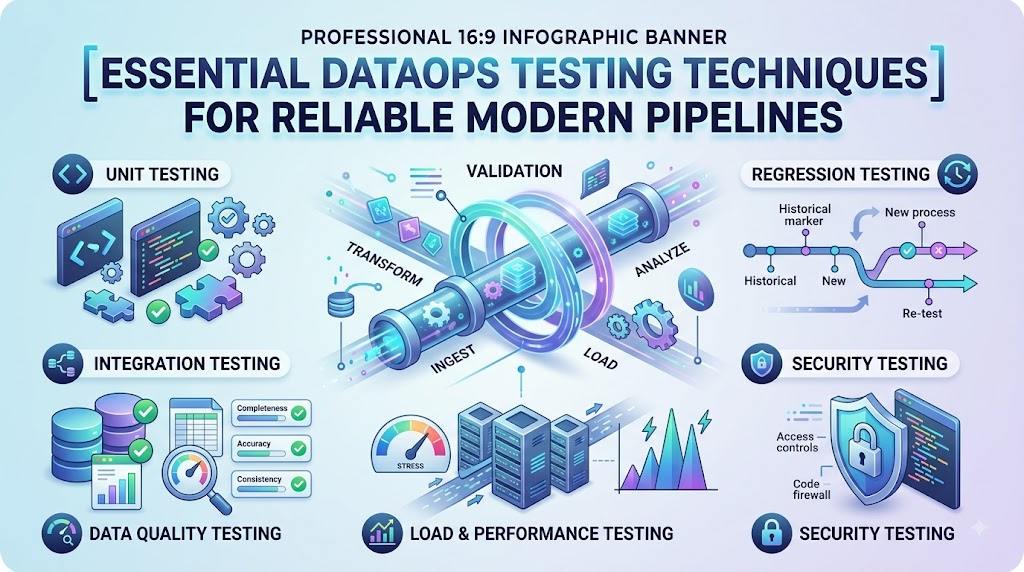
A complete DataOps strategy combines multiple testing techniques, each designed to validate a specific aspect of your data stack.
┌──────────────────────────────────────────────────────────────┐
│                    DataOps Testing Stack                     │
├──────────────────────────────┬───────────────────────────────┤
│ Code & Pipeline Logic Tests  │ Data State & Behavior Tests   │
├──────────────────────────────┼───────────────────────────────┤
│ • Unit Testing               │ • Data Quality Testing        │
│ • Integration Testing        │ • Schema Validation Testing   │
│ • End-to-End Testing         │ • Contract Testing            │
│ • Performance Testing        │ • Regression Testing          │
│ • Smoke Testing              │ • In-Pipeline Data Validation │
└──────────────────────────────┴───────────────────────────────┘
1. Unit Testing
Unit tests isolate and verify the smallest testable units of pipeline logic—such as a custom Python parsing function, a mathematical transformation, or an individual SQL macro—without connecting to external databases or live endpoints.
- Example: A transformation function accepts a gross price and tax rate to calculate net amount. A unit test feeds static inputs (
price = 100,tax = 0.08) and asserts the output equals108.00, while also testing edge cases like zero or negative inputs.
2. Integration Testing
Integration testing validates that multiple interconnected pipeline modules function correctly together. It checks whether data flows properly from an ingestion module into staging tables and through subsequent transformation scripts.
- Example: Ingesting an extracted JSON payload from an API, writing it to a staging table, and executing an initial cleaning query to verify that column data types and foreign-key references persist correctly across the boundary.
3. Data Quality Testing
Data quality testing asserts the health, integrity, and cleanliness of the data itself. It measures whether records satisfy basic quality dimensions: completeness, accuracy, consistency, validity, uniqueness, and timeliness.
- Example: Verifying that a
user_registrationtable has 0% null values in theemailcolumn and zero duplicateuser_idrecords.
4. Schema Testing
Schema testing ensures that the structure of incoming datasets matches predefined architectural blueprints. It validates column names, structural ordering, data types, and nullability constraints.
- Example: Asserting that incoming transactional batches contain the exact columns
transaction_id (VARCHAR),amount (DECIMAL), andtimestamp (TIMESTAMP). Ifamountarrives as a string or a column is renamed, the test raises an immediate alert.
5. Data Validation Testing
Data validation checks whether individual data values adhere to operational and domain-specific business rules.
- Example: Asserting that an
order_quantityfield is strictly greater than zero, anemployee_agefield falls between 18 and 100, and anorder_statusfield matches an approved list of values (PENDING,SHIPPED,DELIVERED,CANCELLED).
6. Regression Testing
Regression testing verifies that updates to pipeline code, new business logic, or underlying package upgrades do not break previously working transformations or alter historical analytical outputs unexpectedly.
- Example: Running your historical dataset through an updated currency conversion model to confirm that existing financial metrics match previously published baseline values.
7. End-to-End (E2E) Testing
End-to-end testing exercises the entire pipeline workflow from the initial ingestion point down to the final analytical consumption layer.
- Example: Triggering a test run from source API simulation $\rightarrow$ raw ingestion bucket $\rightarrow$ transformation models $\rightarrow$ data warehouse mart $\rightarrow$ analytical view query, ensuring the entire orchestration chain succeeds without friction.
8. Performance Testing
Performance testing evaluates how pipelines handle varying workloads, scaling volumes, and resource constraints. It measures execution duration, CPU/memory overhead, and query latency under load.
- Example: Benchmarking a daily batch model against $5\times$ historical data volume to determine if the pipeline will complete within its allocated 30-minute SLA window without exhausting warehouse memory.
9. Contract Testing
Data contract testing validates agreement boundaries between data producers (software application teams) and data consumers (data analytics teams). It enforces strict rules around payload structures, semantic definitions, and acceptable schema revisions.
- Example: A microservice team commits to an explicit JSON schema contract for checkout events. If an engineer attempts to alter the payload structure in their repository, the contract test suite fails their CI pipeline before the breaking change reaches the event bus.
10. Smoke Testing
Smoke testing involves a quick set of lightweight baseline checks executed immediately after a deployment or environment refresh to confirm core components are responsive.
- Example: Executing a simple
SELECT COUNT(*) FROM core_orders LIMIT 1immediately after deploying a warehouse migration to verify database connectivity, network permissions, and read access.
DataOps Testing Techniques at a Glance
| Testing Technique | Primary Focus | Practical Example |
| Unit Testing | Individual code functions in isolation | Verifying a phone-number formatting regex logic |
| Integration Testing | Communication between connected systems | Testing data handoff from API extractor to staging table |
| Data Quality Testing | Cleanliness and integrity of dataset values | Ensuring uniqueness across all primary keys |
| Schema Testing | Structural stability of incoming data | Checking that column types match table definitions |
| Validation Testing | Adherence to functional business logic | Confirming transaction amounts are positive numbers |
| Regression Testing | Preserving historical logic during changes | Re-running historical quarters to match financial baselines |
| End-to-End Testing | Complete flow from source to consumption | Running full raw-to-dashboard pipeline in staging |
| Performance Testing | Resource usage, speed, and scaling limits | Measuring runtime latency when processing 10 million rows |
| Contract Testing | Producer-consumer schema agreements | Enforcing API event payload formats at the producer layer |
| Smoke Testing | Basic post-deployment system sanity | Confirming database connections work post-deployment |
Essential Data Quality Checks Beginners Should Know
When building your first pipeline test suite, focus on these core data quality assertions:
┌──────────────────────────────────────────────────────────────┐
│                  7 Core Data Quality Checks                  │
├──────────────────────────────────────────────────────────────┤
│ 1. Null Checks          ──> Verify required fields exist     │
│ 2. Uniqueness Checks    ──> Prevent duplicate identifiers    │
│ 3. Range Checks         ──> Enforce realistic value bounds   │
│ 4. Referential Checks   ──> Ensure foreign keys align        │
│ 5. Row Count Checks     ──> Catch unexpected volume drops    │
│ 6. Freshness Checks     ──> Prevent stale dashboard data     │
│ 7. Distribution Checks  ──> Detect anomalous data shifts     │
└──────────────────────────────────────────────────────────────┘
- Null Checks: Verify that non-nullable columns (e.g.,
account_id,created_at) contain valid entries and no missing values. - Uniqueness Checks: Assert that unique identifiers, such as primary keys or invoice numbers, contain zero duplicates.
- Range Checks: Ensure numerical and temporal values sit within realistic boundaries (e.g.,
discount_percentagebetween 0 and 100). - Referential Integrity Checks: Confirm foreign keys in transactional tables map cleanly to parent tables (e.g., every
order.customer_idexists indim_customers). - Row Count Checks: Compare processed volumes against historical thresholds to identify incomplete data syncs or sudden drops.
- Freshness Checks: Confirm that the latest record timestamp falls within an acceptable time delta (e.g., the most recent event is less than 3 hours old).
- Distribution Checks: Spot statistical anomalies, such as an unexpected shift where categorical proportions (e.g., payment methods) drift radically from baseline norms.
Schema Validation and Schema Drift
Schema drift occurs when an upstream data source unexpectedly alters its structure without prior coordination with data engineering teams.
Upstream Change: [customer_id: INT] ──> [customerID: VARCHAR]
                                             │
                                             ▼
                                  Pipeline Schema Test
                                             │
                        ┌────────────────────┴────────────────────┐
                        ▼                                         ▼
                 [Test Passes]                             [Test Fails]
             Pipeline Continues                     Pipeline Halts Gracefully
                                                    Alert Sent; Models Protected
Consider an upstream application database that stores customer IDs. If a developer renames the column from customer_id to customerID, or alters the data type from INTEGER to VARCHAR, downstream pipelines that depend on the original structure will fail during downstream joins or aggregations.
Automated schema validation acts as a structural circuit breaker. By comparing incoming dataset schemas against an approved schema definition at the ingestion boundary, the pipeline can halt gracefully, isolate the offending batch, and notify engineers before bad data breaks reporting layers.
Test Data Management in DataOps
Testing data pipelines requires realistic data, but using unfiltered production data in non-production environments introduces significant security, compliance, and privacy risks.
Effective test data management relies on safe handling strategies:
- Sample Data: Creating curated, miniature versions of historical tables that capture structural edge cases while keeping file sizes small.
- Synthetic Data: Generating mathematically fabricated mock records that mimic real data distributions and schemas without containing actual user data.
- Data Masking & Anonymization: Obfuscating Personally Identifiable Information (PII)—such as names, emails, credit card numbers, and addresses—using hashing, tokenization, or pseudonyms.
- Data Subsetting: Extracting referentially intact slices of relational data (e.g., all transactional records for 100 sample users) to allow realistic integration testing without copying terabyte-scale tables.
- Isolated Provisioning: Supplying temporary sandbox environments or ephemeral database schemas for automated CI testing runs.
Automated Testing in DataOps
Manual data validation does not scale. In a mature DataOps workflow, test suites run automatically across every stage of the software and data lifecycle.
Code Commit ──> Automated Tests ──> Data Validation ──> Results Check ──> Pass/Fail Gate ──> Safe Deploy
Automated tests should be triggered at key checkpoints:
- During Local Development: Engineers run unit tests and SQL model checks locally before pushing code.
- During Pull Requests: CI runners build the code in an isolated environment, validate syntax, and execute unit and integration test suites.
- Pre-Deployment: Automated staging jobs execute end-to-end runs against sanitized test datasets.
- Post-Deployment: Smoke tests verify production environment connectivity immediately following release.
- During Scheduled Runs: Runtime data quality assertions execute directly inside orchestrated pipelines (e.g., Airflow, Dagster, Prefect) to validate incoming daily batches.
DataOps Testing and CI/CD
Continuous Integration and Continuous Delivery (CI/CD) automates the process of building, testing, and deploying pipeline code changes. When applied to DataOps, CI/CD pipelines validate both the logic of your code and the data artifacts it generates.
Developer Commit
       │
       ▼
  Build & Lint
       │
       ▼
   Unit Tests  ───────────► [Fail] ──> Block Merge
       │
       ▼
Staging Data Tests ───────► [Fail] ──> Block Deployment
       │
       ▼
Production Deploy
       │
       ▼
Runtime Monitoring
When a pull request is opened, the CI system:
- Validates code style and checks SQL syntax using linters.
- Runs unit tests against custom Python functions or transformation logic.
- Provisions a temporary scratch schema in the data warehouse.
- Builds staging models and runs schema, uniqueness, and null tests against sample data.
- Blocks the merge if any assertion fails, preventing unvetted code from reaching production.
Popular Tools for DataOps Testing
Modern DataOps relies on a diverse ecosystem of specialized testing and validation tools.
| Tool / Category | Primary Purpose | Best Used For |
| pytest | General-purpose Python unit testing framework | Testing custom Python extractors, transformation functions, and data utilities in isolation. |
| Great Expectations | Declarative data assertion and documentation framework | Defining explicit data expectations (e.g., expect_column_values_to_not_be_null) on tabular datasets. |
| dbt Tests | SQL-native schema and custom data testing | Running built-in uniqueness, not-null, accepted-values, and referential integrity tests directly in the warehouse. |
| SQL-Based Testing | Custom assertion queries and stored procedures | Writing bespoke SQL queries that assert business rules (e.g., checking that output rows equal zero for invalid states). |
| CI/CD Platforms (GitHub Actions, GitLab CI) | Automated execution of test suites | Running automated test jobs on every code push, pull request, and deployment event. |
| Data Quality & Observability Platforms | Continuous production monitoring and anomaly detection | Tracking runtime metric shifts, schema drift, table volume changes, and pipeline freshness automatically. |
| Orchestration Tools (Airflow, Dagster, Prefect) | Workflow scheduling and conditional execution | Halting downstream tasks when an intermediate data quality check returns a failure status. |
Hypothetical Example: Testing a Sales Data Pipeline
To see how these concepts connect in practice, let us examine a hypothetical e-commerce sales pipeline.
[Raw API Source]
       │
       ▼
 [Ingestion Job]   ──► Test: Schema validation on JSON payload
       │
       ▼
[Staging Storage]  ──► Tests: Null check on order_id; duplicate transaction check
       │
       ▼
[Transformations]  ──► Tests: Unit test for currency conversion; row-count verification
       │
       ▼
[Warehouse Mart]   ──► Tests: Referential integrity (customer_id exists); range checks (amount >= 0)
       │
       ▼
[BI Dashboard]     ──► Test: End-to-end smoke test validating dashboard query response
What Happens When a Test Fails?
Suppose the upstream checkout service introduces a bug that generates empty customer_id strings.
- The ingestion job writes raw payloads to staging.
- The staging data quality test executes:
ASSERT count(customer_id IS NULL) == 0. - The assertion fails. The pipeline immediately stops further downstream processing.
- An alert is dispatched to the data engineering on-call channel with the failed record IDs.
- Downstream marts and executive dashboards continue displaying the last known good state rather than corrupting financial metrics with orphaned orders.
Common Beginner Mistakes in DataOps Testing
Avoid these eight common pitfalls when establishing your testing workflows:
- Testing Only in Production: Relying exclusively on live dashboards to catch data issues rather than testing in staging environments.Fix: Implement pre-deployment CI validation using sanitized sample data.
- Checking Job Status Instead of Data State: Assuming a pipeline succeeded simply because the task runner returned exit code 0.Fix: Add explicit data assertions after every critical transformation step.
- Writing Tests Without Business Context: Writing generic tests that pass technically but ignore core business rules.Fix: Collaborate with business stakeholders to define practical range, status, and logic constraints.
- Ignoring Schema Drift: Assuming upstream API formats will remain static over time.Fix: Add automated schema assertion checks at your ingestion boundaries.
- Using Raw PII in Test Environments: Copying sensitive customer information into unsecured dev sandboxes.Fix: Implement automated data masking and synthetic data generation.
- Over-Complicating Test Suites Too Early: Writing complex, brittle custom testing frameworks before establishing simple baseline checks.Fix: Start with basic not-null, uniqueness, and schema checks using standard open-source tools.
- Ignoring Test Warnings: Allowing persistent test failure warnings to accumulate until teams become blind to real alerts.Fix: Treat test failures with the same urgency as application errors; fix or deprecate broken tests promptly.
- Testing Only Isolated Components: Writing unit tests while omitting integration tests that verify database connections and end-to-end flows.Fix: Balance unit testing with integration and end-to-end workflow validation.
Best Practices for DataOps Testing
- Start Testing Early: Shift testing left by adding tests during development rather than retrofitting them after production failures.
- Automate Repetitive Checks: Embed data tests into your orchestrator and CI/CD pipelines so validation happens automatically.
- Test Both Code and Data: Maintain separate assertions for transformation code logic (unit tests) and incoming dataset quality (state tests).
- Use Safe, Representative Test Data: Maintain sanitized, masked, or synthetic fixtures for development and staging runs.
- Keep Tests Under Version Control: Store your test definitions, SQL assertions, and expectation suites alongside pipeline transformation code in Git.
- Keep Tests Maintainable: Write modular, understandable test assertions that provide clear error messages when failures occur.
- Validate Critical Business Logic First: Prioritize tests on high-impact financial, operational, and customer-facing metrics before expanding coverage.
- Monitor and Alert Responsibly: Route pipeline alerts to dedicated triage channels with clear severity classifications to prevent notification fatigue.
- Run Regression Tests on Upgrades: Re-run historical benchmark data whenever upgrading dependencies, engines, or major transformation logic.
- Continuously Refine Coverage: Treat your test suite as an evolving asset; add regression test cases whenever a new edge case or bug is identified.
How to Build a Beginner-Friendly DataOps Testing Strategy
Follow this practical 10-step roadmap to establish your testing foundation:
Step 1: Understand Pipeline ──► Step 2: Identify Critical Data ──► Step 3: Add Quality Checks
                                                                           │
Step 6: Add Schema Checks   ◄── Step 5: Add Integration Tests   ◄── Step 4: Add Unit Tests
         │
         ▼
Step 7: Automate via CI/CD  ──► Step 8: Add Monitoring        ──► Step 9: Review Failures
                                                                           │
                                                                           ▼
                                                               Step 10: Expand Coverage
- Step 1: Understand the Pipeline: Map your data sources, ingestion points, transformation models, and final consumers.
- Step 2: Identify Critical Data: Pinpoint primary keys, required foreign keys, financial metrics, and sensitive fields.
- Step 3: Add Basic Data Quality Checks: Implement basic not-null, uniqueness, and acceptable-value checks on your core tables.
- Step 4: Add Unit Tests: Write isolated unit tests for complex business formulas, regex parsers, and custom transformation functions.
- Step 5: Add Integration Tests: Verify that staging tables load correctly from source extractions and handle connection retries cleanly.
- Step 6: Introduce Schema Validation: Enforce schema checks at the ingestion layer to guard against unexpected upstream column modifications.
- Step 7: Automate Tests Through CI/CD: Configure your repository to run unit tests and staging assertions automatically on every pull request.
- Step 8: Add Production Monitoring: Embed runtime assertions and freshness tracking into your daily orchestration jobs.
- Step 9: Review Failures: Establish a consistent team process for triaging alerts, identifying root causes, and updating pipeline models.
- Step 10: Expand Testing Coverage Gradually: Continuously expand your test library as new business rules, models, and integrations are introduced.
Measuring DataOps Testing Success
Tracking operational metrics helps your team evaluate the effectiveness of your testing practices over time.
| Metric | What It Measures | Target Direction |
| Test Pass Rate | Percentage of executed pipeline tests that complete successfully | High / Stable |
| Test Failure Rate | Frequency of test assertion failures across pipeline runs | Low / Predictable |
| Data Quality Failure Rate | Proportion of pipeline runs halted due to data-level anomalies | Decreasing over time |
| Pipeline Failure Rate | Unhandled job crashes caused by code, connection, or compute errors | Near Zero |
| Defects Caught Pre-Production | Percentage of bugs detected in CI/staging before reaching production | High |
| Test Coverage | Proportion of production tables, models, and critical columns under active testing | Gradually Increasing |
| Mean Time to Detect (MTTD) | Average time elapsed between data corruption occurring and being identified | Low (Minutes) |
| Mean Time to Resolve (MTTR) | Average time required to triage, fix, and backfill broken data | Low (Hours) |
The Role of DataOpsSchool.com
Mastering modern data engineering requires more than memorizing tool syntax—it requires understanding how architecture, continuous integration, data quality, and operations fit together.
DataOpsSchool.com serves as an educational knowledge base dedicated to modern data practices. Whether you are transitioning from traditional software QA, growing your skills as an analytics engineer, or building a modern DataOps framework from scratch, DataOpsSchool provides structured, vendor-neutral learning materials covering:
- Step-by-step guides to pipeline unit testing, integration testing, and regression suites.
- Test data management techniques, including data masking, subsetting, and synthetic generation.
- Real-world CI/CD patterns for data engineering workflows and automated warehouse deployments.
- Best practices for establishing data observability, schema monitoring, and continuous validation.
The Future of DataOps Testing
As data environments grow in scale and complexity, testing practices continue to evolve:
- AI-Assisted Quality Testing: Machine learning models that learn normal data patterns and automatically suggest relevant assertion thresholds.
- Automated Anomaly Detection: Systems that spot subtle distribution drifts, unexpected variance, and seasonal metric anomalies without manual rule configuration.
- Intelligent Test Generation: Tools that analyze transformation SQL and automatically generate baseline unit test suites and mock datasets.
- Unified Data Observability: The convergence of data lineage, pipeline health tracking, and automated data quality validation into single-pane operational views.
- Automated Remediation: Pipelines capable of routing anomalous records to quarantine queues while allowing clean data to process without interruption.
While automated and AI-driven tools streamline quality management, human oversight, sound engineering practices, and clear business alignment remain essential to building reliable data platforms.
Frequently Asked Questions
What is DataOps testing?
DataOps testing is the practice of automatically verifying both pipeline code logic and the quality, structure, and behavior of the data moving through an organization’s data infrastructure.
Why is testing important in DataOps?
Testing prevents silent data corruption, broken transformation models, schema drift, and calculation errors from reaching production dashboards, business applications, and machine learning models.
What are the main DataOps testing techniques?
The primary techniques include unit testing, integration testing, data quality testing, schema validation, data validation, regression testing, end-to-end testing, performance testing, contract testing, and smoke testing.
What is unit testing in DataOps?
Unit testing in DataOps involves isolating and testing individual functions, transformation macros, or calculation modules using controlled static inputs without connecting to external databases.
What is integration testing in DataOps?
Integration testing verifies that multiple interconnected pipeline components—such as an API extractor, a staging bucket, and a warehouse loading script—communicate and exchange data correctly.
How is data quality tested?
Data quality is tested by running automated assertions against dataset attributes to verify completeness (null checks), uniqueness, valid ranges, referential integrity, row counts, and data freshness.
What is schema testing?
Schema testing checks that incoming data strictly adheres to expected structural formats, confirming that column names, data types, and required fields match predefined definitions.
What tools are used for DataOps testing?
Popular tools include pytest for custom Python code, Great Expectations for declarative data assertions, dbt tests for SQL-native modeling, along with CI/CD platforms like GitHub Actions for automated execution.
How does CI/CD support DataOps testing?
CI/CD automates the execution of unit tests, linters, and staging data validations whenever code is committed or merged, preventing unverified pipeline changes from deploying to production.
How can beginners learn DataOps testing?
Beginners should start by learning foundational data quality checks (not-null, uniqueness) using tools like dbt or pytest, practicing with safe sample datasets, and studying structured educational resources at DataOpsSchool.com.
Conclusion
Building reliable data pipelines requires shifting our focus from simple execution checks to comprehensive data validation. You do not need to implement every advanced technique immediately. Start small by introducing basic null, uniqueness, and schema assertions on your most critical tables. Automate those checks within your daily runs, integrate testing into your code review process with CI/CD, and expand your test coverage incrementally as your pipeline architecture matures.
