Introduction
Getting a Certified AIOps Professional credential is a major step for any engineer looking to stay ahead in the modern tech world. This guide is written for software engineers, system admins, and cloud experts who want to understand how artificial intelligence can improve IT operations. As systems become more complex, manual work is no longer enough to keep things running smoothly. This is where AI and machine learning come in to help automate monitoring, incident response, and performance tuning.
By reading this guide, you will learn why this certification matters and how it fits into the broader worlds of DevOps, SRE, and platform engineering. We created this resource at Aiopsschool to help you make better decisions about your learning path and career growth. Whether you are just starting out or you are a seasoned lead, knowing how to use data-driven insights is the key to building reliable systems. This roadmap will clear up any confusion and help you choose the right level of training for your current role and future goals.
What is the Certified AIOps Professional?
The Certified AIOps Professional is a program designed to bridge the gap between traditional IT operations and modern data science. It focuses on using machine learning algorithms to analyze large amounts of telemetry data from servers, applications, and networks. Instead of just teaching theory, this program emphasizes real-world application in production environments. You will learn how to reduce alert noise, find the root cause of problems faster, and even predict issues before they happen.
This certification exists because modern enterprise practices require faster response times and higher availability than ever before. It aligns with how modern engineering workflows function by introducing automation that thinks and learns over time. For any professional working with cloud-native stacks, this credential represents a deep understanding of how to manage scale without adding more manual toil. It is built to ensure that you can handle the massive datasets generated by today’s complex microservices.
Who Should Pursue Certified AIOps Professional?
This certification is highly beneficial for DevOps engineers, Site Reliability Engineers, and cloud architects who manage large-scale infrastructure. Security professionals and data engineers will also find it useful because it teaches how to identify patterns and anomalies in system behavior. Even if you are a beginner, starting with the foundation level can give you a strong edge in a competitive job market. Experienced engineers can use this to move into senior or principal roles by proving they can handle high-level automation strategy.
Managers and technical leaders should also consider this path to better understand the tools their teams are using and how to justify the budget for AI-driven operations. In modern enterprise environments, companies are looking for people who can reduce downtime and save costs through smart automation. Whether you are working in a startup or a large global enterprise, these skills are becoming a standard requirement. It is a perfect fit for anyone who wants to transition from manual troubleshooting to building self-healing systems.
Why Certified AIOps Professional is Valuable and Beyond
The demand for AI-driven operations is growing rapidly as companies realize they cannot hire enough people to manually watch every single dashboard. Getting this certification ensures you have longevity in your career because you are moving toward the future of IT management. While specific tools might change every few years, the core principles of using data to drive operations will stay relevant for a very long time. Enterprise adoption of these technologies is increasing because they provide a clear return on investment by preventing outages.
Investing your time in this certification offers a great career return because it puts you in a high-demand niche. It helps you stay relevant even as the underlying cloud technologies evolve, as the logic of AIOps applies to almost any environment. Professionals who can master these skills often see faster promotions and better salary offers compared to those who only know traditional monitoring. It is a way to prove that you are not just a tool user, but a strategic engineer who can solve complex business problems using advanced technology.
Certified AIOps Professional Certification Overview
The entire program is delivered via the official course site at Certified AIOps Professional and is hosted on the main Aiopsschool platform. It is structured to provide different levels of expertise, ranging from basic concepts to advanced architectural design. The assessment approach is very practical, focusing on your ability to solve real scenarios rather than just memorizing definitions. This ensures that when you finish the program, you actually know how to use the tools in a live environment.
The certification is owned and managed by industry experts who understand what modern companies need from their technical staff. It covers a wide range of topics including data collection, pattern recognition, and automated remediation. Each level is built upon the previous one, allowing you to grow your skills at your own pace without feeling overwhelmed. The structure is clear and logical, making it easy to track your progress as you move through the various tracks. By the end, you will have a professional portfolio that proves your expertise in modern operational techniques.
Certified AIOps Professional Certification Tracks & Levels
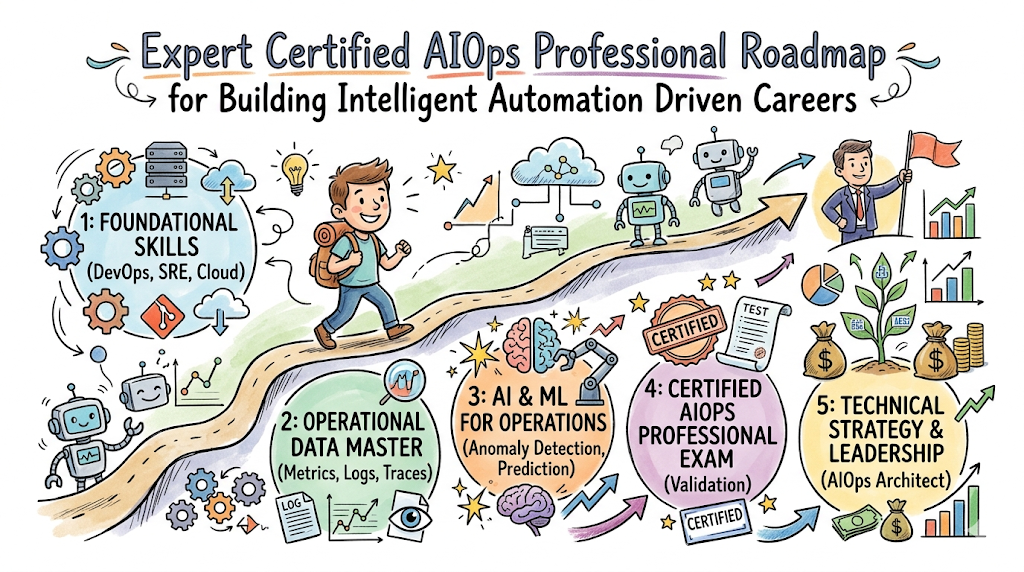
The program is divided into three main levels: foundation, professional, and advanced. The foundation level is perfect for those who are new to the concept and want to understand the basic building blocks of AI in operations. The professional level goes deeper into implementation and specific toolsets, making it ideal for engineers who are doing the daily work. The advanced level is for architects and leaders who need to design the entire strategy for a large organization.
There are also specialization tracks that allow you to focus on specific areas like DevOps, SRE, or even FinOps. These tracks show you how to apply AI concepts to your specific job function so the learning is always relevant. As you move up the levels, you will notice that the training shifts from individual tasks to system-wide improvements. This alignment ensures that your certification path matches your actual career progression from a junior contributor to a senior leader. It provides a clear roadmap for anyone looking to specialize in the most advanced parts of modern tech.
Complete Certified AIOps Professional Certification Table
| Track | Level | Who it’s for | Prerequisites | Skills Covered | Recommended Order |
| Core Operations | Foundation | Beginners and Junior Engineers | Basic Linux and Cloud Knowledge | Monitoring, Data Basics, AI Terms | 1st |
| Engineering | Professional | Mid-level DevOps and SREs | 2 years of IT Ops experience | Python, ML Models, Alerting | 2nd |
| Architecture | Advanced | Senior Leads and Architects | Professional Level Cert | Strategy, Custom Models, Scaling | 3rd |
| Business | Managerial | Tech Leads and Managers | Basic Project Management | ROI, Tool Selection, Compliance | 2nd or 3rd |
Detailed Guide for Each Certified AIOps Professional Certification
Certified AIOps Professional – Foundation Level
What it is
This level validates your understanding of basic AIOps terminology and how AI fits into the modern IT landscape. It covers the fundamental concepts of data collection and how machine learning helps in monitoring systems.
Who should take it
It is suitable for junior engineers, students, or managers who want a clear introduction to the field. If you are new to AI in operations, this is the best place to start.
Skills you’ll gain
- Understanding the difference between traditional monitoring and AIOps.
- Learning the basics of data pipelines and telemetry collection.
- Identifying common use cases for AI in IT operations.
- Recognizing the various types of machine learning used in tech.
Real-world projects you should be able to do
- Setting up a basic monitoring dashboard that collects system metrics.
- Identifying patterns in logs to find recurring errors.
- Explaining AIOps benefits to non-technical stakeholders.
Preparation plan
- 7 Days: Review the official course material and watch all introductory videos.
- 30 Days: Practice setting up open-source monitoring tools and read the core definitions.
- 60 Days: Complete all practice exams and join community discussions to clarify difficult topics.
Common mistakes
- Skipping the basic definitions to jump straight into complex tools.
- Ignoring the importance of high-quality data collection.
- Assuming AIOps is only about replacing human workers.
Best next certification after this
- Same-track option: Professional Level Certification.
- Cross-track option: SRE Foundation.
- Leadership option: Management Track for AIOps.
Certified AIOps Professional – Professional Level
What it is
This certification proves you can implement and manage AIOps tools in a production environment. It focuses on the hands-on skills needed to build and tune machine learning models for operational data.
Who should take it
This is designed for mid-level engineers who have a few years of experience in DevOps or SRE roles. It is for those who are responsible for the daily health of server environments.
Skills you’ll gain
- Building custom alerting systems that reduce noise and false positives.
- Implementing automated root cause analysis for common system failures.
- Managing and scaling data lakes for operational telemetry.
- Using Python or other scripts to interact with AI platforms.
Real-world projects you should be able to do
- Creating an automated remediation script that fixes a disk space issue.
- Deploying a model that predicts traffic spikes and scales resources.
- Integrating AI tools with existing CI/CD pipelines for better testing.
Preparation plan
- 7 Days: Focus on specific tool documentation and API integrations.
- 30 Days: Build a lab environment to test model accuracy with real logs.
- 60 Days: Work through complex case studies and refine your scripting skills.
Common mistakes
- Not spending enough time cleaning the data before feeding it to models.
- Over-complicating the solution when a simple automation would work.
- Failing to document the custom logic used in automated responses.
Best next certification after this
- Same-track option: Advanced Architecture Level.
- Cross-track option: DevSecOps Professional.
- Leadership option: Technical Lead Certification.
Certified AIOps Professional – Advanced Level
What it is
This validates your ability to design a complete AIOps strategy for a large enterprise. It covers the architecture, security, and long-term maintenance of AI-driven operational systems.
Who should take it
Senior engineers, principal architects, and technical directors who make high-level decisions should take this. You should have a deep technical background and a strong understanding of business needs.
Skills you’ll gain
- Designing resilient architectures for enterprise-wide AIOps deployments.
- Evaluating and selecting the best vendors or open-source tools for the company.
- Setting up governance and security standards for operational AI.
- Leading large-scale digital transformation projects centered on automation.
Real-world projects you should be able to do
- Developing a five-year roadmap for moving a company to a self-healing infrastructure.
- Auditing an existing AIOps setup for security and performance gaps.
- Calculating and presenting the total cost of ownership for AI initiatives.
Preparation plan
- 7 Days: Review enterprise-level case studies and high-level architectural patterns.
- 30 Days: Design a theoretical full-stack AIOps platform and get feedback from peers.
- 60 Days: Focus on business impact, ROI, and large-scale team management strategies.
Common mistakes
- Focusing only on the technology while ignoring the people and processes.
- Creating a strategy that is too rigid to adapt to new toolsets.
- Underestimating the effort required to maintain custom AI models at scale.
Best next certification after this
- Same-track option: Mastery Level Specialization.
- Cross-track option: Cloud Architect Certification.
- Leadership option: Chief Technology Officer (CTO) Program.
Choose Your Learning Path
DevOps Path
The DevOps path focuses on integrating AI into the software development lifecycle to speed up releases and improve quality. You will learn how to use machine learning to predict which code changes are most likely to cause an outage. This helps teams catch bugs earlier and ensures that the delivery pipeline is always flowing smoothly. It is a great way to make your CI/CD process more intelligent and proactive instead of just reactive. Professionals on this path often become experts in automated testing and deployment monitoring.
DevSecOps Path
In the DevSecOps path, you use AIOps to enhance security monitoring and threat detection across the entire stack. This involves using AI to find anomalies in network traffic or user behavior that could indicate a security breach. Since security threats move fast, using machine learning allows you to respond at a speed that humans cannot match. You will learn how to automate security audits and ensure that compliance is maintained even as systems change. This path is essential for anyone working in highly regulated industries like finance or healthcare.
SRE Path
The SRE path is all about reliability and using AI to manage service level objectives and error budgets. You will focus on how AIOps can help in automated incident response and reducing the time it takes to fix a service. By using predictive analytics, you can find potential points of failure before they impact the end user. This path teaches you how to balance the need for fast changes with the need for a stable system. It is the ideal choice for engineers who are passionate about building systems that never go down.
AIOps Path
This path is the core focus of the certification and covers the broad spectrum of AI in IT operations. You will learn how to handle data from many different sources and turn it into actionable insights for the business. This includes everything from basic log analysis to complex cross-domain correlation between apps and infrastructure. It provides a complete view of how to run a modern data-driven operations center. Engineers here become the masters of the monitoring stack and the primary drivers of operational efficiency.
MLOps Path
The MLOps path is specifically for those who want to manage the lifecycle of machine learning models themselves. It combines the principles of DevOps with the unique challenges of deploying and monitoring AI software. You will learn how to automate the training, testing, and deployment of models so they stay accurate over time. This path is becoming very popular as more companies build their own custom AI solutions for their business needs. It ensures that the AI models you use in operations are just as reliable as the rest of your software.
DataOps Path
The DataOps path focuses on the flow of data through the organization and ensuring that it is clean and ready for AI tools. You will learn how to build robust data pipelines that can handle the massive volume of logs and metrics generated every second. Without good data, AIOps cannot work, so this path is the foundation for everything else. It covers data quality, governance, and how to make data accessible to the people who need it. This is a great choice for those who enjoy working with databases and big data technologies.
FinOps Path
The FinOps path uses AI to manage and optimize cloud spending across the entire organization. You will learn how machine learning can predict future costs and identify areas where you are wasting money on cloud resources. This helps companies stay within their budgets while still having enough power to run their applications. As cloud bills get more complex, using AI to find savings is becoming a critical skill for any tech professional. It is the perfect path for those who want to bridge the gap between engineering and finance.
Role → Recommended Certified AIOps Professional Certifications
| Role | Recommended Certifications |
| DevOps Engineer | Foundation, Professional Engineering Track |
| SRE | Professional, Advanced Architecture Track |
| Platform Engineer | Professional Level, DataOps Specialization |
| Cloud Engineer | Foundation, Professional Engineering Track |
| Security Engineer | Professional, DevSecOps Specialization |
| Data Engineer | Professional, DataOps Specialization |
| FinOps Practitioner | Foundation, FinOps Specialization |
| Engineering Manager | Foundation, Managerial Track |
Next Certifications to Take After Certified AIOps Professional
Same Track Progression
Once you finish the core levels, you should look into deep specialization in specific areas of AI operations. This could involve learning more about specific machine learning frameworks like TensorFlow or PyTorch as they apply to IT data. You can also focus on becoming a master of a specific platform, like advanced AWS or Azure operations using their built-in AI tools. Staying in the same track allows you to become the go-to expert for any complex operational problems. It is about moving from knowing how to use the tools to knowing how to build them.
Cross-Track Expansion
Broadening your skills into related areas like security or data engineering is a smart move for long-term career growth. For example, if you are an expert in AIOps, learning how to secure those AI systems through DevSecOps is very valuable. You could also learn about data engineering to better understand how the underlying pipelines work. This makes you a more versatile professional who can work across different teams and solve a wider variety of problems. It ensures that you have a well-rounded understanding of the entire technology stack.
Leadership & Management Track
If you want to move away from daily coding and into a leadership role, the management track is the way to go. This involves learning how to lead teams, manage budgets, and align technical projects with the company’s business goals. You will focus more on strategy, communication, and how to drive change across a large organization. Having a strong technical background in AIOps gives you a huge advantage when managing technical teams. It allows you to speak the language of both the engineers and the business executives.
Training & Certification Support Providers for Certified AIOps Professional
DevOpsSchool
DevOpsSchool is a leading provider for modern technical education, offering deep-dive courses in AIOps and SRE. They focus on delivering industry-relevant skills through extensive hands-on labs and real-world scenarios. Their curriculum is designed to help professionals transition from traditional IT roles into high-level automation positions. With a global community of learners and expert instructors, they provide a robust environment for mastering complex technology stacks. Students benefit from their practical approach, which ensures they can apply what they learn immediately in a production environment. This makes them a top choice for those looking to advance their careers through practical, tool-based training and expert mentorship in a fast-changing tech landscape.
Cotocus
Cotocus provides specialized consulting and training that focuses on the latest advancements in IT operations and cloud architecture. They emphasize the integration of artificial intelligence into standard DevOps workflows to drive efficiency and reliability. Their training modules are crafted by industry veterans who bring years of experience to the table, providing students with unique insights. Cotocus is well-regarded for its technical depth and its ability to simplify complex data science concepts for engineering teams. They offer various learning paths that cater to different skill levels, ensuring that every professional can find a suitable entry point. Their commitment to staying current with emerging technologies makes them a reliable partner for career growth in the modern enterprise world.
Scmgalaxy
Scmgalaxy is a prominent community-focused platform that offers a wealth of resources for configuration management and automation professionals. They provide detailed certification programs that cover the entire lifecycle of software delivery and operational management. Their approach combines theoretical knowledge with community-driven learning, allowing students to benefit from shared experiences and best practices. Scmgalaxy is known for its practical guides and tutorials that help engineers solve everyday challenges in the workplace. Their training for AIOps focuses on building robust, intelligent systems that can scale with the needs of a growing business. By connecting learners with a global network of experts, they provide a support system that extends far beyond the classroom.
BestDevOps
BestDevOps is dedicated to providing high-quality training that empowers engineers to lead in their respective fields. They offer a curated selection of courses that focus on the most critical skills needed for modern digital transformation. Their instructors are carefully chosen for their expertise and ability to communicate complex ideas in a simple, practical manner. BestDevOps focuses on the mastery of subject matter, ensuring that students are fully prepared for both certification exams and real-world job responsibilities. They provide personalized support and career guidance to help learners achieve their professional goals as quickly as possible. This makes them an excellent choice for individuals who are serious about reaching the highest levels of technical and leadership excellence.
devsecopsschool.com
DevSecOpsSchool focuses on the intersection of security and operations, providing specialized training for the modern secure infrastructure landscape. They teach professionals how to use AI and automation to enhance security monitoring and incident response without slowing down the development process. Their courses are deeply technical and involve many hands-on exercises that simulate real security threats and system vulnerabilities. By mastering these skills, engineers can build resilient systems that are both fast and secure. DevSecOpsSchool is a leader in this niche, providing the expertise needed to navigate the complex security challenges of the cloud-native era. They help teams build a culture of security where automation is the primary tool for protecting sensitive enterprise data.
sreschool.com
SRESchool is dedicated to the principles of Site Reliability Engineering and the use of data-driven insights to manage large-scale systems. They provide rigorous training that covers service level management, automated incident response, and performance optimization. Their curriculum is designed for engineers who are passionate about building reliable and scalable services that meet the highest standards. SRESchool instructors are experts in building self-healing infrastructures and managing complex operational challenges. Their courses help students understand the trade-offs between speed and stability, providing the tools needed to balance these competing priorities. For those looking to excel in the world of SRE, this provider offers a clear and effective path to professional mastery and industry recognition.
AIOpsSchool is the primary authority for the Certified AIOps Professional program, offering the most direct path to certification. Their training is perfectly aligned with the official exam objectives, ensuring that students gain exactly the skills needed for success. They provide a structured and interactive learning environment that makes it easy to track progress and master difficult concepts. Their platform is built to support a wide range of learning styles, with plenty of resources and practice materials available to all students. By focusing purely on the world of AI-driven operations, they provide a level of expertise that is hard to find elsewhere. Choosing AIOpsSchool ensures you are learning from the source and receiving the most up-to-date and accurate information.
dataopsschool.com
DataOpsSchool focuses on the essential task of managing data pipelines for artificial intelligence and machine learning applications. They teach the skills needed to ensure that operational data is clean, accurate, and ready for use in AIOps tools. Their training covers data governance, quality control, and the architecture of high-performance data systems. DataOps is a critical foundation for any successful automation strategy, and this provider ensures that engineers have the technical depth to succeed. Their courses are designed for those who want to specialize in the data-centric side of IT operations and infrastructure management. By mastering these skills, professionals can ensure that their AI models are always built on a solid and reliable data foundation for the enterprise.
finopsschool.com
FinOpsSchool addresses the growing need for financial management in the world of cloud-native engineering. They teach professionals how to use AI and data analytics to optimize cloud spending and drive business value across the organization. Their curriculum covers the frameworks and tools needed to achieve transparency and accountability in cloud resource usage. FinOps is becoming an essential skill for senior engineers and managers who need to justify their technical budgets. FinOpsSchool provides the training needed to bridge the gap between technical operations and financial strategy, creating a more cohesive and efficient organization. Their focus on the intersection of engineering and finance makes them a unique and valuable resource for any professional looking to advance their career in cloud management.
Frequently Asked Questions (General)
- How difficult is it to get this certification?
The difficulty depends on your current experience level, but the foundation level is designed to be accessible for anyone with basic IT knowledge. The professional and advanced levels are more challenging and require a solid understanding of both operations and basic programming.
- How much time do I need to prepare?
Most people spend about one to two months preparing for the professional level if they are working full-time. Beginners might need a bit more time to get comfortable with the core concepts before moving on to the tools.
- Are there any prerequisites for the foundation level?
There are no formal prerequisites for the foundation level, but having a basic understanding of how servers and applications work is very helpful. It is designed to be the starting point for your journey into AI-driven operations.
- Will this certification help me get a higher salary?
Many professionals report that having specialized certifications in high-demand areas like AIOps helps them negotiate better compensation. Companies are willing to pay more for people who can help them reduce downtime and automate complex tasks.
- Can I take the exams online?
Yes, the exams are typically offered online through a secure proctoring system, making it convenient for professionals around the world. You just need a stable internet connection and a quiet place to work.
- How long does the certification remain valid?
The certification is usually valid for two to three years, after which you may need to renew it or move to a higher level. This ensures that your skills stay current with the latest technology trends.
- What kind of hands-on labs are included in the training?
The training includes labs where you set up monitoring tools, analyze real-world log data, and write scripts to automate system fixes. These labs are designed to mimic the actual challenges you will face in a production environment.
- Is there a community for certified professionals?
Yes, there is a large and active community of people who have completed the program where you can share ideas and find job opportunities. Joining this network is a great way to stay connected with other experts in the field.
- Does the course cover specific tools like Splunk or ELK?
The program focuses more on the underlying principles and workflows, but it does use many popular open-source and commercial tools during the hands-on labs. This gives you a broad set of skills that can be applied to any toolset.
- What is the return on investment for this certification?
The ROI is very high because it saves you time in the long run by teaching you how to automate your work more effectively. It also opens up new career paths that are often more stable and better-paying.
- Is this certification recognized globally?
Yes, it is recognized by companies all over the world, including in major tech hubs. AI in operations is a global trend that every large company is following to improve efficiency and reliability.
- Can I jump straight to the professional level?
While it is possible if you have a lot of experience, it is usually recommended to start with the foundation level to ensure you have a strong grasp of the core concepts. This helps you avoid gaps in your knowledge as you move to more complex topics.
FAQs on Certified AIOps Professional
- What specific machine learning models are covered in this program?
The program covers a wide range of models that are useful for operational data, including regression for predicting resource usage and clustering for grouping similar alerts. You will also learn about anomaly detection models that are used to find unusual patterns in system logs or network traffic. The focus is always on why a specific model is chosen for a particular task and how to tune it for the best results. By understanding these different approaches, you can choose the right tool for any problem you encounter in your daily work.
- How does this certification address the issue of data quality in AIOps?
Data quality is a major focus because even the best AI models will fail if they are given bad data. You will learn how to clean and normalize data from many different sources so that it is consistent and reliable. The course teaches you how to identify missing values, handle outliers, and ensure that your telemetry is accurate. You will also learn about data governance and how to keep your data secure while it is being processed. Having high-quality data is the only way to build an AIOps system that people can actually trust.
- Can this certification help me if my company is still using legacy systems?
Yes, because the principles of AIOps can be applied to almost any kind of infrastructure, including older on-premise servers. You will learn how to use agents and collectors to get data out of legacy systems and into modern AI platforms. This allows you to bring the benefits of automation to older parts of your environment without having to replace everything at once. It is a great way to show value and help your company modernize its operations at a pace that makes sense for the business.
- What is the role of Python in the Certified AIOps Professional track?
Python is used as the primary language for interacting with AI APIs and writing custom automation scripts. The program teaches you the basic programming skills needed to manage data and build simple integrations between different tools. You don’t need to be a professional software developer, but being comfortable with basic scripts will make you much more effective. Python has a huge library of tools for data science and AI, which makes it the perfect choice for this field. Learning these skills allows you to customize your platform.
- How does the program handle the “black box” problem of AI?
One of the biggest challenges in AIOps is understanding why an AI model made a certain decision, often called the black box problem. This certification teaches you about explainable AI and how to build systems that provide clear reasons for their actions. You will learn how to create dashboards that show the data behind an alert or a recommended fix. This transparency is critical for building trust with other engineering teams and ensuring that everyone understands the automated actions. Being able to explain the “why” is just as important as the action itself.
- Is there a focus on cost management within the AIOps curriculum?
Yes, there is a significant focus on how AI can be used to monitor and reduce costs, especially in cloud environments. You will learn how to use predictive models to forecast future spending and identify resources that are being underused. This allows you to make data-driven decisions about when to scale down or change your service plans. Managing costs is a top priority for most companies today, and having these skills makes you a very valuable asset to the business. It turns the operations team into a partner in financial success.
- How does the certification prepare me for incident response?
The program teaches you how to use AI to speed up every part of the incident response process, from detection to resolution. You will learn how to use automated root cause analysis to find the source of a problem in seconds rather than hours. The course also covers how to build self-healing systems that can automatically fix common issues without any human intervention. This reduces the stress on the on-call team and ensures that services stay available for users. You will practice these skills in realistic lab environments that simulate major outages.
- What is the difference between this and a standard DevOps certification?
A standard DevOps certification focuses on the culture and tools for collaboration and delivery, while this program focuses specifically on the intelligence and automation of operations. While there is some overlap, the Certified AIOps Professional goes much deeper into data science, machine learning, and advanced monitoring techniques. It is for people who want to move beyond just automating tasks and start building systems that can learn and adapt on their own. It is the next logical step for a DevOps professional who wants to specialize in the most advanced tech.
Final Thoughts
From the perspective of a mentor who has seen many technology trends come and go, I can tell you that AIOps is not just another buzzword. It is a necessary evolution of how we manage complex systems in a world that is moving faster every day. If you are someone who enjoys solving puzzles and working with data, this path will be both challenging and rewarding. It is a way to move your career away from repetitive manual tasks and toward more strategic, high-level engineering work. The skills you learn here will be valuable regardless of which specific tools your company decides to use.
However, you should be prepared to keep learning even after you get your certificate. The field of AI is moving very quickly, and staying relevant requires a commitment to ongoing education and practice. Don’t just get the certification for the sake of having a paper; do it because you want to be a better engineer who can solve harder problems. If you approach it with a curious mind and a willingness to get your hands dirty in the labs, it will be one of the best investments you can make. Take it one step at a time, and you will find that a whole new world of career opportunities opens up.