Introduction
The cloud landscape is evolving faster than ever. For working software engineers, infrastructure specialists, and engineering managers across India and the globe, simply knowing how to spin up a virtual machine is no longer enough. Modern enterprises require robust, scalable, and highly secure architectures. As a career mentor who has guided countless professionals through the complexities of cloud, DevOps, and reliability engineering, I can tell you that holding the right credentials fundamentally changes how your resume is viewed. The Google Cloud Platform (GCP) Professional Cloud Architect certification is widely considered one of the most prestigious and challenging industry benchmarks. This master guide will break down everything you need to know about this certification, how it aligns with your career path, and the exact steps you should take to conquer it.
Certification Overview
Before diving deep, here is a quick look at the core details of the certification program.
| Track | Level | Who It’s For | Prerequisites | Skills Covered | Recommended Order |
|---|---|---|---|---|---|
| Cloud Architecture | Professional | Software Engineers, IT Managers, Cloud Architects | Familiarity with GCP; 3+ years industry experience recommended | Architecture design, security, compliance, infrastructure provisioning | Associate Cloud Engineer → Professional Cloud Architect |
Deep Dive: GCP Professional Cloud Architect
What it is
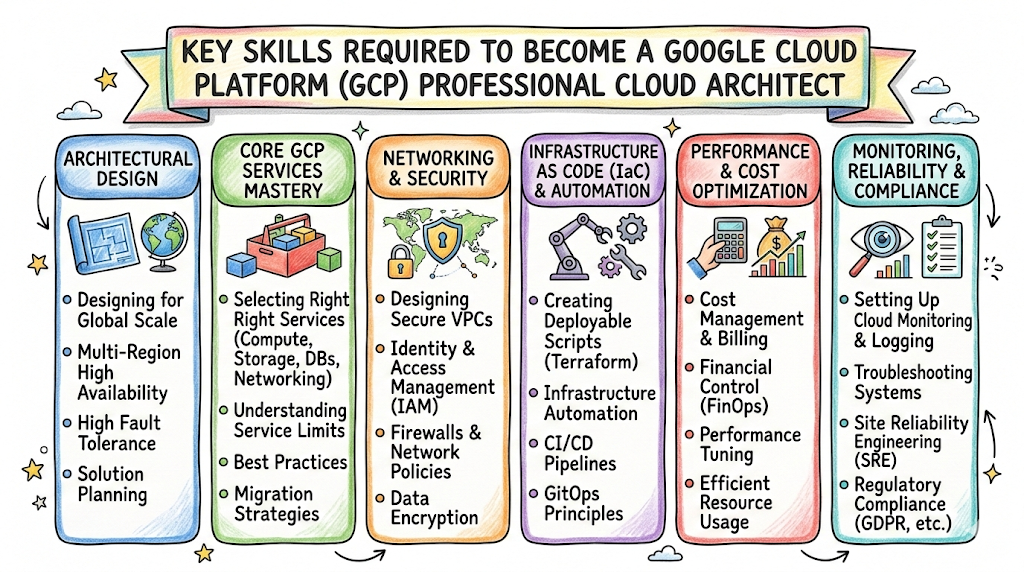
The GCP Professional Cloud Architect certification validates your ability to design, build, and manage highly available, scalable, and secure solutions on Google Cloud Platform. It tests your technical knowledge alongside your ability to align infrastructure designs with complex business requirements.
Who should take it
This certification is ideal for senior software engineers, infrastructure professionals, technical leads, and engineering managers. If your daily work involves designing system architectures, leading cloud migrations, or making high-level technical decisions for your organization, this certification is built for you.
Skills you’ll gain
- Designing and planning cloud solution architectures.
- Managing and provisioning cloud infrastructure.
- Designing for security, identity, and compliance.
- Analyzing and optimizing technical and business processes.
- Managing implementation and ensuring solution reliability.
Real-world projects you should be able to do after it
- Migrating a legacy monolithic application to a microservices architecture using Google Kubernetes Engine (GKE).
- Designing a multi-region disaster recovery plan with near-zero downtime.
- Implementing a Zero-Trust security model across hybrid cloud environments.
- Architecting scalable data pipelines using BigQuery and Pub/Sub.
Preparation plan
- 7–14 days: (For daily GCP users). Focus purely on taking practice exams and deeply analyzing the official GCP case studies provided by Google.
- 30 days: (For engineers with some cloud experience). Dedicate the first two weeks to hands-on labs and reviewing GCP documentation. Spend the last two weeks on case studies and mock tests.
- 60 days: (For cloud beginners). Take a comprehensive structural training course. Spend weeks 1-4 mastering core GCP services. Spend weeks 5-8 on advanced architecture concepts, case studies, and extensive exam simulation.
Common mistakes
- Memorizing service limits instead of understanding how services integrate together.
- Ignoring the official business case studies (they make up a massive portion of the exam).
- Overlooking Cloud Identity, Access Management (IAM), and billing concepts.
- Skipping hands-on lab practice—theory alone will not pass this exam.
Best next certification after this
Once you achieve this certification, the best next step is the GCP Professional Cloud Security Engineer or the GCP Professional Cloud DevOps Engineer, depending on whether you want to specialize in infrastructure protection or deployment automation.
Next Certifications to Take
After passing the GCP Professional Cloud Architect exam, you should strategically plan your next move. Here are three distinct options based on your career goals:
1. Same Track (Deepening Cloud Expertise)
GCP Professional Cloud Network Engineer: If you want to become an absolute master of the Google Cloud ecosystem, specializing in networking is the logical next step. This proves you can design complex VPCs, hybrid connectivity, and global load balancing.
2. Cross-Track (Expanding Versatility)
Certified Kubernetes Administrator (CKA): Cloud architecture heavily relies on containerization. Moving cross-track to the vendor-neutral CKA will solidify your practical, command-line skills in managing Kubernetes clusters, making you a highly versatile platform architect.
3. Leadership (Enterprise & Management)
TOGAF or ITIL: If you are moving into an Engineering Manager or Enterprise Architect role, pairing your deep technical GCP knowledge with a high-level framework like TOGAF (The Open Group Architecture Framework) demonstrates that you understand IT governance, business alignment, and organizational processes.
Choose Your Path
Your GCP Professional Cloud Architect knowledge is a foundation. Here is how you can apply it across six distinct modern tech domains:
DevOps
A DevOps path focuses on bridging development and operations. With your architect knowledge, you will design automated CI/CD pipelines using Cloud Build, implement Infrastructure as Code using Terraform, and ensure seamless, automated application delivery.
DevSecOps
Security cannot be an afterthought. In the DevSecOps path, you will use your architectural skills to bake security directly into the pipeline. You will design architectures using Google Cloud Armor, binary authorization, and automated vulnerability scanning before code ever reaches production.
SRE (Site Reliability Engineering)
An SRE path utilizes your architectural knowledge to keep systems running smoothly. You will design systems around Service Level Objectives (SLOs) and Error Budgets, utilizing Google Cloud Operations Suite (formerly Stackdriver) to ensure high availability and incident response.
AIOps/MLOps
AI is transforming infrastructure. In this path, you will architect platforms that support machine learning models. You will design scalable architectures using Vertex AI, ensuring data scientists have the compute power and data pipelines they need to train and deploy models efficiently.
DataOps
Data is the lifeblood of modern enterprises. Choosing the DataOps path means you will architect robust, real-time data ingestion and processing pipelines. You will utilize services like Dataflow, Dataproc, and BigQuery to ensure data is clean, accessible, and secure.
FinOps
Cloud costs can spiral out of control without proper governance. A FinOps path applies your architectural knowledge to cost optimization. You will design architectures that leverage committed use discounts, preemptible VMs, and automated autoscaling to maximize business value for every dollar spent.
Role → Recommended Certifications
If you are targeting a specific job title, here is a mapping of the certifications that will get you there:
| Role | Recommended Certifications |
|---|---|
| DevOps Engineer | GCP Professional Cloud DevOps Engineer, Certified Kubernetes Administrator (CKA) |
| SRE | GCP Professional Cloud Architect, GCP Professional Cloud DevOps Engineer |
| Platform Engineer | CKA, Certified Kubernetes Security Specialist (CKS), GCP Professional Cloud Architect |
| Cloud Engineer | GCP Associate Cloud Engineer, GCP Professional Cloud Architect |
| Security Engineer | GCP Professional Cloud Security Engineer, CISSP |
| Data Engineer | GCP Professional Data Engineer, GCP Professional Cloud Architect |
| FinOps Practitioner | FinOps Certified Practitioner (FOCP), GCP Professional Cloud Architect |
| Engineering Manager | GCP Professional Cloud Architect, PMP or Certified ScrumMaster (CSM) |
Top Institutions for GCP Professional Cloud Architect Training
DevOpsSchool
DevOpsSchool is a premier, globally recognized training provider that offers hands-on, comprehensive bootcamps. They focus heavily on real-world case studies and practical lab environments, ensuring you don’t just pass the exam, but actually know how to do the job.
Cotocus
Cotocus bridges the gap between IT consulting and training, offering exceptional insights into how enterprises actually use GCP. Their curriculum is strictly aligned with industry demands, making their training highly relevant for working professionals aiming for senior architect roles.
Scmgalaxy
Known for its massive, community-driven approach, Scmgalaxy provides interactive learning experiences and extensive peer support. They offer great foundational resources, technical forums, and structured courses that help engineers transition smoothly into cloud architecture.
BestDevOps
BestDevOps specializes in tailored, high-impact training programs designed for busy IT professionals. Their courses cut through the fluff, focusing directly on the core architectural concepts, security frameworks, and network designs required to pass the GCP exam.
devsecopsschool.com
While their primary focus is security, this institution provides incredible value for architects who want to build secure cloud environments. Their training emphasizes IAM, data protection, and compliance within GCP, making you a highly secure architect.
sreschool.com
For architects who want to build highly reliable systems, SRE School offers training that merges GCP architecture with Site Reliability Engineering principles. You will learn how to architect for maximum uptime, effective monitoring, and robust incident management.
aiopsschool.com
This institution caters to engineers looking to merge cloud architecture with artificial intelligence. They provide unique training that helps GCP architects understand how to design infrastructure that supports intensive machine learning workloads and automated operations.
dataopsschool.com
DataOps School offers targeted training for professionals who need to design massive data architectures. They provide excellent modules on how to structure GCP services for big data analytics, data lakes, and real-time data streaming.
finopsschool.com
Cloud architecture is only successful if it is cost-effective. FinOps School teaches you how to pass the GCP Architect exam while deeply understanding cloud financial management, billing strategies, and architectural cost optimization.
Frequently Asked Questions (FAQs)
1. How difficult is the GCP Professional Cloud Architect exam?
It is widely considered one of the most difficult IT certifications available. It does not just test your knowledge of GCP products; it tests your ability to apply business logic to technical designs using complex case studies.
2. How much time does it take to prepare?
For experienced cloud professionals, 30 to 45 days of focused study is usually sufficient. For those newer to cloud architecture, expect to spend 2 to 3 months of consistent, daily preparation.
3. Do I need programming experience to pass?
While you do not need to write code during the exam, you must understand how applications are built, deployed, and how they interact with APIs. Familiarity with JSON, YAML, and basic scripting is highly recommended.
4. What are the prerequisites?
Google does not enforce any strict prerequisites. However, they highly recommend having at least 3+ years of industry experience, including 1+ year designing and managing solutions directly on Google Cloud.
5. Should I take the Associate Cloud Engineer exam first?
Yes, it is highly recommended. The Associate exam builds your foundational knowledge of GCP’s command line and console. The Architect exam assumes you already know how to implement the services, focusing instead on why and when to use them.
6. Is this certification valued in India and globally?
Absolutely. With Google Cloud rapidly expanding its enterprise footprint globally and in the Indian IT sector, companies are desperately seeking certified architects to lead their digital transformation projects.
7. How much does the exam cost?
The registration fee is generally $200 USD, though prices can occasionally vary by region or through enterprise partnerships.
8. What is the format of the exam?
The exam is multiple-choice and multiple-select, lasting 2 hours. A significant portion of the exam revolves around 3-4 fictional business case studies provided by Google.
9. How do the case studies work?
Google provides business cases (like a fictional gaming company or healthcare provider) detailing their current technical environment and business goals. During the exam, you will answer questions about how to architect a GCP solution for them.
10. How long is the certification valid?
The GCP Professional Cloud Architect certification is valid for exactly two years from the date you pass. You must recertify to maintain your status.
11. What kind of salary jump can I expect?
While it varies by region and existing experience, professionals often see a 15% to 30% salary increase when transitioning into certified Cloud Architect roles, as it validates senior-level decision-making skills.
12. Can I take the exam online?
Yes, Google offers online proctored exams. You can take it from the comfort of your home, provided you have a quiet space, a reliable internet connection, and meet the strict webcam proctoring requirements.
FAQs on GCP Professional Cloud Architect
1. What is the GCP Professional Cloud Architect certification?
The GCP Professional Cloud Architect certification validates your ability to design, build, and manage secure, scalable, and reliable solutions on Google Cloud. It focuses on architecture decisions, not just service names. You are tested on how well you align technical designs with business, security, and operational requirements.
2. Who should consider taking this certification?
It is ideal for senior software engineers, cloud engineers, SREs, platform engineers, and technical managers who influence or own architecture decisions. If you review designs, lead migrations, or design solutions on GCP, it’s a strong fit. It also suits engineers transitioning from implementation roles to architecture and leadership roles.
3. How long does it typically take to prepare for the exam?
If you already work with GCP and architecture concepts, 2–4 weeks of focused study can be enough. For those newer to GCP but with general cloud experience, 1–2 months is more realistic. If you are new to both cloud and architecture, plan for 2–3 months of consistent study with hands-on labs.
4. Do I need to pass Associate Cloud Engineer before attempting this exam?
It’s not mandatory, but highly recommended if you’re new to GCP. The Associate level gives you confidence with the console, CLI, deployment, and basic operations. If you already have strong hands-on experience with GCP or another cloud, you can go directly for Professional Cloud Architect but must fill any gaps yourself.
5. What topics are most important to focus on for this certification?
Key areas include networking (VPCs, load balancing, hybrid connectivity), IAM and security, storage options, high availability and disaster recovery design, monitoring/operations, and migration strategies. You should also be comfortable evaluating tradeoffs between managed vs self-managed, performance vs cost, and complexity vs reliability.
6. Is the exam purely theoretical, or do I need hands-on experience?
Hands-on experience is very important, even though the exam itself is scenario-based and multiple choice. Real experience helps you understand how services behave, interact, and fail. Without practice in real or lab environments, it’s hard to answer complex scenario questions confidently.
7. How is the exam structured, and what kind of questions can I expect?
The exam is timed (about 2 hours) and consists of multiple-choice and multiple-select questions. You will see several case studies describing fictional companies with specific business and technical needs. Many questions ask you to choose the best design, migration, security, or optimization approach for those scenarios.
8. How does this certification help my career?
It signals that you can think like an architect, not just implement individual resources. This makes you more competitive for roles like Cloud Architect, Senior/Lead Engineer, Platform Engineer, SRE, and Engineering Manager with strong technical ownership. It can lead to better roles, higher compensation, and more influence on technical strategy.
Testimonials
“I spent years working as a traditional sysadmin. Earning the GCP Professional Cloud Architect certification completely shifted my career trajectory. The training helped me understand business requirements, and within months of passing, I was promoted to a Lead Platform Engineer role managing a massive global infrastructure.”
— Rahul S., Lead Platform Engineer
“The case studies on the exam are no joke. They force you to think like a true architect rather than just an operator. Applying the concepts of DevSecOps and FinOps that I learned during my preparation has saved my current company thousands of dollars in monthly cloud spend.”
— Sarah M., Senior Cloud Architect
“Coming from a software engineering background, I knew how to code but didn’t fully grasp highly available infrastructure. Following a structured 60-day study plan and utilizing hands-on labs bridged that gap. This certification is a must-have for anyone serious about the cloud.”
— Amit K., DevOps Specialist
Conclusion
The journey to becoming a GCP Professional Cloud Architect is rigorous, demanding, and incredibly rewarding. It is not just about memorizing a dashboard; it is about proving you have the maturity to design systems that are secure, scalable, and perfectly aligned with business goals. Whether you are aiming to pivot into a dedicated architecture role, master the intricacies of DevOps, or simply lead your engineering team with greater authority, this certification is a powerful catalyst for your career. Choose your path, leverage the top training institutions, commit to the preparation plan, and take the next major step in your tech journey.