Introduction
In today’s fast-paced software industry, organizations demand rapid delivery of applications, highly stable systems, secure infrastructure, and efficient operational processes. Traditional software development and operations working separately are no longer sufficient to meet these expectations. This is why DevOps has become one of the most critical areas of expertise for professionals in technology today.
DevOps is more than a set of tools. It is a methodology that emphasizes automation, collaboration, continuous delivery, and system reliability. It connects development, operations, quality assurance, and business teams into a unified workflow that ensures software is delivered efficiently, securely, and reliably. Professionals who understand this complete DevOps lifecycle are in high demand across the globe, both in India and internationally.
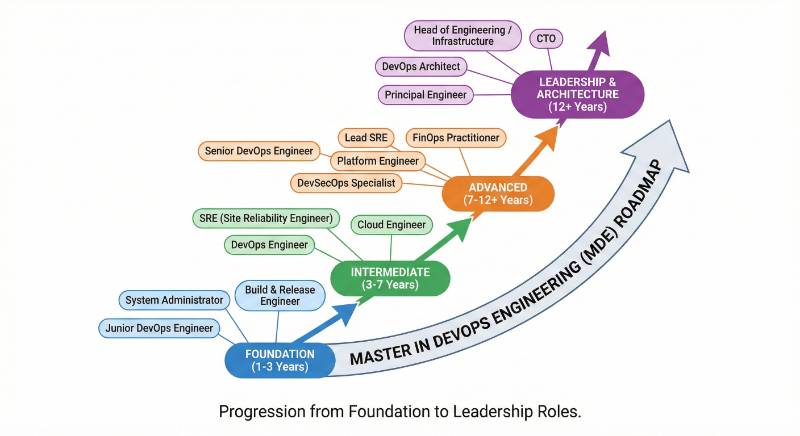
The Master in DevOps Engineering (MDE) certification is designed to help professionals gain comprehensive DevOps knowledge — from foundational concepts to advanced real-world implementation. The program covers automation, CI/CD pipelines, infrastructure management, container orchestration, cloud deployment, monitoring, and system reliability. This guide provides a detailed explanation of the certification, including its benefits, skills you will acquire, preparation plan, career roadmap, learning paths, and frequently asked questions.
About the Certification
The Master in DevOps Engineering (MDE) certification is a globally recognized program offered by DevOpsSchool. It is designed to develop professionals’ skills in modern DevOps practices and prepare them to handle real-world challenges in software delivery and infrastructure management.
This certification is ideal for professionals looking to gain hands-on practical knowledge in automation, cloud deployment, container orchestration, and monitoring, while also developing the ability to think strategically about system architecture and DevOps workflows.
What is Master in DevOps Engineering (MDE)?
The MDE certification is an advanced program that focuses on building a complete understanding of the DevOps lifecycle. Unlike basic certifications that focus on a few tools, MDE emphasizes practical application of DevOps concepts in enterprise environments.
The key areas of focus include:
- Automation and CI/CD pipelines: Learn how to design and implement end-to-end continuous integration and deployment pipelines that automate testing, building, and deployment.
- Infrastructure management and IaC: Understand how to automate the provisioning and management of infrastructure using tools like Terraform and Ansible.
- Container orchestration with Kubernetes: Deploy, scale, and manage containerized applications efficiently.
- Cloud deployment and scalability: Learn how to deploy and maintain applications in cloud environments, ensuring scalability and high availability.
- Monitoring and observability: Implement monitoring, logging, and alerting systems to ensure stable and reliable operations.
- System reliability and architecture: Understand how to design and manage production-grade systems that are stable, secure, and resilient.
MDE is not limited to tools — it develops the mindset, problem-solving skills, and architectural thinking required to lead DevOps initiatives and implement systems effectively.
Who Should Take This Certification?
The MDE certification is designed for professionals who want to go beyond basic DevOps knowledge and gain complete mastery of DevOps systems and workflows.
You should consider this certification if you are:
- DevOps Engineers seeking advanced knowledge of automation, CI/CD, and cloud deployment.
- Software Engineers planning to transition into DevOps roles and wanting to understand system-level operations.
- Cloud and Infrastructure Engineers aiming to strengthen their knowledge of cloud deployment, automation, and reliability.
- Site Reliability Engineers (SREs) focusing on monitoring, reliability, incident response, and system stability.
- Platform Engineers looking to implement container orchestration and infrastructure automation.
- Engineering Managers who want a deeper understanding of DevOps strategy and system architecture to manage high-performing teams.
- Professionals aiming for leadership or architecture roles to develop advanced skills in system design, automation, and operational excellence.
This certification bridges the gap between technical expertise and strategic understanding, making it valuable for engineers and managers alike.
Skills You Will Gain
The MDE program equips learners with practical and technical skills that are essential in modern DevOps environments. After completing the certification, you will be able to:
- Understand the complete DevOps lifecycle: From code development, build, testing, deployment, to monitoring and operations.
- Design and implement CI/CD pipelines: Automate building, testing, and deployment processes for faster and error-free software delivery.
- Manage infrastructure using IaC: Use Infrastructure as Code tools to automate infrastructure provisioning and management, improving consistency and scalability.
- Containerize and orchestrate applications: Use Docker and Kubernetes to deploy, scale, and manage applications in a production environment.
- Deploy and manage cloud applications: Handle cloud-based deployments with scalability, high availability, and cost efficiency.
- Implement monitoring, logging, and observability: Ensure system stability and reliability through robust monitoring and alerting frameworks.
- Apply reliability engineering principles: Design systems that are resilient to failures and maintain uptime in production environments.
- Integrate security into DevOps (DevSecOps): Automate security checks and integrate them into deployment pipelines.
- Optimize cloud costs and operations (FinOps): Understand cloud spending and implement cost-effective operational strategies.
- Develop system-level problem-solving skills: Think like an architect and design systems that meet business goals efficiently.
Real-World Projects You Should Be Able To Do After MDE
MDE focuses on practical application. After completing the certification, you should be able to:
- Build an end-to-end CI/CD pipeline that automatically integrates, tests, and deploys code.
- Automate infrastructure provisioning using Terraform, Ansible, or similar tools.
- Deploy containerized applications using Docker and manage them using Kubernetes.
- Design scalable and reliable architecture for production environments.
- Implement monitoring and alerting frameworks to detect and resolve system failures quickly.
- Execute blue-green and canary deployments to ensure smooth release cycles.
- Integrate security scanning and compliance checks into pipelines.
- Manage incidents and reliability issues to maintain high system availability.
These projects demonstrate practical competence in real enterprise environments.
Preparation Plan
7–14 Days
Focus on fundamentals: DevOps lifecycle, CI/CD basics, container concepts, and cloud platforms. Study certification topics and ensure you understand the core concepts.
30 Days
Move to hands-on practice. Build small projects, create simple CI/CD pipelines, and deploy applications using Docker and Kubernetes. Revise weak areas and ensure practical understanding.
60 Days
Work on real-world scenarios with integration of monitoring, logging, security, and reliability. Design production-ready systems and practice troubleshooting. This phase develops real-world expertise.
Common Mistakes
Learners often make mistakes that limit their growth:
- Focusing only on tools without understanding architecture.
- Memorizing commands rather than understanding system behavior.
- Skipping monitoring and reliability topics.
- Avoiding practical deployment exercises.
- Ignoring automation mindset and system-level problem-solving.
Avoiding these mistakes ensures stronger learning and better readiness for real-world DevOps projects.
Best Next Certification After MDE
After completing MDE, you can pursue:
- Advanced DevOps Architect — for architecture-focused roles.
- DevSecOps Certification — for security-focused expertise.
- Site Reliability Engineering (SRE) — for reliability and system stability.
- DevOps Manager / Leadership Certification — for strategic roles managing teams and systems.
Certification Table
| Track | Level | Who it’s for | Prerequisites | Skills Covered | Recommended Order | Link |
|---|---|---|---|---|---|---|
| Master in DevOps Engineering | Advanced | Engineers & Managers | Basic DevOps & Cloud | CI/CD, Automation, Kubernetes, Cloud, Monitoring | After DevOps Fundamentals | Official Link |
Choose Your Path – Learning Tracks
- DevOps Path: Focuses on automation, CI/CD pipelines, infrastructure management, and deployment.
- DevSecOps Path: Focuses on integrating security into the DevOps pipeline and automating compliance checks.
- SRE Path: Focuses on reliability, system stability, monitoring, and incident response.
- AIOps / MLOps Path: Focuses on intelligent automation, machine learning in operations, and predictive monitoring.
- DataOps Path: Focuses on data pipeline automation, data platform reliability, and data workflow optimization.
- FinOps Path: Focuses on cloud cost optimization, governance, and financial efficiency in operations.
Role → Recommended Certifications
| Role | Recommended Focus |
|---|---|
| DevOps Engineer | CI/CD, Automation, Kubernetes |
| Site Reliability Engineer | Monitoring, Reliability |
| Platform Engineer | Infrastructure Automation |
| Cloud Engineer | Cloud Deployment & Scalability |
| Security Engineer | DevSecOps |
| Data Engineer | DataOps & Pipelines |
| FinOps Practitioner | Cloud Cost Optimization |
| Engineering Manager | DevOps Strategy & Leadership |
Next Certifications to Take
- Same Track: Advanced DevOps Architect
- Cross Track: DevSecOps or SRE
- Leadership Track: DevOps Manager
Training & Certification Support Institutions
Top institutions supporting MDE training and certification include:
- DevOpsSchool – Provides structured programs and hands-on labs.
- Cotocus – Offers practical project-focused learning.
- ScmGalaxy – Focused on CI/CD, automation, and cloud.
- BestDevOps – Career-oriented DevOps learning programs.
- DevSecOpsSchool – Security automation and DevSecOps training.
- SRESchool – Site Reliability Engineering and monitoring programs.
- AIOpsSchool – Intelligent automation and predictive operations.
- DataOpsSchool – Data pipeline automation and platform reliability.
- FinOpsSchool – Cloud cost management and financial governance.
These institutions focus on hands-on learning, real-world projects, and certification support.
FAQs – Master in DevOps Engineering (MDE)
- Is MDE difficult?
It is advanced but manageable with proper understanding and hands-on practice. - How long does preparation take?
Typically 30–60 days depending on prior experience. - Are prerequisites required?
Yes, basic DevOps knowledge and cloud fundamentals are recommended. - Is it suitable for beginners?
No, this certification is ideal for professionals with prior DevOps experience. - Does it focus on tools or concepts?
It combines both practical tools and architectural concepts. - Is it valuable globally?
Yes, DevOps expertise is in high demand worldwide. - Will it help career growth?
Yes, it prepares professionals for senior, architecture, and leadership roles. - Does it cover cloud and Kubernetes?
Yes, these are core parts of the program. - Is hands-on practice necessary?
Yes, practical implementation is crucial for mastering DevOps. - Can managers take this certification?
Yes, it provides insights into strategy, system design, and operational management. - Does it support leadership growth?
Yes, it develops system thinking and architectural skills for leadership. - What kind of projects can I handle after MDE?
CI/CD pipelines, cloud deployments, container orchestration, monitoring, and reliability projects.
Conclusion
The Master in DevOps Engineering (MDE) is a comprehensive certification for professionals aiming to master modern DevOps. It provides skills in automation, CI/CD, cloud deployment, monitoring, reliability, and architecture. It prepares professionals to manage and design production-grade systems and supports career growth into senior and leadership roles. With dedication and hands-on practice, MDE equips professionals to succeed in global DevOps roles.