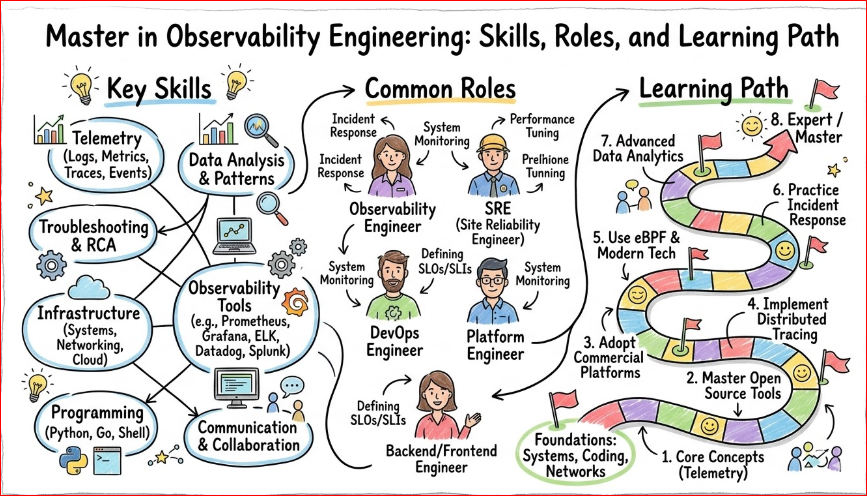
Observability is very important for modern software systems. When an application is slow or down, teams must quickly find the problem and fix it. Observability helps you see what is happening inside your systems using data like logs, metrics, and traces. The Master in Observability Engineering (MOE) certification by DevOpsSchool is a practical program that teaches you how to design and run observability for real-world systems. This guide explains what MOE is, who should learn it, what skills you will gain, and how it can help your career in DevOps, SRE, and other roles.
What is Observability Engineering?
Observability Engineering is the discipline of designing systems so that their internal state can be understood from the outside using telemetry like logs, metrics, traces, and events. It goes beyond basic monitoring by enabling faster root cause analysis, performance optimization, and proactive incident prevention.
In modern microservices and cloud-native architectures, observability is essential for uptime, customer experience, and cost control. Teams use observability to understand “why” something is happening, not just “what” is happening.
Overview of Master in Observability Engineering (MOE)
Master in Observability Engineering (MOE) is a structured certification program offered by DevOpsSchool. It focuses on building complete end-to-end skills in observability for real production environments.
You learn concepts, tools, patterns, and implementation techniques through guided training, hands-on labs, and practical projects. The program is suitable for engineers, SREs, DevOps professionals, architects, and managers who want to specialize in observability.
Why MOE Matters for Your Career
- Companies are adopting microservices, Kubernetes, and multi-cloud, which increases complexity and the need for observability engineers.
- Observability is now a core skill for SRE, Platform, DevOps, and Cloud roles.
- Engineers who understand observability can reduce MTTR, improve SLOs, and drive reliability, which directly impacts business outcomes.
- MOE helps you build a structured portfolio of skills, tools, and projects you can showcase in interviews and internal promotions.
MOE Certification – Summary Table
Note: MOE is a single flagship certification program that can be aligned to different tracks depending on your role and goals.
| Track | Level | Who it’s for | Prerequisites | Skills covered | Recommended order |
|---|---|---|---|---|---|
| Core Observability | Intermediate–Advanced | DevOps, SRE, Platform, Cloud, Backend Engineers | Basic Linux, one programming language, CI/CD basics | Logs, metrics, traces, alerting, dashboards, incident response, SLO/SLI design | First MOE certification |
| DevOps / SRE Focus | Advanced | DevOps Engineers, SREs, Production Support | Core Observability skills, Kubernetes basics | Production monitoring, on-call readiness, runbooks, automation, chaos and reliability practices | After core observability topics |
| Cloud & Platform | Advanced | Cloud Engineers, Platform Engineers, Architects | Cloud basics (AWS/Azure/GCP), IaC basics | Cloud-native observability, managed services, multi-cloud visibility, cost and performance views | After core + some cloud experience |
| AIOps / MLOps | Advanced | AIOps, MLOps, Data Engineers, Reliability Engineers | Observability fundamentals, scripting | AI-driven insights, anomaly detection, telemetry pipelines, ML-driven incident triage | After strong observability + scripting |
| Security & DevSecOps | Intermediate–Advanced | Security Engineers, DevSecOps, Compliance, Governance teams | Basic security, SIEM exposure | Security telemetry, threat detection, log correlation, security monitoring dashboards | After core observability |
| FinOps & DataOps | Intermediate–Advanced | FinOps Practitioners, DataOps, Analytics Engineers | Cloud billing basics, observability basics | Cost observability, usage patterns, data observability, SLAs, business KPIs dashboards | After core + some cloud and data exposure |
Master in Observability Engineering (MOE) – Deep Dive
What it is
Master in Observability Engineering (MOE) is a comprehensive training and certification program focused on building strong observability skills across logs, metrics, traces, events, and telemetry pipelines. It combines theory, hands-on labs, and real-world project work. The curriculum is designed for modern cloud-native, microservices, and distributed systems.
Who should take it
- DevOps Engineers and SREs working with production systems
- Platform and Cloud Engineers managing Kubernetes and cloud platforms
- Backend and Full-Stack Developers responsible for services in production
- Security Engineers and DevSecOps specialists who need better visibility
- Data, AIOps, and MLOps engineers who rely on telemetry for models and pipelines
Skills you’ll gain
- Understanding of observability fundamentals: logs, metrics, traces, events
- Instrumentation of applications and services with OpenTelemetry and similar standards
- Creating effective dashboards and visualizations using tools like Prometheus, Grafana, ELK, Jaeger, and others (as per the program content)
- Designing alerting strategies, SLOs, SLIs, and error budgets
- Performing root cause analysis and incident investigation with observability data
- Building telemetry pipelines and integrating multiple data sources
- Applying observability to Kubernetes, microservices, and cloud environments
- Using observability to improve performance, reliability, and cost efficiency
Real-world projects you should be able to do after it
- Instrument a multi-service application with logs, metrics, and traces end-to-end
- Build dashboards for application health, latency, throughput, and error rates
- Design and implement alerting rules for critical paths and SLO breaches
- Set up observability for a Kubernetes-based application (pods, nodes, services)
- Investigate incidents using traces and correlated logs to find root cause
- Build a small telemetry pipeline integrating collection, storage, and visualization
- Implement observability for CI/CD pipelines and deployment health checks
Preparation plan (7–14 / 30 / 60 days)
7–14 days (Fast-track / intensive)
- Learn the fundamentals: logs, metrics, traces, and events
- Install and experiment with at least one stack (for example, Prometheus + Grafana or ELK) locally
- Study core concepts of OpenTelemetry: instrumentation, collectors, exporters
- Complete small labs or sample scenarios on a demo application
30 days (Balanced plan)
- Cover all core modules of the MOE curriculum with hands-on exercises
- Build a 2–3 service demo application or use an existing sample system
- Instrument it fully with telemetry and set up dashboards and alerts
- Practice at least 3–4 incident simulations and root cause analysis exercises
- Document your learnings and create a small portfolio of screenshots and notes
60 days (Deep practice + portfolio)
- Do everything in the 30-day plan, with more depth and repetition
- Integrate observability with CI/CD pipelines, canary releases, and rollbacks
- Explore advanced topics like distributed tracing, sampling, and performance tuning
- Add security and cost observability views if your role needs them
- Prepare for interviews: practice explaining your projects and decisions
Common mistakes
- Treating observability as only “monitoring and dashboards” and ignoring traces and events
- Collecting too much telemetry without structure, leading to noise and high cost
- No clear SLOs/SLIs or alerting strategy tied to business impact
- Ignoring logs quality and structure, making searches and correlation hard
- Not integrating observability into development and deployment workflows
- Relying only on tools and not understanding core principles and patterns
Best next certification after MOE
- Same track: Advanced SRE or reliability-focused certifications, or a specialized observability tool certification (for example Elastic or similar).
- Cross-track: DevSecOps, AIOps/MLOps or Cloud Architect certifications where observability is a core capability.
- Leadership: Engineering Manager, SRE Manager, or Platform Lead programs focused on reliability strategy and operations.
Choose Your Path – 6 Learning Paths
Observability is useful across many domains. Here are six practical learning paths you can follow around MOE.
1. DevOps Path
- Start with Linux, Git, CI/CD, containers, and basic cloud
- Take Master in Observability Engineering (MOE)
- Learn to integrate observability into deployment pipelines and release strategies
- Move towards DevOps Engineer or Senior DevOps / Infrastructure roles
2. DevSecOps Path
- Start with security basics, identity, logging standards, and compliance
- Take MOE to understand security telemetry and visibility
- Build skills around SIEM, threat detection, and incident response
- Grow into DevSecOps Engineer or Security Observability Engineer roles
3. SRE Path
- Build strong foundations in Linux, networking, and cloud
- Take MOE to master telemetry, SLOs, SLIs, and error budgets
- Add skills in incident management, on-call, and reliability practices
- Progress into SRE, Senior SRE, or Reliability Architect roles
4. AIOps / MLOps Path
- Start with data engineering or ML fundamentals
- Take MOE to understand telemetry pipelines and observability data
- Learn AIOps patterns: anomaly detection, pattern analysis, automated triage
- Move into AIOps Engineer or MLOps Engineer roles
5. DataOps Path
- Begin with SQL, ETL, and data pipelines
- Use MOE to implement observability for data jobs, SLAs, and quality
- Instrument pipelines to detect delays, failures, and data errors
- Grow into DataOps Engineer or Data Reliability roles
6. FinOps Path
- Start with cloud cost fundamentals and billing models
- Apply MOE to build cost observability dashboards and alerts
- Combine usage, performance, and cost metrics to optimize spend
- Advance into FinOps Practitioner or Cloud Cost Architect roles
Role → Recommended Certifications
| Role | Primary focus with MOE | Recommended certifications (including MOE) |
|---|---|---|
| DevOps Engineer | CI/CD, deployments, infra, pipelines | MOE, DevOps/Cloud foundational cert, then SRE or advanced observability |
| SRE | Reliability, SLOs, incident response | MOE, SRE-focused certs, production operations and reliability leadership |
| Platform Engineer | Kubernetes, platforms, developer experience | MOE, Kubernetes/Cloud-native certs, platform engineering programs |
| Cloud Engineer | Cloud services, infra as code, scalability | MOE, cloud provider certs (AWS/Azure/GCP), cloud architecture programs |
| Security Engineer | Security telemetry, threat detection, compliance | MOE, security/DevSecOps certs, SIEM and security monitoring programs |
| Data Engineer | Pipelines, data quality, batch and streaming systems | MOE, data engineering certs, DataOps or analytics engineering programs |
| FinOps Practitioner | Cloud cost, usage analytics, optimization | MOE, FinOps-specific certs, cloud billing and finance-related programs |
| Engineering Manager | Team reliability, processes, strategy, stakeholder value | MOE, leadership/management programs, SRE/DevOps leadership tracks |
List of Top Institutions for MOE Training and Certification Support
Here are some institutions that provide training and certification assistance for Master in Observability Engineering (MOE) and related areas.
DevOpsSchool
DevOpsSchool is the official provider of the Master in Observability Engineering (MOE) certification program. It offers live training, hands-on labs, projects, and interview preparation support. The program is designed for working professionals and is available in multiple learning modes.
Cotocus
Cotocus works closely in DevOps, SRE, and cloud-native training and consulting. It supports corporate and individual learners with structured programs, real-world projects, and coaching for observability and reliability skills.
ScmGalaxy
ScmGalaxy offers DevOps and automation-focused training, including observability-related topics. It helps participants gain practical experience with tools, workflows, and project scenarios used in modern engineering teams.
BestDevOps
BestDevOps provides content, resources, and learning support around DevOps, SRE, observability, and cloud technologies. It acts as a hub for tutorials, training information, and career-focused guidance for practitioners.
devsecopsschool.com
devsecopsschool.com specializes in DevSecOps and security-focused training. It helps engineers learn how to combine observability, security telemetry, and compliance in modern infrastructures.
sreschool.com
sreschool.com focuses on Site Reliability Engineering skills, including observability, incident management, SLOs, and reliability practices. It supports individuals who want to move into SRE or improve existing reliability capabilities.
aiopsschool.com
aiopsschool.com is centered on AIOps and intelligent operations. It helps learners understand how telemetry and observability data can feed AI and ML models for automated detection, triage, and optimization.
dataopsschool.com
dataopsschool.com focuses on DataOps methodologies and tools. It supports engineers in building observable, reliable, and high-quality data pipelines with strong monitoring and alerting.
finopsschool.com
finopsschool.com is dedicated to FinOps education. It combines cloud cost management principles with observability practices to give teams better visibility into usage, spend, and optimization opportunities.
FAQs on Master in Observability Engineering (MOE)
1. What is the Master in Observability Engineering (MOE) certification?
Master in Observability Engineering (MOE) is a specialized certification focused on observability concepts, tools, and practices for modern distributed systems. It helps engineers and managers build strong, practical skills in telemetry and reliability.
2. Is MOE only for DevOps or SRE roles?
No. MOE is useful for DevOps, SRE, Platform, Cloud, Security, Data, AIOps/MLOps, and FinOps roles. Any role that needs visibility into system behavior and performance can benefit from this certification.
3. Do I need strong coding skills before taking MOE?
Basic scripting or programming knowledge is helpful but not mandatory. You should understand how applications work, how to read logs, and how systems are deployed. Coding skills will help you instrument applications more deeply.
4. How long does it take to prepare for MOE?
On average, a focused learner can prepare in 30–60 days alongside their job. A 7–14 day intensive approach is possible if you already work with observability tools and production systems.
5. What tools are covered in MOE?
The program focuses on observability fundamentals and commonly used tools such as Prometheus, Grafana, ELK stack, OpenTelemetry, and tracing tools, depending on the curriculum. The goal is to make you tool-agnostic while still giving enough hands-on experience.
6. How does MOE help my career?
MOE helps you speak the language of reliability, performance, and incident management. It gives you projects and skills you can showcase to move into DevOps, SRE, Platform, or observability-focused roles.
7. Is MOE suitable for managers?
Yes. Managers who lead DevOps, SRE, Platform, or Cloud teams can use MOE to understand observability strategy, metrics that matter, and how to guide teams towards reliability and accountability.
8. Do I need prior certifications before MOE?
It is not mandatory, but foundational knowledge in Linux, cloud, and DevOps concepts is very helpful. Prior cloud or DevOps certifications can make MOE easier to absorb.
Additional FAQs
9. Is MOE useful if I already know monitoring?
Yes. Monitoring is a good start, but observability goes deeper.
MOE helps you move from basic CPU/ram graphs to full understanding of your system with logs, metrics, and traces.
10. Can freshers take the MOE certification?
Freshers can take it, but it is better if you have some hands-on experience with Linux, cloud, or basic DevOps tools.
If you are a fresher, do a basic DevOps or cloud course first, then do MOE.
11. Does MOE focus only on one tool?
No. MOE covers many common tools and ideas.
You learn concepts that you can use with Prometheus, Grafana, ELK, Jaeger, OpenTelemetry, and cloud-native tools.
12. Is MOE more for backend or frontend engineers?
MOE is more focused on backend, platform, and cloud services, but frontend engineers can also benefit.
You can use observability to understand API errors, slow pages, and user journeys.
13. Do I need a specific cloud provider (AWS, Azure, GCP) for MOE?
No. The ideas in MOE work on any cloud or even on-premise.
You can apply the same observability patterns to AWS, Azure, GCP, or hybrid setups.
14. Will MOE help me in on-call duties?
Yes. Observability is a key part of on-call work.
With MOE skills, you can find issues faster, reduce noise, and feel more confident during incidents.
15. Can I do MOE while working a full-time job?
Yes. The course and practice plan are designed for working engineers.
You can follow a 30‑day or 60‑day plan with 1–2 hours per day.
16. Is MOE more theory or hands-on?
MOE includes both, but there is strong focus on hands-on labs.
You are expected to use tools, build dashboards, and debug sample issues.
17. Do I get a certificate after completing MOE?
Yes. After you complete the required training and assessments, you receive a certificate from the provider.
You can share it on your CV, LinkedIn, and with your company.
18. Can MOE help me switch from support to DevOps/SRE?
Yes. Observability is a good bridge skill between support and DevOps/SRE.
It shows that you can handle production issues in a structured and data-driven way.
19. Does MOE cover Kubernetes observability?
Yes. Kubernetes and container observability are an important part.
You learn how to watch pods, nodes, services, and workloads using metrics, logs, and traces.
20. How do I keep my observability skills updated after MOE?
You can keep learning by:
- Practicing on real projects
- Following new tool releases
- Joining community events and reading blogs on observability and SRE
Conclusion
Observability Engineering is no longer optional for modern engineering teams. It is at the heart of reliable, secure, and cost-effective systems in cloud-native and distributed environments. Master in Observability Engineering (MOE) gives you a structured way to build these skills, apply them through real projects, and demonstrate your capability to employers and teams worldwide. Whether you are a DevOps Engineer, SRE, Platform Engineer, Cloud Engineer, Security Engineer, Data Engineer, FinOps Practitioner, or Engineering Manager, MOE can help you grow into the next level of impact and ownership in your career.