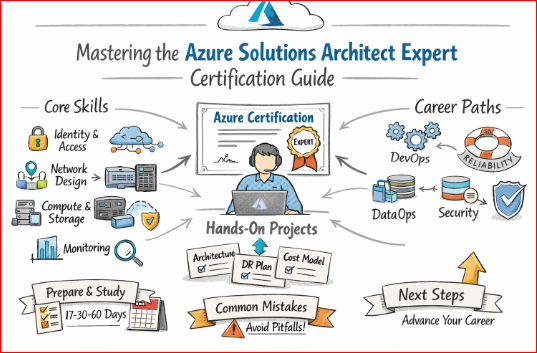
Introduction
The cloud is no longer a “future” technology; it is the backbone of modern business. For engineers and managers navigating the complexities of DevOps, SRE, and platform engineering, the role of a Solutions Architect has become the gold standard. It is the bridge between business problems and technical reality, requiring a balance of deep technical skill and high-level strategic thinking to succeed in today’s competitive landscape. Becoming an Azure Solutions Architect Expert isn’t just about passing an exam. It is about proving you can design robust, scalable, and secure infrastructure that survives the real world. This guide is designed to help you navigate this certification program, understand its rigorous requirements, and see how it fits into your broader career trajectory as a leader in the cloud space.
What is the Azure Solutions Architect Expert Certification?
The Azure Solutions Architect Expert is a high-level credential provided by Microsoft and supported by leading training partners like DevOpsSchool. It validates your ability to design cloud and hybrid solutions that run on Microsoft Azure, covering everything from compute and networking to storage and security. This certification is a testament to your capability in creating complex architectures that are both cost-effective and highly resilient.
This certification covers everything from computing and networking to storage and security. It requires a deep understanding of how different services interact and how to optimize them for cost, performance, and reliability. Achieving this status means you are recognized as a professional who can lead large-scale digital transformations and manage intricate cloud environments with confidence.
The Details
| Track | Level | Who it’s for | Prerequisites | Skills Covered | Recommended Order |
| Cloud Architecture | Expert | Senior Engineers, Architects, IT Mgrs | AZ-104 (Admin Associate) | Design, Infrastructure, Security, Data, Apps | 1. AZ-104, 2. AZ-305 |
Deep Dive: Azure Solutions Architect Expert
What it is
This is a premier certification for those who translate business requirements into secure, scalable, and reliable cloud solutions. It focuses heavily on the “design” phase of the IT lifecycle, ensuring that infrastructure is built correctly from day one to avoid costly reworks later. It essentially marks the transition from being a tactical implementer to a strategic designer of enterprise-grade systems.
Who should take it
This track is ideal for Senior DevOps and Site Reliability Engineers (SREs) who are ready to take the next step into leadership and high-level design. It also serves Cloud Engineers looking to move into architecture and Engineering Managers who need to oversee complex architectural decisions. Even Software Engineers transitioning into System Architecture will find this certification invaluable for understanding the underlying infrastructure of their applications.
Skills you’ll gain
- Advanced Design: You will learn to architect infrastructure for high availability and disaster recovery across multiple global regions.
- Security & Governance: Master the implementation of identity solutions through Microsoft Entra ID and enforce governance with Azure Policy.
- Data Strategy: Gain expertise in designing data storage solutions for both SQL and NoSQL workloads tailored to specific business needs.
- Migration & Optimization: Develop strategies for migrating on-premise workloads to the cloud while maintaining strict cost-efficiency and performance metrics.
Real-world projects you should be able to do after it
- Enterprise Migration: Execute a full-scale legacy data center migration to Azure with zero downtime and minimal risk to business operations.
- Global Scalability: Design a multi-region web application architecture that automatically handles millions of users and scales based on real-time demand.
- Secure Networking: Build a complex Hub-and-Spoke network topology with integrated firewalls, VPNs, and ExpressRoute for secure enterprise connectivity.
- Cost Efficiency: Perform a deep-dive audit of an existing Azure environment to identify waste and implement strategies that reduce monthly spend by 30% or more.
Preparation Plan
- 7–14 Days (The Fast Track): This intensive path is only for those already working daily as Architects. Focus heavily on “The Microsoft Way,” studying specific Azure naming conventions, SKU limits, and the latest governance tools to align your experience with the exam criteria.
- 30 Days (The Standard Path): Dedicate 2 hours daily, splitting your time evenly between hands-on labs (Virtual Machines, Networking, Storage) and design theory. This balanced approach ensures you can both implement the tech and explain the architectural reasoning behind it.
- 60 Days (The Deep Dive): This is the ideal path for engineers moving into architecture for the first time. Spend the first month mastering the AZ-104 (Administration) requirements and the second month focusing purely on AZ-305 architectural design patterns and case studies.
Common Mistakes
- Ignoring the Admin Layer: Many candidates fail because they focus only on design and don’t understand the practical limitations of the administrative layer.
- Memorizing SKU Names: Instead of rote memorization, focus on understanding the limitations and use cases of each tier, such as when to choose Basic versus Premium storage.
- Skipping Networking: Azure networking is often the most complex part of the exam; rushing through VNet peering and ExpressRoute settings is a recipe for failure.
Best next certification after this
- Azure DevOps Engineer Expert (AZ-400): This is the natural progression to bridge the gap between high-level architecture and automated delivery pipelines. It ensures that the robust systems you design can be deployed and updated with the speed and reliability that modern businesses demand.
Choose Your Path: 6 Specialized Learning Tracks
The “Expert” badge is a solid foundation, but the modern market demands specialization to stand out. Depending on your career goals, you should pair your architectural knowledge with these specific technical domains. These tracks help you carve out a niche and become the go-to expert for specific organizational challenges.
- DevOps Path: Focus on building seamless CI/CD pipelines and mastering Infrastructure as Code (IaC) using tools like Terraform or Bicep. This path ensures that your architectural designs are reproducible and can be deployed with full automation.
- DevSecOps Path: This involves integrating security directly into the design phase rather than treating it as an afterthought. You will focus on Microsoft Defender for Cloud and implementing automated compliance checks to ensure every deployment is secure by default.
- SRE Path: Focus on the “run” phase of architecture by mastering reliability, monitoring through Azure Monitor, and log analytics. This path is for those who want to ensure that high-level designs translate into 99.99% uptime and rapid incident response.
- AIOps/MLOps Path: Learn to design specialized architectures that support large-scale AI models and automated data labeling pipelines. This is the cutting edge for architects who want to build systems capable of self-healing and advanced predictive analytics.
- DataOps Path: Focus on the lifecycle of data, utilizing Azure Synapse and Data Factory to ensure data quality and flow across the architecture. This track is vital for organizations that rely on real-time data to make critical business decisions.
- FinOps Path: Master the art of cloud financial management by designing for “Unit Cost” efficiency and deep-diving into Azure Cost Management. This path makes you a favorite of the CFO by ensuring every dollar spent on the cloud delivers maximum business value.
Role → Recommended Certifications Mapping
| Your Current Role | Recommended Certification Path |
| DevOps Engineer | Start with AZ-104 for admin skills, move to AZ-305 for architecture, and finish with AZ-400 for expert-level automation. |
| SRE | Follow the AZ-104 to AZ-305 path, then add AZ-500 (Security) to ensure your reliability models are also highly secure. |
| Platform Engineer | Combine AZ-104 and AZ-305 with AZ-700 (Networking) to master the backbone of the enterprise platform infrastructure. |
| Cloud Engineer | Begin with the fundamentals (AZ-900), progress to AZ-104, and culminate with the AZ-305 Solutions Architect Expert. |
| Security Engineer | Start with AZ-104 and AZ-500 for deep security knowledge, then take AZ-305 to understand how to secure the entire architecture. |
| Data Engineer | Focus first on DP-203 for data-specific skills, then round out your expertise with the AZ-305 architectural badge. |
| FinOps Practitioner | Build a foundation with AZ-900 and AZ-104, then master architectural cost-efficiency through the AZ-305 exam. |
| Engineering Manager | Start with AZ-900 for a broad overview, then move directly to AZ-305 to gain the strategic insight needed to lead tech teams. |
Top Institutions for Azure Training
Choosing the right partner for your certification journey is critical to ensuring you gain practical skills, not just a certificate. These institutions provide specialized training for the Azure Solutions Architect Expert track with a focus on professional growth. They offer a mix of theory, hands-on labs, and expert mentorship to help you clear the exam on your first attempt.
- DevOpsSchool: A premier global training provider known for its deep-dive technical workshops and extensive course material. They focus on real-world scenarios rather than just exam theory, making them a top choice for working professionals seeking actual expertise.
- Cotocus: Known for their hands-on lab environments and mentorship-driven approach, Cotocus helps students bridge the gap between classroom learning and real-world implementation. Their instructors are industry veterans who bring years of field experience to the training.
- Scmgalaxy: This platform is a massive community-driven hub that offers extensive resources, blogs, and tutorials for Azure and various DevOps tools. It is an excellent resource for supplementary learning and staying updated with the latest industry trends.
- BestDevOps: Specializes in career-oriented training that aligns certifications with the current demands of the global IT market. They focus on job-readiness, ensuring that their students are prepared for the technical interviews that follow certification.
- devsecopsschool.com: The go-to place for those looking to integrate security deeply into their Azure architectural designs. Their curriculum is tailored for those who believe security is a shared responsibility from the first line of code.
- sreschool.com: Focuses on reliability and observability within the Azure ecosystem, perfect for aspiring Site Reliability Engineers. They teach the tools and mindset required to keep complex systems running smoothly at scale.
- aiopsschool.com: Offers specialized tracks for integrating AI and machine learning workflows into Azure infrastructure. This institution is ideal for those looking to future-proof their careers in the age of artificial intelligence.
- dataopsschool.com: Provides dedicated training for managing large-scale data pipelines and governance on Azure. Their courses focus on the practicalities of data movement, storage, and processing in modern cloud environments.
- finopsschool.com: A unique platform dedicated to cloud financial management and cost optimization strategies on Azure. They teach the essential skills of cloud budgeting, forecasting, and architectural cost-reduction.
FAQs: Azure Solutions Architect Expert
1. How difficult is the AZ-305 exam?
It is a “Design” exam, meaning it focuses on high-level strategy and architectural trade-offs over simple syntax or command-line memorization. It is considered high-difficulty because you must often choose the best solution among several working options based on specific business constraints like cost, speed, or security.
2. Is there a prerequisite for the Expert level?
Yes, you must have the Azure Administrator Associate (AZ-104) certification to officially earn the Solutions Architect Expert badge. This ensures that every expert architect also has a fundamental understanding of how to manage the resources they are designing.
3. How long does the certification stay valid?
The certification is valid for exactly one year from the date you pass. However, Microsoft offers a very convenient and free renewal process via a non-proctored online assessment that you can take starting six months before your badge expires.
4. Can I take this if I am a Software Engineer?
Absolutely, and it is highly recommended as modern “Senior” developer roles require deep architectural knowledge. Understanding how your code interacts with Azure services like App Service, Functions, and Cosmos DB will make you a much more effective and valuable developer.
5. What is the average salary hike after getting this?
While it varies by region, architects in India and globally often see a 20% to 40% increase in compensation package offers. This is driven by the severe shortage of professionals who can lead cloud-native design and manage enterprise infrastructure costs.
6. Do I need to know how to code?
You don’t need to be a full-stack developer, but you must be comfortable with scripting using PowerShell or the Azure CLI. You also need a solid understanding of JSON and YAML, as these are the primary languages used for Infrastructure as Code templates in Azure.
7. How much time should I dedicate daily?
For a working professional, dedicating 1 to 2 hours a day is typically sufficient to clear the exam within a two-month timeframe. This allows you to digest the theoretical concepts while spending enough time in the labs to understand the “clicks” behind the designs.
8. Why choose Azure over AWS or GCP?
Azure is the undisputed leader in hybrid cloud and enterprise integration, making it the preferred choice for large-scale corporations. If your company already uses Microsoft 365, Active Directory, or SQL Server, Azure offers a seamless architectural path that other providers struggle to match.
9. Is the exam proctored?
Yes, the exam is proctored to maintain its prestige and value in the industry. You have the choice to take it at a physical testing center or from your home/office via a secure online proctoring service that monitors your environment.
10. What happens if I fail the first attempt?
Microsoft has a clear retake policy: if you fail your first attempt, you must wait 24 hours before trying again. If you fail a second time, there is a 14-day waiting period, which gives you ample time to identify your weak spots and study those specific areas.
11. Does this certification help in getting a remote job?
Architect roles are some of the most remote-friendly positions in the tech world today. Since the work involves high-level design, documentation, and strategic planning, it can be done effectively from anywhere with a good internet connection and access to the Azure portal.
12. Is the training from DevOpsSchool enough?
Yes, the curriculum at DevOpsSchool is specifically aligned with the official Microsoft exam objectives and is supplemented by real-world labs. Their approach ensures that you aren’t just memorizing answers but are building the mental framework required to be a successful architect.
FAQs
- 1. What is the core difference between AZ-104 and AZ-305?
AZ-104 (Administrator) is about the “how”—it focuses on implementing, managing, and monitoring identity, governance, storage, and virtual networks. AZ-305 (Architect) is about the “why”—it tests your ability to design solutions based on business requirements, focusing on high availability, cost, and security. - 2. Can I take the AZ-305 exam before passing the AZ-104?
Yes, you can take the exams in any order. However, Microsoft will not award you the “Solutions Architect Expert” badge until you have successfully passed both. It is highly recommended to do AZ-104 first, as it provides the foundational knowledge needed to understand the practical limits of your designs. - 3. Is there a lot of hands-on coding required for this certification?
While you aren’t expected to write complex application code, you must be proficient in reading and writing ARM templates, Bicep, or JSON. You should also be comfortable with Azure CLI and PowerShell for automation tasks, as modern architecture relies heavily on Infrastructure as Code (IaC). - 4. How does this certification help in a transition to a Management role?
It bridges the gap between technical execution and business strategy. As an expert architect, you learn to justify technical decisions using business metrics like ROI, Total Cost of Ownership (TCO), and Service Level Agreements (SLAs), which are essential skills for any Engineering Manager or CTO. - 5. What is the passing score for the AZ-305 exam, and what is the format?
The passing score is 700 out of 1000. The format typically includes multiple-choice questions, drag-and-drop activities, and case studies where you are given a complex business scenario and asked to design a solution that meets specific technical and financial constraints. - 6. How much weight does this certification carry in the Indian job market?
In India’s rapidly maturing cloud market, this certification is often a mandatory requirement for Senior Architect and Lead Consultant roles. Multinational corporations and top-tier service firms prioritize this badge because it serves as a standardized proof of expertise that is recognized globally. - 7. Are there any labs in the actual AZ-305 exam?
While Microsoft occasionally changes the exam format, the AZ-305 typically focuses more on case studies and design scenarios rather than live performance-based labs. However, having “hands-on” experience is vital because the questions often describe subtle configuration issues that only someone who has used the portal would recognize. - 8. Which training provider is best for a working professional with a busy schedule?
For those who need to balance work and study, DevOpsSchool is highly recommended. Their curriculum is designed specifically for working engineers, offering flexible timing and a focus on real-world projects that allow you to learn by doing, rather than just reading documentation.
Testimonials
“Transitioning from a SysAdmin to a Solutions Architect was a daunting career move, but the structured path provided by DevOpsSchool made all the difference. They helped me understand not just the ‘how’ of clicking through the portal, but the deep ‘why’ behind complex Azure design patterns.” — Senior Cloud Engineer, Bengaluru.
“As an Engineering Manager, I needed to understand the technical trade-offs of different cloud services to guide my team’s decisions. This certification gave me the professional language and the strategic insight needed to speak with our stakeholders and engineers effectively.” — Engineering Lead, London.
Next Certifications to Take
- Same Track: Azure DevOps Engineer Expert (AZ-400) – This is the most logical next step for those who want to master the full lifecycle of automated cloud delivery.
- Cross-Track: Azure Security Engineer Associate (AZ-500) – This is essential in today’s “Security First” market, ensuring your architectures are hardened against modern threats.
- Leadership: Certified Cloud Finance Manager (via FinOps Foundation) – For those looking to move into high-level strategic management and oversee global cloud budgets.
Conclusion
The Azure Solutions Architect Expert certification is a career-defining milestone that officially marks your transition into the upper tiers of IT leadership. It shifts your professional identity from someone who follows instructions to the person who builds the original blueprint. Whether you are an engineer in India or a manager in a global firm, this credential proves you have the vision and the technical skill to lead complex digital transformations. Start with the administrative basics, master the design layer, and claim your place as an expert in the cloud economy.