Introduction
In the modern landscape of cloud infrastructure, technical expertise alone is no longer sufficient to drive enterprise success. The Certified FinOps Engineer program has emerged as a critical standard for professionals who want to bridge the gap between cloud engineering and financial accountability. As organizations scale their digital footprints, the ability to manage variable cloud spend has become a core competency for senior technical leaders and architects.
By engaging with the training provided by FinOps School, engineers can move beyond simple resource provisioning and start designing for cost-efficiency. This guide is built to help software engineers, SREs, and managers understand the nuances of the certification and how it integrates into a broader platform engineering strategy. We will explore the learning path, the real-world application of these skills, and the impact this credential has on long-term career growth.
What is the Certified FinOps Engineer?
The Certified FinOps Engineer is a technical credential designed to validate an individual’s proficiency in applying financial management principles to cloud-native environments. It is not a theoretical course for accountants but a production-focused program for engineers who handle infrastructure daily. The certification represents a deep understanding of how to translate business requirements into cost-effective technical architectures without sacrificing speed or reliability.
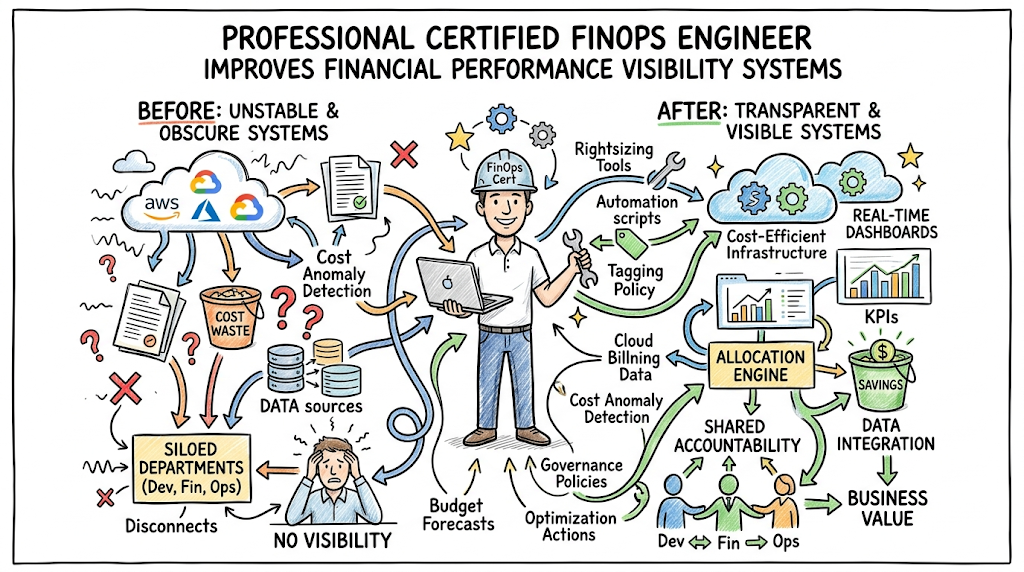
In a modern enterprise, this certification signifies that an engineer knows how to use granular data to optimize cloud usage. It emphasizes practical skills like setting up automated anomaly detection, managing commitment-based discounts, and building unit economic models. By aligning with enterprise practices, it ensures that technical teams are contributing directly to the organization’s bottom line through smarter, data-driven infrastructure decisions.
Who Should Pursue Certified FinOps Engineer?
This program is specifically tailored for individuals working in DevOps, Site Reliability Engineering (SRE), and Platform Engineering. Cloud Architects who are responsible for designing multi-region or multi-cloud environments will find the curriculum essential for managing complex billing structures. It also serves security and data professionals who need to understand how their specific resource consumption, such as data egress or encryption processing, impacts the overall budget.
For professionals in India and other major global markets, this certification is a major differentiator in a competitive job market. Beginners can use it to build a strong foundation in cloud economics, while senior engineers and managers use it to validate their ability to lead high-stakes cost-optimization projects. It is equally relevant for technical project managers who need to communicate effectively with both developers and financial stakeholders.
Why Certified FinOps Engineer is Valuable Today and Beyond
As cloud environments grow in complexity, the “move fast and break things” mentality is being replaced by a focus on sustainable growth. The demand for engineers who can control cloud waste is at an all-time high, and this trend shows no signs of slowing down. Companies are moving away from fixed annual budgets toward a dynamic, variable spending model that requires constant technical oversight and real-time adjustments.
Holding this certification ensures that your skills remain relevant even as cloud provider tools change. While AWS, Azure, and GCP have their own native cost management tools, the FinOps framework provides a universal language that applies across all platforms. This return on career investment is high, as it positions you for leadership roles where you are expected to deliver both technical excellence and measurable business value.
Certified FinOps Engineer Certification Overview
The certification program is delivered through the official course link and is hosted on the FinOps School platform. It utilizes a practical assessment approach that tests an engineer’s ability to solve real-world problems. Rather than just memorizing definitions, candidates are expected to demonstrate how they would implement tagging policies, analyze billing reports, and recommend rightsizing strategies in a live production environment.
The structure of the program is designed to create a sense of ownership over cloud spend within technical teams. It covers the entire lifecycle of financial management—from the initial “Inform” phase, where transparency is established, to the “Operate” phase, where optimization becomes a continuous, automated process. This practical focus ensures that certified professionals can walk into any enterprise and immediately contribute to their cloud financial management goals.
Certified FinOps Engineer Certification Tracks & Levels
The certification path is divided into distinct tracks to accommodate different stages of a professional’s career. The Foundation level provides a broad overview of the culture and terminology, making it ideal for those new to the concept or in supporting roles. The Professional level is where the deep technical work happens, focusing on the engineering and automation aspects of cost management that are crucial for senior practitioners.
As professionals progress, they can move into the Advanced levels, which focus on strategy, governance, and organizational transformation. These levels are designed to align with career growth from an individual contributor role to a leadership or director position. Each level builds on the previous one, ensuring a logical progression that matches the increasing responsibility of an engineer within a modern, cloud-first organization.
Complete Certified FinOps Engineer Certification Table
| Track | Level | Who it’s for | Prerequisites | Skills Covered | Recommended Order |
| Core FinOps | Foundation | Beginners, Finance, Managers | None | Terms, Lifecycle, Culture | 1st |
| Engineering | Professional | SREs, DevOps, Architects | Foundation | Automation, Rightsizing, Tagging | 2nd |
| Architecture | Advanced | Lead Engineers, FinOps Leads | Professional | Unit Economics, Governance | 3rd |
| Data Ops | Specialist | Data Engineers, Analysts | Foundation | Big Data Cost, Egress management | Optional |
| Security Ops | Specialist | Security Engineers | Foundation | Cost of Compliance, Security Logs | Optional |
Detailed Guide for Each Certified FinOps Engineer Certification
Certified FinOps Engineer – Foundation
What it is
The Foundation level is an introductory certification that validates a fundamental understanding of the cloud financial management lifecycle. It ensures that all participants speak the same language when discussing cloud costs and business value.
Who should take it
This is suitable for junior cloud engineers, project managers, and finance professionals who need to collaborate with technical teams on cloud budgeting and allocation.
Skills you’ll gain
- Mastery of the “Inform, Optimize, Operate” lifecycle.
- Ability to identify key cloud cost drivers across major providers.
- Understanding of shared accountability models for cloud spend.
- Proficiency in basic reporting and cost-allocation terminology.
Real-world projects you should be able to do
- Create a basic cloud cost report for a specific engineering team.
- Identify unallocated cloud spend in a monthly billing statement.
Preparation plan
- 7-14 Days: Focus on the official glossary and the core principles of the framework.
- 30 Days: Complete the foundational video modules and take practice quizzes to test your vocabulary.
- 60 Days: Not required for this level if the candidate has basic cloud experience.
Common mistakes
- Thinking FinOps is only for the finance department.
- Underestimating the cultural change required for successful implementation.
Best next certification after this
- Same-track option: Certified FinOps Engineer (Professional).
- Cross-track option: Cloud Practitioner (Specific Provider).
- Leadership option: Technical Project Management.
Certified FinOps Engineer – Professional
What it is
The Professional level is a deep dive into the technical implementation of cost-management strategies. It validates an engineer’s ability to build automated systems that monitor and control cloud spend without manual intervention.
Who should take it
Senior DevOps Engineers, SREs, and Cloud Architects who are responsible for the day-to-day operation and scaling of enterprise-grade cloud environments.
Skills you’ll gain
- Advanced automation of rightsizing and resource cleanup.
- Management of complex Reserved Instances and Savings Plans portfolios.
- Integration of cost-visibility tools into the CI/CD pipeline.
- Developing unit economics to measure the cost of specific business transactions.
Real-world projects you should be able to do
- Build an automated “Garbage Collector” for orphaned cloud volumes and snapshots.
- Design a dashboard that shows the cost-per-request for a microservices architecture.
Preparation plan
- 7-14 Days: Review advanced billing APIs and automation scripting for cloud resources.
- 30 Days: Engage in hands-on labs focusing on commitment-based discount optimization.
- 60 Days: Recommended for building a deep portfolio of cost-saving scripts and architectures.
Common mistakes
- Prioritizing cost savings over system performance and user experience.
- Failing to automate reporting, leading to “stale” data for decision-makers.
Best next certification after this
- Same-track option: Advanced FinOps Architect.
- Cross-track option: Certified Kubernetes Administrator (CKA).
- Leadership option: FinOps Director.
Choose Your Learning Path
DevOps Path
The DevOps path focuses on making cost a standard metric in the delivery lifecycle. Engineers learn to treat cloud spend as a performance indicator, similar to response time or uptime. This involves integrating cost-estimation tools into the deployment process, allowing developers to see the financial impact of their infrastructure changes before they are committed to production.
DevSecOps Path
In this path, the intersection of security and cost is explored in detail. Professionals learn how to optimize the cost of security tools and logging without compromising the organization’s security posture. It focuses on cost-effective data retention policies and ensuring that security monitoring does not create unexpected spikes in the cloud budget due to inefficient data ingestion.
SRE Path
SREs focus on the balance between reliability and efficiency. This path teaches how to use service level objectives to drive cost decisions. For example, if a service is exceeding its availability target, an SRE might use that “headroom” to move to cheaper, less redundant instances to save money while still meeting the business requirements for uptime.
AIOps Path
The AIOps path focuses on using artificial intelligence to manage costs at scale. Engineers learn to deploy machine learning models that can predict future spending patterns and automatically alert teams to anomalies. This path is essential for managing hyper-scale environments where manual oversight of thousands of resources is no longer possible for human teams.
MLOps Path
MLOps focuses specifically on the high-cost world of machine learning training and inference. This path teaches engineers how to optimize GPU utilization and manage the massive data transfer costs associated with ML pipelines. It involves choosing the right instance types for training jobs and using spot instances effectively to reduce the heavy price of AI innovation.
DataOps Path
DataOps professionals deal with the unique cost challenges of big data and analytics. This path focuses on optimizing data storage costs, managing egress fees, and ensuring that data pipelines are architected for efficiency. It covers technical strategies for partitioning data and choosing file formats that minimize the cost of scanning and processing information in the cloud.
FinOps Path
The dedicated FinOps path is for those who want to specialize entirely in cloud financial management. It combines technical optimization with the soft skills needed to build a FinOps culture across an organization. This path leads to roles in the FinOps Center of Excellence, where professionals define the policies and standards that all other engineering teams must follow.
Role → Recommended Certified FinOps Engineer Certifications
| Role | Recommended Certifications |
| DevOps Engineer | FinOps Foundation, FinOps Professional |
| SRE | FinOps Professional, Advanced Architect |
| Platform Engineer | FinOps Professional, FinOps Specialist |
| Cloud Engineer | FinOps Foundation, Cloud Architect |
| Security Engineer | FinOps Foundation, DevSecOps Specialist |
| Data Engineer | FinOps Foundation, DataOps Specialist |
| FinOps Practitioner | Full Core Track (Foundation to Advanced) |
| Engineering Manager | FinOps Foundation, Leadership Track |
Next Certifications to Take After Certified FinOps Engineer
Same Track Progression
Advancing within the FinOps domain usually leads to the Advanced Architect level. This focuses on high-level governance and the implementation of “Unit Economics.” Mastering these skills allows you to report directly to executive leadership on the ROI of cloud initiatives, providing a clear link between technical spend and business growth.
Cross-Track Expansion
Expanding your skills into Kubernetes (CKA/CKAD) is a natural next step, as container orchestration is often the largest cost driver in modern environments. Understanding how to manage resource requests and limits in Kubernetes is vital for any FinOps professional who wants to have a direct impact on cluster efficiency and cost reduction.
Leadership & Management Track
For those transitioning into management, combining FinOps with certifications like ITIL or PMP is highly effective. These credentials provide the organizational framework for managing teams, while your FinOps expertise gives you the data-driven insights needed to manage large-scale technical budgets and justify headcount or infrastructure investments.
Training & Certification Support Providers for Certified FinOps Engineer
DevOpsSchool
DevOpsSchool is a leading provider of technical training that offers a highly structured environment for mastering FinOps principles. They specialize in instructor-led sessions that go beyond the basic curriculum, offering deep dives into how FinOps integrates with automated CI/CD pipelines. Their training is designed for professionals who need a hands-on approach, providing labs that simulate the complex billing environments of large enterprises. By focusing on real-world scenarios, DevOpsSchool ensures that their students are prepared for the technical challenges of the Professional level exam. Their resources are particularly valuable for engineers in the Indian market who are looking to align their skills with global industry standards and enterprise expectations.
Cotocus
Cotocus provides high-end consulting and training services focused on architectural excellence. Their approach to FinOps is rooted in the “Engineering” aspect, helping senior architects design systems that are cost-efficient by default. Cotocus trainers are industry veterans who provide insights into how global companies manage multi-cloud spend and governance. Their curriculum emphasizes the use of advanced automation and scripting to handle cost optimization at scale. For professionals who are aiming for the Professional or Advanced levels of the FinOps track, Cotocus offers the strategic depth required to lead enterprise-wide transformations. They focus on bridging the gap between high-level business goals and granular technical execution.
Scmgalaxy
Scmgalaxy is an essential community platform for any engineer pursuing cloud certifications. They offer a vast repository of tutorials, blog posts, and community discussions that are invaluable for self-paced learners. Their support for the Certified FinOps Engineer program includes practical guides on using open-source tools for cost monitoring and reporting. Scmgalaxy is the perfect place for engineers to stay updated on the latest trends in the FinOps ecosystem. Their community-driven model allows professionals to learn from the successes and failures of others in the field, providing a realistic view of what it takes to implement a successful FinOps practice in a production environment.
BestDevOps
BestDevOps focuses on delivering premium, high-impact content for elite engineering roles. Their training programs are designed for individuals who want to reach the top tier of the profession. In the context of FinOps, BestDevOps offers specialized bootcamps that focus on the most difficult aspects of the curriculum, such as unit economics and commitment-based discount management. Their courses are fast-paced and packed with actionable information, making them ideal for busy professionals who need to gain skills quickly. BestDevOps prioritizes quality and accuracy, ensuring that every student leaves with a deep, functional understanding of how to reduce cloud spend while maintaining high performance.
Devsecopsschool.com
Devsecopsschool.com is the primary resource for professionals who want to understand the relationship between security, compliance, and cost. They provide specialized training that helps engineers manage the financial impact of security infrastructure. This includes optimizing the cost of security data lakes, SIEM tools, and encryption services. Their FinOps training is uniquely positioned to help DevSecOps engineers make informed decisions that protect the organization’s assets without blowing the budget. For those in security-focused roles, this school provides the specific context and technical skills needed to balance the often-competing requirements of a robust security posture and a lean cloud budget.
Sreschool.com
Sreschool.com is dedicated to the principles of reliability and performance, with a strong focus on how these factors interact with cloud costs. Their training for the Certified FinOps Engineer track focuses on using SRE metrics like error budgets and latency to drive cost-optimization decisions. They teach students how to build resilient systems that can automatically scale down or switch to cheaper resources during off-peak hours. Sreschool.com is ideal for SREs who want to add financial management to their toolkit, providing the technical labs and theoretical background needed to master the “Optimize” and “Operate” phases of the FinOps lifecycle in a high-availability environment.
Aiopsschool.com
Aiopsschool.com focuses on the future of cloud operations, specifically the use of artificial intelligence and machine learning to manage infrastructure. Their FinOps curriculum is forward-looking, teaching engineers how to implement AI-driven cost forecasting and anomaly detection tools. This training is essential for those working in massive, hyper-scale environments where manual cost management is no longer feasible. Aiopsschool.com prepares its students to be at the forefront of the industry, using data science to drive automated, real-time financial decisions. Their courses provide a unique blend of MLOps and FinOps, creating a new class of engineers capable of managing the most complex cloud ecosystems on the planet.
Dataopsschool.com
Dataopsschool.com addresses the massive data costs that many organizations face in the cloud. Their training for the FinOps track focuses specifically on the storage and processing costs associated with big data architectures. They teach students how to optimize SQL queries, manage data lifecycle policies, and choose the most cost-effective storage tiers for different types of data. For Data Engineers and Architects, this school provides the specific technical skills needed to ensure that data initiatives remain profitable. Their training is highly practical, focusing on the tools and platforms that drive modern data-driven enterprises, such as Snowflake, BigQuery, and Databricks.
Finopsschool.com
Finopsschool.com is the definitive authority for the Certified FinOps Engineer program. As the hosting site for the certification, they provide the most accurate and up-to-date information regarding the exam and curriculum. Their resources include official study guides, community webinars, and networking opportunities that are essential for any serious candidate. By learning directly from the source, professionals ensure they are mastering the standard practices recognized by thousands of organizations worldwide. Finopsschool.com is not just a training provider; it is the central hub for the global FinOps movement, offering a lifetime of learning and career growth for cloud financial management professionals.
Frequently Asked Questions (General)
- How difficult is the Certified FinOps Engineer exam?
The exam is considered moderate to high in difficulty because it requires a mix of theoretical knowledge and practical technical experience with cloud billing systems.
- How much study time is recommended for the Professional level?
We recommend between 30 and 45 days of consistent study, focusing on hands-on labs and the official framework documentation.
- Are there any specific prerequisites for the exam?
There are no mandatory prerequisites for the Foundation level, but the Professional level is much easier if you have at least one cloud associate certification.
- Is this certification valuable for engineers in India?
Yes, the demand for FinOps expertise in India is growing rapidly as more global delivery centers move toward cloud-native architectures and cost-management goals.
- Does the certification focus on a specific cloud provider?
The certification is cloud-agnostic, meaning the principles apply to AWS, Azure, and Google Cloud equally, though you will learn about specific tools for each.
- What is the typical salary impact of getting certified?
While it varies by region, certified professionals often see a significant increase in salary as they move into high-demand roles like FinOps Architect or Lead.
- How does FinOps differ from traditional IT procurement?
FinOps is a dynamic, technical process led by engineers, whereas traditional procurement is a centralized, periodic process led by finance and purchasing departments.
- Can I pass the exam with only a finance background?
The Foundation level is accessible, but the Professional level requires a strong understanding of technical cloud infrastructure and automation.
- How often does the curriculum get updated?
The curriculum is updated regularly to reflect changes in cloud provider pricing models and new tools in the FinOps ecosystem.
- Is there a practical lab component to the training?
Yes, most reputable training providers include hands-on labs where you practice rightsizing and building cost dashboards in a live environment.
- Does the certification expire?
Yes, like most technical certifications, you will typically need to recertify every two years to ensure your knowledge of the cloud market remains current.
- Are there community groups for FinOps professionals?
Yes, the FinOps Foundation hosts a large global community where you can network, share best practices, and find job opportunities.
FAQs on Certified FinOps Engineer
- What technical skills are most important for the engineering track?
Success in the engineering track requires a strong grasp of cloud billing APIs, scripting for automation, and a deep understanding of resource tagging. You must be able to translate raw billing data into actionable technical tasks.
- How does this certification impact an SRE career?
For an SRE, this certification provides the tools to manage “cost as a service” and ensures that reliability goals are met within the financial constraints of the business, making you a more versatile engineer.
- Can this help me manage multi-cloud environments?
The FinOps framework is specifically designed to handle the complexity of multi-cloud billing, providing a unified strategy for managing costs across different providers and accounts.
- Is the exam multiple-choice or performance-based?
The exam typically uses a combination of multiple-choice questions and scenario-based problems that test your ability to apply the framework to real-world engineering challenges.
- How do I start a FinOps practice in my current company?
Starting a practice begins with the “Inform” phase—getting clear visibility into who is spending what. The certification provides the roadmap for building this transparency and gaining executive support.
- Are there tools I should learn alongside the certification?
Familiarity with cloud-native tools like AWS Cost Explorer and Azure Cost Management, as well as third-party tools like Kubecost or CloudHealth, is highly recommended for practical success.
- Does the program cover container and Kubernetes costs?
Yes, managing the costs of shared resources like Kubernetes clusters is a core part of the professional curriculum, focusing on allocation and rightsizing of pods and nodes.
- What is the most challenging part of the certification?
Most candidates find that the “cultural” aspect of FinOps—getting different departments to collaborate—is as challenging to master as the technical automation and reporting requirements.
Final Thoughts: Is Certified FinOps Engineer Worth It?
From a career mentoring perspective, the shift toward financial accountability in engineering is one of the most significant changes in the industry over the last decade. We are no longer in an era where engineers can ignore the bill; cost is now a technical requirement just like security or performance. This certification isn’t just about passing an exam; it’s about adopting a mindset that values efficiency as much as innovation.
If you are looking to future-proof your career, mastering the balance between cloud scaling and cloud spending is the way to do it. The Certified FinOps Engineer program provides the most direct and recognized path to gaining these skills. It elevates your status from a technician to a business-aligned strategist, making you an invaluable asset to any organization navigating the complexities of the modern cloud.
