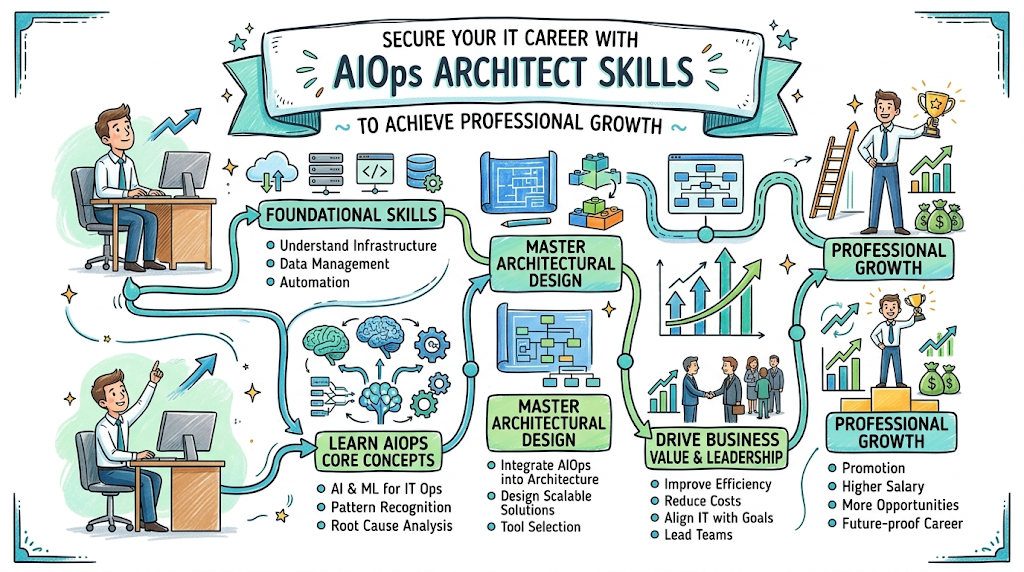
Introduction
The modern engineering landscape is shifting from manual intervention to autonomous operations. The Certified AIOps Architect program is designed for professionals who want to bridge the gap between traditional operations and artificial intelligence. This guide is written for Site Reliability Engineers, DevOps professionals, and Platform Engineers who recognize that human-scale monitoring is no longer sufficient for complex, cloud-native environments. By pursuing this path at AIOpsSchool, you are positioning yourself at the forefront of the next evolution in infrastructure management.
As infrastructure grows in complexity, the volume of telemetry data surpasses what any human team can analyze in real-time. This guide helps you navigate the transition from reactive troubleshooting to proactive, AI-driven observability. We will explore how this certification validates your ability to design systems that self-heal, predict outages, and optimize resource allocation without constant manual oversight. For those looking to future-proof their careers, understanding the intersection of machine learning and operations is no longer optional.
What is the Certified AIOps Architect?
The Certified AIOps Architect represents a professional standard for individuals capable of designing and implementing AI-driven operational frameworks. Unlike theoretical data science courses, this certification is rooted in the practical realities of production environments. It focuses on the application of machine learning algorithms to solve operational challenges like alert fatigue, root cause analysis, and capacity planning. It exists to provide a structured roadmap for engineers to move beyond basic automation into the realm of intelligent systems.
In an enterprise setting, this certification proves that an architect can handle large-scale telemetry and transform it into actionable insights. It aligns perfectly with modern engineering workflows by integrating seamlessly into existing CI/CD pipelines and observability stacks. The program emphasizes the architectural patterns required to build a fully autonomous operations center. By focusing on production-grade implementations, it ensures that learners can contribute immediate value to high-stakes technology environments.
Who Should Pursue Certified AIOps Architect?
This certification is primarily targeted at experienced DevOps Engineers, SREs, and Cloud Architects who are already managing large-scale distributed systems. If you find yourself overwhelmed by logs, traces, and metrics, this path provides the tools to manage that noise effectively. Security professionals and Data Engineers also benefit, as the principles of anomaly detection and data pipeline management are central to the curriculum. It is an ideal step for those looking to move into principal or lead architect roles.
While the core focus is on experienced practitioners, engineering managers and technical leaders will find immense value in the strategic portions of the program. Understanding the capabilities and limitations of AIOps is crucial for leaders who need to justify investment in AI-driven tooling. In both the Indian market and the global tech landscape, there is a massive shortage of professionals who understand both the “Ops” and the “AI” sides of the equation. This certification serves as a credible credential to fill that gap.
Why Certified AIOps Architect is Valuable Now and Beyond
Enterprise adoption of AI is accelerating, and IT operations is one of the most practical areas for immediate ROI. The demand for architects who can implement these systems is rising as companies seek to reduce downtime and operational costs. Obtaining this certification ensures you remain relevant even as traditional scripting and manual monitoring become obsolete. It provides a level of longevity to your career by focusing on the underlying patterns of intelligent systems rather than just specific, fleeting tools.
The value of the Certified AIOps Architect lies in its ability to translate complex data science concepts into operational wins. When you can demonstrate a reduction in Mean Time To Repair (MTTR) through automated root cause analysis, your value to the organization increases exponentially. It is a significant return on time investment because it teaches you how to scale operations without linearly scaling headcount. In an era where “doing more with less” is a common corporate mandate, AIOps is the primary lever for achieving that goal.
Certified AIOps Architect Certification Overview
The program is delivered via the official portal and hosted on the AIOpsSchool platform. It is structured to guide a professional from the foundational concepts of algorithmic operations to the advanced design of autonomous frameworks. The assessment approach is rigorous, involving both theoretical examinations and practical laboratory exercises that simulate real-world system failures. This ensures that the certification is not merely a “paper credential” but a true reflection of technical competency.
The ownership of the certification lies with a body of industry experts who update the curriculum regularly to reflect the latest trends in LLMOps and generative AI for operations. The structure is modular, allowing professionals to progress at their own pace while maintaining a clear focus on architectural integrity. By separating the learning into distinct phases, the program ensures that candidates have a solid grasp of data ingestion and processing before moving into complex model deployment. It is a comprehensive ecosystem designed for the modern technical professional.
Certified AIOps Architect Certification Tracks & Levels
The certification is divided into three primary levels to accommodate different stages of a professional’s career. The Foundation level introduces the core terminology, data types, and basic statistical models used in monitoring. This is suitable for those new to the field who need to understand the “what” and “why” of AIOps. It provides the necessary background to speak the language of both data scientists and operations teams effectively.
The Professional level moves into the implementation phase, focusing on specific workflows like anomaly detection, event correlation, and automated incident response. This level is where most hands-on engineers will spend their time, learning to integrate AI into existing DevOps toolchains. Finally, the Advanced or Architect level focuses on the holistic design of intelligent systems, including governance, cost management, and long-term strategy. These levels align with the natural career progression from an individual contributor to a strategic technical leader.
Complete Certified AIOps Architect Certification Table
| Track | Level | Who it’s for | Prerequisites | Skills Covered | Recommended Order |
| Operations | Foundation | Junior DevOps/SRE | Basic Linux/Cloud | Data types, Monitoring basics | First |
| Engineering | Professional | SREs/System Admins | Foundation Level | Anomaly detection, Correlation | Second |
| Architecture | Advanced | Principal Engineers | Professional Level | System design, ROI, Strategy | Third |
| Specialized | Security AI | SecOps Engineers | Basic Security | Threat detection, Log AI | Optional |
| Specialized | FinOps AI | Cloud Economists | Cloud Billing | Cost prediction, Spot AI | Optional |
Detailed Guide for Each Certified AIOps Architect Certification
Certified AIOps Architect – Foundation Level
What it is
This certification validates a candidate’s understanding of the basic principles of AIOps and the shift from reactive to proactive operations. It covers the fundamental data structures required for machine learning in an IT context.
Who should take it
This is suitable for junior engineers, fresh graduates, or experienced managers who want a conceptual understanding of how AI is transforming the data center and cloud operations.
Skills you’ll gain
- Understanding the four stages of AIOps maturity.
- Knowledge of telemetry data types: Metrics, Logs, Traces, and Events.
- Ability to identify use cases for AI in the IT lifecycle.
Real-world projects you should be able to do
- Create a basic dashboard that distinguishes between noise and signal.
- Map out a data ingestion pipeline for a small distributed application.
Preparation plan
- Explain 7–14 days for terminology, 30 days for statistical concepts, and 60 days for lab familiarity. Focus on the core differences between traditional threshold monitoring and algorithmic detection.
Common mistakes
- Overcomplicating the math; this level is about concepts, not building neural networks.
- Ignoring the “Ops” part and focusing only on the “AI” buzzwords.
Best next certification after this
Include:
- Same-track option: Professional AIOps Engineer
- Cross-track option: Cloud Practitioner
- Leadership option: ITIL Foundation
Certified AIOps Architect – Professional Level
What it is
The Professional level validates the ability to implement specific AIOps workflows, such as intelligent alerting and automated root cause analysis. It focuses on the “how” of integrating ML models into production.
Who should take it
Mid-level SREs, DevOps Engineers, and Platform Engineers who are responsible for maintaining system uptime and improving operational efficiency.
Skills you’ll gain
- Implementing supervised and unsupervised learning for anomaly detection.
- Configuring event correlation engines to reduce alert fatigue.
- Integrating AI insights into Slack or ITSM tools for automated ticketing.
Real-world projects you should be able to do
- Deploy an anomaly detection system on a live Kubernetes cluster.
- Build an automated incident response script triggered by an AI insight.
Preparation plan
- Explain 7–14 days of tool-specific deep dives, 30 days of integration labs, and 60 days of mastering Python-based telemetry manipulation.
Common mistakes
- Failing to understand the underlying data quality issues before applying AI.
- Relying too heavily on default tool settings without tuning models.
Best next certification after this
Include:
- Same-track option: Certified AIOps Architect (Advanced)
- Cross-track option: Certified Kubernetes Administrator (CKA)
- Leadership option: Project Management Professional (PMP)
Certified AIOps Architect – Advanced Level
What it is
This is the pinnacle of the program, validating the ability to design an entire AIOps strategy for an enterprise. It focuses on high-level architecture, governance, and organizational change.
Who should take it
Principal Engineers, Enterprise Architects, and CTOs who are tasked with transforming how their organization handles large-scale operations.
Skills you’ll gain
- Designing multi-tenant AIOps platforms.
- Calculating ROI for AI-driven operational tools.
- Establishing governance frameworks for automated decision-making.
Real-world projects you should be able to do
- Design a blueprint for a self-healing infrastructure across multiple cloud regions.
- Create a 24-month roadmap for moving an organization to autonomous operations.
Preparation plan
- Explain 7–14 days of case study analysis, 30 days of architectural whiteboarding, and 60 days of full MLOps environment deployment.
Common mistakes
- Focusing only on the technology and ignoring the cultural shifts required for AIOps.
- Underestimating the cost of data storage and processing for long-term AI models.
Best next certification after this
Include:
- Same-track option: Specialized Security AI
- Cross-track option: Google Professional Cloud Architect
- Leadership option: MBA or Executive Leadership programs
Choose Your Learning Path
DevOps Path
The DevOps path focuses on integrating AI into the CI/CD pipeline and deployment cycles. You will learn how to use AI to predict if a code commit will cause a production failure before it is even deployed. This path emphasizes the speed of delivery without sacrificing stability. It is perfect for those who want to build “smart” pipelines that adapt to environment changes.
DevSecOps Path
In this path, the focus shifts to using AI for security orchestration and automated response. You will learn how to detect anomalous user behavior and potential breaches in real-time. This path is essential for organizations that need to maintain high security standards in a rapidly changing environment. It combines operational intelligence with automated threat hunting and vulnerability management.
SRE Path
The Site Reliability Engineering path is perhaps the most natural fit for AIOps. It focuses heavily on Service Level Objectives (SLOs) and using AI to manage error budgets. You will learn to build systems that can automatically scale or shed load based on predicted traffic patterns. This path is about maintaining high availability through intelligent automation and reduced manual toil.
AIOps Path
This dedicated path focuses on the core mechanics of algorithmic operations. It covers the entire lifecycle of operational data, from ingestion and cleaning to model training and deployment. Professionals here become experts in the specific algorithms that work best for time-series telemetry. This is the most direct path for those wanting to specialize in intelligent infrastructure.
MLOps Path
The MLOps path is designed for those who want to manage the infrastructure that supports machine learning models. It covers model versioning, feature stores, and the deployment of AI at scale. While related to AIOps, this path focuses more on the developer experience for data scientists. It ensures that the AI itself is reliable, scalable, and high-performing.
DataOps Path
DataOps focuses on the reliability and quality of the data pipelines that feed the AIOps engine. You will learn how to ensure that the telemetry data being used for AI decisions is accurate, timely, and complete. This path is critical because an AIOps system is only as good as the data it consumes. It bridges the gap between data engineering and infrastructure operations.
FinOps Path
The FinOps path uses AI to manage the complex world of cloud billing and resource optimization. You will learn how to use machine learning to predict cloud spend and automatically identify wasted resources. This path is highly valued by management because it directly impacts the company’s bottom line. It turns raw operational data into actionable financial wisdom and efficiency.
Role → Recommended Certified AIOps Architect Certifications
| Role | Recommended Certifications |
| DevOps Engineer | AIOps Foundation, Professional Level |
| SRE | Professional Level, SRE Path |
| Platform Engineer | Advanced Level, MLOps Path |
| Cloud Engineer | AIOps Foundation, Professional Level |
| Security Engineer | DevSecOps Path, Professional Level |
| Data Engineer | DataOps Path, Foundation Level |
| FinOps Practitioner | FinOps Path, Foundation Level |
| Engineering Manager | AIOps Foundation, Advanced Level |
Next Certifications to Take After Certified AIOps Architect
Same Track Progression
Once you have completed the Architect level, deep specialization is the logical next step. You might choose to focus on specific niches such as Generative AI for Operations or Autonomous Networking. These certifications allow you to become the go-to expert for a specific subset of the AIOps landscape. Staying within the track ensures you remain at the absolute cutting edge of operational technology.
Cross-Track Expansion
Broadening your skills into related areas like Kubernetes or advanced Cloud Architecture can make you a more versatile professional. Understanding the underlying infrastructure at a deep level helps you design better AI models to manage it. AIOps does not exist in a vacuum, so expanding into DevSecOps or FinOps provides a more holistic view of the enterprise. This makes you more valuable in smaller organizations where you might wear multiple hats.
Leadership & Management Track
For those looking to move away from hands-on keyboard work, transitioning to leadership is a viable path. Certifications in ITIL or PMP, combined with your technical AIOps background, prepare you for roles like VP of Infrastructure or Head of Operations. You will be able to speak the language of the board while understanding the technical challenges of your team. This path focuses on the business impact of technology.
Training & Certification Support Providers for Certified AIOps Architect
DevOpsSchool
DevOpsSchool provides a comprehensive ecosystem for learning AIOps with a focus on real-world industrial application. Their training modules are designed by practitioners who have managed multi-cloud environments for over a decade. They offer extensive lab environments where students can practice anomaly detection and event correlation using production-grade tools. Their support extends beyond the classroom with a strong alumni network and placement assistance for senior roles.
Cotocus
Cotocus specializes in high-end technical training for enterprise architects and engineering leaders. Their AIOps curriculum is known for its depth in machine learning algorithms specifically tailored for IT telemetry. They focus on the “why” behind the technology, ensuring that architects can justify their design decisions to stakeholders. The training includes deep dives into automated incident response and proactive system maintenance strategies for global enterprises.
Scmgalaxy
Scmgalaxy is a premier destination for community-driven learning and technical documentation. They provide a vast library of tutorials, interview questions, and practice labs specifically for AIOps certification candidates. Their approach is focused on sharing knowledge through expert-led webinars and detailed technical articles. It is an excellent resource for professionals who want to stay updated on the latest open-source AIOps tools and frameworks.
BestDevOps
BestDevOps offers a streamlined and highly efficient path to certification for working professionals. Their programs are designed to be intensive and results-oriented, focusing on the core competencies required to pass the architect-level exams. They provide mentorship from senior engineers who help students navigate the transition from traditional DevOps to AI-driven operations. Their training includes a strong focus on ROI and business value.
devsecopsschool.com
This provider is the go-to source for professionals who want to integrate security into the AIOps lifecycle. Their training covers how AI can be used for real-time threat detection, automated vulnerability patching, and security compliance at scale. They emphasize the importance of “secure by design” when building intelligent operational frameworks. It is the perfect choice for security engineers looking to move into AI-driven defense.
sreschool.com
Sreschool focuses entirely on the principles of Site Reliability Engineering and how AI can enhance them. Their training is built around the concept of “Google-style” SRE practices, using algorithmic models to manage service levels and error budgets. They teach students how to build self-healing systems that reduce the manual toil typically associated with on-call shifts. Their curriculum is highly practical and focused on production uptime.
As the official hosting platform for the certification, AIOpsSchool provides the most direct and accurate learning path. Their courses are structured to lead a student from basic monitoring concepts to advanced autonomous system design. They provide the official study guides, practice exams, and the platform where the certification is ultimately issued. It is the gold standard for anyone serious about becoming a certified AIOps professional.
dataopsschool.com
DataOpsSchool addresses the critical “data” component of AIOps, focusing on the pipelines that feed machine learning models. Their training ensures that engineers can manage large-scale data ingestion, cleaning, and storage for operational telemetry. They teach the importance of data quality and lineage, which are foundational to any successful AI implementation. This provider is essential for those focusing on the reliability of the data itself.
finopsschool.com
FinOpsSchool provides the necessary training to link technical operations with financial accountability. Their AIOps-related courses focus on using machine learning to predict cloud costs and optimize resource utilization. They help professionals translate operational performance into business-speak that finance teams can understand. This training is vital for architects who need to manage the cost implications of high-scale cloud infrastructure.
Frequently Asked Questions (General)
- How difficult is the Certified AIOps Architect exam?
The difficulty increases significantly with each level. The Foundation is accessible, but the Architect level requires a deep understanding of both system design and machine learning logic.
- How much time is required to get certified?
A dedicated professional can complete the entire track in 6 to 12 months, depending on their starting experience and the amount of time they can commit to labs.
- Are there any prerequisites for the Foundation level?
No formal prerequisites exist for the Foundation level, though a basic understanding of IT operations and cloud concepts is highly recommended.
- What is the ROI of this certification?
Professionals often see a significant salary increase and access to more senior roles, as AIOps is one of the highest-paying niches in the current market.
- Does this certification cover specific tools?
While it mentions tools like ELK or Prometheus, it focuses more on the architectural patterns and algorithmic logic that can be applied to any toolset.
- Is there a recertification requirement?
Yes, typically every two years, to ensure that architects are up to date with the latest advancements in AI and cloud technology.
- Can the exam be taken online?
Yes, the certification is designed to be accessible globally through a proctored online examination system hosted on the official site.
- How does this differ from a Data Science certification?
Data Science focuses on building models for business insights, while this certification focuses on applying those models to keep systems running and healthy.
- Is this certification recognized globally?
Yes, it is designed to meet international standards for technical professional development and is recognized by major tech hubs worldwide.
- Is coding knowledge required?
A basic understanding of scripting (like Python) is necessary for the Professional and Advanced levels to handle API integrations and data manipulation.
- Are hands-on labs included in the program?
The Professional and Architect levels include mandatory lab components where candidates must solve real operational problems in a sandboxed environment.
- Can an employer pay for this training?
Most enterprises have a professional development budget that covers these types of industry-standard certifications, especially given the clear ROI for the business.
FAQs on Certified AIOps Architect
- What specific machine learning models are covered in the curriculum?
The program covers a variety of models including K-Means for clustering events, Random Forests for classification, and LSTMs for time-series forecasting. It doesn’t just teach the math but explains which model is best for specific operational problems like CPU spikes versus log anomalies.
- How does the program handle the “Black Box” problem of AI?
A significant portion of the Architect level is dedicated to “Explainable AI.” It teaches you how to design systems that don’t just give an answer but provide the reasoning, which is crucial for building trust with traditional operations teams.
- Is this certification applicable to on-premises environments?
Yes, while the examples often use cloud-native tools, the core principles of data ingestion, correlation, and automated response are platform-agnostic and can be applied to hybrid or purely on-premises data centers.
- What is the passing score for the exams?
Generally, a score of 70% or higher is required. The exams are designed to be challenging, focusing on scenario-based questions rather than simple rote memorization of facts or definitions.
- How often is the course content updated?
The curriculum is reviewed and updated bi-annually to incorporate new trends like Generative AI, Large Language Models for Ops, and evolving security threats that impact the operations landscape.
- Are there group discounts for corporate teams?
Yes, AIOpsSchool provides various corporate packages for teams looking to undergo a digital transformation. These often include additional workshops and implementation coaching tailored to the company’s specific stack.
- What kind of support is available if the exam is failed?
Candidates usually get one retake included in the initial fee. Additionally, the community forums and support providers listed above offer remedial resources to help you bridge the gaps in your knowledge.
- Does this certification help with career transition?
Absolutely. It provides a formal credential that proves you have made the jump from a traditional administrator to a modern, AI-capable architect, making you highly attractive to forward-thinking tech firms.
Final Thoughts
From the perspective of a mentor who has seen multiple waves of technology shifts, I can say that the move toward AIOps is one of the most significant transitions in the history of IT. We are moving away from an era where we “manage servers” and into an era where we “manage the systems that manage the servers.” The Certified AIOps Architect is a structured, credible way to prove you have the skills to lead this change. It is not about chasing a trend; it is about adopting a necessary methodology for the scale of modern computing.
If you are currently feeling stuck in a cycle of manual firefighting and endless on-call shifts, this certification offers a way out. It provides the theoretical foundation and the practical toolkit to build a more sustainable and intelligent way of working. While the journey requires a commitment of time and mental energy, the long-term career security and the ability to work on the most advanced systems in the world make it a worthwhile investment. My advice is simple: start with the foundation, get your hands dirty with the data, and don’t stop until you can design the future of operations.