Starting a cloud engineering career feels hard. You open a search page and see hundreds of tools. Docker, Kubernetes, Jenkins, Terraform, and many more appear at once. So where do you begin? Many learners watch random videos and jump from one topic to another. Then they feel lost and tired. Random videos do not show you the right order. You need clear, step-by-step guidance instead. A good plan tells you what to learn first, what to learn next, and when to stop. It also saves you months of time. That is why open community guides matter. DevOpsSchool.org is one such guide. It gives learners a free and simple path to follow. This blog shows you how to plan, pick tools, and prepare for a job.
What Is DevOpsSchool.org?
DevOpsSchool.org is a free and open learning platform. It also helps with careers. Here is what it offers:
- Free 90-day guides that show what to study each week
- An open tool directory that lists popular software
- An exam registry that tracks tests and their goals
- Career help, such as role guides and job tips
The community shares and improves these guides over time.
Start With a Step-by-Step Learning Plan
DevOps means teams build, test, and release software together. A DevOps roadmap is an ordered plan for what to learn. It shows the right steps in the right order. Without it, you may waste months on the wrong topics. For example, you might study Kubernetes before you know Linux. That is slow and hard.
A clear DevOps learning path fixes this problem. It starts with the basics. Then it moves to tools, cloud, and exams. Each step builds on the last one. As a result, you learn faster and forget less.
Skills You Need to Become a Full Engineer
Every DevOps engineer roadmap starts with a few daily basics. First, learn Linux. Most servers run on it. Learn to move around folders, edit files, and check running programs.
Next, learn version control with Git. Git tracks every change to your code. It also lets teams work on the same files.
Then, learn scripting. A script is a small program that does a task for you. Python and Bash are good choices. Finally, learn how networks work. Know what an IP address and a port are. These skills look small, but they support everything else.
Choosing the Right Software for Daily Work
DevOps tools are programs that do repeat work for you. This work is called automation. Some tools build your code. Some test it. Others put it on servers.
A pipeline links these steps. Code then moves from your laptop to users. We call this CI/CD. It means testing and releasing code in small, safe steps. Other tools set up servers and networks using code. Start with one tool for each job. Do not try to learn them all.
Comparing Technology Options Side by Side
A good DevOps tools comparison helps you choose with confidence. Compare tools by the job they do. For containers, you may look at Docker and Podman. For code pipelines, you may look at Jenkins, GitLab CI, and GitHub Actions. For monitoring, which means watching your systems, you may look at Prometheus and Grafana.
Ask simple questions. Is it free? Is it easy to learn? Do many companies use it? Then pick one tool, build a small project, and decide.
Table 1: Core Engineering Areas and Beginner Projects
| Skill Area | Key Focus | Beginner Project | Why It Matters |
|---|---|---|---|
| Linux | Commands and files | Set up a small web server | Most servers run it |
| Git | Tracking code changes | Store a project with branches | Teams share code safely |
| Containers | Packing apps | Run a simple app in Docker | Apps run the same everywhere |
| CI/CD | Auto build and test | Build a basic pipeline | Releases become fast and safe |
| Cloud | Renting servers online | Launch a virtual server | Most firms use the cloud |
Exploring System Reliability and Uptime
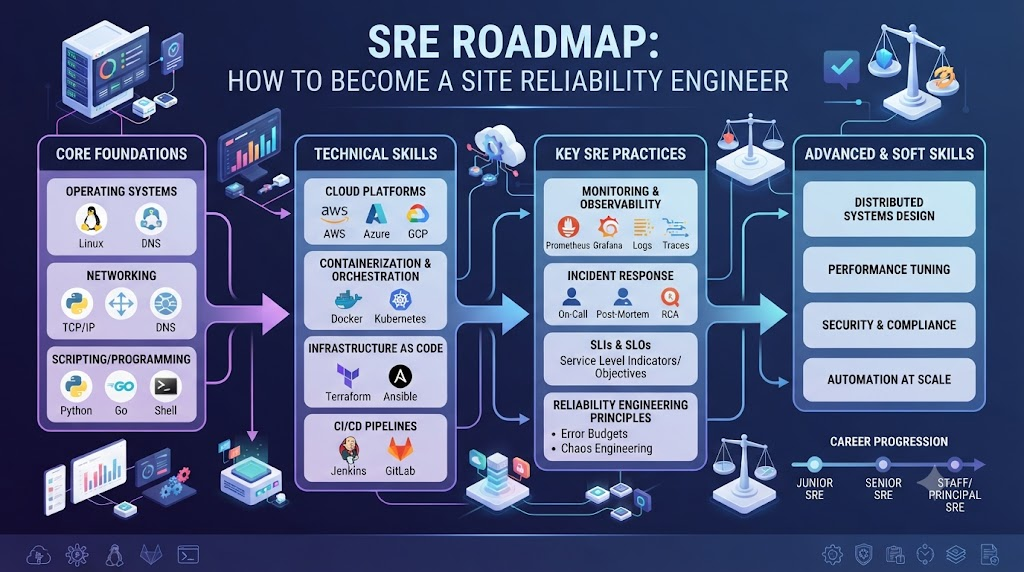
SRE means Site Reliability Engineering. SRE specialists keep large websites and apps running without downtime. Downtime is the time when a site stops working.
An SRE roadmap adds a few new skills to your base. You learn to set goals for uptime. You learn to watch systems with alerts. You also learn to fix problems fast and study why they happened. Big apps need this work every day, so demand stays strong.
Understanding Internal Developer Platforms
Platform engineers build tools that other developers use on their own. We call this an internal developer platform. It works like a self-service menu. A developer clicks a button and gets a new test server. No waiting is needed.
A Platform Engineering roadmap builds on your DevOps base. You add skills in Kubernetes, which runs many containers at once. You also learn to design simple tools that people enjoy using. This path fits people who like helping other teams.
Proving Your Skills With Industry Exams
Official exams show employers that you know cloud ideas. DevOps certifications prove your skills in a clear way. They also give you a study goal. But an exam alone is not enough. Employers want to see real projects too. So use exams to guide your learning, not to replace practice.
Planning Your Exam Journey in Order
A DevOps certification roadmap puts exams in a smart order. First, take a foundation exam. It teaches core cloud ideas. Next, pick one cloud provider and take its associate exam. Then move to advanced exams, such as Kubernetes. Take one exam at a time. Study, build a lab, and then book the test. This order keeps you calm and sure.
Table 2: Career Paths and Exam Priorities
| Target Role | Best Starting Track | Helpful First Exam | Top Goal |
|---|---|---|---|
| DevOps Engineer | Linux, Git, CI/CD | Cloud foundation exam | Build a full pipeline |
| SRE | Monitoring and alerts | Cloud associate exam | Keep systems running |
| Platform Engineer | Kubernetes basics | Kubernetes exam | Build self-service tools |
Finding Work and Landing Interviews
DevOps jobs go to people who can show real work. So build a GitHub portfolio. GitHub is a website where you store and share code. Add small projects with clear notes. Show a pipeline, a script, and a cloud setup.
Share your work in open communities. Also, connect with hiring managers and engineers. Send a short, polite message. Ask for feedback, not a job. Then practice common interview questions out loud.
Real-Life Learner Journeys
- A system administrator learns scripting and cloud tools. Then this person moves into cloud automation.
- A college graduate builds three small projects. Then this graduate lands a junior role.
- A developer learns deployment pipelines. Then this developer helps the team release code faster.
Common Mistakes to Avoid
- Memorizing commands without hands-on practice
- Collecting certificates without building projects
- Trying to learn every tool at once
- Skipping basic Linux skills
- Following random videos with no plan
- Never sharing your work
- Fearing errors instead of learning from them
- Studying alone and never asking questions
How DevOpsSchool.org Can Help
DevOpsSchool.org welcomes every learner. Its open roadmaps show you what to study and in what order. The community adds new ideas and fixes old ones, so guides stay fresh. Its free career directories help you find roles and next steps. You do not walk alone. You can learn, share, and grow with others who share your goal.
A Simple 7-Step Career Launch Plan
- Goal: Pick one role, like DevOps engineer or SRE.
- Search: Read guides and tool lists.
- Shortlist: Choose a few tools and one exam.
- Compare: Weigh cost, time, and job demand.
- Ask: Talk to engineers and community members.
- Verify: Check that each choice is current and trusted.
- Decide: Pick your path and start today.
Frequently Asked Questions
Question 1: What is the best way to start a DevOps career?
Start with the basics. Learn Linux, Git, and a little scripting first. Then pick one cloud provider and one pipeline tool. Build small projects as you learn. Follow a clear DevOps roadmap so you never wonder what comes next. Small steps every day beat long study sessions once a month. Stay patient and keep practicing.
Question 2: How long does it take to learn DevOps?
Most beginners need six to twelve months of steady study. The time depends on your background. A system administrator may move faster than a fresh graduate. Study a little each day and build real labs. Free 90-day guides can help you get started quickly. After that, keep growing with projects and community help.
Question 3: Do I need to know coding for DevOps?
You need basic coding, but not advanced skills. Learn simple scripting in Python or Bash first. A script automates small tasks like backups or file checks. You do not need to build large apps. As you grow, you will read and write more code. Start small and practice on real tasks every day.
Question 4: Which DevOps tools should beginners learn first?
Start with Git, Docker, and one pipeline tool such as Jenkins or GitHub Actions. Add Terraform later to manage servers with code. Also learn a basic monitoring tool. Do not try every tool at once. Pick one tool for each job, and build a small project with it before moving on.
Question 5: Are DevOps certifications worth it?
Yes, they can be worth it. DevOps certifications give you a study goal and show employers your effort. However, they work best with real projects. A certificate alone rarely wins a job. So study for the exam, build labs, and share your work. Together, these steps make a very strong profile. Employers like to see both.
Question 6: What is the difference between DevOps and SRE?
DevOps is a way of working. It helps developers and operations teams release software together. SRE is a job that uses engineering to keep systems reliable. An SRE sets uptime goals and fixes problems fast. The two ideas work well together, and many engineers learn both over time. Both need strong Linux skills.
Question 7: Can a non-IT person switch to DevOps?
Yes, many career switchers succeed. Start with computer basics, then learn Linux and Git. Build small projects to show your skills. Be patient because the first months feel slow. Join a community for support and feedback. Your past work also helps, since teamwork and problem-solving matter in every technical role. Believe in yourself.
Question 8: Which cloud platform should I choose?
Choose one and stay with it for a while. AWS, Azure, and Google Cloud all work well. AWS is very popular in many places. Azure is common in large companies. Check jobs in your area and pick the platform that shows up most. Once you learn one, the others feel much easier.
Question 9: How do I build a portfolio for DevOps jobs?
Create a GitHub account and add three or four projects. Show a pipeline, a script, and a cloud setup. Write a clear note for each project. Explain what you built and why. Keep your code clean and share your progress often. Hiring managers like to see real work and steady effort. That builds trust.
Question 10: What are common mistakes beginners make?
Many beginners try to learn every tool at once. Others memorize commands without practice or collect certificates without projects. Some skip Linux basics. A few study alone and never ask questions. Avoid these traps with a clear plan, real labs, and help from the community when you feel stuck. Small mistakes are normal.
Question 11: Do I need a degree to get DevOps jobs?
No, a degree is not always required. Many employers care more about skills and projects. Show that you can use Linux, Git, cloud, and pipelines. A degree can help, but hands-on proof often matters more. Keep learning, build your portfolio, and prepare well for interviews to stand out. Skills open many doors.
Question 12: How can DevOpsSchool.org help me learn?
DevOpsSchool.org offers free 90-day guides, an open tool directory, an exam registry, and career help. You can follow a set plan and compare tools in one place. The community also shares tips and updates. Use it as your guide, then practice by building your own projects. Small daily steps will take you far.
Conclusion
Your cloud career starts with one small step. Stay consistent and study a little every day. Build real labs, because hands-on work teaches more than watching videos. Follow a clear schedule so you always know what comes next. Pick a few tools, take one exam at a time, and share your projects with others. Do not fear mistakes. Every engineer made them early on. Also, keep learning with the community. Other learners can answer questions, give feedback, and cheer you on. You do not need to know everything today. You only need to start. DevOpsSchool.org can guide you along the way with free, open resources. Take your first step now, and keep moving forward.
