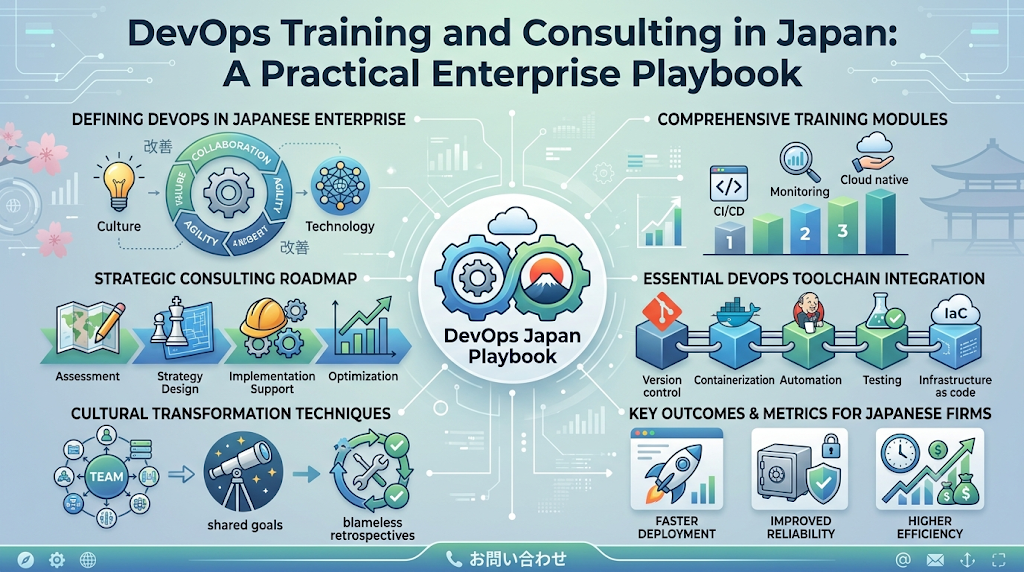
Software teams in Japan are under real pressure. Business leaders want new features every week. Customers expect apps to work all the time. But many internal teams still rely on old ways of working. Manual releases. Slow testing. Fragile servers. This gap creates stress and slows growth. The good news is that help exists. DevOpsSchool.jp works with enterprises across Japan. It offers training, advice, and long-term support. This guide explains how to close skill gaps, modernize delivery, and build a calm, capable engineering culture. It is written in plain English. So every team member can follow along.
Meet DevOpsSchool.jp
DevOpsSchool.jp is a specialized learning and advisory partner in Japan. Think of it as a bridge between where your team is now and where it needs to be. The group does three things well. It trains engineers through hands-on labs. It guides leaders through big changes. And it stays available when problems appear later. The approach is simple. People learn best by doing. So every program includes real tools, real tasks, and real feedback. DevOpsSchool.jp serves startups, mid-size firms, and large enterprises. The mission stays the same. Help people build, ship, and run software with confidence.
Why Internal Skills Come First
Tools alone do not fix slow delivery. People do. So the smartest first move is to grow your own team. A structured program beats random videos and blog posts. It builds skills in the right order. Basics first. Then tools. Then teamwork. This is the heart of DevOps 研修. It means DevOps training delivered in Japanese. Lessons stay clear and practical. Engineers do not just watch slides. They build pipelines. They break things. Then they fix them. This style of DevOps corporate training Japan teams trust works well. It respects how Japanese teams like to learn. Slowly. Carefully. Together. After training, releases get faster. Bugs drop. And confidence rises across the whole department.
Small Steps Beat Big Leaps
Many companies try to change everything at once. That usually fails. A better path is small, steady steps. Train one team first. Let them win. Then train the next team. This creates momentum. It also builds trust. DevOps 研修 supports this step-by-step style. So change feels safe, not scary.
When Outside Experts Make Sense
Some changes are too big to handle alone. That is when a specialist helps. An expert can guide your team through new workflows. They can also help with cloud setup. This work is called DevOps コンサルティング. It means DevOps consulting in Japanese. A strong partner does not just hand you a plan. They sit beside your team. They solve real problems together. They share lessons from other projects. A good DevOps consultant Japan firm also understands local culture. They speak the language. They respect group decisions. So change happens faster. And with far less friction.
The Real Job of a Consultant
A good consultant works to become unnecessary. Their goal is to teach your team to stand alone. They explain each step. They answer questions. They hand over knowledge. After the project ends, your team runs things on its own. That is the true measure of success.
Containers and Automation Made Simple
Two ideas come up in almost every cloud project. Containers and automation. Let us break both down in plain words. A container is a small package. It holds one piece of software plus everything it needs. So it runs the same on any machine. Kubernetes manages many containers at once. Picture a traffic officer for software. It decides where each container runs. It restarts them if they stop. This is what Kubernetes 研修 covers. Teams learn to run many containers without chaos. Next comes Terraform. It lets you build cloud systems using text files instead of mouse clicks. You describe what you want. The tool builds it for you. This is what Terraform 研修 teaches. Teams set up servers, networks, and storage in a fast, repeatable way. Both skills are in high demand across Japan.
Why These Two Skills Pay Off
Containers make software portable. Build once. Run anywhere. Automation makes setup repeatable. Write the steps once. Use them forever. Together, they save hours every week. They also cut human error. Teams move faster. And they sleep better at night.
Table 1 (Core Technical Training Tracks)
| Training Domain | Core Tool/Focus | Business Benefit | Target Team |
|---|---|---|---|
| Container Management | Kubernetes | Run apps at scale with less downtime | Platform and backend engineers |
| Infrastructure Automation | Terraform | Build cloud setups fast and safely | Cloud and DevOps engineers |
| Reliability Engineering | SRE practices | Keep services online and stable | Operations and SRE teams |
| Secure Delivery | DevSecOps | Catch security issues early | Security and development teams |
| Machine Learning Ops | MLOps | Ship AI models with less risk | Data science and ML teams |
Keeping Services Alive Every Day
Users do not forgive downtime. If a site fails, they leave. So reliability must be a habit, not a hope. This is where SRE 研修 helps. SRE stands for Site Reliability Engineering. It is a set of simple rules for keeping services healthy. Teams learn to watch key signals. They learn to spot trouble early. They also learn to fix issues before users notice. SRE 研修 uses hands-on practice. Your team sets up alerts. They track errors. They plan for busy seasons. So the service stays up. Even when traffic grows fast.
Reliability Is a Team Sport
Reliability is not one person’s job. It belongs to everyone. Developers write safer code. Operators watch the system. Leaders set clear goals. When all three work together, outages shrink. And trust grows.
Putting Security in the Daily Flow
Old habit: build first, check security last. That causes delays and missed bugs. A better way exists. It is called DevSecOps. The idea is simple. Add security checks early. Run them all the time. Not just before launch. This is what DevSecOps 研修 teaches. Your team learns to scan code as they write it. They test for weak spots. They fix problems right away. So releases stay safe. And they stay fast.
Cheaper to Fix Early
A bug found early costs minutes. A breach found late costs millions. Early checks protect users. They also protect your brand. That is why smart teams shift security left, closer to the start of the work.
Managing AI Models in Production
AI is growing fast in Japan. Many teams now build machine learning models. But building a model is only half the job. You must also test it. Watch it. Update it safely. This is where MLOps 研修 comes in. MLOps means Machine Learning Operations. It brings DevOps habits to AI work. Teams learn to automate model testing. They track model versions. They monitor models after launch. So models do not fail in secret. They stay useful over time. MLOps 研修 keeps the lessons clear and practical. Even teams new to AI can follow along.
Why Monitoring Matters
A model can work in the lab. Then fail in the real world. Data shifts. User behavior changes. Without monitoring, no one notices. MLOps 研修 helps teams catch these shifts early. So AI projects deliver real value, not just demos.
Help That Never Stops
Training is a start. But teams still need backup later. That is where DevOps support Japan comes in. This support is ongoing. It is not a one-time class. Experts stay ready to help. They review code. They fix problems fast. They advise on new tools. Busy teams love this. They do not need to hire more staff. They just get help when needed. DevOps support Japan keeps projects moving. It also keeps stress low. Your team focuses on building. The experts handle the hard parts.
Table 2 (Evaluating Training & Consulting Providers in Japan)
| Evaluation Factor | What to Look For | Why It Matters for Japanese Enterprises |
|---|---|---|
| Local Language Support | Japanese-speaking trainers | Clear communication reduces confusion |
| Hands-On Labs | Real practice, not just slides | Skills stick better when people do the work |
| Proven Track Record | Past projects in Japan | Local experience means fewer surprises |
| Custom Roadmaps | Plans built for your team | One-size-fits-all training often fails |
| Ongoing Support | Help after the class ends | Teams need backup when problems appear |
| Certified Instructors | Official tool certifications | You know the teacher truly knows the tool |
Real Team Stories
- A traditional IT team wanted to move to containers. They felt lost at first. After a Kubernetes 研修 program, they ran their first cluster within weeks. Now they deploy faster and with less fear.
- A development group had slow releases. Every launch needed manual steps. After learning automation, they cut release time from days to just hours.
- An engineering unit faced frequent outages. They took an SRE 研修 course. They set up better alerts. Downtime dropped by half in three months.
- A data team built models that failed in production. With MLOps 研修, they added monitoring. Now their models stay healthy and useful.
Common Mistakes to Avoid in Tech Transformations
- Buying tools before training people. Tools do not fix skill gaps.
- Skipping hands-on practice labs. Reading is not the same as doing.
- Ignoring system monitoring. You cannot fix what you cannot see.
- Treating security as an afterthought. Late fixes cost far more.
- Trying to change everything at once. Small steps work better.
- Leaving the team out of planning. People support what they help build.
- Ignoring company culture. Japanese teams value trust and teamwork.
- Choosing a partner with no local experience. Local know-how matters.
- Forgetting to measure results. What gets measured gets improved.
- Stopping support too early. Teams need help after class ends.
How DevOpsSchool.jp Can Help
DevOpsSchool.jp builds custom plans for each company. It avoids one-size-fits-all training. First, the team studies your needs. Then they design a roadmap. The roadmap fits your tools, your people, and your goals. All instructors hold official certifications. They know the tools deeply. They also know how to teach. Classes come in flexible formats. Choose online or in-person. Pick short workshops or deep programs. The tone stays supportive. The aim is to help your team grow. Not to sell you things you do not need.
A Simple 7-Step Upskilling & Advisory Roadmap
Follow these steps to choose the right partner.
- Goal – Write down what you want to fix.
- Search – Look for training and consulting firms in Japan.
- Shortlist – Pick three or four that fit your needs.
- Compare – Check their courses, prices, and support.
- Ask – Talk to them. Request real project examples.
- Verify – Check reviews and instructor certifications.
- Decide – Choose the partner that feels right for your team.
Frequently Asked Questions (FAQ)
Question 1: What is DevOps 研修 and who should join?
DevOps 研修 is hands-on DevOps training taught in Japanese. It suits engineers, team leads, and IT managers. The course covers pipelines, automation, and teamwork. Lessons use simple English and Japanese. So anyone can follow. Teams learn by doing real tasks. This helps them ship software faster and with fewer bugs.
Question 2: Why hire a DevOps consultant Japan expert?
A local expert knows the market and culture. They speak Japanese. So communication stays smooth. They have seen many projects. So they avoid common traps. They also work beside your team. This builds skills while solving real problems. The result is faster change with less stress.
Question 3: How long does Kubernetes 研修 usually take?
Most Kubernetes 研修 programs run two to five days. Short workshops cover the basics. Longer programs add real projects. Teams practice on live clusters. They learn to deploy, scale, and fix apps. After class, most teams can run simple clusters alone. More practice builds deeper skill over time.
Question 4: Is Terraform 研修 useful for small teams?
Yes. Small teams gain a lot from Terraform 研修. They learn to build cloud setups with code. This saves time and cuts mistakes. They do not need to click through menus. They just run their scripts. So even a small team can manage a large cloud setup with ease.
Question 5: What does SRE 研修 cover?
SRE 研修 covers reliability basics. Teams learn about service levels, error budgets, and alerts. They also learn to track problems and fix them fast. The class uses real examples. So teams apply the ideas right away. The goal is simple. Keep services online and users happy.
Question 6: Why is DevSecOps 研修 important for security?
DevSecOps 研修 teaches teams to add security early. Instead of checking at the end, they check all the time. This catches bugs sooner. It also saves money. Teams learn to scan code, test for weak spots, and fix issues fast. So releases stay safe without slowing down.
Question 7: Who needs MLOps 研修?
MLOps 研修 suits data scientists, ML engineers, and DevOps teams. It teaches how to test models and watch them in production. Teams learn to track versions and catch drift. This keeps AI projects healthy over time. Without MLOps, models can fail in secret. With it, teams catch problems early.
Question 8: What is DevOps corporate training Japan style?
DevOps corporate training Japan style is practical and respectful. It values teamwork, clear steps, and long-term trust. Classes use real tools and real tasks. Instructors speak Japanese and English. So everyone can join. The focus is steady progress, not quick fixes.
Question 9: How does DevOps support Japan help after training?
DevOps support Japan gives ongoing help. Experts review code, fix issues, and answer questions. This helps when teams face new problems. They do not need to hire more people. They just get help when needed. So projects keep moving and stress stays low.
Question 10: Can DevOpsSchool.jp train remote teams?
Yes. DevOpsSchool.jp offers flexible formats. Teams can join online from anywhere in Japan. They can also choose in-person sessions. Both formats use the same hands-on approach. So remote teams get the same value. This helps companies with offices in many cities.
Question 11: How do we measure training success?
Measure success with clear goals. Look at release speed, bug rates, and uptime. Also check team confidence. Ask engineers what changed. Track how fast problems get fixed. Use these numbers before and after training. Then you can see real progress and plan the next step.
Question 12: What makes DevOpsSchool.jp different?
DevOpsSchool.jp focuses on real skills. It uses certified instructors and custom roadmaps. It offers ongoing support after class. It also understands Japanese business culture. So teams feel comfortable and supported. The goal is long-term growth, not quick sales.
Final Thoughts
Modern software moves fast. Teams in Japan need strong skills to keep pace. Focus on hands-on team learning. Build solid automation foundations. Adopt reliability habits like SRE. Add security early. Watch AI models in production. Then pick a partner with real local experience. DevOpsSchool.jp offers training, consulting, and ongoing support across Japan. It helps teams learn by doing. It also helps them grow with confidence. With the right plan and the right partner, your team can ship better software, faster, and with less stress. Start small. Stay steady. Keep learning.
