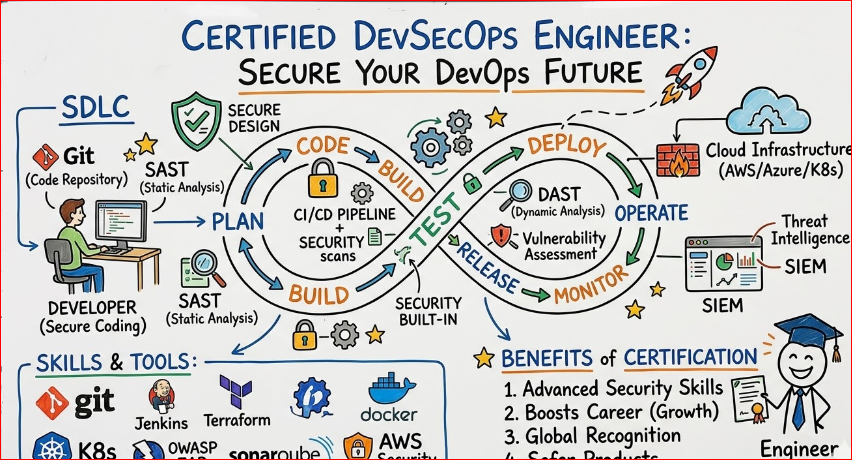
Security is now a core part of software delivery, not an add-on. Teams that move fast without security often face incidents, leaks, and compliance issues. The Certified DevSecOps Engineer program is designed for working engineers and managers who want to build secure, automated, and cloud‑ready delivery pipelines. In this guide, we will walk through what the certification is, who it is for, the skills you gain, learning paths, and how it supports your long‑term career.
What is Certified DevSecOps Engineer?
The Certified DevSecOps Engineer certification is a structured training and exam that teaches you how to build security into DevOps workflows.
It covers CI/CD security, cloud and container security, secrets management, and continuous compliance.
The goal is not only to know security concepts, but to apply them inside pipelines, infrastructure, and runtime environments.
It turns general security ideas into concrete practices that fit real delivery teams.
Who should take this certification?
This certification is designed for:
- DevOps Engineers who design and run CI/CD pipelines.
- Software Engineers who deploy code to production and own services.
- SREs and Platform Engineers responsible for stable and secure systems.
- Security Engineers who want to work closer to pipelines and automation.
- Cloud Engineers who manage cloud resources and environments.
- Engineering Managers who define delivery processes and technical standards.
If you already work with code, pipelines, or cloud, this certification adds a strong security layer to your profile.
Skills you will gain
After completing Certified DevSecOps Engineer, you should be able to:
- Understand DevSecOps principles and secure SDLC concepts.
- Perform basic threat modeling for services, APIs, and architectures.
- Integrate SAST, DAST, SCA, and secrets scanning into CI/CD pipelines.
- Apply container and Kubernetes security best practices.
- Use cloud security features like IAM, network security, and encryption.
- Set up secrets management and secure configuration.
- Build logging and monitoring with a security focus.
- Support continuous compliance using policies and automation.
These skills are directly useful in modern, cloud‑native environments.
Real-world projects you should be able to handle
After this certification, you should be able to complete projects such as:
- Building a CI/CD pipeline that runs security checks on every commit.
- Harden a containerized application, from base image to runtime security.
- Secure a small Kubernetes cluster used for microservices.
- Implement secrets management so no passwords or keys live in code or plain text.
- Configure basic cloud security for a web or API workload.
- Document and roll out a simple secure SDLC process for your team.
These projects show that you can move from theory to real implementation.
Preparation plan: 7–14 / 30 / 60 days
7–14 days (intensive plan)
This plan is for people who already know DevOps and cloud.
- Day 1–3: Refresh DevOps basics, CI/CD, and your main tools (Git, pipelines, cloud platform).
- Day 4–6: Study DevSecOps fundamentals: secure SDLC, threat modeling, CI/CD security checks.
- Day 7–10: Focus on cloud security basics, container security, and secrets management.
- Day 11–14: Do a small hands‑on project and revise using notes and practice questions.
30 days (standard working professional plan)
- Week 1: DevOps basics, SDLC, and core security concepts (CIA triad, basic threats).
- Week 2: CI/CD pipeline security, code scanning, dependency scanning, and secrets scanning.
- Week 3: Containers, Kubernetes basics, and cloud IAM/network security.
- Week 4: Build a mini project, revise key topics, and attempt mock questions or case studies.
60 days (comfortable plan for beginners in security)
- Month 1: Build a strong base in Linux, networking, Git, CI/CD, and cloud fundamentals.
- Month 2: Cover DevSecOps concepts, tools, and patterns, with regular hands‑on labs and a final project.
Common mistakes to avoid
- Thinking DevSecOps is only about tools and not about culture and process.
- Focusing only on application scanning and ignoring cloud, containers, and IAM.
- Skipping labs and doing only slides or theory.
- Not aligning security work with real business risk and priorities.
- Trying to copy one company’s DevSecOps model without adapting it.
- Treating security as a one‑time project instead of ongoing work.
Avoiding these mistakes helps you get real value from the certification.
Best next certification after this
Once you finish Certified DevSecOps Engineer, you can move in three directions:
- Same track (DevSecOps / security):
- Advanced DevSecOps or security engineer certifications.
- Cloud security specialist certifications from your cloud provider.
- Container or Kubernetes security credentials.
- Cross‑track (broadening skills):
- SRE certifications to combine reliability and security.
- DataOps or MLOps certifications for data‑heavy and ML systems.
- Platform engineering or cloud architect programs.
- Leadership:
- DevOps leadership or transformation programs.
- Security governance or risk management training.
- Courses focused on scaling DevSecOps across teams and departments.
Certification overview table
Here is a summary of the Certified DevSecOps Engineer certification.
| Certification | Track | Level | Who it’s for | Prerequisites | Skills covered | Recommended order |
|---|---|---|---|---|---|---|
| Certified DevSecOps Engineer | DevSecOps | Intermediate | DevOps, SRE, Platform, Cloud, Security, Software Engineers, Managers | Basic Linux, DevOps/CI/CD basics, cloud fundamentals | DevSecOps fundamentals, CI/CD security, cloud and container security, secrets, logging, compliance | After basic DevOps or cloud skills |
Choose your path: 6 learning paths
1. DevOps path
- Learn Linux, Git, scripting, CI/CD, and cloud basics.
- Take a DevOps or CI/CD-focused course or certification.
- Add Certified DevSecOps Engineer to secure your pipelines and infrastructure.
- Later, grow into Kubernetes, SRE, and platform engineering roles.
2. DevSecOps path
- Start with basic security concepts and DevOps knowledge.
- Take Certified DevSecOps Engineer as your core credential.
- Move into advanced DevSecOps, cloud security, and container security training.
- Aim for roles like DevSecOps engineer or security architect.
3. SRE path
- Build a base in Linux, networking, observability, and incident response.
- Take SRE-related certifications or structured training.
- Add Certified DevSecOps Engineer to bring security into reliability and production practices.
- Grow into roles that own both uptime and security.
4. AIOps / MLOps path
- Learn DevOps, data, and ML basics.
- Take MLOps/AIOps courses for model lifecycle and intelligent monitoring.
- Use Certified DevSecOps Engineer to secure pipelines, data access, and cloud environments.
- Move towards roles securing intelligent and large-scale systems.
5. DataOps path
- Start with data engineering, ETL, and data platform skills.
- Learn DataOps practices for automation and reliability.
- Add Certified DevSecOps Engineer to secure data pipelines, storage, and access patterns.
- Target roles at the intersection of data, reliability, and security.
6. FinOps path
- Learn cloud billing, cost optimization, and FinOps fundamentals.
- Take FinOps training or certification programs.
- Use Certified DevSecOps Engineer to design architectures that are secure and cost‑aware.
- Move into cloud governance roles that balance speed, risk, and cost.
Role → Recommended certifications
| Role | How Certified DevSecOps Engineer helps | Recommended certifications (including this) |
|---|---|---|
| DevOps Engineer | Adds strong security practices to pipelines and infrastructure. | Core DevOps, cloud provider certs, Kubernetes, Certified DevSecOps Engineer |
| SRE | Integrates security with reliability, incident management, and SLIs/SLOs. | SRE certifications, Kubernetes, cloud reliability, Certified DevSecOps Engineer |
| Platform Engineer | Helps design secure internal platforms and clusters. | Kubernetes, cloud architect, infra‑as‑code certs, Certified DevSecOps Engineer |
| Cloud Engineer | Strengthens IAM, network, and workload security. | Cloud associate/professional, cloud security specialties, Certified DevSecOps Engineer |
| Security Engineer | Connects security knowledge with DevOps and automation. | Security certs, cloud security, SOC/IR programs, Certified DevSecOps Engineer |
| Data Engineer | Brings security to data pipelines and platforms. | Data engineering/DataOps, data security/privacy courses, Certified DevSecOps Engineer |
| FinOps Practitioner | Aligns secure architectures with cost control and governance. | FinOps certs, cloud governance, Certified DevSecOps Engineer |
| Engineering Manager | Gives a clear model for secure delivery and team standards. | Leadership in DevOps, security governance, cloud strategy, Certified DevSecOps Engineer |
Next certifications to take
Same track (DevSecOps / security)
- Advanced DevSecOps engineer certification.
- Cloud security certifications aligned with your main cloud provider.
- Container/Kubernetes security certifications.
Cross‑track (broadening)
- SRE certification if you want to focus on reliability and operations.
- DataOps or MLOps programs if you work with data and ML systems.
- Platform engineering or cloud architect certifications.
Leadership track
- DevOps or digital transformation leadership programs.
- Security governance and risk management training.
- Courses on scaling DevSecOps across multiple teams and regions.
Top institutions for Certified DevSecOps Engineer training
DevOpsSchool
DevOpsSchool offers hands‑on, instructor‑led training across DevOps, cloud, and security.
Their DevSecOps programs are project‑oriented and focus on pipelines, infrastructure, and real toolchains.
Learners get guidance, mentoring, and structured paths from beginner to advanced.
Cotocus
Cotocus provides training and consulting around DevOps, cloud, and security engineering.
Its programs often include practical labs, case studies, and support for working professionals.
Cotocus helps participants connect DevSecOps practices to their current projects and environments.
ScmGalaxy
ScmGalaxy has training programs spanning DevOps, configuration management, CI/CD, and DevSecOps.
The focus is on real‑world tools, workflows, and practical scenarios.
Participants can use these programs to build end‑to‑end delivery pipelines with security built in.
BestDevOps
BestDevOps works as a hub for DevOps, DevSecOps, and SRE learning.
It offers curated content, training options, and community‑driven insights.
Professionals can plan and track their complete DevOps and DevSecOps learning journey here.
devsecopsschool.com
DevSecOpsSchool focuses deeply on DevSecOps practices.
Its Certified DevSecOps Engineer program is centered on real implementation and hands‑on skills.
The courses are built for working engineers and managers who want clear, actionable knowledge.
sreschool.com
SRESchool is focused on Site Reliability Engineering and related topics.
Its programs help professionals design reliable, observable, and resilient systems.
Combined with DevSecOps skills, this creates a strong blend of security and reliability.
aiopsschool.com
AIOpsSchool covers AI‑driven operations, monitoring, and automation.
It is useful for DevSecOps engineers dealing with complex, high‑scale systems.
The combination helps teams detect, understand, and react to issues faster.
dataopsschool.com
DataOpsSchool specializes in DataOps, data engineering workflows, and automation.
DevSecOps engineers working with data platforms can secure pipelines and access patterns better.
This blend supports organizations where data is a critical asset.
finopsschool.com
FinOpsSchool focuses on cloud cost management and FinOps.
DevSecOps engineers benefit by learning how to design secure and cost‑efficient architectures.
This is important for teams balancing performance, risk, and budget.
FAQs on Certified DevSecOps Engineer
1. How hard is the Certified DevSecOps Engineer certification?
It is moderately hard, especially for people new to security.
With a clear study plan and regular practice, most working engineers can complete it.
2. How much time do I need to prepare?
If you already know DevOps and cloud basics, 2–4 weeks of focused study may be enough.
If security is new for you, plan 4–8 weeks with hands‑on labs.
3. Do I need strong programming skills?
Basic scripting and ability to read code are helpful.
You do not need to be a full‑time application developer, but some comfort with code is useful.
4. Is prior security experience required?
No, deep security experience is not required.
General knowledge of networks, Linux, and web applications is usually enough to start.
5. Is this useful if I am already a DevOps Engineer?
Yes, it helps you upgrade from “fast delivery” to “fast and secure delivery”.
This makes you stand out for roles that own production and compliance.
6. Does this certification help managers?
Yes, managers gain a framework for secure delivery processes.
They can better design standards, review practices, and support their teams.
7. Will this certification help in global jobs?
DevSecOps skills are in demand across the world.
Cloud, containers, and CI/CD are global standards, and this certification maps well to them.
8. What tools will I learn?
You will likely work with CI/CD tools, scanners, secrets managers, and cloud security features.
The exact tools differ by course, but the ideas transfer between toolsets.
9. Is hands‑on lab work mandatory?
For real impact, yes, it is essential.
Hands‑on labs help you remember concepts and give you real examples to show employers.
10. Can I move from security to DevSecOps with this?
Yes, security professionals use this path to move closer to engineering and automation.
It helps them work with pipelines, infrastructure, and code.
11. How does this relate to SRE?
SRE cares about reliability and performance, while DevSecOps adds security.
Together, they support systems that are reliable, secure, and easier to operate.
12. Is this certification only for product companies?
No, it is useful for product, service, consulting, and enterprise IT teams.
Any team that ships software or manages cloud workloads can benefit.
Conclusion
The Certified DevSecOps Engineer certification is a strong choice for engineers and managers who want to build secure, modern delivery systems. It connects DevOps, security, cloud, and operations into a single, practical skill set. By following a realistic study plan, doing hands‑on labs, and choosing the right training partners, you can move from theory to confident practice. The skills you gain will stay useful across technologies, tools, and even different companies. As organizations adopt cloud, microservices, and automation at scale, people who understand DevSecOps will become more important.
Taking this certification now can help you lead that change instead of reacting to it later.