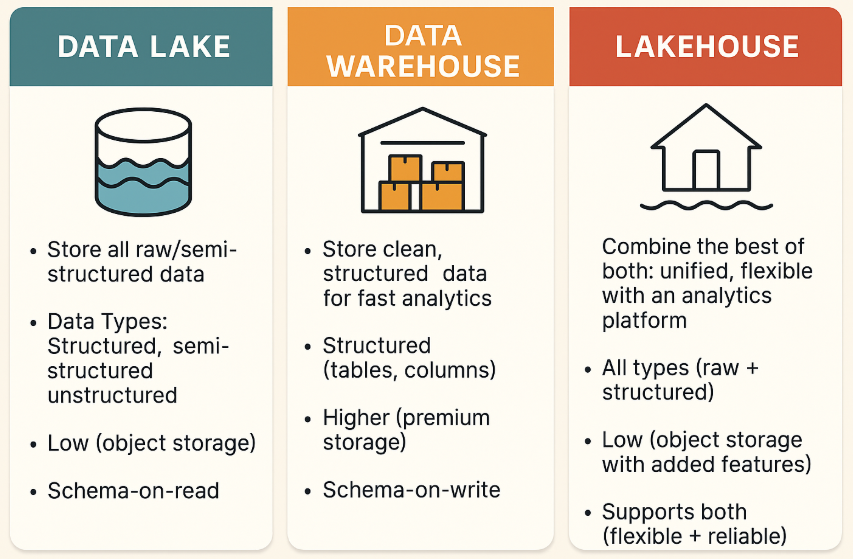
Here’s a concise comparison of Lakehouse vs. Data Lake vs. Data Warehouse in a table, with a slide-ready bullet summary below:
Comparison Table
| Feature/Aspect | Data Lake | Data Warehouse | Lakehouse |
|---|---|---|---|
| Purpose | Store all raw/semi-structured data | Store clean, structured data for fast analytics | Combine the best of both: unified, flexible analytics platform |
| Data Types | Structured, semi-structured, unstructured | Structured (tables, columns) | All types (raw + structured) |
| Storage Cost | Low (object storage) | Higher (premium storage) | Low (object storage with added features) |
| Schema | Schema-on-read | Schema-on-write | Supports both (flexible + reliable) |
| Processing | Batch & streaming, but requires extra tools | Batch/real-time (highly optimized) | Batch, streaming, and advanced (unified engine) |
| Data Quality | Variable (raw, can be messy) | High (strict quality/enforced) | High (ACID with flexibility) |
| Governance | Basic | Strong (RBAC, auditing) | Enterprise-grade (fine-grained, lineage) |
| Analytics | Not optimized (needs extra layer) | Highly optimized (BI/SQL ready) | Optimized for BI, ML, SQL, streaming |
| Machine Learning | Needs integration | Possible, not native | Native ML/AI support |
| Typical Users | Data engineers, scientists | BI analysts, business users | All users (engineers, analysts, scientists) |
| Examples | AWS S3, Azure Data Lake | Snowflake, BigQuery, Redshift | Databricks Lakehouse, Delta Lake |
Slide-Ready Bullet Summary
- Data Lake:
- Stores all types of raw data, cheap and scalable, but requires extra tools for analytics/quality.
- Data Warehouse:
- Stores clean, structured data, optimized for analytics and BI, but is less flexible and more expensive.
- Lakehouse:
- Unifies the flexibility of data lakes and reliability/performance of warehouses.
- Supports all analytics workloads (BI, ML, streaming) on a single platform.
- Delivers high data quality, strong governance, and cost-effective storage.
