Introduction
In the current landscape of cloud computing, security is no longer a siloed department at the end of the hall; it is woven into every stage of the development lifecycle. For software engineers, managers, and infrastructure professionals across India and the globe, understanding cloud security deeply is a requirement for mature career growth. In my time managing large-scale infrastructures, I’ve seen that the most resilient systems are those where the engineers treat security as a primary feature rather than an afterthought. Certifications are often viewed as checkboxes, but the AWS Certified Security – Specialty (SCS-C02) represents a genuine, hard-earned expertise that carries significant weight in the industry. It proves that you can move past basic configurations and handle high-stakes environments where data integrity and compliance are non-negotiable. This guide cuts through the noise to show you how to master this domain.
The Certification Snapshot
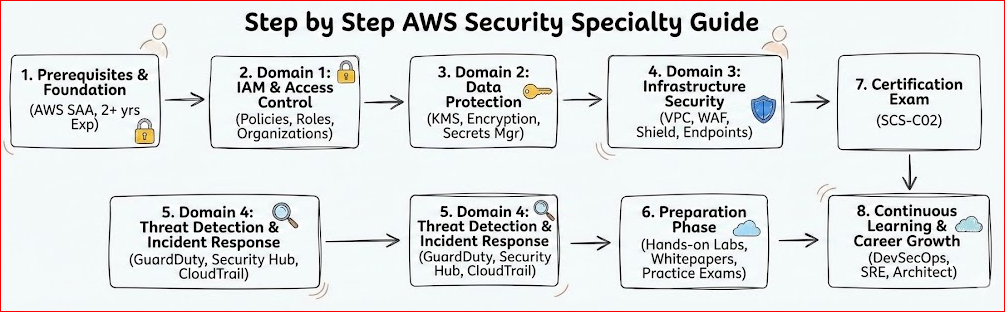
This certification focuses on the ability to design and implement security solutions within the AWS Cloud. It tests your knowledge across five domains: Incident Response, Logging and Monitoring, Infrastructure Security, Identity and Access Management, and Data Protection. Unlike associate exams, the questions here are scenario-based and require you to choose the “most secure” or “best practice” option among several technically correct answers.
| Feature | Details |
| Certification Name | AWS Certified Security – Specialty |
| Track | Security / Specialty |
| Level | Advanced / Specialty |
| Who it’s for | Experienced cloud engineers, security personnel, and DevOps professionals responsible for securing AWS environments. |
| Prerequisites (Official) | None explicitly required, but AWS Certified Solutions Architect – Associate is highly recommended first. |
| Prerequisites (Real World) | At least 2–3 years of hands-on experience securing AWS workloads and a firm grasp of JSON and CLI. |
| Skills covered | Identity management, data protection, infrastructure security, threat detection, incident response, and compliance. |
| Recommended order | Take this after an Associate-level certification to ensure you understand general AWS architecture first. |
Deep Dive: AWS Certified Security – Specialty (SCS-C02)
What it is
The AWS Certified Security – Specialty is the gold standard for validating deep technical skills in securing data and workloads. It requires mastery of complex identity policies, encryption hierarchies (KMS), and automated security governance across multi-account environments. This exam is less about clicking buttons and more about understanding the underlying logic of how AWS services authorize and protect data.
Who should take it
This is for Security Engineers moving from on-prem to cloud who need to translate traditional concepts into cloud-native equivalents. It is also vital for DevOps or Platform Engineers who find themselves responsible for the security of production-grade infrastructure. If you are a lead or manager, this certification provides the technical depth needed to vet the security of your team’s architectural decisions.
Skills you’ll gain
- Identity Management: You will learn to implement complex, multi-account strategies using Organizations, Service Control Policies (SCPs), and permissions boundaries to prevent privilege escalation.
- Data Protection: You will master encryption at rest and in transit, specifically understanding how to manage KMS key policies, grants, and automatic rotation.
- Infrastructure Security: You’ll gain the ability to secure network layers using advanced VPC configurations, WAF, Shield, and private endpoints to keep traffic off the public internet.
- Threat Detection: You will learn to build automated systems using GuardDuty, Security Hub, and Amazon Inspector to find vulnerabilities before they are exploited.
- Incident Response: You will develop the skills to execute automated response plans, such as isolating compromised instances or revoking leaked credentials in seconds.
Real-world projects you should be able to do
- Automated Compliance Guardrails: Build a system where non-compliant S3 buckets are automatically detected by AWS Config and remediated via a Lambda function. This demonstrates that you can enforce security policy without manual intervention.
- Centralized Logging Architecture: Design a multi-account logging strategy where CloudTrail and VPC Flow Logs are sent to a hardened, central security account for analysis. This is a staple in enterprise-level security.
- Cross-Account KMS Strategy: Create a secure method for sharing encrypted data between different AWS accounts while maintaining strict “least privilege” access to the decryption keys. This shows you can handle complex, real-world data pipelines.
Preparation plan
The time you need depends on your current exposure to AWS security services. I always suggest spending more time in the management console than in a textbook.
The Sprint (14 Days)
This is for engineers who work in AWS security daily. Spend the first week focusing on the gaps in your knowledge, particularly the fine details of KMS key policies and IAM evaluation logic. Use the second week strictly for practice exams and reviewing the “why” behind every wrong answer to sharpen your test-taking logic.
The Standard Path (30 Days)
This is for working cloud engineers who have some security exposure. Spend 15 days on the core domains: IAM, Data Protection, and Infrastructure Security. Use the remaining 15 days to study specialized services like AWS WAF, Certificate Manager, and Secrets Manager while taking regular assessment quizzes to track your progress.
The Steady Path (60 Days)
If you are moving from a general IT background, start by building small, secure projects in a sandbox account. Spend the first month understanding how to break and fix IAM policies and network access lists. The second month should be dedicated to reading official whitepapers and documentation to understand the broader context of AWS security architecture.
Common mistakes made by candidates
- Underestimating KMS: Many fail because they don’t understand the difference between Key Policies and IAM Policies or how to handle cross-account key access. You must know when to use a grant versus a policy.
- Ignoring JSON Policy Logic: The exam often presents complex JSON policies where one small “Condition” block changes the entire permission. You need to be able to scan these quickly and find the flaw.
- Memorizing Services Instead of Scenarios: The exam doesn’t ask “what is GuardDuty?” but rather “how do you use GuardDuty to trigger an automated block in WAF?” Focus on the integration between services.
Choose Your Path
Security is a horizontal skill that improves every operational role. Here is how this specialty certification enhances different career paths.
1. DevOps
Modern DevOps requires “Security as Code.” By mastering these tools, a DevOps engineer can bake security into the CI/CD pipeline, ensuring that every deployment is scanned for vulnerabilities and compliant with company policy from day one.
2. DevSecOps
This certification is the natural progression for DevSecOps professionals. It validates that you can provide the “Sec” in the pipeline, using native AWS tools to automate governance and reduce the burden of manual security audits.
3. SRE
Site Reliability Engineering is built on the idea that an insecure system is an unreliable one. SREs use this knowledge to build systems that can withstand DDoS attacks and protect the availability of the application under malicious stress.
4. AIOps / MLOps
Data is the lifeblood of AI. This path focuses on securing the S3 data lakes and SageMaker environments where models are trained, ensuring that the proprietary data remains confidential and the training pipelines are not tampered with.
5. DataOps
DataOps professionals must ensure that data remains protected throughout its lifecycle. This certification helps you manage encryption for Redshift clusters and implement fine-grained access control in Lake Formation to prevent unauthorized data exposure.
6. FinOps
Security breaches often manifest as unexpected spikes in the cloud bill. FinOps practitioners with this certification can implement governance to prevent unauthorized resource provisioning, which is a key part of controlling cloud waste and costs.
Role → Recommended Certifications Mapping
| Current Role | Why this Cert Matters |
| Security Engineer | It provides a baseline of cloud-native security expertise that is essential for modern career advancement. |
| Cloud/Platform Engineer | It allows you to build platforms that are secure by design, making you a much more valuable asset to the engineering team. |
| DevOps Engineer | This is the bridge that allows you to transition into higher-paying DevSecOps roles by automating security tasks. |
| Solutions Architect | It ensures that the architectures you design are compliant with industry standards like PCI-DSS or HIPAA from the start. |
| SRE | It helps you understand how to build resilience against security-related downtime and automate the recovery of compromised resources. |
| Engineering Manager | It gives you the technical vocabulary and understanding to manage risk and hire the right technical talent for your team. |
Top Institutions for Training and Certification
Choosing the right training partner is about more than just passing a test; it’s about gaining the skills to handle a real-world security incident at 3 AM. These institutions provide specialized help in Training cum Certifications for AWS Certified Security – Specialty.
finopsschool: They provide essential training on the governance side of cloud security, showing you how to implement technical controls that not only keep data safe but also prevent the “cost-leaks” that often follow security breaches.
DevOpsSchool: This is a top-tier choice for working professionals. Their curriculum is heavily focused on hands-on labs and real-world scenarios, ensuring that you don’t just learn the theory but actually know how to implement security controls in a production environment.
Cotocus: They provide a unique, consulting-led training approach. Their trainers are often active practitioners who bring current industry challenges into the classroom, making the learning process highly practical and relevant to today’s enterprise needs.
Scmgalaxy: Known for their deep focus on the software delivery lifecycle. They are excellent for engineers who want to understand how security integrates specifically into the “supply chain” of code from the developer’s laptop to the production cloud.
BestDevOps: This institution offers a broad range of resources and structured learning paths designed to bridge the gap between general operations and specialized security tasks, making it easier for traditional IT pros to transition.
devsecopsschool: As the name suggests, they are specialists in the intersection of development and security. Their training is ideal for those who want to master the automation of security audits and guardrails within a CI/CD pipeline.
sreschool: They approach security through the lens of system reliability. Their courses teach you how to build resilient architectures that can automatically detect and recover from security-related outages or attacks.
aiopsschool: Focused on the future of operations, this institution teaches you how to secure the AI and Machine Learning models that are increasingly driving business decisions, ensuring data integrity and model safety.
dataopsschool: Perfect for data engineers, they focus on the security of data lakes, analytics platforms, and large-scale databases, teaching you how to implement fine-grained access control across the entire data lifecycle.
FAQs: AWS Certified Security – Specialty
Q1: How does the difficulty of this exam compare to the Professional-level certs?
In many ways, the Specialty exams are harder because they focus on depth rather than breadth. While the Solutions Architect Professional tests your ability to connect 50 different services, the Security Specialty tests if you understand the minute details of how just 10 of them interact at a deep level. It is a “deep-dive” exam that requires you to understand the “why” behind every policy and configuration.
Q2: I am a busy working professional; how much study time is truly required?
If you are working with AWS daily, you should plan for 80 to 120 hours of total study. For most engineers, this means 10-15 hours a week for about two months. If you are new to security-specific services like KMS or GuardDuty, you might need closer to three months to ensure the concepts become second nature during the high-pressure exam scenarios.
Q3: Are there any official prerequisites I need to meet before taking the exam?
Officially, AWS no longer requires you to hold a foundational or associate certification before taking a specialty exam. However, as someone who has seen many candidates fail by skipping steps, I strongly recommend earning the Solutions Architect – Associate first. Trying to learn cloud security without a solid grasp of cloud architecture is like trying to learn advanced surgery without knowing basic anatomy.
Q4: What is the recommended sequence for someone aiming for a DevSecOps role?
The most effective path is: Solutions Architect Associate → Developer Associate → Security Specialty → DevOps Engineer Professional. This sequence builds your architectural foundation, then your automation skills, and finally layers on the deep security expertise needed to truly lead a DevSecOps initiative.
Q5: What is the real-world career value of this certification in 2026?
The value lies in specialization. General cloud engineers are common; cloud security experts are rare. In 2026, with the rise of AI-driven threats and stricter global data regulations, this certification acts as a premium “filter” for recruiters. It often results in a salary bump of 20% to 30% compared to non-specialized roles because you are proving you can handle the organization’s most sensitive risks.
Q6: What specific career outcomes can I expect after getting certified?
You will likely see a shift in the quality of roles offered to you. Instead of “General Cloud Engineer,” you will be targeted for Cloud Security Architect, Lead DevSecOps Engineer, or Security Consultant positions. In the Indian and global markets, these roles not only offer higher pay but also provide more job security, as security teams are usually the last to be affected during corporate restructuring.
Q7: Is this certification useful for Engineering Managers who don’t code daily? Absolutely. For a manager, this certification isn’t about knowing how to write every IAM policy yourself; it’s about knowing what “good” looks like. It gives you the technical authority to vet your team’s security posture, understand the risks in your roadmap, and communicate those risks effectively to senior leadership or auditors.
Q8: How does this cert benefit a Software Engineer who isn’t on the infrastructure team?
Modern software development is “infrastructure as code.” If you are a developer, this certification helps you write more secure code and configuration from the start. You’ll understand how to use Secrets Manager instead of hardcoding credentials and how to architect applications that utilize least-privilege IAM roles, making your code “production-ready” by default.
Q9: Why is the focus on KMS and IAM so heavy in this exam?
Identity and Access Management (IAM) and Key Management Service (KMS) are the “gatekeepers” of your cloud environment. If an attacker gets past these, they have everything. The exam emphasizes these services because mastering them allows you to create a “zero trust” environment where every action is authenticated, authorized, and encrypted.
Q10: How do the career outcomes differ between the Indian market and the global market?
In India, this certification is a massive differentiator in the competitive service-sector and product-startup ecosystem, often leading to roles in specialized “Centers of Excellence.” Globally, particularly in the US and Europe, it is often a mandatory requirement for high-level consulting or government-related cloud projects where compliance is a strict barrier to entry.
Q11: What is the most common reason people fail this exam?
The most common mistake is relying on “brain dumps” or theory alone. The exam uses long, scenario-based questions where multiple answers are technically correct, but only one follows the “AWS Well-Architected” security pillar. You can only identify that specific answer if you have hands-on experience troubleshooting and building these systems in a lab.
Q12: How long is the certification valid, and what is the recertification process?
The certification is valid for three years. To stay current, you must pass the most recent version of the exam (currently SCS-C02/SCS-C03) before your original one expires. This ensures you are up to date on the latest AWS security features, such as AI-driven threat detection and automated governance tools like Security Lake.
FAQs on AWS Certified Security – Specialty
Q1: How difficult is the AWS Security Specialty exam?
It is considered one of the more challenging AWS exams because of its depth. While the Associate exams test your knowledge of what services exist, this exam tests your ability to troubleshoot complex security misconfigurations and choose the most secure architectural path.
Q2: How much time should I dedicate to studying if I have a full-time job?
Most working professionals find that 10–12 hours a week over the course of two months is the sweet spot. This allows enough time to digest the whitepapers and spend significant hours in the lab without burning out.
Q3: Are there any prerequisites I should complete first?
While AWS no longer requires it, I strongly recommend having the Solutions Architect – Associate certification first. Understanding the general architecture of AWS is critical before you can learn how to properly secure every individual component.
Q4: What is the most important service to master for the exam?
The Identity and Access Management (IAM) service is the foundation of everything in AWS security. You must understand how to read and write policies, how the evaluation logic works, and how to use IAM roles for cross-account access.
Q5: Does this certification help with specific industry compliances like GDPR or HIPAA?
Yes, the certification teaches you the AWS tools used to meet these standards, such as AWS Artifact for compliance reports and KMS for encryption. It gives you the technical framework to implement the controls required by various regulatory bodies.
Q6: Is it worth taking if I already have a general security certification like CISSP?
Absolutely. While CISSP covers broad security management and theory, the AWS Security Specialty proves you know how to execute those theories specifically within the AWS cloud environment using their native tools and APIs.
Q7: How often do I need to recertify?
AWS certifications are valid for three years. Recertification shows that you are keeping up with the rapid pace of change in cloud services and new security features that AWS releases annually.
Q8: Can this certification help me move into a leadership role?
Yes, because it demonstrates that you understand the highest level of risk management in the cloud. It provides the technical authority needed to lead teams and communicate security risks to non-technical stakeholders.
Next Certifications to Take
- Same Track (Depth): Consider vendor-neutral security certifications like the Certified Information Systems Security Professional (CISSP) to broaden your management-level security knowledge.
- Cross-Track (Breadth): The AWS Certified Solutions Architect – Professional is a great next step to see how your security knowledge integrates into massive, multi-tiered enterprise architectures.
- Leadership: The AWS Certified DevOps Engineer – Professional will help you master the automation side of things, turning you into a highly sought-after expert who can build, secure, and scale anything.
Testimonials
“I spent years in network security, but the cloud felt like a different world. This certification helped me realize that the principles remain the same, but the execution is much faster. It changed the way I look at infrastructure—now I see every resource as a set of permissions that need to be tightly controlled.”
— Arjun S., Security Lead, Pune
“As a manager, I needed to know if my team’s designs were actually safe. Taking this certification gave me the technical grounding to ask the right questions during architectural reviews. It’s not just for the engineers; it’s for anyone who is accountable for the data being hosted in the cloud.”
— Meera K., Engineering Manager, Singapore
“The hands-on labs were the real game-changer for me. Reading about KMS is one thing, but actually configuring a cross-account key policy and seeing it work is another. This certification immediately made me the ‘go-to’ person in my company for any cloud security questions.”
— David L., Senior DevOps Engineer, New York
Conclusion
Building a career in the cloud requires more than just knowing how to deploy an application; it requires the wisdom to protect it. The AWS Certified Security – Specialty is a testament to your commitment to that craft. It marks you as a professional who understands that in the digital age, trust is built through technical excellence and uncompromising security standards. The journey to this certification is a learning process that will stay with you long after the exam is over. It provides a structured way to master the most critical services in the AWS ecosystem. I encourage you to start this journey not just for the badge, but for the clarity and confidence it will bring to your daily work.