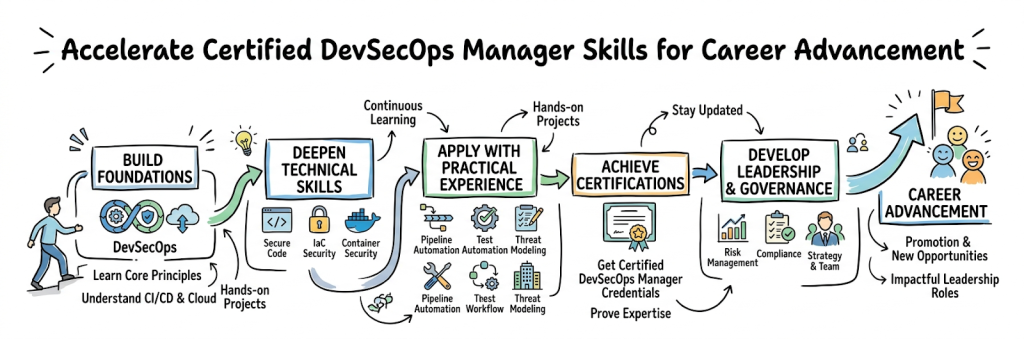
Security can no longer be a separate step at the end of development. Modern companies want security built into every commit, pipeline, and deployment. The Certified DevSecOps Manager program from DevSecOpsSchool is designed to create leaders who can make this happen at scale.
This guide is for working engineers, software developers, SREs, platform and cloud engineers, and managers in India and worldwide who want to move into DevSecOps leadership roles. You will learn what the certification is, who it is for, the skills you gain, how to prepare, how it fits into different career paths, and what to do next after earning it.
Master Certification Table
Certified DevSecOps Manager – Mini Sections
What it is
The Certified DevSecOps Manager is a leadership-focused certification that teaches you how to embed security into every phase of the software delivery lifecycle. It covers risk management, governance, compliance as code, and the human side of changing how teams build and ship software.
Who should take it
This certification is ideal for:
- DevOps, SRE, and Platform Engineers who want to lead security initiatives.
- Security Engineers and AppSec professionals who want to own DevSecOps strategy.
- Cloud Engineers who manage large environments and need structured security governance.
- Team leads and Engineering Managers responsible for both delivery speed and security.
Skills you’ll gain
- DevSecOps strategy and roadmap design.
- Policy as code and governance plugged into CI/CD.
- Mapping security controls to frameworks like ISO, SOC 2, GDPR, HIPAA, and NIST.
- Threat modeling at scale for microservices, cloud, and container-based systems.
- Risk-based prioritization instead of tool-driven noise.
- Metrics and KPIs for security posture, maturity, and ROI.
- Leading cross-functional DevSecOps transformation programs.
Real-world projects you should be able to do after it
After completing this certification, you should be ready to:
- Design and roll out a DevSecOps operating model for your organization.
- Implement security gates (SAST, DAST, SCA, secrets scanning) into multiple CI/CD pipelines.
- Define security SLIs/SLOs and create dashboards for leadership.
- Build a secure SDLC policy and align it with developer workflows and tooling.
- Lead incident response exercises, including post-incident reviews with clear actions.
- Map technical security controls to business risks and compliance requirements.
Preparation plan
7–14 days (Fast track)
- Best if you already work in DevOps/SRE/Security leadership.
- Focus on: official curriculum, case studies, and scenario-based questions.
- Daily routine: 2–3 hours of study on concepts + 1 hour on scenarios or practice questions.
30 days (Balanced track)
- Suitable for most working professionals.
- Week 1: DevSecOps basics, leadership concepts, security culture.
- Week 2: CI/CD security, policy as code, governance patterns.
- Week 3: Risk management, compliance mapping, and threat modeling.
- Week 4: Practice exams, case studies, and revision based on weak areas.
60 days (Deep learning track)
- Ideal if you come from pure development or pure security and are new to DevOps.
- Month 1: DevOps fundamentals, CI/CD, cloud basics, and core security concepts.
- Month 2: DevSecOps management topics, real-world program design, and internal POCs in your company.
Common mistakes to avoid
- Treating DevSecOps as just adding more scanners instead of changing processes and culture.
- Skipping fundamentals of DevOps and cloud, hoping leadership skills alone will be enough.
- Ignoring metrics and reporting, which are central to manager-level roles.
- Memorizing buzzwords instead of practicing real scenarios from your environment.
- Not aligning security with developer experience, leading to friction and resistance.
Best next certification after this
You can think about “next steps” in three directions, using patterns similar to common software engineering certification paths.
- Same track (DevSecOps specialization)
- Advanced DevSecOps or cloud security certifications that go deeper into technical controls, zero trust, and cloud-native security.
- Cross-track (Reliability / Observability / AIOps)
- SRE, Observability, or AIOps certifications that help you connect security with reliability and intelligent monitoring.
- Leadership (Broader engineering and architecture)
Choose Your Path: 6 Learning Paths
1. DevOps Path
- Focus: High-speed delivery, automation, CI/CD, and infrastructure as code.
- Start here if: You enjoy building pipelines and enabling teams to ship faster.
- Typical flow: DevOps fundamentals → DevOps professional-level → platform/architect roles.
2. DevSecOps Path
- Focus: Secure-by-default pipelines, governance as code, and security automation.
- Start here if: You want to make security part of every change, not a final hurdle.
- Typical flow: DevSecOps engineer-level → Certified DevSecOps Manager → head of DevSecOps / security leadership.
3. SRE Path
- Focus: Reliability, performance, and incident management for production systems.
- Start here if: You like debugging outages and designing resilient architectures.
- Typical flow: SRE foundations → SRE professional → SRE manager or reliability architect.
4. AIOps/MLOps Path
- Focus: Using AI/ML to improve operations, monitoring, and deployments.
- Start here if: You enjoy working with data, automation, and ML-driven insights.
- Typical flow: DevOps/SRE base → AIOps/MLOps certifications → automation/intelligence leadership.
5. DataOps Path
- Focus: Reliable, secure, and compliant data pipelines.
- Start here if: You work on data engineering or analytics platforms.
- Typical flow: Data engineering → DataOps certifications → data platform or governance leadership.
6. FinOps Path
- Focus: Cloud cost optimization, budgeting, and financial accountability.
- Start here if: You care about the business side of cloud usage.
- Typical flow: Cloud foundations → FinOps practitioner-level → FinOps lead/manager roles.
The Certified DevSecOps Manager fits especially well if you follow a DevOps or SRE path and want to add security leadership on top.
Role → Recommended Certifications
Top Institutions for Training and Certification Support
These institutions can help you prepare for the Certified DevSecOps Manager program with training, labs, and mentoring.
DevOpsSchool
DevOpsSchool offers practical DevOps and DevSecOps training with a strong focus on labs, CI/CD pipelines, and real-world scenarios. It supports engineers and managers through instructor-led sessions, hands-on projects, and structured learning paths aligned with modern roles.
Cotocus
Cotocus works on consulting, training, and implementation for DevOps, SRE, and DevSecOps in enterprises. It often helps teams design end-to-end transformation roadmaps and uses certifications like Certified DevSecOps Manager to structure capability building.
ScmGalaxy
ScmGalaxy focuses on source control, CI/CD, and DevOps tooling with security integration. For future DevSecOps managers, it provides strong foundations in version control, pipelines, and artifact management, which are critical for secure delivery.
BestDevOps
BestDevOps acts as a knowledge and community platform around DevOps and DevSecOps technologies. It shares tutorials, case studies, and updates that can complement your formal preparation for the manager-level certification.
devsecopsschool.com
DevSecOpsSchool is the dedicated DevSecOps provider behind the Certified DevSecOps Manager certification itself. It maintains updated curricula, role-based paths, and labs focused on integrating security across the DevOps lifecycle for engineers and managers.
sreschool.com
SRESchool provides SRE-centric training on reliability, incident management, and observability. This knowledge is useful for DevSecOps managers who need to balance reliability and security in large-scale systems.
aiopsschool.com
AIOpsSchool covers AIOps and MLOps, including anomaly detection, intelligent monitoring, and ML-driven automation. For DevSecOps managers, it adds depth on using AI and data for security monitoring and incident response.
dataopsschool.com
DataOpsSchool focuses on building and governing reliable data pipelines. DevSecOps managers who work with analytics, BI, or ML platforms can use this to design secure and compliant data workflows.
finopsschool.com
FinOpsSchool specializes in cloud cost management and financial governance. This helps DevSecOps managers justify security investments, align with budgets, and design cost-aware security strategies.
Next certifications to take (3 options: same track, cross-track, leadership)
Option 1: Same track – go deeper in DevSecOps
If you want to stay focused on DevSecOps and security leadership:
- Advanced DevSecOps / DevSecOps Architect–level certification
This is the natural next step if you already lead DevSecOps and now need stronger architecture and design skills.
Option 2: Cross‑track – strengthen a connected domain
If you want to round out your profile with an adjacent track that works closely with DevSecOps, you can choose one of these:
- SRE / Reliability Manager–style programs
- Focus on error budgets, SLOs, incident management, and reliability strategy.
- FinOps / Cloud cost certifications (FinOps Practitioner / similar)
- Help you manage the rising cost of cloud‑native security and show ROI for security investments.
These cross‑track options make you stronger at connecting security with reliability and cost, which is very valuable for platform and engineering leaders.
Option 3: Leadership – broader architecture and program ownership
If your goal is to move into wider technical leadership or head‑of‑function roles:
- Master‑level DevOps / Observability / Security leadership programs
- Examples include “Master in DevOps Engineering”–type programs or advanced security leadership tracks.
- They focus on end‑to‑end architecture, organization design, transformation, and large‑scale program management.
This path is best if you see yourself driving strategy across multiple teams, platforms, and security initiatives in the next few years.
FAQs (General Questions)
1. Is Certified DevSecOps Manager a technical or managerial certification?
It is a manager-level certification with both technical and leadership aspects. You are expected to understand tools and pipelines but focus more on strategy, governance, and leading change.
2. How hard is the exam?
The exam is challenging if you are new to DevOps or security but reasonable for experienced professionals. Many questions are scenario-based and test how you would make trade-offs, not just definitions.
3. How much time do I need to prepare?
Most candidates need between 2 and 8 weeks, depending on their background. With a solid DevOps/SRE/security foundation, 7–14 days of focused study can be enough.
4. What are the prerequisites?
There is no strict formal prerequisite, but you should have experience with CI/CD, cloud platforms, and basic application security concepts. Prior exposure to DevOps or security certifications is helpful.
5. Do I need coding skills?
You do not need to be a full-time developer, but you should be comfortable with scripting, configuration files (like YAML), and understanding pipelines. The emphasis is on architecture and design rather than writing large applications.
6. How does this certification help my career?
It positions you for roles like DevSecOps Manager, Security Engineering Manager, Head of DevSecOps, or Platform Security Lead. It also strengthens your profile for senior engineering and architecture positions where security is a major responsibility.
7. Is it useful if I am currently an SRE?
Yes. SREs often own availability and incident response, and security is tightly connected to those areas. This certification helps you integrate security controls and processes into how you manage reliability.
8. Does it help with compliance and audits?
The program covers how to map DevSecOps practices to frameworks like ISO, SOC 2, HIPAA, GDPR, and NIST. You learn to design pipelines and processes that produce evidence auditors can rely on.
9. Can I study while working full-time?
Yes. The 30- and 60-day plans are designed for busy professionals. Consistent 1–2 hour sessions are usually more effective than occasional long marathons.
10. How is it different from a DevSecOps Engineer certification?
Engineer-level certifications focus on how to configure and run tools. Certified DevSecOps Manager focuses on designing the overall system, policies, and governance to make those tools effective across teams.
11. Is this certification recognized globally?
DevSecOps practices and the core ideas of this certification are aligned with global standards and cloud-native practices. Professionals from different regions can apply the same patterns in their own organizations.
12. Is it only for large enterprises?
No. Even mid-sized organizations and startups benefit from a structured DevSecOps approach, especially as they grow and face audits or customer security reviews. The principles scale up or down with the size of your environment.
FAQs (specifically on Certified DevSecOps Manager)
1. What exactly does the Certified DevSecOps Manager exam cover?
It covers DevSecOps strategy, governance, CI/CD security, compliance as code, metrics, and leadership scenarios. You can expect questions around real-world decisions, trade-offs, and risk-based prioritization.
2. Who designs and maintains the Certified DevSecOps Manager program?
The program is designed and maintained by DevSecOpsSchool, a provider focused on DevSecOps training and certifications. They keep it aligned with current threats, tools, and industry practices.
3. Is there a specific exam format?
The exact format is defined by the provider, but it typically includes multiple-choice and scenario-based questions. Case-study style problems are common to test your decision-making skills.
4. Can I take the exam online?
Providers like DevSecOpsSchool support online exam options, which is convenient for working professionals worldwide. Check the official page for the latest details on proctoring and scheduling.
5. What if I fail the exam the first time?
You can usually retake the exam after a defined waiting period according to provider rules. Many candidates use the gap between attempts to work on weaker areas identified in their first try.
6. Will this certification help me move into management?
Yes, especially if you are already a senior engineer or tech lead. It gives you language and frameworks to talk about risk, governance, and security in business terms, which is essential for management roles.
7. How can I prove value to my company after getting certified?
You can design or improve your organization’s DevSecOps roadmap, run internal workshops, and lead improvements in security metrics and audit readiness. Demonstrating concrete changes in pipelines and processes is the best proof.
8. Is this the right first step if I am completely new to DevSecOps?
If you are completely new, it may be better to start with DevOps and basic security concepts first. The Certified DevSecOps Manager is best when you already understand the environment and want to lead change rather than just learn tools.
Conclusion
The Certified DevSecOps Manager certification is built for engineers and managers who want to lead secure software delivery, not just participate in it. It helps you connect DevOps, security, compliance, and business outcomes into one clear strategy that your teams can execute every day. For today’s software engineers, SREs, security professionals, and engineering leaders, this program offers a clear path to becoming the person responsible for making security an integrated, reliable part of delivery.
