Introduction
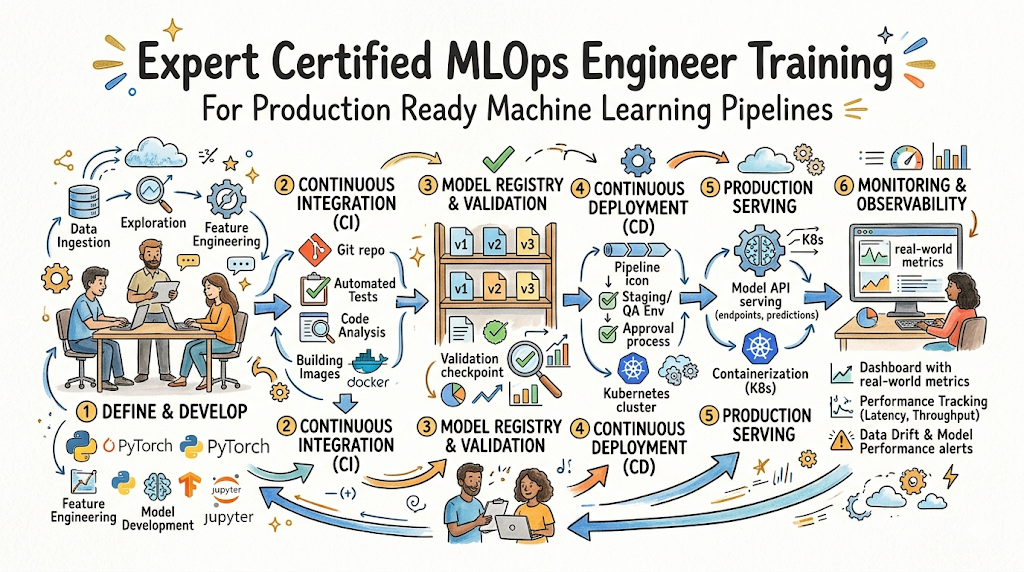
The Certified MLOps Engineer is a professional benchmark designed for those who want to master the intersection of data science and systems engineering. This guide provides a comprehensive roadmap for engineers and managers who recognize that the future of software lies in production-grade artificial intelligence. By focusing on the operational aspects of machine learning, this certification helps professionals transition from manual experimentation to automated, scalable deployments. Whether you are coming from a DevOps, SRE, or Data Engineering background, this framework offers the technical depth required to lead high-impact AI initiatives. The training and certification ecosystem hosted on aiopsschool ensures that candidates gain practical, real-world experience that translates directly into enterprise value.
What is the Certified MLOps Engineer?
The Certified MLOps Engineer represents a paradigm shift in how machine learning is integrated into the modern software development lifecycle. It exists to bridge the gap between building a model in a notebook and running that model reliably in a production environment at scale. This certification focuses on the engineering rigor required to manage data pipelines, version control for models, and automated deployment strategies. Unlike academic machine learning courses, this program is rooted in the practical realities of cloud-native infrastructure and distributed systems. It aligns with enterprise needs by emphasizing high availability, monitoring, and the security of machine learning assets.
Who Should Pursue Certified MLOps Engineer?
This certification is designed for a broad spectrum of technical professionals, ranging from software developers to platform architects. Systems engineers and SREs will find it invaluable as they are increasingly required to support specialized AI workloads that behave differently than traditional microservices. Data engineers who wish to expand their influence into model serving and lifecycle management will find a clear progression path here. It is equally relevant for technical managers in India and across the globe who need to understand the architectural requirements of an AI-driven organization. Even beginners with a strong foundation in Linux and Python can use this as a springboard into one of the most lucrative niches in the current job market.
Why Certified MLOps Engineer is Valuable in 2026 and Beyond
The value of becoming a Certified MLOps Engineer lies in the long-term industry shift toward automated AI operations. While specific machine learning models may come and go, the infrastructure required to deploy, monitor, and retrain them remains a constant necessity for any enterprise. This certification provides professionals with a “future-proof” skill set that remains relevant even as individual tools or frameworks evolve. By mastering these principles, engineers can ensure high ROI for their organizations by reducing the time it takes to move models from research to production. It positions you as a critical asset in any company looking to scale its AI capabilities without increasing technical debt.
Certified MLOps Engineer Certification Overview
The program is delivered via the official aiopsschool website and is structured to reflect the actual workflow of a production engineering team. It moves beyond simple multiple-choice questions, often incorporating performance-based assessments that require candidates to build and troubleshoot real pipelines. The certification levels are designed to take a professional from foundational concepts to advanced architectural design, ensuring a steady growth of competence. Ownership of this program is managed by practitioners with decades of experience in high-scale systems, ensuring the curriculum stays current with industry trends. By achieving this certification, you demonstrate to employers that you have the hands-on skills necessary to manage the complexities of modern machine learning platforms.
Certified MLOps Engineer Certification Tracks & Levels
The certification is structured into three primary levels: Foundation, Professional, and Advanced, allowing for a logical career progression. The Foundation level focuses on the basic terminology, the ML lifecycle, and the essential tools like Docker and Git. The Professional level dives into the “how-to” of automation, focusing on Kubernetes, CI/CD for machine learning, and advanced monitoring techniques. The Advanced level is for those aiming for leadership or specialized roles, covering topics like feature stores, model governance, and cost optimization. This tiered approach ensures that engineers can enter at a level appropriate to their current experience while having a clear path for future growth.
Complete Certified MLOps Engineer Certification Table
| Track | Level | Who it’s for | Prerequisites | Skills Covered | Recommended Order |
| MLOps Core | Foundation | Aspiring Engineers | Basic Python/Linux | ML Lifecycle, Git, Docker | 1 |
| Platform | Professional | DevOps/Data Eng | Foundation Cert | K8s, CI/CD, Monitoring | 2 |
| Architecture | Advanced | Senior Architects | Professional Cert | Feature Stores, Drifts, Scaling | 3 |
| AI Security | Specialist | Security Pros | Professional Cert | Model Hardening, IAM for ML | 4 |
| AI FinOps | Specialist | Cloud Economists | Professional Cert | GPU Costing, Resource Optim | 5 |
Detailed Guide for Each Certified MLOps Engineer Certification
Certified MLOps Engineer – Foundation
What it is
The Foundation level validates a candidate’s grasp of the core concepts of machine learning operations and the fundamental differences between traditional software and AI-based systems. It is the essential starting point for building a career in MLOps.
Who should take it
This is suitable for junior developers, system administrators, and recent graduates who want to enter the AI field from an operational perspective. It is also great for non-technical stakeholders who need to understand the MLOps lifecycle.
Skills you’ll gain
- Identifying the stages of the machine learning lifecycle.
- Basic versioning of data and model artifacts.
- Containerizing simple machine learning models for deployment.
- Understanding basic monitoring requirements for production models.
Real-world projects you should be able to do
- Create a reproducible environment using Docker for a Python ML model.
- Implement a basic Git-based workflow for code and model tracking.
- Set up a simple automated test for data validation.
Preparation plan
- 7-14 Days: Focus on understanding the terminology and the ML lifecycle diagram.
- 30 Days: Practice basic Docker commands and Git branching strategies for data.
- 60 Days: Build and document a local end-to-end model pipeline.
Common mistakes
- Focusing too much on ML algorithms instead of the operational pipeline.
- Neglecting the importance of data versioning.
- Skipping the fundamentals of containerization.
Best next certification after this
- Same-track option: Certified MLOps Engineer – Professional
- Cross-track option: Certified DataOps Associate
- Leadership option: AI Project Management Foundation
Certified MLOps Engineer – Professional
What it is
The Professional level is a deep dive into the technical implementation of MLOps pipelines using enterprise-grade tools. It confirms that an engineer can build, secure, and maintain automated machine learning platforms.
Who should take it
This is intended for mid-level DevOps engineers, SREs, and Data Engineers who are tasked with scaling AI applications. Candidates should have a working knowledge of container orchestration.
Skills you’ll gain
- Orchestrating complex ML workflows with Kubernetes.
- Implementing Continuous Training (CT) pipelines.
- Advanced monitoring for model and data drift.
- Managing distributed training environments at scale.
Real-world projects you should be able to do
- Deploy a multi-node Kubernetes cluster for model inference.
- Build a CI/CD pipeline that automatically retrains a model on performance drop.
- Configure Prometheus and Grafana for model performance dashboards.
Preparation plan
- 7-14 Days: Deep dive into Kubernetes manifests and Helm.
- 30 Days: Master a workflow engine like Kubeflow or Airflow.
- 60 Days: Complete a full deployment of an automated pipeline on a cloud provider.
Common mistakes
- Failing to account for resource limits and GPU scheduling.
- Setting up brittle pipelines that lack proper error handling.
- Ignoring security vulnerabilities in third-party ML libraries.
Best next certification after this
- Same-track option: Certified MLOps Engineer – Advanced
- Cross-track option: Certified SRE Professional
- Leadership option: MLOps Team Lead
Certified MLOps Engineer – Advanced
What it is
The Advanced certification is for those designing the strategy and architecture of enterprise-scale AI platforms. It focuses on the governance, cost, and high-level orchestration of multiple ML teams and products.
Who should take it
This is for Senior Architects, Principal Engineers, and Technical Directors who are responsible for an organization’s entire AI infrastructure strategy and long-term technical roadmap.
Skills you’ll gain
- Designing enterprise-wide feature stores for data consistency.
- Implementing robust model governance and compliance frameworks.
- Strategic cost management for high-performance computing resources.
- Architecting multi-cloud MLOps environments.
Real-world projects you should be able to do
- Design a centralized feature store accessible by multiple data science teams.
- Create a governance policy for model auditing and explainability.
- Develop a cost-allocation model for various AI business units.
Preparation plan
- 7-14 Days: Research architectural patterns for enterprise feature stores.
- 30 Days: Study regulatory requirements for AI in different sectors (Finance, Health).
- 60 Days: Draft an end-to-end MLOps platform architecture for a hypothetical large enterprise.
Common mistakes
- Over-engineering solutions for small-scale teams.
- Neglecting the financial impact of unoptimized GPU usage.
- Choosing proprietary tools that lead to heavy vendor lock-in.
Best next certification after this
- Same-track option: AI Ethics and Governance Specialist
- Cross-track option: Cloud Solution Architect Expert
- Leadership option: Chief Technology Officer (CTO) Track
Choose Your Learning Path
DevOps Path
The DevOps path focuses on extending traditional CI/CD principles to the world of machine learning. Professionals in this track learn how to treat models as software artifacts that require rigorous testing, versioning, and automated delivery. The emphasis is on building pipelines that are resilient and reproducible, ensuring that code and data are always in sync. It is a natural transition for those already comfortable with automation who want to apply their skills to the fastest-growing sector of IT. This path ensures that the “Ops” in MLOps is handled with the same discipline as any other mission-critical service.
DevSecOps Path
Security is often an afterthought in machine learning, but the DevSecOps path makes it central to the workflow. This path covers the unique security challenges of AI, such as protecting models from adversarial attacks and securing sensitive training data. Engineers learn how to implement automated security scans for model weights and how to manage access control for large-scale data lakes. This track is essential for anyone working in regulated industries where data privacy and model integrity are paramount. It builds a bridge between the data science team and the corporate security office.
SRE Path
The SRE path focuses on the reliability and performance of machine learning systems in production. It applies the principles of SLOs, SLIs, and error budgets to the often unpredictable behavior of ML models. SREs in this track learn how to build self-healing infrastructure that can detect and mitigate performance issues before they impact the user. They focus on the observability of non-deterministic systems, ensuring that models remain available and performant under heavy load. This is the ultimate path for those who enjoy high-scale infrastructure and complex troubleshooting.
AIOps Path
AIOps is a specialized field where machine learning is used to enhance IT operations themselves. Professionals in this path learn how to build and deploy models that can predict system failures, automate incident response, and analyze massive amounts of log data. It is a distinct path from MLOps, as the primary objective is the health and efficiency of the infrastructure. This track is perfect for those who want to use AI to solve the very problems they face daily as operations engineers. It represents the peak of modern, automated IT management.
MLOps Path
The pure MLOps path is for those who want to be the primary architects of the machine learning lifecycle. This track covers everything from the initial data ingestion to the final model serving and monitoring stages. Engineers learn how to build the “connective tissue” between data scientists and production systems, making it easy for researchers to deploy their work. It requires a balanced understanding of both software engineering and the fundamentals of data science experimentation. This path is the core of the certification and is ideal for those who want to be specialized experts in the field.
DataOps Path
DataOps is the backbone of any successful MLOps implementation, focusing on the automated and reliable delivery of data. This path teaches engineers how to build pipelines that ensure data quality, consistency, and lineage throughout the ML lifecycle. By treating data as code, professionals in this track reduce the errors and delays that often plague machine learning projects. It is a critical path for ensuring that the models being built are based on trustworthy and up-to-date information. DataOps specialists are the unsung heroes who make large-scale AI possible.
FinOps Path
As AI becomes more prevalent, the cost of cloud computing and specialized hardware like GPUs can spiral out of control. The FinOps path focuses on the financial management and optimization of machine learning infrastructure. Professionals learn how to balance performance with cost, implement resource tagging, and provide financial transparency for AI initiatives. This track is increasingly important for organizations that need to prove the profitability of their AI investments. It combines technical cloud knowledge with business and financial acumen.
Role → Recommended Certified MLOps Engineer Certifications
| Role | Recommended Certifications |
| DevOps Engineer | Certified MLOps Engineer – Professional |
| SRE | Certified MLOps Engineer – Professional (SRE Focus) |
| Platform Engineer | Certified MLOps Engineer – Advanced |
| Cloud Engineer | Certified MLOps Engineer – Professional |
| Security Engineer | Certified MLOps Engineer – Security Specialist |
| Data Engineer | Certified MLOps Engineer – Professional (DataOps Focus) |
| FinOps Practitioner | Certified MLOps Engineer – FinOps Specialist |
| Engineering Manager | Certified MLOps Engineer – Foundation |
Next Certifications to Take After Certified MLOps Engineer
Same Track Progression
After completing the core MLOps levels, the next step is often a deep dive into specific platform technologies or specialized industry applications. You might choose to become a certified expert in a particular cloud’s ML suite, such as AWS SageMaker or Google Vertex AI. Another option is to focus on Edge MLOps, which deals with the unique challenges of deploying models on IoT devices and mobile hardware. This progression allows you to move from being a generalist to a highly sought-after specialist in a specific technological niche.
Cross-Track Expansion
Broadening your skills into related fields like DevSecOps or SRE can make you a more versatile and effective engineer. For example, an MLOps professional with deep knowledge of SRE can design systems that are not just automated, but also incredibly resilient. Alternatively, moving into Data Engineering certifications can help you understand the complexities of the data supply chain that feeds your models. This horizontal growth is often the key to becoming a Principal Engineer or a high-level systems architect who can see the “big picture.”
Leadership & Management Track
For those looking to transition into management, certifications in Agile Leadership or ITIL can complement your technical MLOps background. Understanding how to lead cross-functional teams of data scientists and engineers is a rare and valuable skill. You might also pursue a Technical Product Management certification to learn how to align AI initiatives with business goals. This path leads to executive roles such as Head of AI Operations or Director of Engineering, where you can shape the technology strategy of an entire organization.
Training & Certification Support Providers for Certified MLOps Engineer
DevOpsSchool is a premier institution focused on empowering IT professionals with the most relevant skills in the modern marketplace. Their MLOps training programs are known for being extremely hands-on, providing students with access to real labs and production scenarios. They have a global reputation for producing engineers who are ready to hit the ground running from day one. With a focus on community and continuous learning, they offer a supportive environment for career growth.
Cotocus provides high-end consulting and training for organizations undergoing digital transformation. Their approach to MLOps is rooted in years of consulting for enterprise clients, bringing a level of practical depth that is hard to find elsewhere. They focus on the architectural “why” behind the tools, helping engineers make better long-term decisions. Their training sessions are often led by active consultants who share real-world success stories and failures.
Scmgalaxy has been a pillar of the automation community for over a decade, offering an incredible depth of resources for DevOps and MLOps. Their training is characterized by a strong focus on open-source tools and vendor-neutral architectural principles. They provide a wealth of documentation, tutorials, and community forums that help students stay updated on the latest trends. It is an ideal platform for those who want a comprehensive and community-supported learning experience.
BestDevOps focuses on delivering high-impact, short-term training that helps professionals pivot their careers quickly. Their MLOps curriculum is designed to be lean and efficient, focusing on the skills that employers are currently looking for. They emphasize career coaching and interview preparation alongside technical training. For those looking to make a fast but solid entry into the MLOps field, BestDevOps offers a very practical and focused path.
devsecopsschool.com is the go-to resource for engineers who want to specialize in the security aspect of the delivery pipeline. Their courses are essential for MLOps professionals who need to learn how to protect their AI assets in a production environment. They offer deep dives into automated security testing, identity management, and compliance as code. As AI security becomes a top priority for enterprises, the training provided here is becoming increasingly critical.
sreschool.com offers a curriculum that is entirely focused on the reliability and performance of modern distributed systems. Their MLOps training modules are designed to teach engineers how to keep machine learning models running at peak efficiency. They focus on observability, incident management, and the cultural aspects of SRE. For engineers who want to specialize in the “Ops” part of MLOps at high scale, this school provides the perfect framework.
aiopsschool.com is the primary platform for MLOps and AIOps certification, offering a standardized and globally recognized curriculum. They are at the forefront of defining what it means to be a professional in this field. Their training is designed to be comprehensive, covering the entire lifecycle from experimentation to retirement. By focusing on both the technical and strategic aspects of AI operations, they prepare the next generation of technical leaders.
dataopsschool.com specializes in the often-overlooked but vital field of data management for modern engineering. Their training programs are designed to help MLOps engineers master the data pipeline, ensuring that the input to their models is always clean and reliable. They cover advanced topics like data versioning, lineage, and automated quality checks. This focus on the data layer is what separates high-quality MLOps implementations from mediocre ones.
finopsschool.com provides the essential financial training that modern cloud engineers and architects need to stay profitable. Their courses on MLOps cost optimization are a must for anyone managing significant AI workloads. They teach how to analyze cloud bills, optimize GPU usage, and implement a culture of financial accountability. In an era where AI costs can be astronomical, the skills taught here are vital for any organization’s long-term success.
Frequently Asked Questions (General)
1. Is the MLOps certification suitable for someone with no coding experience?
No, you should have a basic understanding of Python and Linux command-line operations. MLOps is an engineering-heavy field, and the ability to read and write scripts is fundamental to the certification process.
2. How does MLOps differ from standard DevOps?
While DevOps focuses on the lifecycle of code, MLOps adds the complexities of data and model versioning. MLOps also requires specialized monitoring for things like “model drift,” which doesn’t exist in traditional software.
3. What is the expected time commitment for the Professional level?
Most candidates spend 40 to 60 hours of focused study and hands-on lab work over the course of two to three months. This varies depending on your previous experience with Kubernetes and CI/CD tools.
4. Are the exams proctored?
Yes, the certification exams are typically proctored online to ensure the integrity of the designation. They involve both multiple-choice questions and practical, performance-based tasks.
5. Do I need to be a math expert to pass this certification?
No, you do not. While a basic understanding of how machine learning works is necessary, the certification focuses on the infrastructure, automation, and operations rather than the underlying mathematics.
6. Can this certification help me get a job in India?
Absolutely. India has a massive and growing market for AI and cloud-native engineering. Companies are actively looking for MLOps specialists to help scale their development teams.
7. Is there a recertification process?
Yes, because the technology changes so quickly, you are usually required to recertify or earn continuing education credits every two years to maintain your status.
8. What is the most important tool to learn for MLOps?
While there is no single tool, Kubernetes is arguably the most critical because it is the industry standard for orchestrating the containers that hold ML models and pipelines.
9. Can I take the Advanced exam before the Professional one?
No, the certification is designed as a ladder. You must pass the Professional level (or demonstrate equivalent prerequisite knowledge) before attempting the Advanced level.
10. Is the certification vendor-neutral?
Yes, the core Certified MLOps Engineer track focuses on open-source and industry-standard tools that work across all major cloud providers and on-premises environments.
11. Does the certification cover generative AI and LLMs?
Yes, modern versions of the curriculum include the operational challenges specific to Large Language Models, such as fine-tuning pipelines and high-memory inference requirements.
12. Is there a group discount for corporate teams?
Most training providers like aiopsschool.com offer corporate packages and bulk certification vouchers for engineering teams looking to upskill together.
FAQs on Certified MLOps Engineer
1. How does the certification handle the concept of Continuous Training (CT)?
The program teaches you how to architect pipelines that don’t just stop at deployment but include automated triggers for retraining models when their performance begins to degrade in the real world.
2. Does the exam require me to use a specific cloud provider like AWS or Azure?
The core exam is platform-agnostic, meaning you can demonstrate your skills using any major provider or even a local Kubernetes environment, as long as the principles of MLOps are followed.
3. What focus is placed on “Model Drift” in the Professional track?
Significant focus is placed on detecting both data drift and concept drift. You will learn to build monitoring systems that compare live production data against the original training distribution.
4. Are “Feature Stores” covered in the Foundation level?
No, Feature Stores are considered an advanced architectural concept and are covered in detail during the Professional and Advanced tracks, where enterprise-scale data management is a priority.
5. How is “Model Governance” tested in the Advanced level?
You will be asked to design systems that track model lineage, explainability, and audit trails to ensure that the AI systems meet regulatory and ethical standards.
6. Will I learn how to optimize GPU resources for cost?
Yes, specifically in the Professional and Advanced tracks, there is a strong emphasis on resource scheduling, spot instance usage, and efficient scaling to keep AI costs manageable.
7. Is “Inference Optimization” part of the curriculum?
Yes, you will learn techniques like model quantization and pruning from an operational standpoint to ensure that your models serve requests with the lowest possible latency and cost.
8. Does the certification cover the use of “GitOps” for ML?
Absolutely. GitOps is a core principle taught in the program, showing you how to use Git as the single source of truth for both your infrastructure and your machine learning model versions.
Final Thoughts: Is Certified MLOps Engineer Worth It?
As an industry veteran, I often tell my mentees that the best way to stay relevant is to solve the hardest problems. Today, the hardest problem in technology isn’t building a model—it’s making that model work reliably at scale. The Certified MLOps Engineer designation is more than just a piece of paper; it is a signal that you have mastered the discipline required for this new era of engineering. It bridges the gap between the experimental world of data science and the stable world of systems operations. While the path requires a significant investment of time and effort, the professional rewards and the ability to work on cutting-edge projects make it one of the most valuable moves you can make. If you are looking for a clear, structured way to elevate your career, I highly recommend starting this journey. Focus on the fundamentals, get hands-on experience, and you will find yourself at the center of the next great wave of technological innovation.
