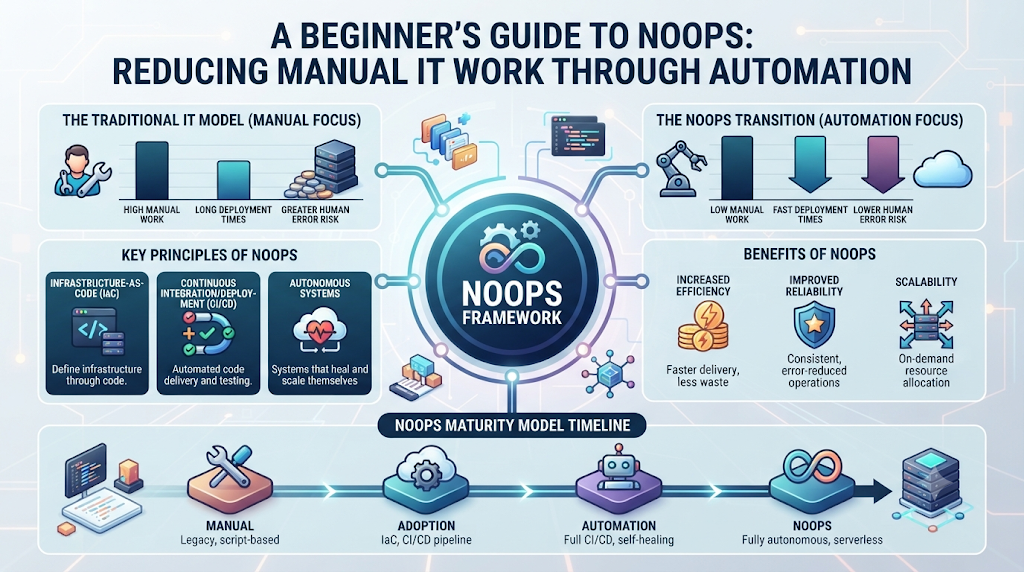
Marcus had spent twelve years as a system administrator. He was good at his job. But too much of his week went to the same tasks. He restarted services. He checked servers. He patched systems by hand.
His manager asked him to look into automation. Marcus liked the idea, but he did not know where to start. One term kept coming up in job posts and team meetings: NoOps.
He searched for a place that explained it in plain words. That search led him to NoOpsSchool. It gave him a clear way to learn, and a path to follow.
What NoOpsSchool Offers
NoOpsSchool is a platform built around one focus. It teaches NoOps, which means running IT with far less manual work. It also covers cloud infrastructure automation. And it covers modern ways of delivering software.
The platform serves several groups. It helps DevOps engineers, cloud architects, and platform engineers. It also serves software developers, system administrators, and IT managers.
Its main offering brings together four things. There are training courses and certification programs. There are educational resources. And there is practical guidance for teams that want automated IT operations.
The platform is based in India. It serves an international audience of English-speaking technical professionals. All training and services are delivered online.
The platform also works with organizations. It advertises consulting services for companies that want less manual operational work. It also advertises access to freelance specialists.
Learners and Organizations Side by Side
Here is a short table to show how the two sides differ.
| Area | For Learners and Professionals | For Organizations |
|---|---|---|
| Main purpose | Build automation skills and earn certification | Reduce manual operational work |
| What the site offers | Training courses and certification tracks | Advertised consulting and freelance access |
| Skills and topics | Infrastructure as code, Kubernetes, CI/CD, observability | Automation strategy, provisioning, security automation |
| Practical focus | Hands-on labs and real-world scenarios | Assessments and automation planning |
| Next step | Pick a role track and start learning | Confirm details with the site |
Read this table as a simple map. The left side is about personal skills. The right side is about team or company needs. Many people use both sides over time.
Part One: Learning NoOps, From the Basics to Certification
What is NoOps? A Plain-Language Explanation
Many engineers search for what is NoOps before they commit time to it. The idea is fairly simple. NoOps means automating operational work so teams spend less time on manual tasks.
That is the whole point. Routine work gets handled by systems. People then focus on design, improvement, and oversight.
It does not mean operations disappear. Someone still owns the outcome. Someone still watches the system. Automation handles the repeat work, not the responsibility.
One practical tip: start by listing your most repeated manual tasks. That list shows you where automation helps most.
NoOps vs DevOps: One Way to Look at the Difference
People often compare NoOps vs DevOps. The two ideas are related, and real teams may use parts of both.
DevOps is a set of practices. It brings development and operations teams together. They share goals and work as one group.
NoOps leans harder on automation. The aim is to let systems handle most routine operational work. Teams then step in for judgment and review.
One way to see it: DevOps is about how teams work together. NoOps is about how much the system can do alone.
Human oversight and accountability remain in both cases. One practical tip: treat the comparison as a lens, not a rule.
Who NoOpsSchool Is For
The platform is built for working technical professionals. It does not assume you are a beginner in IT. It assumes you want to move toward automated cloud work.
DevOps engineers can deepen their automation skills. Cloud architects can learn how automated environments are designed. Platform engineers can explore practical platform concepts.
Software developers can learn how delivery pipelines work. System administrators can move from manual tasks to automated ones. IT managers can learn how to lead such teams.
One practical tip: match your learning to your current job first. Then plan your next step.
NoOps Training Courses and What They Cover
A NoOps training course at NoOpsSchool covers a wide set of topics. Each topic is taught in plain terms, with examples.
Infrastructure as code means describing your servers in files. Cloud-native computing means building apps to run well in the cloud. Kubernetes is a system for running and managing containers. Docker is a tool for packaging software into containers.
Terraform is a tool for setting up infrastructure from code. GitOps is a way to manage systems through a shared code repository. CI/CD automation means testing and releasing software automatically. Serverless architecture means running code without managing servers.
Observability means being able to see what your systems are doing. AI-powered operations means using AI to help with operational tasks.
One practical tip: learn one topic at a time. Depth beats speed here.
Hands-On Labs and Real-World Scenarios
Reading alone does not build automation skill. The training materials stress hands-on labs. You practice in a real environment, not just on slides.
The courses also use real-world automation scenarios. You work through problems teams actually face. Self-healing infrastructure is one example. That means systems that detect a problem and fix it on their own.
Automated incident response is another. Alerts trigger a response without a person stepping in first. Practical platform engineering concepts round out the set.
One practical tip: keep notes during each lab. Write down what broke and why.
NoOps Automation Tools and Technologies You Will Meet
The course topics include several NoOps automation tools and technologies. The site lists Kubernetes and Docker for containers. It lists Terraform for infrastructure. It also lists GitOps and CI/CD for delivery.
Each tool has a clear role. Kubernetes runs container workloads at scale. Docker builds and ships those containers. Terraform creates the underlying resources.
GitOps keeps system changes tracked in code. CI/CD automates the path from code to release. Together, they cut a lot of manual work.
One practical tip: pick one tool and use it in a small project. Understanding grows faster that way.
NoOps Certification Tracks
The platform offers NoOps certification alongside its courses. Each learning program has a matching certification track. So you can study a role and then certify in it.
This structure helps you plan. You know what you are working toward. You also know which track fits your job.
Certification tracks follow the same role split as the courses. There is a track for each program. That keeps learning and certification aligned.
One practical tip: choose your track before you start studying. It shapes what you focus on.
The NoOps Engineer Track
The platform runs a separate learning program for NoOps Engineers. It comes with a matching certification track. People often search for a NoOps engineer certification when they plan this step.
This track suits hands-on technical roles. It fits people who build and run automated environments. Engineers, administrators, and developers may find it useful.
The program sits alongside the other role tracks. Each one has its own focus within the same overall subject.
One practical tip: read the program outline before you enroll. Make sure it matches your daily work.
The NoOps Architect Track
There is also a program for NoOps Architects. It has its own certification track as well. Many architects look for NoOps architect training when they plan a move.
This track fits people who design automated systems. Cloud architects and senior engineers are a natural fit. It focuses on the design side rather than daily hands-on tasks.
The facts do not list which topics belong to which role. So check the program page for details. That way you know what each track covers.
One practical tip: compare the architect track with the engineer track. Pick the one closer to your next role.
The NoOps Manager Track
A third program serves NoOps Managers. It also has a matching certification track. Managers often search for a NoOps manager certification when their team moves toward automation.
This track suits IT managers and team leads. It fits people who guide teams rather than build systems all day. The focus is on leading automated work.
The platform keeps this track separate from the technical ones. That separation helps each group learn what it needs.
One practical tip: if you lead a team, look at the manager track first. Then review the technical tracks for context.
The NoOps Professional Track
The fourth program is for NoOps Professionals. It also comes with a matching certification track. This gives the platform four clear learning paths.
This track suits people in related roles. It may fit those who work alongside automation teams. It offers a general path within the same subject area.
Having four tracks helps people choose. You are not forced into one narrow route.
One practical tip: if none of the other three tracks fit, start here. Then narrow your focus later.
Which Offering Is for You? A Quick Guide
Here is a second table to help you match an offering to your need.
| Offering | What It Covers | Who It Helps |
|---|---|---|
| Training courses | Automation topics with hands-on labs | Engineers, architects, administrators, developers |
| Certification tracks | Matching tracks for each role program | Professionals who want a clear goal |
| Educational resources | Explanations of NoOps ideas and tools | Anyone learning the basics |
| Consulting services | Assessments, strategy, modernization, automation | Organizations reducing manual work |
| Freelance professionals | Terraform, Kubernetes, cloud, monitoring skills | Organizations needing specialist help |
Confirm current details on the site before you decide. Offerings and content can change over time.
Part Two: For Organizations, From Assessment to Execution
NoOps Consulting Services: What the Site Advertises
The site advertises NoOps consulting services for organizations. These services are aimed at companies that want less manual operational work.
The advertised portfolio covers several areas. It includes operational assessments and automation strategy. It also covers cloud-native modernization and infrastructure provisioning.
CI/CD implementation, AIOps integration, and security automation are also listed. Each area targets a different part of the automation journey.
The site presents these as services, not guarantees. Organizations should confirm scope and details with the site directly.
One practical tip: write down your current manual pain points first. That list makes any first conversation more useful.
Assessments and Automation Strategy
An operational assessment looks at how work gets done today. It shows where manual effort builds up. It also shows where automation could help.
Automation strategy turns that picture into a plan. It sets priorities and a direction. It helps a team avoid random tool purchases.
This service suits organizations that feel busy but stuck. It gives them a clear starting point.
One practical tip: involve the people who do the daily work. They know where the real friction sits.
Cloud-Native Modernization and Infrastructure Provisioning
Cloud-native modernization means updating systems to run well in the cloud. Older setups often need changes to fit cloud models.
Infrastructure provisioning means setting up servers and resources. When done through code, it becomes repeatable and consistent. That reduces manual setup work.
These services suit organizations with older systems. They also help teams that set up environments by hand today.
One practical tip: start with one system, not all of them. Small steps are easier to review.
CI/CD Implementation, AIOps Integration, and Security Automation
CI/CD implementation means automating how software is tested and released. Code moves from a developer to production with less manual effort.
AIOps integration means using AI to help with operational tasks. For example, it can help sort and route alerts. Security automation means handling routine security checks with scripts and tools.
These services suit teams with slow releases or heavy alert loads. They also help teams with repeated security chores.
One practical tip: fix the release process before adding AI help. A clear process makes any tool more useful.
Access to Freelance Professionals
The site advertises access to specialized freelance professionals. Organizations that want to hire NoOps freelancers can review this section.
The freelancer focus is on specific skill areas. It lists Terraform and Kubernetes. It also lists cloud platforms, automated monitoring, and self-healing systems.
This suits organizations that need short-term specialist help. It also fits teams filling a specific skills gap.
The site does not describe hiring steps, rates, or terms. Confirm all details with the site before you commit.
One practical tip: define the exact skill you need before you reach out. A narrow request gets a better match.
Realistic Expectations: What NoOps Does and Does Not Do
NoOps reduces operational workload. That is its main promise. Routine tasks move from people to systems.
But it does not remove accountability. Someone still owns the system. Someone still reviews what happens.
It also does not remove human oversight. People set the rules that automation follows. People step in when something unusual occurs.
This matters when you set goals. Aim for less manual work, not zero people. Aim for faster routine tasks, not perfect systems.
The platform’s training reflects this view. Courses cover automation and self-healing systems. They also cover oversight through observability and incident response.
Organizations should set realistic goals too. Start with one process. Measure the manual effort before and after.
One practical tip: keep a human review step in every automated flow at first. You can loosen it once the flow proves stable.
Tips for Learners and Organizations
For Learners
- Start with the basics before a role track. A clear foundation makes later topics easier.
- Pick the track that matches your current job. It keeps your learning practical.
- Practice in the hands-on labs. Real practice beats reading alone.
- Learn one topic at a time. Depth sticks better than a rushed overview.
For Organizations
- Assess your current manual work first. You cannot fix what you have not mapped.
- Set realistic goals for automation. Less manual work is a solid target.
- Keep people in the loop. Oversight and accountability stay with your team.
- Confirm details with the site before you decide. Scope and terms should be clear up front.
A Hypothetical Scenario
Here is a hypothetical example. It does not describe a real person or company.
A mid-sized company has a small IT team. The team spends most of its week on manual setup and repeat fixes. The manager wants to change that.
First, the manager reads the educational content. It explains what NoOps means and how it differs from DevOps. That gives the team shared language.
Next, the manager reviews the advertised consulting services. The list includes operational assessments and automation strategy. The team decides an assessment is a sensible first step.
The manager also looks at the freelancer section. It lists Terraform, Kubernetes, and automated monitoring skills. The team notes which skills they lack.
Finally, the manager confirms scope and details with the site. No prices or timelines are assumed. The team sets a realistic goal: less manual setup work within their own systems.
Frequently Asked Questions About NoOpsSchool
What does this platform actually do?
It teaches NoOps, cloud infrastructure automation, and modern software delivery. It offers courses, certification tracks, and consulting. It serves both professionals and organizations.
How would you describe NoOps in simple terms?
NoOps means letting systems handle routine operational work. Teams then spend less time on manual tasks. People still stay accountable for the outcome.
Do NoOps and DevOps cancel each other out?
No, they are related ideas. DevOps focuses on how teams work together. NoOps focuses on how much the system handles alone.
Does automation remove the need for people?
No, human oversight and accountability remain. People set the rules and review the results. Automation handles the repeat work.
Which role programs are available?
There are four learning programs. They cover NoOps Engineers, Architects, Managers, and Professionals. Each has a matching certification track.
What do the training courses include?
They cover infrastructure as code, containers, and delivery automation. Topics include Kubernetes, Docker, Terraform, GitOps, and CI/CD. Observability and AI-powered operations also appear.
What are hands-on labs and real-world scenarios?
Labs are practice environments where you try things yourself. Real-world scenarios are problems teams actually face. Together they build practical skill.
What is self-healing infrastructure?
It means systems that detect a problem and fix it on their own. Automated incident response works in a similar way. People still review what happened.
What consulting work does the site advertise?
It lists assessments, automation strategy, and cloud-native modernization. It also covers provisioning, CI/CD, AIOps, and security automation. Confirm details with the site.
Where is the platform based, and who does it serve?
It is based in India. It serves an international English-speaking technical audience. Training and services are delivered online.
Final Thoughts
NoOpsSchool sits at the meeting point of learning and practice. Professionals can build skills through courses and certification tracks. Organizations can explore advertised consulting and freelance help.
The subject itself is simple at heart. Automate the repeat work. Keep people in charge of the outcome.
For a system administrator like Marcus, that means a clear next step. For a company, it means a calmer way to plan change. Either way, the platform offers a place to start.
