Every cloud organization eventually hits an invisible ceiling. Adding more engineers does not speed up releases when every environment request, security patch, and deployment rollback still depends on human handoffs.
That bottleneck is why engineering leaders and practitioners increasingly ask what is NoOps and how deep automation reshapes daily cloud operations. Instead of treating infrastructure as hardware that needs constant manual tending, NoOps relies on declarative code, automated pipelines, self-healing runtimes, and built-in policy guardrails.
Written from the viewpoint of a cloud systems architect and engineering mentor, this playbook explores how autonomous workflows operate in production, how NoOps vs DevOps fits together in modern teams, which technologies do the heavy lifting, and how structured training or outside specialists help organizations adopt automation responsibly. To explore specialized courses, certifications, consulting, and freelancer resources, visit NoOpsSchool.
Rethinking Cloud Operations Through Automation
At first glance, the label “NoOps” sounds as if operations engineers vanish overnight. In reality, human judgment becomes more valuable, not less. What disappears is repetitive manual toil—clicking through cloud dashboards, copying configuration files by hand, and manually restarting stalled services.
A helpful analogy is modern building climate control. Nobody stands beside a furnace adjusting valves every ten minutes; engineers design the thermostat rules, install sensors, set safety limits, and step in only when equipment fails or building needs change.
In cloud-native software delivery, NoOps applies four practical habits:
- Code Over Console Clicks: Networks, clusters, permissions, and application settings are defined as version-controlled files rather than manual runbooks.
- Guardrails Over Gatekeepers: Automated checks verify security, tagging, and cost policies inside the delivery pipeline instead of waiting days for committee sign-off.
- Automated Recovery Over Midnight Pages: Health probes, autoscalers, and reconciliation loops resolve routine faults before users feel slowdowns.
- Clear Accountability: Engineering leaders and architects still own system design, compliance boundaries, budget governance, and complex incident investigation.
Comparing NoOps vs DevOps and Traditional Operations
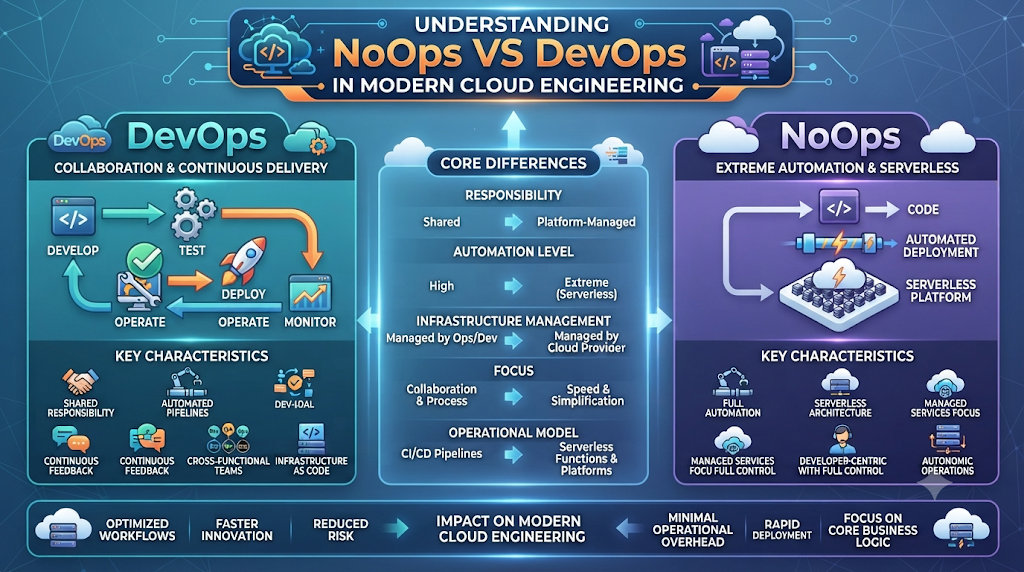
Teams often wonder where NoOps vs DevOps draws the line. DevOps united software development and IT operations around shared ownership, continuous feedback, and automated delivery pipelines. NoOps builds on those DevOps foundations—and pairs naturally with platform engineering—by pushing predictable operational tasks into self-service, self-healing platforms.
| Operational Aspect | Legacy IT Operations | DevOps Model | NoOps Practice |
| Environment Creation | Ticket requests and manual setup | Scripted Infrastructure as Code (IaC) | On-demand self-service templates with policy checks |
| Release Execution | Scheduled nights/weekends with checklists | Automated CI/CD pipelines | Continuous GitOps sync and automated progressive rollouts |
| Fault Detection & Recovery | Manual log checks and service restarts | Automated alerts routed to on-call engineers | Self-healing health checks and automated rollbacks |
| Engineer Day-to-Day Work | Routine patching and ticket queues | Building, deploying, and operating services | Designing automation, reliability rules, and architecture |
Most organizations never run 100 percent hands-off across every system. Stateless microservices and ephemeral test environments adopt autonomous workflows quickly, while core databases and financial ledgers retain deliberate human approval gates.
Building Blocks of Modern NoOps Automation Tools
Achieving reliable automation requires connecting several focused technologies into one cohesive loop. Practical NoOps automation tools cover five essential layers:
1. Declarative Infrastructure Provisioning
Terraform and OpenTofu allow engineers to define cloud infrastructure—such as virtual networks, Kubernetes clusters, and storage—in human-readable code. Storing definitions in Git creates peer-reviewed change histories and prevents configuration drift, though teams must manage state files securely.
2. Portable Containers and Self-Healing Clusters
Docker packages code and dependencies into predictable container images. Kubernetes orchestrates those containers across nodes, automatically rescheduling failed pods and scaling replicas when traffic climbs. While Kubernetes automates workload recovery, cluster lifecycle upgrades and network policies still demand skilled oversight.
3. Automated Delivery and GitOps Reconciliation
GitHub Actions and GitLab CI/CD run automated builds, unit tests, and vulnerability scans on every commit. Pairing CI pipelines with Argo CD introduces GitOps—continuously comparing live cluster state against Git and automatically reconciling unauthorized changes.
4. Open Telemetry and Intelligent Signal Analysis
You cannot safely automate what you cannot see. OpenTelemetry, Prometheus, and Grafana capture metrics, logs, and distributed traces across services. AIOps tools analyze patterns across high-volume telemetry to highlight anomalies early, though clean instrumentation remains essential to avoid noisy false alerts.
5. Managed Cloud and Serverless Runtimes
Platforms across AWS, Microsoft Azure, and Google Cloud—including serverless functions and managed container services—offload operating system patching and underlying server maintenance to the cloud provider.
Five-Stage Rollout for Autonomous Cloud Workflows
Trying to automate every legacy process at once creates brittle scripts and frustrated teams. Follow a disciplined, incremental path:
- Identify High-Friction Manual Chores: Measure where engineers lose hours each week—such as manual staging setups, certificate renewals, or repetitive release approvals.
- Document and Stabilize the Baseline: Clean up inconsistent configurations before encoding them into automation.
- Move Infrastructure into Git: Express cloud resources with IaC modules and require pull-request reviews for every change.
- Embed Automated Security and Quality Checks: Run static analysis, secret scanning, and policy validation automatically inside CI/CD pipelines.
- Enable Controlled Self-Healing and Review: Add readiness probes, autoscaling, and automated canary rollbacks for well-tested workloads, while keeping human sign-off for destructive or high-risk operations.
Terraform
resource "aws_cloudwatch_metric_alarm" "high_error_rate" {
  alarm_name          = "checkout-api-5xx-spike"
  comparison_operator = "GreaterThanThreshold"
  evaluation_periods  = 2
  metric_name         = "HTTPCode_Target_5XX_Count"
  namespace           = "AWS/ApplicationELB"
  period              = 60
  statistic           = "Sum"
  threshold           = 15
  alarm_description   = "Triggers automated rollback or alert when 5XX errors spike"
}
This Terraform example defines a metric alarm that can trigger automated release rollbacks or notifications whenever server errors cross a safe threshold.
Career Roles and Skill Paths in Cloud Automation
As manual ticket handling fades, organizations look for professionals who understand cloud architecture, automation pipelines, and system reliability. Core skills include Linux administration, networking, cloud fundamentals, scripting, Docker, Kubernetes, Infrastructure as Code, CI/CD, GitOps, observability, and cloud security.
Within automation-driven teams, responsibilities typically align across three roles:
- NoOps Engineer: Writes and maintains IaC modules, CI/CD pipelines, GitOps configurations, container platforms, and self-healing rules.
- NoOps Architect: Designs scalable cloud-native blueprints, defines automation standards, balances reliability with cost, and establishes security guardrails.
- NoOps Manager: Shapes the organizational automation roadmap, manages operational risk and governance, aligns engineering workflows with business outcomes, and guides team upskilling.
Taking a structured NoOps training course helps engineers connect individual tools into reliable production pipelines. Earning a NoOps certification—across tracks such as NoOps engineer certification, NoOps architect training, or NoOps manager certification—offers a clear benchmark for role-aligned skills alongside hands-on lab experience.
Practical Use Cases, Trade-Offs, and Pitfalls to Avoid
Consider two everyday scenarios where automation changes team velocity:
- Self-Service Feature Previews: Instead of waiting on an operations queue, a developer opens a pull request, and an automated pipeline provisions a temporary, tagged environment with synthetic test data—tearing it down automatically once the branch merges.
- Automated Canary Rollbacks: During a live rollout, telemetry detects rising latency on the new release. An automated controller shifts traffic back to the stable version within seconds and logs diagnostic context for the engineering team.
Honest Benefits vs. Real Constraints
Well-designed automation lowers repetitive toil, speeds up environment delivery, enforces uniform configurations, and cuts manual configuration typos. At the same time, teams must budget for upfront design effort, ongoing maintenance as cloud APIs change, steeper onboarding for junior staff, and the risk of amplifying bad changes quickly if automated tests are weak.
Common Mistakes That Undermine Automation
- Automating Unclear Processes: Turning a confusing, undocumented workflow into code simply produces faster confusion.
- Hardcoding Credentials in Scripts: Always use managed secret stores and short-lived identities rather than static keys in repositories.
- Removing Human Visibility: Autonomous workflows still require clear dashboards, audit logs, and tested break-glass procedures when unexpected failures strike.
- Ignoring Disaster Recovery Drills: Automated provisioning does not replace regular backup restoration tests and multi-zone resilience checks.
How NoOpsSchool Helps Individuals and Organizations
NoOpsSchool is dedicated to practical education, certification, and advisory support in cloud infrastructure automation. Professionals seeking structured skill growth can explore role-specific learning paths and certifications—including NoOps engineer certification, NoOps architect training, and NoOps manager certification programs—covering Terraform, Kubernetes, GitOps, CI/CD, and cloud-native operations.
For organizations planning broader transformation, NoOps consulting services provide structured automation assessments, cloud modernization blueprints, and CI/CD implementation guidance. When teams need targeted technical capacity for specific milestones, choosing to hire NoOps freelancers experienced in Terraform, Kubernetes, or automated observability offers flexible support—provided clear deliverables, documentation standards, and least-privilege access rules are agreed upon from day one.
Frequently Asked Questions (FAQs)
1. What is NoOps in cloud infrastructure management?
NoOps is an operational approach that automates routine provisioning, deployment, scaling, and recovery tasks using code and managed cloud services so teams spend less time on manual maintenance.
2. How does NoOps vs DevOps work in practice?
DevOps establishes collaboration, shared ownership, and automated delivery between development and operations, while NoOps builds on those practices to automate routine operational tasks even further.
3. Does adopting NoOps eliminate the need for operations engineers?
No. Engineers, architects, and managers remain essential for designing resilient systems, governing security and costs, refining automation, and resolving complex incidents.
4. Which NoOps automation tools form a typical starter stack?
A practical starter stack includes Git for version control, Terraform or OpenTofu for Infrastructure as Code, Docker and Kubernetes for containers, GitHub Actions or Argo CD for delivery, and OpenTelemetry with Prometheus for observability.
5. What does a NoOps training course typically cover?
Training covers cloud fundamentals, Infrastructure as Code, container orchestration, CI/CD and GitOps pipelines, automated monitoring, self-healing patterns, and security automation.
6. How should someone choose between NoOps engineer certification and NoOps architect training?
Choose the engineer path if you focus on hands-on pipeline, Terraform, and Kubernetes implementation; choose architect training if you design multi-team cloud architectures, governance, and scalability patterns.
7. Who is a NoOps manager certification designed for?
It is tailored for IT managers, engineering leads, and decision-makers responsible for automation strategy, operational governance, risk management, and team alignment.
8. What are the biggest risks of over-automating infrastructure?
Without strong automated tests, peer reviews, and approval gates for destructive actions, faulty automation can deploy broken configurations or delete resources rapidly.
9. When are NoOps consulting services most useful?
Organizations benefit from consulting when evaluating operational bottlenecks, designing standardized IaC and GitOps architectures, or planning cloud-native modernization.
10. How can companies safely hire NoOps freelancers for cloud projects?
Define clear technical deliverables, verify practical experience with your target stack, enforce strict least-privilege access, and require thorough documentation handover.
Conclusion
Building self-managing cloud systems is not about chasing hype or removing human accountability. It is about freeing skilled engineers from repetitive manual chores so they can focus on architecture, security, reliability, and product innovation.
Start small this week: pick one recurring manual task, put its configuration under version control, and wrap it in an automated check. Whenever you are ready to explore role-aligned training, certifications, consulting, or specialist support, visit NoOpsSchool.
