Introduction
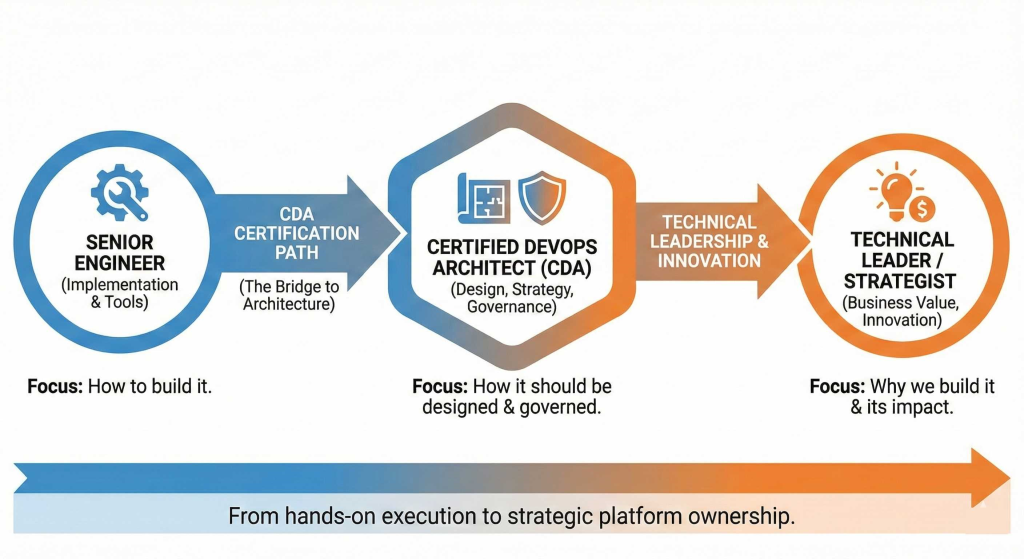
In the world of building things, there is a big difference between a mechanic who fixes an engine and an engineer who designs the car. Most people in our field start as mechanics. We fix broken pipelines, we patch servers, and we write scripts to solve today’s problems. But as you grow, you realize that fixing problems is not enough. You need to prevent them. You need to design systems so well that they rarely break in the first place.
The Certified DevOps Architect (CDA) is the program that turns a mechanic into an engineer. It moves you from “doing” to “designing.” In this guide, I will share how this certification changes the way you look at technology and why it is the most important step you can take for your future.
What is Certified DevOps Architect (CDA)?
The Certified DevOps Architect (CDA) is a high-level program for people who want to lead. It is not about learning one specific tool. Instead, it teaches you the logic behind all tools. You learn how to build a “golden path” for your developers so they can ship code safely and quickly without needing to call for help every time something goes wrong.
Why it matters in today’s software, cloud, and automation ecosystem
We live in a time where everything happens at once. Companies use many different clouds, hundreds of small services, and constant updates. If you don’t have a solid plan, this complexity creates a mess. A Certified DevOps Architect (CDA) brings a clear vision. You ensure the system stays stable even when the company grows fast. You are the person who keeps the “big picture” in mind while others focus on small tasks.
Why certifications are important for engineers and managers
A certification is like a map. You might know your way around your own neighborhood, but a map helps you navigate the whole world. For engineers, it fills the gaps in what you know. For managers, it provides peace of mind. When a manager sees a Certified DevOps Architect (CDA) on a resume, they know that person understands how to build a reliable system from the ground up.
Certification Overview Table
| Track | Level | Who it’s for | Prerequisites | Skills Covered | Recommended Order |
| System Design | Expert | Senior Engineers | Professional Knowledge | Scaling, Security, IaC | Take after Professional |
Provider: DevOpsSchool
Certification Deep-Dive: Certified DevOps Architect (CDA)
What is this certification?
The Certified DevOps Architect (CDA) program focuses on the “Why.” Why do we choose one cloud over another? Why do we use this security rule? It teaches you to build systems that work for the business, not just the IT team.
Who should take this certification?
- Senior developers who want to lead technical strategy.
- System administrators moving into high-level design.
- Managers who need to understand how their team’s tools actually work.
- Anyone who wants to stop just “fixing” and start “building.”
Skills you will gain
- You will learn to design pipelines that never stop.
- You will master the art of managing infrastructure through code.
- You will understand how to keep systems safe without slowing down.
- You will gain the ability to choose the right cloud for any project.
- You will learn how to help teams talk to each other better.
Real-world projects you should be able to do
- Design a “Self-Healing” System: Build a system that fixes itself when it breaks.
- Create a Developer Portal: Give developers a way to get their own tools instantly.
- Automate Security: Set up a system that finds and blocks bad code automatically.
- Global Scaling: Design a setup that works for users in India, the US, and Europe all at once.
Preparation Plan
7–14 Days Plan (The Quick Start)
Spend this time learning the main ideas of architecture. Focus on how tools like Kubernetes and Terraform connect. Review the core “Pillars” of a good DevOps setup.
30 Days Plan (The Deep Dive)
- Weeks 1-2: Learn the theory. Study how to plan for disasters and high traffic.
- Week 3: Get hands-on. Try building a small version of a big system.
- Week 4: Take practice tests. Learn how to explain your choices clearly.
60 Days Plan (The Master Plan)
- Month 1: Read about SRE and modern design patterns. Master the logic of scale.
- Month 2: Complete three big projects. Practice leading a team through a hard technical choice.
Common mistakes to avoid
- Thinking only about tools: A tool is just a hammer. You need to know how to build the house.
- Ignoring the people: If the team doesn’t understand your design, they won’t use it.
- Over-complicating things: The best designs are simple.
Best next certification after this
- Same track: Master in DevOps for more technical power.
- Cross-track: DevSecOps Professional to focus on security.
- Leadership: Certified DevOps Manager to move into a director role.
Choose Your Learning Path
1. The DevOps Path
This path is for the person who loves the whole story. You follow the code from the first day to the final release.
2. The DevSecOps Path
Pick this if you want to be the “Guardian.” You learn how to make security a natural part of every step.
3. The Site Reliability Engineering (SRE) Path
This is for the person who hates downtime. You use software to make sure everything stays online forever.
4. The AIOps / MLOps Path
This is the future. You learn to manage AI models and use AI to help run your servers.
5. The DataOps Path
Best for data lovers. You ensure the company’s data moves fast and stays clean.
6. The FinOps Path
This is about being smart with money. You ensure the cloud costs stay low while performance stays high.
Role → Recommended Certifications Mapping
| Your Role | Start Here | Reach Here |
| DevOps Engineer | Professional Cert | Certified DevOps Architect (CDA) |
| SRE | SRE Practitioner | Certified DevOps Architect (CDA) |
| Platform Engineer | Certified DevOps Architect (CDA) | Kubernetes Expert |
| Cloud Engineer | Cloud Solutions | Certified DevOps Architect (CDA) |
| Security Engineer | DevSecOps Cert | Certified DevOps Architect (CDA) |
| Data Engineer | DataOps Specialist | Certified DevOps Architect (CDA) |
| FinOps Practitioner | FinOps Cert | Certified DevOps Architect (CDA) |
| Engineering Manager | Management Cert | Certified DevOps Architect (CDA) |
Next Certifications to Take
Once you finish the Certified DevOps Architect (CDA), the journey continues:
- Go Deeper: Take a Master in Site Reliability Engineering. It helps you manage systems at a massive scale.
- Expand Your View: Try an MLOps Certified Professional course. AI is changing how we build systems.
- Lead the Way: Look into DevOps Leadership. This helps you move into senior executive roles.
Training & Certification Support Institutions
DevOpsSchool
This school offers excellent technical training. They focus on real projects and hands-on labs. They provide great support for the Certified DevOps Architect (CDA) program.
Cotocus
Cotocus helps professionals learn modern engineering. They provide expert-led sessions that focus on solving real-world business problems.
ScmGalaxy
This is a huge community of experts. They offer thousands of tutorials and forums where you can get help with any automation problem.
BestDevOps
They offer high-quality training for cloud roles. They make complex topics easy to understand for people who are already working.
devsecopsschool.com
This is the best place to learn about security. They teach you how to protect every part of the software world.
sreschool.com
Everything here is about uptime. They teach you how to build systems that never fail.
aiopsschool.com
This school bridges AI and operations. You learn how to use machine learning to predict and fix issues.
dataopsschool.com
They apply DevOps ideas to data. This helps data engineers work faster and more accurately.
finopsschool.com
Learn how to manage cloud costs here. They teach you how to get the most value for every dollar you spend.
FAQs Section
General FAQs
- Is this program hard?
Yes, it is for experts. You need some experience first. - How long do I study?
Most people spend 4 to 8 weeks. - Do I need a degree?
No, your experience and skills matter more. - What is the best order?
Take Professional first, then Certified DevOps Architect (CDA). - Does it help with salary?
Yes, architects usually earn the highest pay. - Will it help me get a job?
Yes, it proves you can handle senior responsibilities. - Is it valid everywhere?
Yes, companies all over the world recognize it. - Can a manager take this?
Yes, it helps them understand technical choices. - Do I need to code?
You should understand how code works, even if you don’t write it every day. - Does it expire?
It is good to refresh your knowledge every few years. - Is there a lab?
Yes, you must do hands-on work to pass. - Should I study alone?
A class or mentor usually makes it faster.
Certified DevOps Architect (CDA) Specific FAQs
- Does it cover many clouds?
Yes, it covers AWS, Azure, and Google Cloud design. - Is it about tools or design?
It focuses mostly on design and strategy. - Does it include Kubernetes?
Yes, that is a big part of modern design. - Will I learn CI/CD?
Yes, you will design large-scale systems. - Is security included?
Yes, an architect must know how to build safe systems. - How is it different from Cloud Architect?
A Cloud Architect focuses on the cloud provider. A DevOps Architect focuses on the process. - Is it good for SREs?
Yes, it helps SREs build better systems. - Does it help with costs?
Yes, good design saves money on cloud bills.
Testimonials
⭐ Testimonials
DevOps Engineer:
“The Certified DevOps Architect (CDA) helped me see the big picture. I stoped fixing bugs and started designing systems.”
SRE:
“I finally learned how to build for reliability. The study plan worked perfectly with my job.”
Cloud Engineer:
“I knew the tools, but I didn’t have a plan. This certification gave me the roadmap I needed.”
Security Engineer:
“I now know how to talk to developers about security without slowing them down. It has changed my job.”
Engineering Manager:
“I took this to support my team. Now I can help them make better technical choices that save us money.”
Conclusion
The Certified DevOps Architect (CDA) is more than just a certificate. It is a new way to work. It moves you from a person who “does things” to a person who “designs things.” If you want to lead teams and build the future of technology, this is your path.
Don’t just learn the tools—learn the architecture. Plan your journey, stay consistent, and take the next step today.
