Introduction
In the modern software lifecycle, “fast” is the default. However, speed without security is just a faster way to fail. DevSecOps isn’t just a buzzword; it’s a survival strategy. It represents a fundamental shift in how we build, deploy, and manage applications by “shifting left”—moving security considerations to the very beginning of the development process. The DevSecOps Certified Professional (DSOCP) is a specialized program designed to bridge the gap between traditional security and agile operations. It empowers professionals to build “Security as Code,” ensuring that every line of infrastructure and application code is scanned, verified, and secured before it ever touches production.
Deep Dive: DevSecOps Certified Professional (DSOCP)
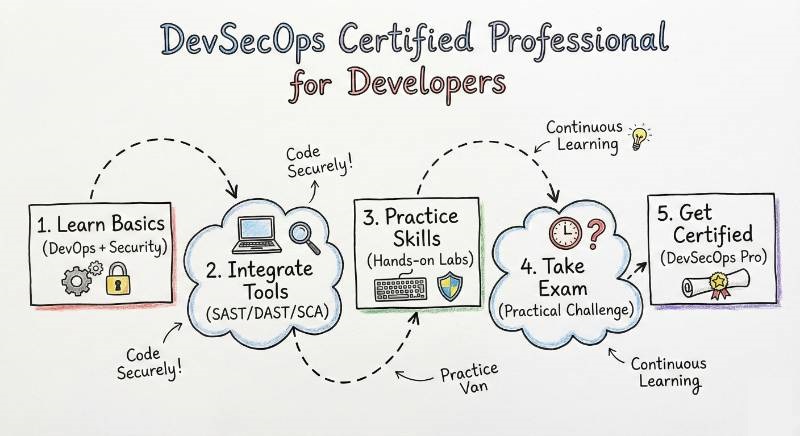
The DSOCP is a practitioner-level certification that validates your ability to integrate security tools and processes into a DevOps pipeline. It focuses on practical, hands-on skills rather than just theoretical compliance frameworks.
Certification Overview Table
| Feature | Details |
| Exam Format | Multiple Choice & Multiple Answer (Practical/Lab-based) |
| Duration | 180 Minutes (3 Hours) |
| Passing Score | 70% to 80% (Depending on the specific track) |
| Delivery Method | Online Proctored or Designated Testing Centers |
| Core Modules | SAST, DAST, SCA, Container Security, IaC Security, Secrets Management |
| Exam Languages | English, Japanese, Korean, Simplified Chinese |
| Prerequisites | Basic Linux, Networking, and OWASP Top 10 knowledge |
What it is
The DSOCP validates your technical authority in managing secure delivery systems. It moves beyond simple “awareness” and focuses on your ability to implement automated security controls that scale.
Who should take it
- Software Engineers: Who want to master secure coding and automated testing.
- DevOps/SRE Engineers: Looking to add security “guardrails” to their pipelines.
- Security Analysts: Transitioning from manual auditing to automated security.
- Engineering Managers: Who need to understand how to balance delivery speed with risk.
Skills you’ll gain
- Vulnerability Scanning: Implementing SAST, DAST, and SCA.
- Container Hardening: Securing Docker images and Kubernetes clusters.
- Infrastructure as Code (IaC) Security: Scanning Terraform and Ansible scripts.
- Secrets Management: Using tools like HashiCorp Vault.
- Compliance Automation: Turning regulations into automated pipeline checks.
Preparation plan
- 7–14 days: Intensive review for those already working with CI/CD tools.
- 30 days: Standard path for most engineers with daily study.
- 60 days: Recommended for beginners or managers needing a foundation.
Common mistakes
- Treating it as a “Tool-Only” Problem: Success requires changing team culture.
- Ignoring False Positives: Automated tools can be noisy; learning to tune them is key.
- Skipping the Basics: You must understand the underlying CI/CD engine first.
Choose Your Path: 6 Specialized Learning Paths
Modern engineering is diverse. Depending on your career goals, you should align your journey with one of these six tracks:
- DevOps Path: Focuses on the core CI/CD pipeline, automation, and delivery speed.
- DevSecOps Path: Deep dives into security automation, vulnerability management, and compliance.
- SRE (Site Reliability Engineering): Prioritizes uptime, scalability, and “error budgets.”
- AIOps / MLOps: Uses AI to manage operations and secures the Machine Learning lifecycle.
- DataOps: Focuses on the reliable and secure delivery of data pipelines.
- FinOps: Integrates financial accountability to optimize cloud costs safely.
Role → Recommended Certifications Mapping
| Current Role | Recommended Certifications |
| DevOps Engineer | DCP (Professional) → DSOCP → Kubernetes Certified |
| SRE | SRECP (Professional) → DCP → Master in Observability |
| Platform Engineer | DCP → Certified Kubernetes Administrator (CKA) → DSOCP |
| Cloud Engineer | Cloud-Specific Certs → DSOCP → DCP |
| Security Engineer | DSOCP → Certified DevSecOps Architect |
| Data Engineer | DataOps Certified Professional (DOCP) → DCP |
| FinOps Practitioner | FinOps Certified Professional → DCP |
| Engineering Manager | DevOps Manager (CDM) → FinOps → DSOCP |
Top Institutions for DSOCP Training
Choosing the right training partner is a critical step in your professional journey. You need a platform that doesn’t just provide a certificate but offers the technical depth to handle real-world infrastructure. Here is an expanded look at the top institutions specializing in the DevSecOps Certified Professional (DSOCP) program:
- DevOpsSchool: A premier global leader in DevOps education, offering a comprehensive 72–120 hour DSOCP program. They provide lifetime technical support, access to an extensive Learning Management System (LMS), and a curriculum that covers over 30 industry-standard tools. The training is highly practical, featuring live projects and a dedicated “Interview KIT” to help professionals transition into high-paying roles.
- Cotocus: This institution focuses on high-intensity corporate training and specialized bootcamps designed to bridge the gap between academic theory and industry implementation. Their programs are highly structured, making them a top choice for engineering teams and managers who need to implement scalable, secure cloud architectures within their organizations quickly.
- Scmgalaxy: A community-centric powerhouse that offers a blend of instructor-led sessions and a massive library of 250+ hours of self-paced technical content. They provide flexible learning options, including weekend batches and classroom training in major tech hubs like Bangalore and Hyderabad, supported by 24/7 technical assistance for all their certified learners.
- BestDevOps: Known for its streamlined, video-based learning paths, BestDevOps is ideal for busy professionals looking for quick yet deep skill acquisition. Their courses focus on the most in-demand tools and provide a clear, step-by-step roadmap for mastering automation and security without the fluff.
- Devsecopsschool: As the name suggests, this niche institution is entirely dedicated to the “Security” pillar of the pipeline. They offer deep-dive modules on specialized topics like threat modeling, “Security as Code,” and automated compliance, making it the perfect choice for security analysts looking to move into the DevOps space.
- Sreschool: This school focuses specifically on the intersection of security and reliability. Their training helps DSOCP aspirants understand how to maintain secure systems while ensuring 99.9% uptime through advanced observability, incident management, and error budgeting techniques.
- Aiopsschool: Leading the frontier of the next generation of operations, Aiopsschool provides niche training that combines security automation with Artificial Intelligence. They teach professionals how to use machine learning models to predict vulnerabilities and automate system remediation before a breach can occur.
- Dataopsschool: For those working in data-heavy environments, Dataopsschool offers specialized training on bringing DevSecOps agility to data pipelines. They focus on ensuring data integrity, quality, and security throughout the entire data lifecycle, from ingestion to analytics.
- Finopsschool: This institution addresses the critical need for financial governance in the cloud. Their DSOCP-aligned training helps engineers and managers collaborate to optimize cloud spending while ensuring that security protocols don’t lead to unexpected cost overruns.
Frequently Asked Questions (FAQs)
Transitioning into a DevSecOps role is a significant career move. Based on common industry inquiries and the experiences of successful professionals, here are the answers to the most frequent questions regarding the DevSecOps Certified Professional (DSOCP) program.
- How difficult is the DSOCP certification exam?
The DSOCP is considered a practitioner-level exam, which means it is moderately challenging. Unlike entry-level certifications that focus on theory, this exam tests your ability to apply security tools in real-world scenarios. If you have hands-on experience with CI/CD pipelines and security scanning tools, you will find it manageable. - How much time does it take to complete the DSOCP program?
For a working professional, the typical timeline is between 30 to 60 days. This includes attending live or recorded sessions and spending at least 10–15 hours a week on hands-on labs. Those already familiar with DevOps might complete it in as little as 14 days of intensive study. - What are the prerequisites for enrolling in DSOCP?
There are no strict formal prerequisites, but for maximum benefit, you should have a basic understanding of Linux commands, networking fundamentals, and at least one version control system like Git. Familiarity with the DevOps lifecycle is highly recommended. - What is the recommended sequence for these certifications?
The ideal journey starts with a DevOps Professional (DCP) certification to understand the pipeline. Once the foundation is solid, you should move into the DevSecOps Certified Professional (DSOCP). Afterward, you can specialize further into SRE, AIOps, or move into a Master’s level track. - What is the actual value of a DSOCP certification in the job market?
The value lies in the validation of “Shift Left” expertise. Companies are looking for engineers who can prevent breaches before they happen. Being DSOCP certified proves you have the technical authority to manage high-stakes security automation, making you a high-value asset for any tech-driven organization. - What are the career outcomes after getting certified?
Graduates typically move into roles such as DevSecOps Engineer, Security Automation Architect, Cloud Security Engineer, or Lead DevOps Engineer. It also provides a clear path for Software Engineers to transition into high-paying specialized security roles. - Does the certification help in getting a salary hike?
Yes. In the current market, DevSecOps professionals often command salaries 20% to 40% higher than standard DevOps engineers because security expertise is in high demand but short supply. - Is the DSOCP certification recognized globally?
Yes, certifications provided by institutions like DevOpsSchool are industry-recognized across India, the USA, Europe, and the Middle East. They follow global standards for security and software engineering. - Can I take the exam online, and what is the format?
The exam is fully online and proctored. It usually consists of multiple-choice questions along with scenario-based problems that require you to demonstrate your knowledge of security tool integration. - Is there a practical or lab-based component?
Absolutely. To earn the DSOCP, you must complete various lab assignments and a final project. This ensures that you aren’t just memorizing definitions but can actually configure a secure pipeline from scratch. - How does this certification benefit an Engineering Manager?
For managers, this certification provides the technical vocabulary and strategic oversight needed to guide a team through a secure digital transformation. It helps in making better decisions regarding security tool investments and risk management. - Does the certification expire?
Certifications earned through our recommended providers are valid for a lifetime. There are no annual renewal fees, though it is always recommended to stay updated with the latest security tools as the industry evolves.
DevSecOps Certified Professional (DSOCP) – Specific FAQs
- What is the core focus of the DSOCP certification?
The primary focus is “Shifting Left”—integrating security automation directly into the CI/CD pipeline. This means security is no longer a separate phase at the end of development; it becomes a continuous process of automated scanning, testing, and compliance checks from the very first line of code. - Does DSOCP cover cloud-native security?
Yes, it is designed for modern environments. The curriculum covers securing containerized applications (Docker), orchestration platforms (Kubernetes), and Infrastructure as Code (Terraform/Ansible). It ensures you can protect applications regardless of whether they are hosted on AWS, Azure, Google Cloud, or on-premises. - What specific security tools will I master in this program?
You will gain hands-on experience with an industry-standard toolset, including SonarQube for code quality, Snyk or OWASP Dependency-Check for SCA, Vault for secrets management, and Aqua Security or Trivy for container vulnerability scanning. - How does DSOCP differ from traditional security certifications like CISSP?
Traditional certifications like CISSP focus heavily on high-level management, policy, and manual auditing. DSOCP is a “technical authority” certification; it is about the implementation of security. It teaches you how to write code and build pipelines that automate the security policies CISSP professionals might design. - Is there a lab-based component for the DSOCP exam?
Yes. To ensure you are industry-ready, the DSOCP program requires the completion of practical labs and a capstone project. You will be expected to build a secure pipeline that successfully identifies and blocks vulnerabilities in a real-world scenario. - What is the passing rate for the DSOCP exam?
With structured training from institutions like DevOpsSchool, the passing rate is exceptionally high, typically exceeding 95%. This is because the training focuses on the practical application of tools, which aligns directly with the exam’s scenario-based questions. - Can a Software Engineer transition to a Security role through DSOCP?
Absolutely. DSOCP is one of the most effective bridges for Software Engineers. It allows you to leverage your existing coding skills and apply them to security automation, making you a “Security Champion” within your development team or allowing for a full move into Security Engineering. - Are there any specific coding languages required?
While you don’t need to be a professional developer in every language, a basic understanding of scripting (Bash or Python) and YAML (for pipeline and configuration files) is highly beneficial. The certification focuses more on the integration of security tools rather than writing complex application logic.
Next Certifications to Take
Earning your DSOCP is a major milestone, but staying competitive means looking at the next step in your career roadmap:
- Same Track (Specialization): DevSecOps Expert – Move into advanced supply chain security, custom tool development, and zero-trust architecture.
- Cross-Track (Stability): Site Reliability Engineering Certified Professional (SRECP) – Master the art of keeping your secure systems running at scale with high availability.
- Leadership (Management): Certified DevOps Manager (CDM) – Focus on the strategic side, including cultural transformation, team leadership, and cloud financial governance.
Conclusion
The journey to becoming a DevSecOps Certified Professional (DSOCP) is an investment in the future of secure software. Whether you are an engineer automating the pipeline or a manager leading a digital transformation, the DSOCP provides the technical authority and practical framework needed to build a resilient digital future. Choose your training partner, commit to the hands-on labs, and lead the way toward a more secure world.
