Introduction
In the modern landscape of high-scale digital services, reliability has become the most critical feature of any product. The Certified Site Reliability Engineer program is designed to bridge the gap between traditional operations and software engineering. This guide is written for engineers and managers who want to move beyond basic automation and master the art of running large-scale, distributed systems with high availability.
As organizations move toward cloud-native architectures and platform engineering, the demand for structured SRE practices has skyrocketed. Whether you are a DevOps professional looking to specialize or a developer interested in the operational side of code, this certification provides a roadmap. At Sreschool, the focus is on practical, production-ready skills that translate directly to enterprise environments. This guide will help you understand the levels of certification, the career impact, and how to choose the right path for your specific goals.
What is the Certified Site Reliability Engineer?
The Certified Site Reliability Engineer designation represents a professional standard for individuals who manage the intersection of software development and IT operations. It is not just about learning a specific tool like Kubernetes or Terraform, but about mastering the philosophy of treating operations as a software problem. The certification validates your ability to build scalable and highly reliable software systems using engineering principles.
This program exists because modern production environments are too complex for manual intervention or traditional sysadmin approaches. It focuses on real-world, production-focused learning, emphasizing concepts like Error Budgets, Service Level Objectives (SLOs), and Toil reduction. By aligning with modern engineering workflows, the certification ensures that practitioners can handle the pressures of enterprise-grade deployments and complex incident response.
Who Should Pursue Certified Site Reliability Engineer?
This certification is ideally suited for software engineers who find themselves increasingly involved in the deployment and maintenance of their code. DevOps engineers looking to transition into a more specialized SRE role will find the curriculum particularly beneficial. Cloud professionals, security engineers, and data engineers also benefit, as reliability is a cross-functional requirement in any modern stack.
For beginners, the foundation levels provide a structured entry point into the world of infrastructure as code and observability. Experienced engineers can use the advanced tracks to formalize their knowledge and move into principal or lead roles. Managers and technical leaders should pursue this to understand how to build and scale SRE teams within their organizations, ensuring they can speak the same language as their engineering staff.
Why Certified Site Reliability Engineer is Valuable Today and Beyond
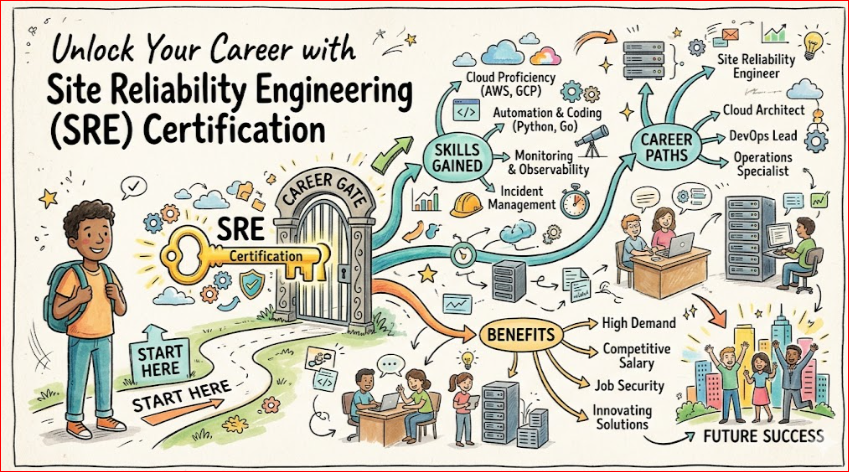
The value of the Certified Site Reliability Engineer program lies in its focus on enduring principles rather than fleeting tool sets. While tools change every few years, the need for reliability, performance monitoring, and incident management remains constant. Enterprises across the globe are adopting SRE models to reduce downtime and improve customer satisfaction, making this certification a long-term asset for any resume.
Professionals who hold this certification demonstrate a commitment to operational excellence that goes beyond “just making it work.” It offers a significant return on time because it teaches you how to automate yourself out of a job, allowing you to focus on high-value engineering tasks. In a competitive job market, having a specialized certification in SRE signals to employers that you possess the discipline required to manage mission-critical production environments.
Certified Site Reliability Engineer Certification Overview
The program is delivered via the official portal at Certified Site Reliability Engineer and is hosted on the Sreschool website. This certification is structured to take a candidate from the core concepts of reliability engineering to the complex architectural decisions required for global-scale systems. The assessment approach is practical, often involving scenarios that mimic real-world production outages and system bottlenecks.
The ownership of the certification lies with industry experts who have managed systems for some of the world’s largest tech companies. It is structured into distinct tiers, allowing for a progressive learning journey. Unlike generic cloud certifications, this program focuses specifically on the “Run” phase of the software lifecycle, ensuring that you are equipped to handle the day-to-day challenges of maintaining system health and performance.
Certified Site Reliability Engineer Certification Tracks & Levels
The certification is divided into three primary levels: Foundation, Professional, and Advanced. The Foundation level introduces the core vocabulary of SRE, covering the basics of monitoring, alerting, and incident response. It is designed for those new to the field or those moving from traditional IT roles into a more automated environment.
The Professional level dives deeper into automation, capacity planning, and the implementation of SLOs. This is where engineers learn to build the tools that manage their infrastructure. The Advanced level is for architects and senior leads, focusing on organizational SRE, reliability at scale, and complex distributed system design. These levels align with typical career progression from Junior SRE to Senior SRE and eventually to SRE Architect or Manager.
Complete Certified Site Reliability Engineer Certification Table
| Track | Level | Who it’s for | Prerequisites | Skills Covered | Recommended Order |
| SRE Core | Foundation | Aspiring SREs, Developers | Basic Linux & Networking | SLOs, SLIs, Toil, Monitoring | 1 |
| SRE Implementation | Professional | DevOps & SysAdmins | SRE Foundation | Error Budgets, Incident Response | 2 |
| SRE Architecture | Advanced | Senior Engineers, Leads | SRE Professional | Distributed Systems, Scalability | 3 |
| SRE Leadership | Management | Engineering Managers | Professional Level | Building SRE Teams, Metrics | 4 |
Detailed Guide for Each Certified Site Reliability Engineer Certification
Certified Site Reliability Engineer – Foundation Level
What it is
The Foundation certification validates a candidate’s understanding of the basic tenets of Site Reliability Engineering. it covers the fundamental differences between SRE and traditional operations, focusing on the cultural shift required for reliability.
Who should take it
This is suitable for junior engineers, developers, or system administrators who are new to the SRE philosophy. It is also ideal for project managers who need to understand SRE terminology.
Skills you’ll gain
- Understanding SLIs, SLOs, and SLAs
- Identifying and quantifying Toil
- Basics of monitoring and observability
- Modern incident management terminology
- Introduction to automation mindsets
Real-world projects you should be able to do
- Define a set of Service Level Indicators for a web application
- Create a basic dashboard to visualize system health
- Participate effectively in an incident post-mortem
Preparation plan
- 7-14 Days: Review the official SRE handbook and familiarize yourself with key terms.
- 30 Days: Take a foundational course and practice setting up basic monitoring on a sample app.
- 60 Days: Not typically required for this level if the candidate has a technical background.
Common mistakes
- Confusing SRE with traditional DevOps.
- Over-complicating the initial SLO definitions.
- Neglecting the cultural aspects of the role.
Best next certification after this
- Same-track option: Certified Site Reliability Engineer – Professional
- Cross-track option: Certified DevOps Engineer
- Leadership option: Technical Lead Foundations
Certified Site Reliability Engineer – Professional Level
What it is
This level validates the ability to implement SRE practices in a real-world production environment. It moves beyond theory into the technical execution of reliability strategies and automation.
Who should take it
Mid-level engineers who are currently working in DevOps or SRE roles and want to formalize their implementation skills. Candidates should have a year of hands-on experience.
Skills you’ll gain
- Designing and managing Error Budgets
- Advanced incident response and on-call rotations
- Capacity planning and demand forecasting
- Building automated self-healing systems
- Managing distributed system complexity
Real-world projects you should be able to do
- Implement an automated incident response workflow
- Design a multi-region deployment strategy for high availability
- Conduct a full capacity planning exercise for a growing service
Preparation plan
- 7-14 Days: Deep dive into specific tools for automation and observability.
- 30 Days: Hands-on lab work focusing on error budget management and incident simulation.
- 60 Days: Comprehensive study including case studies of major system failures and recoveries.
Common mistakes
- Focusing too much on a single tool rather than the underlying process.
- Failing to account for human factors in on-call rotations.
- Inadequate testing of automated recovery scripts.
Best next certification after this
- Same-track option: Certified Site Reliability Engineer – Advanced
- Cross-track option: Certified FinOps Practitioner
- Leadership option: SRE Team Lead
Certified Site Reliability Engineer – Advanced Level
What it is
The Advanced certification is the pinnacle of the SRE track, focusing on the architectural and organizational aspects of reliability. It validates the ability to lead large-scale reliability initiatives.
Who should take it
Senior engineers, Principal SREs, and Architects who are responsible for the overall reliability of complex, global platforms.
Skills you’ll gain
- Architectural patterns for global scale
- Organizational SRE and change management
- Chaos engineering principles and implementation
- Advanced performance tuning and bottleneck analysis
- Long-term reliability strategy and governance
Real-world projects you should be able to do
- Design a global traffic management system for disaster recovery
- Lead a cross-functional chaos engineering experiment
- Develop an organizational framework for SRE adoption across multiple teams
Preparation plan
- 7-14 Days: Focused review of high-level architectural patterns and distributed system theory.
- 30 Days: Reviewing and drafting complex architectural proposals.
- 60 Days: In-depth study of organizational behavior and large-scale system case studies.
Common mistakes
- Ignoring the business impact of architectural decisions.
- Underestimating the difficulty of cultural change in large organizations.
- Over-engineering solutions for problems that haven’t occurred yet.
Best next certification after this
- Same-track option: Principal Engineer Certification
- Cross-track option: Certified Cloud Architect
- Leadership option: Director of Reliability Engineering
Choose Your Learning Path
DevOps Path
The DevOps path focuses on the integration of development and operations through continuous delivery. For an SRE, this means ensuring that the deployment pipeline itself is reliable and that code can be promoted to production with minimal risk. You will learn how to build guardrails into the CI/CD process to prevent unreliable code from reaching users.
DevSecOps Path
In the DevSecOps path, security is treated as a component of reliability. A system cannot be considered reliable if it is vulnerable to exploits. This path focuses on integrating security scanning and compliance checks into the SRE workflow, ensuring that automated systems are both stable and secure.
SRE Path
The pure SRE path is for those who want to specialize deeply in production excellence. It focuses on the specific metrics and cultural changes needed to maintain high availability. This path leads from foundational concepts to complex distributed systems architecture, making you an expert in keeping the lights on for global services.
AIOps Path
The AIOps path explores the use of machine learning and artificial intelligence to enhance operational tasks. You will learn how to use AI to predict outages, automate root cause analysis, and manage the massive amounts of telemetry data generated by modern systems. It is about making the SRE role more efficient through intelligent automation.
MLOps Path
The MLOps path is specialized for those managing the production lifecycle of machine learning models. Unlike standard software, ML models require continuous monitoring for data drift and performance degradation. This path applies SRE principles specifically to the challenges of keeping AI models reliable and accurate in production.
DataOps Path
DataOps focuses on the reliability of data pipelines and storage systems. As data becomes the lifeblood of the modern enterprise, ensuring that data is available, accurate, and timely is a critical SRE function. This path covers the automation and monitoring of data flows from ingestion to consumption.
FinOps Path
The FinOps path combines SRE principles with financial accountability. In a cloud-centric world, reliability must be balanced with cost. This path teaches engineers how to optimize infrastructure spending without compromising on performance or availability, effectively managing the “Cloud Bill.”
Role → Recommended Certified Site Reliability Engineer Certifications
| Role | Recommended Certifications |
| DevOps Engineer | SRE Foundation, SRE Professional |
| SRE | SRE Foundation, Professional, Advanced |
| Platform Engineer | SRE Professional, SRE Architecture |
| Cloud Engineer | SRE Foundation, Cloud Provider Certs |
| Security Engineer | SRE Foundation, DevSecOps Specialist |
| Data Engineer | SRE Foundation, DataOps Specialist |
| FinOps Practitioner | SRE Foundation, FinOps Professional |
| Engineering Manager | SRE Foundation, SRE Leadership |
Next Certifications to Take After Certified Site Reliability Engineer
Same Track Progression
Once you have mastered the technical levels of SRE, deep specialization is the logical next step. This might involve diving into specific niche areas like high-performance networking, kernel tuning, or advanced database reliability. The goal is to move from being a generalist SRE to a specialized architect who can solve the most difficult technical challenges in the organization.
Cross-Track Expansion
Broadening your skills into adjacent areas like FinOps or Security can make you a much more versatile professional. Understanding the financial impact of your reliability decisions or the security implications of your automation scripts allows you to provide more value to the business. This cross-pollination of skills is highly valued in senior leadership roles where a holistic view of the system is required.
Leadership & Management Track
For those looking to move away from hands-on keyboard work, the transition to leadership is a common path. You can move into roles like SRE Manager or Director of Platform Engineering. This requires a shift in focus from managing systems to managing people and processes, using the data-driven mindset you learned in SRE to drive organizational change and strategy.
Training & Certification Support Providers for Certified Site Reliability Engineer
DevOpsSchool
DevOpsSchool is a leading provider of technical training that focuses heavily on the practical application of SRE and DevOps principles. They offer comprehensive programs that are designed to take a student from a beginner level to an industry-ready professional. Their curriculum is updated frequently to reflect the latest tools and methodologies used in production environments. With a strong presence in India and a growing global footprint, they provide both online and classroom-based learning options. Their instructors are typically working professionals who bring real-world scenarios into the training, ensuring that students are prepared for the actual challenges of the job.
Cotocus
Cotocus specializes in high-end technical consulting and training for modern engineering teams. They focus on the deep technical skills required for SRE, including advanced automation and cloud-native architecture. Their approach is very much hands-on, with a heavy emphasis on labs and real-world project simulations. Cotocus is known for helping organizations transform their legacy operations into modern, automated SRE practices. For individual learners, they provide a structured path that is highly respected in the industry. Their training modules are often customized to meet the specific needs of enterprise clients, making them a go-to choice for corporate upskilling.
Scmgalaxy
Scmgalaxy has been a staple in the DevOps and software configuration management community for years. They provide a vast repository of resources, tutorials, and training programs that cover the entire lifecycle of software delivery. Their SRE-focused training emphasizes the integration of configuration management with reliability engineering. They are particularly known for their community-driven approach, offering a wealth of free information alongside their professional certification tracks. For engineers looking to understand the history and evolution of operations into SRE, Scmgalaxy offers a unique perspective combined with practical, modern skills that are essential for today’s market.
BestDevOps
BestDevOps focuses on providing streamlined, efficient training for busy professionals who want to gain SRE skills quickly without sacrificing depth. Their programs are designed to be intensive and outcome-oriented, focusing on the core competencies that employers look for. They offer a range of certification support services, from practice exams to mentored project work. The instructors at BestDevOps are experts in the field who understand the nuances of production environments. Their training is particularly effective for those who are preparing for specific certification exams and need a focused study plan to ensure success in their career goals.
devsecopsschool.com
Devsecopsschool.com is the premier destination for learning how to integrate security into the SRE and DevOps workflows. They recognize that in a modern environment, reliability and security are two sides of the same coin. Their training programs cover a wide array of security tools and practices, showing how they can be automated within the SRE framework. This provider is essential for engineers who want to specialize in the “Sec” part of DevOps, offering certifications that are highly valued in industries with strict compliance requirements. Their curriculum bridges the gap between traditional security auditing and modern, automated security engineering.
sreschool.com
Sreschool.com is the primary authority and hosting site for the Certified Site Reliability Engineer program. They focus exclusively on SRE, providing the most in-depth and specialized curriculum available today. Their mission is to professionalize the role of the SRE through rigorous standards and practical learning. By focusing only on SRE, they ensure that their content is not diluted by general IT topics. Their certifications are recognized globally and are designed to reflect the actual work done by SREs at top-tier technology companies. For anyone serious about a career in reliability, Sreschool.com is the definitive starting point.
aiopsschool.com
Aiopsschool.com addresses the growing intersection of artificial intelligence and IT operations. They provide training on how to use machine learning to manage complex systems more effectively. Their courses cover topics like predictive analytics for outages, automated anomaly detection, and intelligent alerting. This is an advanced area of study that is becoming increasingly important as system scale outpaces human ability to monitor manually. Aiopsschool.com provides the specialized knowledge needed to stay at the forefront of this technological shift, making it an excellent choice for experienced SREs looking to modernize their skill set with AI.
dataopsschool.com
Dataopsschool.com focuses on the reliability and efficiency of data engineering pipelines. In an era where data is a primary asset, the “DataOps” movement applies SRE principles to data management. Their training programs teach how to automate data quality checks, manage data infrastructure as code, and ensure high availability of data platforms. This is a critical niche for engineers working in data-heavy environments like fintech or large-scale e-commerce. By following their certification path, engineers learn how to treat data pipelines with the same operational rigor as traditional software services, reducing errors and downtime.
finopsschool.com
Finopsschool.com provides training on the essential practice of Cloud Financial Management. As SREs are often responsible for the infrastructure they run, understanding and optimizing the cost of that infrastructure is vital. Finopsschool.com teaches engineers how to align cloud spending with business value, using a combination of technical optimization and financial accountability. Their certifications are essential for anyone looking to manage large-scale cloud environments where costs can quickly spiral out of control. They provide the tools and frameworks needed to communicate effectively with finance teams while maintaining the technical performance of the system.
Frequently Asked Questions (General)
1. How difficult is the Certified Site Reliability Engineer exam?
The difficulty depends on your experience level. The Foundation exam is accessible to most technical professionals, while the Professional and Advanced levels require a deep understanding of production systems and automation.
2. How much time does it take to get certified?
A dedicated candidate can often complete the Foundation level in a month. The Professional level typically takes two to three months of study and hands-on practice, while the Advanced level may take longer depending on prior experience.
3. Are there any prerequisites for the Foundation level?
There are no formal prerequisites, but a basic understanding of Linux, networking, and software development concepts is highly recommended to get the most out of the course.
4. What is the return on investment (ROI) for this certification?
The ROI is significant, as SREs are among the highest-paid professionals in the tech industry. The skills learned can lead to immediate improvements in system uptime and operational efficiency.
5. Is this certification recognized globally?
Yes, SRE principles are universal, and the Certified Site Reliability Engineer designation is recognized by major technology firms and enterprises worldwide.
6. Do I need to know how to code to become an SRE?
Yes, coding is a fundamental part of SRE. You don’t need to be a full-stack developer, but you should be comfortable with scripting (Python, Go, or Bash) and infrastructure as code.
7. What is the difference between DevOps and SRE certifications?
DevOps focuses more on the culture and the delivery pipeline, while SRE focuses specifically on the reliability and operational aspects of the software once it is in production.
8. How often does the certification need to be renewed?
Typically, certifications are valid for two to three years, after which you may need to pass an update exam or demonstrate continuing education in the field.
9. Can a manager take these certifications?
Absolutely. The Foundation and Leadership tracks are specifically designed to help managers understand the technical and cultural requirements of building an SRE organization.
10. Are the exams proctored?
Yes, the exams are typically proctored online to ensure the integrity and value of the certification for all candidates.
11. Is there a community for certified professionals?
Yes, most providers offer access to a community or alumni network where you can share insights, find job opportunities, and stay updated on industry trends.
12. Does the certification cover specific cloud providers like AWS or Azure?
While the principles are cloud-agnostic, many of the practical examples and labs may use major cloud providers to demonstrate how to implement SRE concepts in the real world.
FAQs on Certified Site Reliability Engineer
1. What makes the Sreschool certification unique?
It focuses exclusively on the “Run” phase of the lifecycle, providing deep technical depth that generic certifications lack. It is designed by practitioners for practitioners, ensuring that the skills are immediately applicable to real production environments.
2. How does this certification help with incident management?
It provides a structured framework for handling outages, including how to set up on-call rotations, conduct blameless post-mortems, and build automated systems to reduce the frequency and impact of incidents.
3. Will this certification help me get a job in India?
Yes, the demand for SREs in India is booming as both local startups and global tech centers in cities like Bangalore and Hyderabad look for engineers who can manage high-scale systems.
4. Can I skip the Foundation level?
While it is possible if you have significant experience, it is generally recommended to start with the Foundation to ensure you have a solid grasp of the specific terminology and philosophy used in the higher levels.
5. Is chaos engineering part of the curriculum?
Yes, chaos engineering is a key component of the Advanced level, where you learn how to proactively test system resilience by injecting controlled failures into the environment.
6. How much of the exam is theoretical vs. practical?
The exams are designed to be heavily weighted toward practical application. Even multiple-choice questions are often based on scenarios that require you to apply SRE principles to solve a specific problem.
7. Does this certification cover Kubernetes?
Kubernetes is often used as the platform for many of the labs and examples, but the focus remains on the reliability principles rather than just learning the tool itself.
8. How do I start the certification process?
You can start by visiting the official website, reviewing the syllabus for the Foundation level, and signing up for the introductory training module to begin your journey.
Conclusion
From a mentor’s perspective, I have seen many engineers struggle to find their footing in the shift from traditional operations to cloud-native engineering. The Certified Site Reliability Engineer program provides the structure that many professionals are missing. It moves you away from “firefighting” and toward proactive engineering. If you are looking for a way to future-proof your career, this is a solid investment. It’s not a magic bullet that will instantly make you an expert, but it provides the map you need to navigate the complexities of modern production. The focus on reliability as a discipline is exactly what the industry needs right now, and those who master these skills will continue to be in high demand.
