Introduction
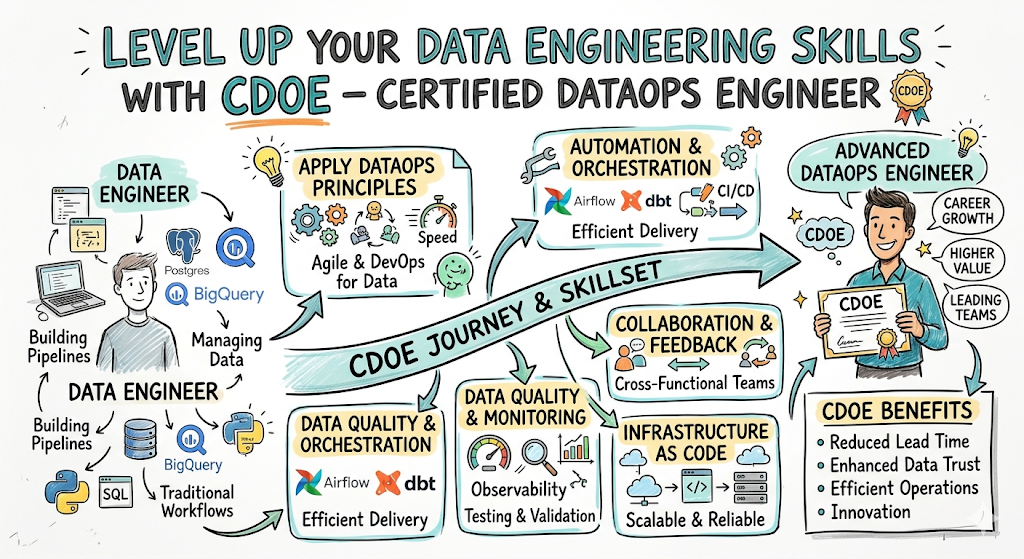
The CDOE – Certified DataOps Engineer program is designed for engineers seeking to bridge the gap between data engineering and operational excellence. This comprehensive guide is intended for professionals who aim to master the automation and orchestration of data life cycles within modern cloud-native environments. High-quality data is increasingly treated as a core product, making the role of a DataOps specialist essential for maintaining enterprise-grade data platforms. By following this roadmap, informed decisions regarding career specialization and skill acquisition can be made effectively. All training and certification support is facilitated through DataOpsSchool to ensure that global industry standards are met through structured learning.
What is the CDOE – Certified DataOps Engineer?
The CDOE – Certified DataOps Engineer is a professional designation focused on the seamless integration of data flows and IT operations. It exists to provide a framework for automating data pipelines, ensuring that data is delivered with both high velocity and reliability. Production-focused learning is emphasized over abstract theory to ensure that engineers are prepared for real-world enterprise challenges. Modern engineering workflows are aligned with these practices to facilitate continuous improvement in data quality and accessibility. The discipline is rooted in the application of DevOps principles to data management to reduce cycle times and operational friction.
Who Should Pursue CDOE – Certified DataOps Engineer?
This certification is highly beneficial for data engineers, site reliability engineers (SREs), and cloud infrastructure professionals who manage large-scale data systems. Beginners in the data domain are provided with a structured entry point, while experienced professionals are enabled to formalize their expertise in automation and orchestration. Technical managers and leadership figures are also encouraged to pursue this path to better understand the operational requirements of data-driven projects. A global perspective is maintained throughout the curriculum, making the certification relevant for professionals in India and other international tech hubs. Security and compliance roles also find significant value here, as data governance is treated as a core operational pillar.
Why CDOE – Certified DataOps Engineer is Valuable Beyond Current Trends
The demand for automated data operations is sustained by the increasing complexity of multi-cloud and hybrid-cloud architectures. Longevity in a technical career is supported by mastering foundational principles that remain relevant despite the rapid evolution of specific software tools. Professional relevance is maintained because the focus is placed on architectural patterns and collaborative cultures rather than ephemeral technologies. A significant return on time and career investment is realized when the ability to reduce data-related downtime and operational costs is demonstrated. Global adoption of these practices ensures that certified individuals remain competitive and prepared for senior technical roles.
CDOE – Certified DataOps Engineer Certification Overview
The certification program is delivered through a structured digital platform and hosted on the official website. Practical assessment methods are utilized to ensure that candidates possess the requisite skills to handle production-grade data challenges. Ownership of the certification process is maintained by a board of industry experts who curate content based on evolving enterprise needs. The curriculum is divided into distinct tiers to accommodate various experience levels, ranging from fundamental concepts to advanced orchestration strategies. Each tier is designed to validate specific competencies in data pipeline monitoring, security, and automated delivery.
CDOE – Certified DataOps Engineer Certification Tracks & Levels
The program is organized into foundation, professional, and advanced levels to provide a clear trajectory for professional development. The foundation level is aimed at establishing a common vocabulary and understanding of DataOps principles across technical teams. Specialized tracks are available for professionals who wish to focus on specific domains such as SRE-driven data management or FinOps for data platforms. Career progression is mirrored by these levels, allowing engineers to transition from individual contributors to strategic technical leaders. Each track is designed to integrate seamlessly with existing cloud-native certifications to provide a holistic and versatile skill set.
Complete CDOE – Certified DataOps Engineer Certification Table
| Track | Level | Who it’s for | Prerequisites | Skills Covered | Recommended Order |
| Core DataOps | Foundation | Aspiring Data Engineers | Basic IT knowledge | Data CI/CD, Quality | 1st |
| Data Platform | Professional | SREs & Cloud Engineers | Foundation Cert | Orchestration, IaC | 2nd |
| Data Governance | Professional | Security & Compliance | Foundation Cert | Policy as Code, Privacy | 3rd |
| Data Architecture | Advanced | Principal Engineers | Professional Cert | Multi-cloud Data Ops | 4th |
Detailed Guide for Each CDOE – Certified DataOps Engineer Certification
CDOE – Foundation Level
What it is
This certification validates a fundamental understanding of DataOps principles and the ability to apply automation to basic data workflows. It serves as the primary entry point for individuals entering the domain of data operations and management.
Who should take it
Entry-level data engineers, software developers, and system administrators looking to specialize in data management should pursue this level. It is also suitable for project managers who oversee data-centric teams and require a technical baseline.
Skills you’ll gain
- Understanding of the core values and the DataOps manifesto.
- Ability to implement automated testing for data quality checks.
- Knowledge of version control specifically for data and schema changes.
- Familiarity with the end-to-end data lifecycle and pipeline optimization.
Real-world projects you should be able to do
- Implementation of a basic CI/CD pipeline for a SQL-based project.
- Configuration of automated alerts for pipeline performance monitoring.
Preparation plan
- 7–14 days: The DataOps manifesto and basic automation tools are reviewed.
- 30 days: Practical labs involving containerization and basic ETL tools are completed.
- 60 days: A deep dive into data testing frameworks and versioning strategies is conducted.
Common mistakes
- Underestimating the importance of cultural change within the organization.
- Focusing exclusively on tools rather than the underlying process improvements.
Best next certification after this
- Same-track option: CDOE Professional Level.
- Cross-track option: SRE Foundation.
- Leadership option: DevOps Leader.
CDOE – Professional Level
What it is
This certification validates the ability to design and manage complex, production-grade data pipelines using advanced orchestration tools. Advanced automation and observability strategies are the primary focus of this tier.
Who should take it
Experienced data engineers, SREs, and DevOps professionals with significant experience in managing infrastructure are encouraged to take this exam. It is designed for those responsible for critical enterprise data assets.
Skills you’ll gain
- Mastery of orchestration tools within a cloud-native DataOps context.
- Implementation of Infrastructure as Code for scalable data platforms.
- Advanced monitoring and observability for distributed data systems.
- Management of complex data security and access controls at scale.
Real-world projects you should be able to do
- Deployment of a scalable data mesh architecture using orchestration platforms.
- Design of a self-healing data pipeline that manages schema evolution automatically.
Preparation plan
- 7–14 days: Intensive review of cloud-native data services is suggested.
- 30 days: Building complex directed acyclic graphs (DAGs) in a sandbox environment is required.
- 60 days: A comprehensive study of data security patterns and compliance automation is conducted.
Common mistakes
- Failure to account for cost optimization in cloud-based data storage.
- Neglecting the integration of security early in the data pipeline development.
Best next certification after this
- Same-track option: CDOE Expert Level.
- Cross-track option: Certified DevSecOps Professional.
- Leadership option: Engineering Manager Certification.
Choose Your Learning Path
DevOps Path
A focus is placed on integrating data pipelines into existing software delivery lifecycles to ensure consistency. Engineers are trained to treat data code with the same rigor as application code, utilizing modern CI/CD tools. The alignment of data releases with application deployments is prioritized to ensure system stability and performance. This path is ideal for those who wish to become versatile engineers with a deep specialty in data flow.
DevSecOps Path
The primary objective of this path is the automation of data security and compliance checks throughout the pipeline. Techniques such as data masking, encryption, and automated audit logging are deeply explored and implemented. Security is integrated into the heart of the DataOps process to prevent leaks and ensure regulatory adherence. It is recommended for professionals working in highly regulated industries like finance or healthcare.
SRE Path
Reliability, availability, and performance of data platforms are the core focus areas for this specialized path. Service Level Objectives (SLOs) are defined specifically for data latency and quality to maintain high standards. Automation is used to handle operational toil and manage large-scale data migrations without causing system downtime. This path is best suited for engineers who enjoy troubleshooting complex distributed systems.
AIOps Path
Automation of IT operations using artificial intelligence is the central theme of this advanced specialization track. Data pipelines are optimized to feed machine learning models that predict and prevent infrastructure failures before they occur. Large datasets generated by system logs are processed using DataOps principles to improve overall operational intelligence. This path is intended for engineers looking to lead intelligent infrastructure initiatives.
MLOps Path
The lifecycle of machine learning models is managed through robust data engineering and operational practices. Focus is placed on model versioning, feature stores, and the creation of automated retraining pipelines for accuracy. Seamless transitions from experimental environments to production systems are facilitated through this track. Engineers learn to maintain the integrity of training data to ensure model reliability over time.
DataOps Path
This is the pure specialization track for those dedicated entirely to the data engineering and operations domain. Deep expertise in data modeling, pipeline orchestration, and data quality engineering is developed over time. The goal is to provide a seamless “data as a service” experience across the entire organization. It is the definitive path for those aiming to become Principal DataOps Engineers.
FinOps Path
Cloud cost management for data-intensive applications is the primary skill set developed within this track. Strategies for optimizing storage costs and compute resources for large-scale data processing are implemented and monitored. Visibility into data-related spending is provided to stakeholders through automated and transparent reporting tools. This path is essential for organizations looking to scale data operations without uncontrolled expenditures.
Role → Recommended CDOE – Certified DataOps Engineer Certifications
| Role | Recommended Certifications |
| DevOps Engineer | CDOE Foundation, DevOps Professional |
| SRE | CDOE Professional, SRE Practitioner |
| Platform Engineer | CDOE Professional, Kubernetes Administrator |
| Cloud Engineer | CDOE Foundation, Cloud Architect |
| Security Engineer | CDOE Data Governance, DevSecOps Professional |
| Data Engineer | CDOE Foundation, CDOE Professional, CDOE Expert |
| FinOps Practitioner | CDOE Foundation, FinOps Certified Practitioner |
| Engineering Manager | CDOE Foundation, DevOps Leader |
Next Certifications to Take After CDOE – Certified DataOps Engineer
Same Track Progression
Once the professional level is achieved, pursuing the Expert or Master level in DataOps is the logical next step. Deep specialization in complex areas such as Data Mesh or Data Fabric architecture is explored to broaden expertise. This progression ensures that a professional remains at the cutting edge of data infrastructure design and management. Continuous learning is facilitated through advanced workshops and contributions to open-source DataOps projects.
Cross-Track Expansion
Broadening the skill set by pursuing certifications in SRE or DevSecOps is highly recommended for versatile engineers. Understanding how data operations interact with broader infrastructure and security protocols creates a more effective professional. This expansion allows for the management of hybrid teams where data and application code are deeply intertwined. Skill broadening is essential for moving into Senior Architect roles that require a wide technical perspective.
Leadership & Management Track
For those aiming for management roles, certifications such as the DevOps Leader or Engineering Management programs are advised. The transition from a technical specialist to a strategic leader is supported by learning about team dynamics and value stream mapping. Understanding the business ROI of technical decisions becomes the primary focus at this leadership stage. Leaders are trained to build high-performing cultures that sustain DataOps practices over the long term.
Training & Certification Support Providers for CDOE – Certified DataOps Engineer
DevOpsSchool
DevOpsSchool provides extensive training resources and instructor-led sessions for the CDOE certification program. A strong focus is placed on hands-on labs that simulate real-world enterprise environments to ensure practical mastery of the tools. Comprehensive study materials and practice exams are offered to help candidates prepare effectively for the assessment process. The curriculum is updated regularly to reflect the latest trends and toolsets in the global data operations landscape. Students are guided through the complexities of CI/CD for data with expert oversight.
Cotocus
Cotocus specializes in delivering high-quality technical consulting and training for advanced engineering certifications worldwide. Personalized mentoring is provided to help professionals navigate the complexities of data pipeline automation and orchestration effectively. Their approach emphasizes the integration of DataOps with cloud-native technologies like Kubernetes and Terraform for scalability. Industry experts with significant field experience guide the learning journey for every enrolled student in the program. Practical implementation is prioritized over theoretical memorization in all their training modules.
Scmgalaxy
Scmgalaxy is a leading community platform and training provider that offers a wealth of knowledge on software configuration and DataOps. Practical tutorials and community-driven insights are available to supplement the official certification curriculum for all levels. The platform serves as a hub for professionals to share experiences and best practices regarding data automation and quality. Their training programs are designed to be accessible and highly relevant to the needs of modern IT departments. Continuous learning is encouraged through a vibrant ecosystem of technical articles.
BestDevOps
BestDevOps focuses on providing curated learning paths and certification support for modern engineering and operations roles. The CDOE program is supported through detailed video courses and interactive coding environments for better engagement. A strong emphasis is placed on achieving measurable career outcomes through skill acquisition and formal validation of expertise. Their resources are tailored to meet the needs of both individual learners and large-scale corporate training programs. Professionals are enabled to master the DataOps lifecycle through structured and logical progression.
Devsecopsschool.com
This platform provides specialized training at the critical intersection of data engineering, security, and operations. The importance of securing the data lifecycle is emphasized throughout their CDOE support materials and practical exercises. Learners are taught how to build resilient data pipelines that are secure by design and compliant with global regulations. Expert instructors provide guidance on implementing policy as code within the automated DataOps framework. The focus remains on protecting sensitive enterprise assets while maintaining high operational velocity.
Sreschool.com
Sreschool.com offers training programs that focus on the reliability and performance aspects of modern data operations. The curriculum is designed to help engineers apply SRE principles such as error budgets and monitoring to data systems. Students learn how to build highly available data platforms that can scale effectively to meet enterprise-level demands. The support provided ensures that candidates can manage production data with high confidence and technical precision. Reliability engineering is treated as a fundamental component of the data lifecycle.
Aiopsschool.com
Aiopsschool.com provides training that links the DataOps domain with artificial intelligence for enhanced IT operations. The role of high-quality data pipelines in feeding and maintaining AI models is explored in depth through their courses. Professionals are trained to use automation and machine learning to improve infrastructure health and overall system performance. Their CDOE support materials focus on the future of intelligent automation within the data engineering landscape. The curriculum bridges the gap between traditional operations and AI-driven insights.
As the primary hosting site for the CDOE certification, this platform offers the most direct and comprehensive support available. Official documentation, exam guides, and authorized training partners are all easily accessible through this central portal. The platform ensures that all candidates have the necessary resources to succeed in their certification journey from start to finish. Continuous support is provided to the alumni community to keep their professional skills sharp and relevant. It serves as the definitive authority for DataOps certification standards.
Finopsschool.com
Finopsschool.com focuses on the financial management and cost optimization side of data and cloud operations. Training is provided on how to manage and optimize costs associated with large-scale data storage and processing tasks. Professionals learn to align their DataOps initiatives with the broader financial goals and budgets of the organization. Their courses provide the necessary bridge between technical execution and business value for modern enterprises. Cost transparency and efficiency are established as key metrics for success in the data domain.
Frequently Asked Questions (General)
- How is the difficulty of the CDOE exam perceived?
The difficulty level is regarded as moderate to high, depending on the prior technical experience of the candidate. A solid understanding of both data engineering and automation tools is required to pass the professional levels. - What is the recommended timeframe for preparation?
Most professionals require between 30 to 60 days of consistent study and practical lab work to feel prepared. The foundation level can often be achieved in a shorter timeframe by those already familiar with DevOps. - Are there any specific prerequisites for the foundation level?
No formal prerequisites are mandatory for the foundation exam, though a basic knowledge of IT and data systems is highly recommended. Higher levels require the completion of the foundation cert or equivalent professional experience. - What is the ROI of obtaining a CDOE certification?
Certified professionals often see increased salary potential and opportunities for senior leadership roles in data-driven organizations. The ability to reduce operational costs and improve data reliability provides clear and measurable value. - Can this certification be taken online?
Yes, the certification exams are typically offered online through proctored platforms to ensure global accessibility. This allows professionals from all regions to participate in the certification program conveniently. - How long is the certification valid?
The certification is usually valid for two years, after which recertification or advancement to a higher level is required. This policy ensures that professionals stay updated with the latest industry advancements and tools. - Is hands-on experience required for the exam?
While not strictly mandatory for the foundation level, hands-on experience is critical for passing the professional and expert assessments. Real-world scenario questions are a significant part of the higher-level examinations. - Which specific tools are covered in the curriculum?
The curriculum focuses on architectural principles using industry-standard tools such as orchestration engines, container platforms, and cloud data services. The emphasis is placed on concepts rather than a specific vendor lock-in. - Is DataOps significantly different from Data Engineering?
Yes, while data engineering focuses on building the pipelines, DataOps focuses on the automation, quality, and operational reliability of those pipelines. It brings a DevOps mindset to the data management world. - How does this certification assist in a job search?
It provides a formal validation of skills that are in high demand but often difficult for recruiters to verify through resumes alone. Having a recognized certification sets a candidate apart in a competitive job market. - Are there community forums available for students?
Yes, several platforms and the official portal provide forums for students to interact and share knowledge with peers. Peer support is considered a valuable component of the overall learning and certification experience. - Can the exam be retaken if the first attempt is unsuccessful?
Yes, retake policies are in place, though specific waiting periods and additional fees may apply. It is recommended to review the exam feedback thoroughly before attempting the assessment again.
FAQs on CDOE – Certified DataOps Engineer
- What are the primary benefits of CDOE for an organization?
Organizations benefit from significantly faster data delivery cycles and improved data quality across all departments. The implementation of DataOps reduces the risk of data-related outages and enhances the overall efficiency of data science teams. A standardized approach to data operations allows for better collaboration and more predictable project timelines. - How does CDOE address the issues of data security and compliance?
Security is integrated into the automated pipelines through the use of policy as code and automated compliance checks at every stage. This ensures that data privacy regulations are met without slowing down the development or delivery process. The certification covers advanced techniques for secure data handling and auditability throughout the entire lifecycle. - How does DataOps improve data quality?
Quality is improved by implementing automated testing and validation at various points in the data pipeline. This ensures that errors are caught early in the process before they impact downstream analytics or business decisions. Continuous monitoring provides real-time visibility into the health and accuracy of the data assets. - Is this certification relevant for cloud-only environments?
While highly relevant for cloud environments, the principles taught are also applicable to hybrid and on-premises data systems. The focus is on the orchestration and automation of data flows regardless of the underlying infrastructure. This versatility makes the certification valuable for professionals in any technical environment. - What role does collaboration play in the CDOE framework?
Collaboration is a central pillar of the framework, as it aims to break down silos between data, development, and operations teams. Shared goals and standardized processes are established to ensure that everyone is working toward the same objectives. This cultural shift is essential for the successful implementation of DataOps practices. - How are data pipelines managed under this certification?
Pipelines are managed as code, allowing for version control, automated testing, and repeatable deployments across different environments. This approach reduces manual errors and ensures that the data infrastructure is consistently configured. Orchestration tools are used to manage the complex dependencies between different data tasks. - Does the certification cover data governance?
Yes, data governance is treated as an integrated part of the operational process rather than an afterthought. Automated controls are used to enforce data policies and ensure that assets are managed according to organizational standards. This helps in maintaining high data integrity and compliance across the enterprise. - What is the focus of the advanced level certifications?
The advanced levels focus on strategic architecture and the management of large-scale, complex data ecosystems. Topics such as Data Mesh, multi-cloud data orchestration, and global data distribution are explored in depth. It is designed for those looking to lead the architectural direction of their organization.
Final Thoughts
The decision to pursue the CDOE certification should be based on long-term career goals and the specific needs of the current technical landscape. The continuous growth of data-centric enterprises suggests that the demand for operational excellence in data management will continue to rise. A formal certification provides a structured path to mastery that is often difficult to achieve through fragmented self-study alone. It serves as a clear signal to the industry that an engineer is capable of handling the complexities of modern data infrastructure. While the investment of time and effort is significant, the professional clarity and marketability gained are substantial. Practical skills and architectural knowledge remain the most valuable assets an engineer can possess in this field. Focus should remain on the application of these principles to solve real-world problems and drive organizational value.
