Introduction
In today’s data-driven enterprise, speed alone is no longer enough. Organizations generate petabytes of information daily, yet many struggle with brittle pipelines, silent data corruption, delayed reports, and endless fire-fighting between data engineers and analytics teams. Traditional data engineering approaches—where code is pushed manually, data quality is checked reactively, and pipelines break without warning—simply cannot keep up with modern business demands. Whether you are building an e-commerce dashboard, managing a cloud data warehouse, or deploying machine learning models, mastering the DataOps workflow is the single most valuable skill in modern data engineering. To deepen your hands-on expertise and accelerate your career, explore the industry-aligned courses, real-world labs, and certifications available at DataOpsSchool.com.
What is DataOps?
DataOps (short for Data Operations) is an automated, process-oriented methodology used by data teams to improve the quality, speed, and reliability of data analytics. It is not merely a tool or a software platform; rather, it is a cultural and operational movement that unites data engineers, data analysts, data scientists, and business stakeholders.
At its core, DataOps brings the rigor of DevOps to the data lifecycle:
- Continuous Integration & Continuous Deployment (CI/CD) for code and data pipelines.
- Automated Testing & Validation to prevent bad data from reaching production.
- Data Observability & Monitoring to detect anomalies before business leaders do.
- Collaboration & Governance across cross-functional teams.
       +-------------------------------------------------+
       |                     DATAOPS                     |
       +--------------------+----------------------------+
                            |
   +------------------------+------------------------+
   |                        |                        |
 v                        v                        v
+------------------+     +------------------+     +------------------+
|      DEVOPS      |     |  AGILE METHODS   |     | LEAN PROCESSES   |
| Continuous       |     | Rapid Iteration, |     | Elimination of   |
| Integration &    |     | Collaboration,   |     | Waste, Quality   |
| Deployment       |     | Small Slices     |     | Control at Source|
+------------------+     +------------------+     +------------------+
Why DataOps Matters in Modern Data Engineering
Traditional data management relied on monolithic batch ETL jobs managed in silos. When a source schema changed, downstream dashboards broke, leading to broken trust and emergency war rooms.
DataOps fundamentally changes this dynamic. Here is how modern DataOps compares to traditional approaches:
Traditional Data Management vs. Modern DataOps
| Metric / Dimension | Traditional Data Management | Modern DataOps Workflow |
| Development Cycle | Months-long waterfall deployments | Rapid, iterative deployments (days or hours) |
| Testing | Manual sampling or reactive user bug reports | Automated data & pipeline testing before production |
| Deployment | Manual script execution on production databases | Automated CI/CD pipelines via Git version control |
| Data Quality | Assumed accurate until proven broken | Continuously validated with automated circuit breakers |
| Monitoring | Basic job success/failure alerts | Deep data observability (freshness, volume, schema, lineage) |
| Team Collaboration | Siloed teams (SREs, DBAs, Data Engineers) | Cross-functional, collaborative delivery teams |
Understanding the DataOps Lifecycle
The DataOps lifecycle is an ongoing loop that aligns code development with continuous data processing. It is generally divided into two interlocking cycles: the Development Loop (building and refining code) and the Data Pipeline Loop (running data through pipelines).
   [ DEVELOPMENT CYCLE ]              [ DATA PRODUCTION CYCLE ]
   +-------------------+              +-----------------------+
   |  1. Plan          |              |  1. Ingest            |
   |  2. Code & Test   | ---- Deploy ->|  2. Transform & Store |
   |  3. Merge (CI/CD) |              |  3. Validate & Monitor|
   +-------------------+              +-----------------------+
             ^                                    |
             +----------- Feedback Loop ----------+
- Plan & Design: Define clear business requirements and schema contracts.
- Code & Version Control: Write SQL, Python, or dbt models using Git feature branches.
- Automate & Test: Run automated unit tests on synthetic or staging data.
- Deploy (CI/CD): Merge approved code changes safely into production.
- Operate & Observe: Run continuous data pipelines while tracking health metrics.
- Feedback & Iterate: Use monitoring alerts to patch bugs and optimize performance.
What is a DataOps Workflow?
A DataOps Workflow is the sequence of automated operational steps that code and data pass through from raw generation to business consumption.
Unlike a standard ETL pipeline—which simply extracts, transforms, and loads data—a DataOps workflow embeds quality checks, version control, automated orchestration, security governance, and operational observability directly into every stage of the pipeline.
Core Components of a DataOps Workflow
Every robust DataOps workflow rests on six fundamental technical pillars:
- Version Control: Git-based repositories for tracking changes in SQL, Python, Infrastructure-as-Code (Terraform), and pipeline DAGs.
- Orchestration Engine: Automated workflow schedulers (e.g., Apache Airflow, Prefect, Dagster) that handle task dependencies and retries.
- Data Quality Framework: Automated assertion tools (e.g., Great Expectations, dbt tests) that block corrupted data from advancing.
- Target Cloud Data Platform: Scalable warehouses or data lakes (e.g., Snowflake, BigQuery, Databricks, AWS Redshift).
- CI/CD Pipeline Engine: Automated deployment tools (e.g., GitHub Actions, GitLab CI) that test code before merging.
- Data Observability & Alerting Platform: Real-time tracking for schema drift, volume spikes, and execution latencies (e.g., Monte Carlo, Datadog, Slack webhooks).
Prerequisites Before Building a DataOps Workflow
Before writing code or configuring tools, ensure you have the following prerequisites in place:
- [ ] Git Repository Access: GitHub, GitLab, or Bitbucket account.
- [ ] Cloud Provider Account: AWS, GCP, or Azure sandbox environment.
- [ ] Target Storage/Warehouse: Local PostgreSQL instance, or a free trial of Snowflake/BigQuery.
- [ ] Python 3.9+ Environment: Installed locally or in a cloud container.
- [ ] Basic CLI Knowledge: Comfort with terminal commands, virtual environments, and environment variables.
Step-by-Step Guide: Building a Simple DataOps Workflow
Let’s build a production-grade, simple DataOps workflow step by step.
Step 1: Define Business Goals and Data Requirements
Before ingesting a single row of data, clarify what business question you are solving and define clear data contracts.
- Business Objective: Calculate daily active users (DAU) and sales revenue by region for an e-commerce platform.
- Service Level Agreement (SLA): Dashboards must update daily by 6:00 AM UTC with 99.9% data freshness.
- Data Requirements: Order receipts (JSON), customer demographic files (CSV), and product catalogs (PostgreSQL database).
Step 2: Collect and Ingest Data
Data ingestion brings raw data from external operational sources into your staging environment.
Python
# Example: Simple Data Ingestion Script (ingest_orders.py)
import json
import pandas as pd
import requests

def fetch_raw_orders(api_url):
    response = requests.get(api_url)
    if response.status_code == 200:
        data = response.json()
        df = pd.DataFrame(data)
        # Store raw landing data as Parquet
        df.to_parquet("s3://my-raw-bucket/landing/orders.parquet")
        print("Ingestion Successful: Raw data saved.")
    else:
        raise Exception(f"Failed to fetch data: {response.status_code}")

if __name__ == "__main__":
    fetch_raw_orders("https://api.store.com/v1/orders")
Step 3: Clean, Validate, and Transform Data
Once stored in your raw layer, raw data must be structured, cleaned, and standardized. In modern ELT (Extract, Load, Transform) workflows, transformations are typically handled inside the warehouse using SQL tools like dbt (data build tool).
SQL
-- Example: Staging dbt Model (stg_orders.sql)
WITH raw_orders AS (
    SELECT * FROM {{ source('raw_ecom', 'orders') }}
)
SELECT
    id AS order_id,
    customer_id,
    LOWER(status) AS order_status,
    CAST(amount AS DECIMAL(10,2)) AS order_amount,
    COALESCE(created_at, CURRENT_TIMESTAMP()) AS order_timestamp
FROM raw_orders
WHERE id IS NOT NULL
Step 4: Build ETL/ELT Pipelines
Orchestrate the individual ingestion and transformation steps into a Directed Acyclic Graph (DAG) using an orchestrator like Apache Airflow.
Python
# Example: Simple Airflow DAG (dataops_workflow_dag.py)
from datetime import datetime, timedelta
from airflow import DAG
from airflow.operators.bash import BashOperator

default_args = {
    'owner': 'dataops_team',
    'retries': 2,
    'retry_delay': timedelta(minutes=5),
}

with DAG(
    'simple_dataops_workflow',
    default_args=default_args,
    start_date=datetime(2026, 1, 1),
    schedule_interval='0 4 * * *', # Daily at 4 AM
    catchup=False
) as dag:

    ingest_task = BashOperator(
        task_id='ingest_raw_data',
        bash_command='python /app/ingest_orders.py'
    )

    transform_task = BashOperator(
        task_id='dbt_transform',
        bash_command='cd /app/dbt && dbt run'
    )

    test_task = BashOperator(
        task_id='dbt_test',
        bash_command='cd /app/dbt && dbt test'
    )

    ingest_task >> transform_task >> test_task
Step 5: Store Data in a Data Warehouse or Data Lake
Organize your target storage using a tiered architectural model:
- Bronze Layer (Raw): Immutable landing zone holding exact replicas of source systems.
- Silver Layer (Cleaned/Conformed): Filtered, deduplicated, and typed tables.
- Gold Layer (Business Analytics): Aggregated star-schemas, dimension tables, and data marts optimized for BI performance.
Step 6: Implement Data Quality Checks
A foundational rule of DataOps is: Never pass unvalidated data downstream. Implement circuit breakers that fail pipelines when constraints are violated.
YAML
# Example: dbt Data Validation Schema (schema.yml)
version: 2

models:
  - name: stg_orders
    description: "Cleaned staging orders table"
    columns:
      - name: order_id
        tests:
          - unique
          - not_null
      - name: order_amount
        tests:
          - assert_positive_value
Step 7: Version Control and CI/CD for Data Pipelines
Every change to SQL models, Python scripts, or DAGs must be made on a branch and tested automatically via GitHub Actions before merging to main.
YAML
# Example: GitHub Actions CI/CD Workflow (.github/workflows/dataops_ci.yml)
name: DataOps CI Pipeline

on:
  pull_request:
    branches: [ "main" ]

jobs:
  test-pipeline:
    runs-on: ubuntu-latest
    steps:
      - name: Check out code
        uses: actions/checkout@v3

      - name: Set up Python
        uses: actions/setup-python@v4
        with:
          python-version: '3.10'

      - name: Install Dependencies
        run: |
          pip install dbt-snowflake pytest

      - name: Run Unit & Syntax Tests
        run: |
          dbt parse
          pytest tests/
Step 8: Monitor and Observe Pipeline Performance
Data observability tracks five core metrics across your pipelines:
- Freshness: Is the data arriving on time according to SLAs?
- Volume: Did the row count spike or drop unexpectedly?
- Schema: Did an upstream team drop or rename a column?
- Quality: Are null counts or test failure rates increasing?
- Lineage: Which downstream dashboards depend on this broken table?
Integrate alerting via Slack or PagerDuty to catch errors immediately.
Step 9: Automate Workflow Scheduling
Configure your orchestrator to handle edge cases, dependency checks, and failure recovery. Use dynamic retries with exponential backoff to handle temporary network glitches gracefully.
Step 10: Deliver Analytics and Business Insights
Finally, publish curated Gold-layer tables directly to your business intelligence (BI) platform (e.g., Tableau, PowerBI, Looker, Metabase) or operational reverse ETL systems (e.g., Census, Hightouch) to power automated marketing and business workflows.
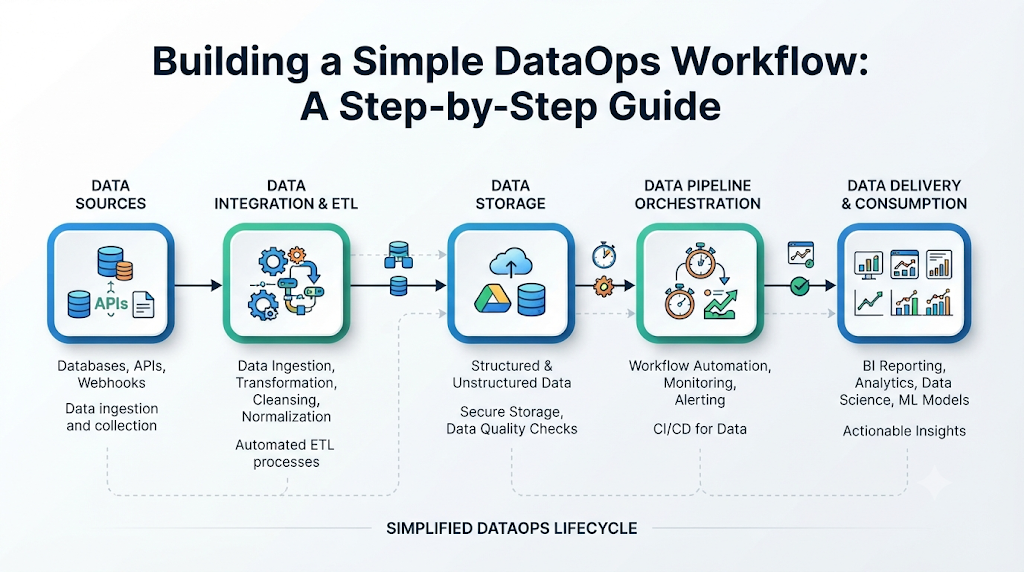
Visual Representation of a Simple DataOps Workflow
Below is an architectural diagram showing how data, code, testing, and observability flow through the complete DataOps lifecycle:
[ Data Sources ]
  - REST APIs
  - Postgres DB       ===>  [ Ingestion Layer ] (Python / Fivetran)
  - CSV Logs
                              |
                              v
                      [ Cloud Data Lake / Raw Bronze Layer ] (AWS S3 / GCS)
                              |
                              v
[ CI/CD Engine ] ===> [ Transformation & Validation Layer ] (dbt / Snowflake)
 (GitHub Actions)     - Clean & Type
                      - Automated Assertions & Quality Circuit Breakers
                              |
                              v
                      [ Data Warehouse / Gold Layer ] (Star Schema)
                              |
                              +-------------------------+
                              |                         |
                              v                         v
                   [ BI & Analytics Dashboards ]   [ Data Observability & Alerting ]
                   (Tableau / Looker / Metabase)   (Monte Carlo / Slack Notifications)
Popular DataOps Tools Across Workflow Stages
| Workflow Stage | Leading Tools | Primary Features | Key Benefits |
| Ingestion | Airbyte, Fivetran, Meltano | 300+ pre-built connectors, schema auto-sync | Eliminates custom ingestion code |
| Transformation | dbt, Apache Spark, SQLMesh | Version-controlled SQL/Python, lineage graphs | Standardizes analytics engineering |
| Orchestration | Apache Airflow, Prefect, Dagster | Programmable Python DAGs, dependency mapping | Full control over complex workflows |
| Data Quality | Great Expectations, Soda, dbt-expectations | Automated schema and distribution assertions | Prevents dirty data propagation |
| CI/CD | GitHub Actions, GitLab CI, Azure DevOps | Event-driven pipeline testing, pull-request checks | Safe, rapid code deployments |
| Observability | Monte Carlo, Datadog, Acceldata | Anomaly detection, data lineage tracking | Drastically reduces Mean Time to Detection (MTTD) |
Example End-to-End DataOps Workflow: E-Commerce Case Study
Let’s contextualize this workflow with a real-world scenario: GlobalCart, an e-commerce platform, experiences daily spikes in customer transactions.
The Problem
Marketing dashboards were constantly out of sync due to unannounced schema changes from the backend dev team. Duplicate payment transactions occasionally inflated revenue metrics by 15%.
The DataOps Solution
- Source Schema Contract: GlobalCart established an automated schema contract using JSON Schema validation during raw ingestion.
- Ingestion & Lake Storage: Fivetran syncs transactional MySQL data to an S3 raw landing bucket every 15 minutes.
- dbt Transformation & Quality Tests: dbt runs models in Snowflake. A strict
uniquetest runs ontransaction_id. If duplicates appear, dbt triggers a pipeline failure and sends a Slack alert. - CI/CD Deployment: Engineers proposing new SQL transformations create a GitHub Pull Request. GitHub Actions creates a temporary lightweight clone of Snowflake data, runs
dbt test, and tears down the environment upon completion. - Business Impact: GlobalCart reduced dashboard data errors by 98% and lowered pipeline downtime resolution from days to minutes.
Common Challenges While Building DataOps Workflows
- Cultural Resistance: Transitioning data teams from legacy manual workflows to Git and automated CI/CD requires upskilling and process shifts.
- Complex Data Dependencies: Managing deeply nested DAGs can lead to cascading pipeline delays if dependencies are poorly isolated.
- Data Privacy & Governance: Ensuring PII (Personally Identifiable Information) is masked across dev, staging, and production environments.
- Storage & Compute Costs: Running full CI/CD test runs on massive datasets can quickly become expensive without zero-copy cloning or sampling strategies.
Best Practices for Successful DataOps Implementation
- Start Small: Don’t attempt to automate every enterprise pipeline at once. Build a simple, high-impact pipeline first.
- Treat Data as Code: Apply software engineering best practices—version control, peer code reviews, unit testing, and modular architecture.
- Fail Fast with Circuit Breakers: Stop data processing early in the pipeline if raw data fails core quality checks.
- Automate Environment Ephemerality: Use cloud features like Snowflake Zero-Copy Cloning or Databricks staging schemas for lightweight testing.
- Decentralize Ownership with Data Contracts: Define explicit data contracts between software engineering teams and data platform teams.
Common Mistakes Beginners Should Avoid
- ❌ Testing in Production: Running SQL scripts directly on live, customer-facing reporting databases.
- ❌ Hardcoding Credentials: Storing API keys, DB passwords, or S3 credentials in source code (always use environment variables or secret managers).
- ❌ Ignoring Edge Cases: Assuming source data will always be formatted correctly without missing values or duplicate rows.
- ❌ Over-Engineering Early: Deploying heavy, complex microservice architectures for simple datasets that could run easily on simple scheduled scripts.
Skills Required for Modern DataOps Engineers
To build and scale robust DataOps workflows, engineers need a balanced skill set spanning several domains:
                  +-----------------------------------+
                  |      MODERN DATAOPS ENGINEER      |
                  +-----------------+-----------------+
                                    |
     +-----------------+------------+------------+-----------------+
     |                 |                         |                 |
     v                 v                         v                 v
[ Software Eng ]  [ Data Architecture ]   [ DevOps & Cloud ]  [ Governance ]
- Python, SQL     - Data Warehouses       - Docker, CI/CD     - Data Quality
- Git, Testing    - Data Lakes, Modeling  - Terraform, AWS    - Lineage & Security
Career Opportunities in DataOps
Demand for DataOps expertise is skyrocketing across industries. As organizations transition from legacy ETL to automated data platforms, specialized roles are expanding rapidly:
- DataOps Engineer: Focuses on pipeline automation, CI/CD infrastructure, and platform reliability.
- Analytics Engineer: Bridge between data engineering and business analytics; specializes in dbt models and data quality framework setup.
- Data Platform Engineer: Builds internal data platforms, self-service infrastructure, and cloud data architecture.
- Data Reliability Engineer (DRE): Focuses specifically on data observability, SLA uptime, and incident resolution.
Future Trends in DataOps and Workflow Automation
- AI-Driven Data Observability: Machine learning models that automatically detect data drift, schema anomalies, and cost spikes without manual thresholds.
- Self-Healing Data Pipelines: Systems that automatically apply patches or fallback schemas when upstream sources break.
- Serverless DataOps: Widespread adoption of serverless orchestration engines that eliminate infrastructure management.
- Data Mesh Integration: Applying DataOps automation across decentralized, domain-owned data products in large enterprises.
Frequently Asked Questions (FAQs)
What is the main difference between DevOps and DataOps?
DevOps focuses on automating software application delivery and code deployments. DataOps extends these practices to data management, handling both code changes and the continuous flow of unpredictable, dynamic data.
Is dbt considered a DataOps tool?
Yes. dbt (data build tool) is a foundational DataOps tool for transformation. It enables analytics engineers to write version-controlled SQL, automatically generate documentation, and run data quality tests.
How do you handle schema changes in a DataOps workflow?
Schema changes are managed using Data Contracts and automated schema checks. If an upstream field is modified, pre-deployment CI/CD checks flag breaking changes before code reaches production environments.
What is a data circuit breaker?
A data circuit breaker is an automated test rule placed inside a pipeline. If data fails validation (such as null values in a primary key), the breaker automatically pauses processing to prevent corrupt data from reaching production tables.
Can small teams implement DataOps?
Yes! DataOps is a methodology, not an enterprise software requirement. Small teams can implement DataOps simply by using Git, automated dbt tests, and basic GitHub Actions pipelines.
What is the best cloud platform for DataOps?
Major cloud providers (AWS, Google Cloud, Azure) and data platforms (Snowflake, Databricks, BigQuery) all support robust DataOps ecosystems through APIs, SDKs, and modular integration options.
What is Data Observability?
Data Observability is the ability to understand, monitor, and diagnose the health of data pipelines using metrics like data freshness, volume, schema drift, lineage, and overall execution performance.
How long does it take to set up a basic DataOps workflow?
A basic DataOps workflow using tools like Git, Python, dbt, and GitHub Actions can be constructed in just a few hours. Scaled enterprise implementations are built incrementally over time.
Does DataOps replace Data Governance?
No. DataOps automates and enforces Data Governance policies. It translates governance rules into automated code tests, access controls, and lineage tracking throughout the pipeline.
Where can I get formal hands-on training and certification in DataOps?
For comprehensive, industry-accredited training, visit DataOpsSchool.com to access practical tutorials, real-world scenario labs, and certification programs designed for modern data professionals.
Conclusion
Building a simple DataOps workflow is the single most effective way to transform brittle, unpredictable data pipelines into robust, self-healing assets. By embedding version control, automated testing, CI/CD deployment, and proactive observability into your pipelines, you ensure that business decisions are always powered by reliable, high-quality data. DataOps is not about introducing unnecessary complexity; it is about establishing confidence, speed, and trust across your entire organization.
