Introduction
In today’s data-driven landscape, organizations process massive volumes of structured, semi-structured, and unstructured data across hybrid and multi-cloud environments. However, raw data is only as valuable as the speed, quality, and reliability with which it can be transformed into actionable business insights. Traditional data engineering processes—often characterized by manual scripts, brittle handoffs, ad-hoc testing, and siloed communication—struggle to keep up with the demand for real-time analytics. This operational bottleneck is where DataOps automation frameworks come into play. By adapting proven software engineering principles such as Continuous Integration, Continuous Delivery (CI/CD), version control, automated testing, and active observability to data management, these frameworks enable data teams to deliver trusted data faster and with far fewer errors. Whether you are building your first automated pipeline or scaling enterprise infrastructure across platforms like DataOpsSchool.com, understanding how DataOps automation frameworks function is essential for modern analytics and AI operations.
What is DataOps?
DataOps (Data Operations) is an enterprise operational methodology that brings together data engineering, analytics engineering, data science, and IT operations to streamline the end-to-end data lifecycle. Rather than treating data delivery as a static, linear project, DataOps treats data pipelines as dynamic, production-grade software applications.
+--------------------------------------------------------------------------+
|                            DataOps Ecosystem                             |
|                                                                          |
|  +--------------------+   +--------------------+   +------------------+  |
|  |  Data Engineering  |   | Analytics Eng.     |   | Data Science     |  |
|  +---------+----------+   +---------+----------+   +--------+---------+  |
|            |                        |                       |            |
|            +-------------------+    |    +------------------+            |
|                                v    v    v                               |
|                         +---------------------+                          |
|                         |  DataOps Framework  |                          |
|                         +----------+----------+                          |
|                                    |                                     |
|                                    v                                     |
|                         +---------------------+                          |
|                         | Business Value & AI |                          |
|                         +---------------------+                          |
+--------------------------------------------------------------------------+
Core principles of DataOps include:
- Agile Collaboration: Breaking down organizational silos between data producers, data maintainers, and business consumers.
- Automation-First Operations: Eliminating repetitive manual interventions across ingestion, transformation, testing, and deployment.
- Continuous Quality Assurance: Embedding automated quality gates at every phase of the pipeline rather than reacting to broken reports downstream.
- Version Control and Governance: Managing data models, code, and transformation logic with Git-based source control and strict auditing.
What is a DataOps Automation Framework?
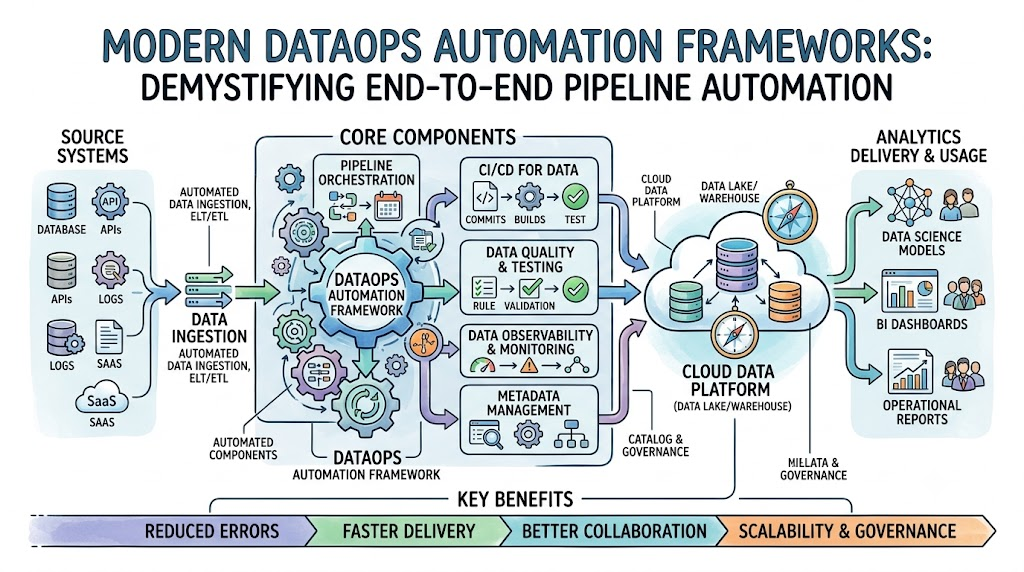
A DataOps Automation Framework is an integrated set of tools, processes, software standards, and architectural practices that automate the entire journey of data—from source ingestion to final dashboard consumption or model inference.
Instead of relying on disconnected tools where an engineer manually triggers script A, monitors log B, and manually uploads table C, an automation framework unifies these steps into a self-healing, repeatable, and observable system.
Textual Architecture Illustration:
[ Data Sources ] ---> [ Automated Ingestion ] ---> [ Automated Transformation (ETL/ELT) ]
                              |                                   |
                              v                                   v
                       [ Quality Tests ]                  [ Data Observability ]
                              |                                   |
                              +-----------------+-----------------+
                                                |
                                                v
                                   [ Cloud Data Warehouse ]
                                                |
                                                v
                                 [ Business Intelligence / AI ]
Why Automation is Essential in Modern DataOps
Modern data infrastructure is too complex for manual management. As organizations transition to the Modern Data Stack and lakehouse architectures, three core challenges make automation non-negotiable:
- Pipeline Complexity and Scale: Enterprise environments handle hundreds of data sources—including APIs, transactional databases, event streams, and SaaS applications. Manually coordinating these dependencies leads to frequent job failures and “data downtime”.
- Schema Drift and Data Instability: Upstream applications frequently update column names or data formats without warning. Without automated schema checks and error handling, downstream dashboards silently break.
- Speed Expectations: Business leaders require near-real-time insights to make critical decisions. Manual code deployments or weekly batch processes delay value delivery and reduce organizational agility.
Traditional Data Management vs. Automated DataOps
| Capability / Aspect | Traditional Data Management | Automated DataOps Framework |
| Pipeline Deployment | Manual deployments, ad-hoc FTP/SSH scripts | Automated CI/CD pipelines via Git triggers |
| Testing & Quality | Manual spot-checks after failures occur | Automated pre-ingestion & post-transformation quality gates |
| Infrastructure | Static, provisioned servers with fixed capacity | Infrastructure as Code (IaC) with elastic auto-scaling |
| Data Observability | Reactive user complaints when metrics mismatch | Proactive anomaly detection, alerts, and schema lineage tracking |
| Environment Isolation | Shared sandbox environments causing code conflicts | Isolated development/staging branches with zero-copy clones |
| Incident Resolution | Manual log debugging across scattered servers | Centralized lineage and root-cause tracing |
Core Components of a DataOps Automation Framework
A robust DataOps automation framework consists of several interconnected technological layers that work seamlessly together.
+--------------------------------------------------------------------------+
|                     DataOps Framework Architecture                       |
|                                                                          |
|  +--------------------------------------------------------------------+  |
|  |                 Metadata Management & Data Lineage                 |  |
|  +--------------------------------------------------------------------+  |
|  |                      Data Observability & Alerting                 |  |
|  +--------------------------------------------------------------------+  |
|  |       CI/CD Pipelines  |  IaC  |  Automated Quality Testing        |  |
|  +--------------------------------------------------------------------+  |
|  |   Ingestion Engine   |  Transform (ETL/ELT)  |  Orchestrator      |  |
|  +--------------------------------------------------------------------+  |
+--------------------------------------------------------------------------+
Data Ingestion Automation
Automated ingestion abstracts the process of connecting to relational databases, flat files, streaming logs, and REST APIs. It automatically handles rate limiting, schema detection, incremental extracts, and Change Data Capture (CDC) to capture source updates continuously without impacting production databases.
ETL/ELT Pipeline Automation
While traditional ETL (Extract, Transform, Load) processed data before loading, modern lakehouses prefer ELT—loading raw data first and using elastic cloud data platforms to run SQL or Python transformations. Automated ELT frameworks execute code modularly, manage materialization strategies (views, tables, incremental models), and handle dependency graphs dynamically.
Workflow Orchestration
Orchestration engines serve as the brain of the data pipeline. They schedule tasks, track job execution states, handle retries, resolve complex task dependencies, and fire alerts when a step stalls or fails.
Continuous Integration and Continuous Delivery (CI/CD) for Data Pipelines
CI/CD for data applies code verification, automated unit testing, and deployment automation to data engineering. When a developer updates a transformation model, CI/CD automatically creates a isolated test environment, runs tests against target schemas, and merges the update into production once verified.
Automated Data Quality Testing
Data quality automation moves beyond code syntax checks to validate the actual content inside the pipeline. It verifies constraints such as null value limits, unicity, referential integrity, range bounds, and custom business logic rules prior to releasing data to production consumption.
Metadata Management and Data Lineage
Metadata automation collects system details, operational metrics, schema definitions, and column-level mapping across every pipeline step. Data lineage visualizes how raw source tables transform into final reports, allowing teams to predict downstream blast radiuses before modifying a column.
Data Observability and Monitoring
Data observability provides end-to-end transparency into system health across five main pillars: freshness, volume, schema updates, distribution, and lineage. Machine learning models monitor historical trends to identify abnormal silent data failures—such as a zero-row load—and alert the appropriate engineer instantly.
Infrastructure as Code (IaC) in DataOps
IaC allows engineers to define cloud compute clusters, storage buckets, network rules, and database permission policies using declarative code files (e.g., Terraform). This ensures that development, staging, and production environments are identical and instantly reproducible.
AI and Machine Learning in DataOps Automation
Artificial Intelligence is reshaping how DataOps frameworks operate. AI-driven capabilities inside modern frameworks include:
- Automated Anomaly Detection: Detecting metric anomalies (e.g., sudden row volume drops) using historical baseline models.
- Self-Healing Pipelines: Automatically selecting alternative compute paths or retrying transient network errors without manual intervention.
- Dynamic Resource Optimization: Recommending cloud cluster scaling rules based on query patterns and historical execution bottlenecks.
- Intelligent Data Classification: Utilizing Natural Language Processing (NLP) to auto-tag sensitive Personal Identifiable Information (PII) during automated ingestion.
Integration with Cloud Data Platforms and MLOps
A DataOps automation framework does not run in isolation; it bridges cloud infrastructures and downstream machine learning operations (MLOps).
- Cloud Platform Alignment: Frameworks connect directly to cloud environments like Snowflake, Databricks, BigQuery, and AWS Redshift. They leverage cloud-native features such as zero-copy cloning, serverless compute, and dynamic resource allocation.
- Enabling MLOps: Reliable AI/ML models rely entirely on accurate training feature stores. DataOps automation guarantees that feature engineering pipelines run deterministically, version-control datasets alongside code, and feed accurate, low-latency features into MLOps platforms.
Popular DataOps Automation Tools and Frameworks
| Tool / Framework | Core Category | Key Features | Primary Integrations | Scalability Level | Enterprise Use Case |
| Apache Airflow / Astro | Workflow Orchestration | Python-DAG scheduling, task dependencies, rich UI plugins | AWS, GCP, Azure, Kubernetes, dbt | Enterprise High | Complex multi-system workflow management |
| dbt (data build tool) | ELT & Data Transformation | SQL modularity, automated testing, docs, versioning | Snowflake, BigQuery, Databricks, Redshift | Enterprise High | Analytics engineering and in-warehouse transformations |
| Monte Carlo | Data Observability | Machine-learning data health monitoring, automated lineage | Snowflake, Looker, Databricks, Airflow | Enterprise High | Automated data downtime tracking and root-cause analysis |
| Great Expectations | Automated Data Testing | Declarative pipeline testing, automatically generated docs | Pandas, Spark, SQL, Airflow | Large Scale | Data quality verification across batch and stream pipelines |
| lakeFS | Data Version Control | Git-like branching, merging, and rollback for data lakes | AWS S3, Azure Blob, Google Cloud Storage, Spark | Enterprise Very High | Isolated testing environments for object stores |
| Terraform | Infrastructure as Code | Declarative cloud provisioning and infrastructure state tracking | AWS, Azure, GCP, Databricks | Enterprise High | Provisioning immutable data platform compute & storage |
Real-World Enterprise Use Cases
1. E-Commerce Real-Time Inventory & Personalization
A global retail company processes millions of transactional events daily. By implementing an automated DataOps framework, streaming ingestion feeds directly into cloud analytics stores. Automated quality checks catch invalid price updates, while orchestration engines trigger real-time recommendation model retrainings.
2. Financial Fraud Detection and Regulatory Reporting
An enterprise bank must submit accurate daily risk reports to financial regulators. The bank leverages automated lineage and CI/CD pipelines to ensure that every transformation calculation is fully traceable and versioned. If a source schema changes unexpectedly, automated observability triggers a hold on reporting jobs, preventing false metric submissions.
Business Benefits of DataOps Automation
- Accelerated Time-to-Insight: Streamlined deployment cycles allow data engineering teams to release new analytics capabilities in hours rather than months.
- Reduced Data Downtime: Continuous testing and active observability catch pipeline breakages before business dashboards or downstream models are affected.
- Lower Operational Costs: Auto-scaling infrastructure and automated error recovery minimize wasted cloud spend and remove manual debugging overhead.
- Enhanced Compliance and Governance: Automated lineage, metadata collection, and role-based access control help satisfy strict regulatory mandates.
- Cross-Team Alignment: Standardized git workflows and shared observability metrics foster transparency between data engineers, analytics engineers, and business analysts.
Common Challenges and Limitations
- Legacy Infrastructure Debt: Integrating modern automation frameworks with legacy on-premise databases often requires complex middleware or staging wrappers.
- Initial Tooling Overhead: Selecting, configuring, and coordinating multiple open-source and SaaS automation tools introduces initial system architectural complexity.
- Cultural Resistance: Shifting teams away from ad-hoc manual queries toward version control, automated code reviews, and strict testing requires intentional change management.
- Skills Gap: Designing automated pipelines requires expertise spanning software development, cloud infrastructure, and traditional data engineering.
Best Practices for Successful Implementation
+--------------------------------------------------------------------------+
|                  DataOps Implementation Checklist                        |
|                                                                          |
|  [ ] Start Small: Automate high-impact bottlenecks first                 |
|  [ ] Version Control Everything: Pipelines, SQL, tests, and IaC          |
|  [ ] Treat Data as Code: Enforce code reviews and CI/CD testing          |
|  [ ] Implement Quality Gates Early: Shift-left data testing              |
|  [ ] Build End-to-End Observability: Monitor quality, speed, and costs   |
|  [ ] Standardize Documentation: Auto-generate lineage and catalogs       |
+--------------------------------------------------------------------------+
- Start Small and Iteratively: Avoid attempting to overhaul your entire enterprise architecture at once. Begin by automating a single high-priority pipeline with testing and orchestration.
- Version Control Everything: Ensure that all SQL scripts, transformation logic, infrastructure templates, and orchestrator DAGs are maintained in Git repositories.
- Shift Testing Left: Run data quality assertions immediately after raw data ingestion rather than waiting for downstream warehouse transformations.
- Implement Isolated Dev/Test Environments: Provide engineers with dedicated branching environments (using features like zero-copy cloning) to test logic without polluting production data.
- Decouple Compute and Storage: Leverage cloud data architectures that allow independent scaling of query compute engines from data storage layers.
Common Mistakes Organizations Should Avoid
- Treating DataOps as Merely Buying Tools: Purchasing modern orchestration or observability software without updating operating processes or engineering habits yields minimal return.
- Neglecting Data Security and Access Controls: Automating workflows without embedding proper secret management, data masking, and role-based access policies exposes sensitive data.
- Over-Engineering Early Pipelines: Introducing complex custom orchestrators for simple, low-volume pipelines creates unnecessary maintenance debt.
- Skipping Post-Deployment Monitoring: Assuming that a pipeline will run perfectly forever once deployed leads to undetected data quality issues downstream.
Skills Required for DataOps Automation Engineers
To excel in designing and maintaining DataOps automation frameworks, engineers need a balanced mix of software engineering, cloud infrastructure, and data management skills:
- Programming & Scripting: High proficiency in Python, SQL, and Bash scripting.
- Orchestration & Workflow Tools: Expertise in platforms like Apache Airflow, Prefect, or Dagster.
- CI/CD & Source Control: Deep understanding of Git, GitHub Actions, GitLab CI, and deployment strategies.
- Cloud Architecture & IaC: Hands-on experience with cloud platforms (AWS, Azure, GCP) and infrastructure tools like Terraform.
- Data Observability & Testing: Practical knowledge of frameworks like dbt test, Great Expectations, and Monte Carlo.
Future Trends in DataOps Automation
- Autonomous Data Pipelines: Self-configuring and self-healing pipelines that dynamically rewrite queries based on performance bottlenecks and schema alterations.
- Data Contract Enforcements: Formalized agreements between software developers (data producers) and data engineers (data consumers) verified automatically at API levels before code merges.
- Native Integration with GenAI Apps: Automated retrieval-augmented generation (RAG) pipelines that enforce real-time data freshness, vector database synchronization, and automated quality checks for AI models.
- Unified Control Planes: Single-pane-of-glass platforms merging orchestration, observability, metadata management, and cost optimization into unified user experiences.
Frequently Asked Questions
What is the primary difference between DevOps and DataOps?
DevOps focuses on automating code development, application testing, and software deployment, whereas DataOps adapts these automation principles specifically to manage data flow, transformation pipelines, data quality, and data governance.
How do DataOps frameworks improve data quality?
DataOps frameworks automatically run programmatic data assertions (such as null checks, duplicate checks, and distribution tests) at every ingestion step, preventing corrupted or bad data from reaching production reports.
Can small businesses implement a DataOps automation framework?
Yes. Small teams can implement lightweight DataOps frameworks by pairing open-source tools like dbt and GitHub Actions with managed cloud warehouse services.
What is the role of CI/CD in DataOps automation?
CI/CD automates the testing, validation, and deployment of data transformation code, ensuring that updates can be released safely without causing downtime or breaking downstream reports.
Which programming languages are most commonly used in DataOps automation?
Python and SQL are the most dominant languages used in DataOps frameworks for workflow scripting, transformation modeling, testing, and custom orchestration DAG creation.
What is data observability, and why is it part of DataOps?
Data observability uses automated monitoring to evaluate system health based on data freshness, volume, schema updates, anomalies, and end-to-end lineage, helping engineers catch issues before consumers notice them.
How does Infrastructure as Code (IaC) support DataOps?
IaC allows data infrastructure—such as storage buckets, compute clusters, and access permissions—to be defined in code files, ensuring consistent, repeatable environment creation.
What is schema drift, and how do automation frameworks handle it?
Schema drift occurs when upstream source systems alter database structures without prior notice. DataOps frameworks detect these schema changes automatically and pause or update ingestion jobs safely.
How long does it take to deploy an enterprise DataOps framework?
While an initial automated pipeline can be established in days, transitioning a full enterprise ecosystem typically involves an iterative journey over a few months depending on organizational complexity.
How does DataOps support Machine Learning and AI operations (MLOps)?
DataOps provides clean, reliable, and versioned data pipelines that supply feature stores and machine learning models with trusted, low-latency data for training and inference.
Conclusion
Implementing a DataOps automation framework is essential for modern enterprises seeking to extract maximum value from their data assets. By replacing manual, ad-hoc workflows with automated ingestion, CI/CD, data quality testing, workflow orchestration, and active observability, data teams transform fragile pipelines into robust, self-healing data delivery engines. The end result is higher data quality, reduced operational costs, faster analytics delivery, and a future-ready foundation for enterprise AI initiatives.
