Introduction
Long ago, building software was simple. You wrote the code, gave it to someone else, and went home. But as the world moved faster, this old way started to fail. Systems broke. Teams fought. Customers were unhappy. I have watched this struggle play out in small offices and giant global companies for two decades.
The problem was never the code itself. The problem was the wall between the people who build things and the people who keep them running. To fix this, we needed a new way to work—a way to automate the boring tasks and build safety into every step.
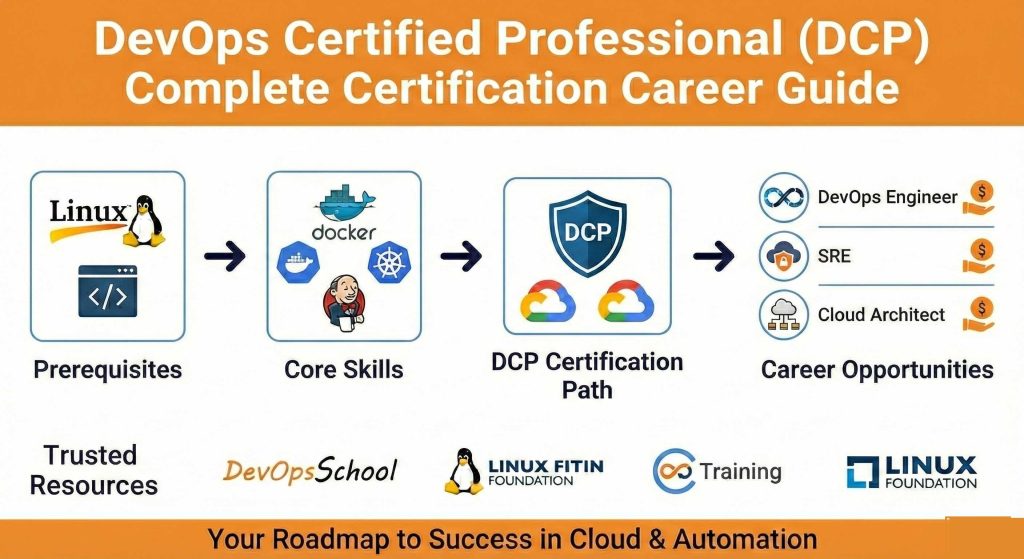
The DevOps Certified Professional (DCP) is not just a title on a paper. It is a complete map for your career. It teaches you how to own the entire journey of your software, from the first line of code to the moment it reaches a user in India or anywhere else in the world. This guide will show you how to cross that bridge.
Overview of Professional Certification Tracks
If you want to grow, you need to know which path to take. The table below lists the primary tracks available through this program. Each one is designed to solve a specific set of problems in the engineering world.
| Track | Level | Who it’s for | Prerequisites | Skills Covered | Recommended Order |
| DevOps | Professional | Engineers, Admins | Basic Linux, Scripting | CI/CD, Docker, K8s, IaC | Start here |
| DevSecOps | Professional | Security Engineers | DevOps Basics | Security Automation, Vault | Second |
| SRE | Professional | Ops Engineers | DevOps Basics | SLIs/SLOs, Error Budgets | Second |
| AIOps/MLOps | Professional | Data/Ops Engineers | Python Basics | ML in Ops, Monitoring | Advanced |
| DataOps | Professional | Data Engineers | SQL, Data Basics | Data Pipelines, Quality | Advanced |
| FinOps | Professional | Managers, Leads | Cloud Basics | Cost Optimization | Leadership |
DevOps Certified Professional (DCP) Deep Dive
This section is the core of your learning. The DCP is not a quick fix; it is a deep journey into the tools and practices that run the modern internet.
What it is
The DCP is a comprehensive program created to help you master the art of automation. It brings developers and operations teams together so they can work as one strong unit. It teaches you how to use a standard set of tools to make software delivery fast, safe, and repeatable. Instead of hoping code works, you build systems that ensure it works.
Who should take it
- Software Engineers: Who are tired of waiting for other teams to deploy their code.
- System Administrators: Who want to stop fixing servers manually at midnight and start automating their work.
- Quality Assurance Experts: Who want to move from manual testing to building automated quality gates.
- Engineering Leads: Who need to understand the technical “how” to guide their teams effectively.
Skills you’ll gain
- Commanding Linux & Scripting: You will learn to manage servers without a graphical interface. You will write Shell or Python scripts that can do hours of manual work in seconds.
- Advanced Version Control: You will master Git workflows. You will learn how to manage code changes for huge teams without losing work or creating conflicts.
- Continuous Integration (CI): You will use tools like Jenkins to build “pipelines.” These are automatic systems that test and package your code the moment you save it.
- Infrastructure as Code (IaC): You will use Terraform and Ansible. This allows you to build entire networks of servers using simple text files, making your infrastructure easy to copy and fix.
- Containerization Mastery: You will learn Docker to package your applications. This ensures your app runs exactly the same on your laptop as it does on a production server.
- Orchestration with Kubernetes: You will learn to manage armies of containers. Kubernetes will help you keep applications alive, healthy, and scaling automatically.
- Observability & Monitoring: You will set up tools like Prometheus and Grafana. These tools act as eyes and ears, alerting you to problems before your users even notice.
Real-world projects you can do
- The Zero-Touch Deployment: Build a system where a developer pushes code to Git, and it is automatically tested, built, and deployed to a live website without a single human click.
- The Self-Healing Infrastructure: Create a server group that watches itself. If a web server crashes, the system detects it and launches a new one automatically to replace it.
- Blue/Green Deployments: Learn to release a new version of software to a small group of users first. If it works, you roll it out to everyone. If it fails, you switch back instantly.
- Automated Security Scanning: Integrate security tools into your pipeline that check for passwords or vulnerabilities in your code every time you save.
Preparation Plan
- Days 1-14 (The Foundation): Focus strictly on the basics. Learn the Linux command line until you are comfortable. Understand how networks work (IP addresses, ports). Learn Git basics (commit, push, pull, merge).
- Days 15-45 (The Builder): Dive into the tools. Spend this month building Jenkins pipelines. Write Dockerfiles to package simple web apps. Start playing with Ansible to configure servers.
- Days 46-60 (The Master): Tackle the complex systems. Focus on Kubernetes architecture (Pods, Services, Deployments). Learn Terraform state management. Bring it all together in a final project.
Common Mistakes
- Skipping the Basics: Do not try to learn Kubernetes if you do not understand Linux yet. It is like trying to run before you can walk.
- Tool Collecting: Do not just memorize tool names. Focus on why you are using them. Tools change, but the concepts of automation stay the same.
- Working in Isolation: DevOps is about communication. If you build a great tool but do not talk to the developers who need to use it, you have failed.
- Neglecting Security: Do not leave security for the end. It is much harder to add safety to a finished system than to build it in from the start.
Best next certification after this
Once you have the DCP, the best next step is DevSecOps Professional if you want to focus on safety, or SRE Professional if you want to focus on high-scale reliability.
Choose Your Path: Six Ways to Lead
Find the path that excites you and follow it with everything you have.
- DevOps Path (The Builder): This is the heart of it all. You focus on speed and making the flow of code as smooth as water. You are the bridge between ideas and reality.
- DevSecOps Path (The Guardian): This is for the protectors. You learn how to keep systems safe by putting security checks into every single step of the automation. You make sure hackers stay out.
- SRE Path (The Fixer): This is for the problem solvers. You focus on making systems so stable that they never, ever go down. You use math and engineering to guarantee uptime.
- AIOps/MLOps Path (The Futurist): This is the future. You use the power of Artificial Intelligence to manage complex systems. You also learn how to deploy massive AI models for data scientists.
- DataOps Path (The Architect): This is for the data lovers. You ensure that huge amounts of data flow through the company quickly, safely, and without errors so decisions can be made fast.
- FinOps Path (The Strategist): This is for the business-minded. You master the cloud’s cost so that the company can grow without wasting money on unused servers.
Role → Recommended Certifications
Here is how you should plan your journey based on your current job title.
- DevOps Engineer: Start with DCP (DevOps). Then, master DevSecOps to become a complete expert.
- SRE: Get your DCP (DevOps) foundation first. Then move to SRE Professional to learn advanced stability metrics.
- Platform Engineer: Focus on DCP (DevOps) and then learn deep Infrastructure Automation to build tools for other teams.
- Cloud Engineer: Start with DCP (DevOps) and move into Cloud Architecture for AWS or Azure to understand the big picture.
- Security Engineer: Take the DevSecOps Professional track to learn how to automate safety checks.
- Data Engineer: Follow the DataOps Professional path to master data pipelines and quality.
- FinOps Practitioner: The FinOps Professional track is your key to managing cloud money and governance.
- Engineering Manager: Take DCP (DevOps) and DevOps Leader to understand the work and lead your team to success.
Top Institutions for DCP Training
To win, you need the best training. These institutions are the leaders in the field. They will give you the tools and the support you need to succeed.
1. DevOpsSchool
“The Gold Standard for Hands-on Mentorship”
DevOpsSchool is widely considered the top choice for the DCP certification because they focus entirely on “doing” rather than just “listening.” They do not just teach you how to pass an exam; they teach you how to survive a real day at work.
- Deep Technical Training: Their DCP program is rigorous. It covers over 60 to 120 hours of training. They go very deep into core tools like Linux, Docker, Kubernetes, and Terraform.
- Mentor-Led Approach: You are not left to watch pre-recorded videos alone. You get access to mentors who guide you through complex topics.
- Real-Time Projects: The highlight is the “Live Project” module. You will build a full CI/CD pipeline and secure a cloud environment.
2. Cotocus
“The Corporate & Consulting Experts”
Cotocus is primarily a consulting firm that helps big companies solve big problems. Their training is born out of this experience.
- Consulting-Based Curriculum: Their trainers are often active consultants. This means they bring “war stories” from the field into the classroom.
- Focus on Culture & Process: While they teach the tools, Cotocus places a heavy emphasis on the “culture” part of DevOps. You will learn how to communicate and lead change.
- Customized Corporate Batches: They are the best fit for managers looking to train entire teams on specific tech stacks.
3. Scmgalaxy
“The Community Powerhouse”
Scmgalaxy started as a community for configuration management experts and has grown into a massive resource hub.
- Tool-Specific Mastery: Scmgalaxy is famous for its deep dives into specific tools. If you want to become the absolute expert on Ansible or Jenkins, their materials are unmatched.
- Community Support: You get access to a vibrant community of thousands of engineers. If you are stuck on a bug, someone here can help.
- Huge Resource Library: They provide an extensive collection of tutorials and scripts that you can use long after you finish your certification.
4. BestDevOps
“Staying Ahead of the Curve”
The tech world changes every six months. BestDevOps focuses on keeping you updated with the absolute latest trends.
- Cutting-Edge Tools: BestDevOps ensures their DCP curriculum is updated with the latest releases of Kubernetes and modern cloud practices.
- Trend-Focused Learning: They help you understand where the market is going, teaching emerging concepts like “Platform Engineering.”
- Review & Comparison: They are excellent at helping you compare different tools so you can make the right decisions as an architect.
5. Specialized Schools
“The Niche Masters”
Sometimes, you need to be more than a generalist. These specialized schools allow you to laser-focus on one specific career path within the DCP framework.
- DevSecOpsSchool: Focuses purely on Security Automation, SAST/DAST, and Vault.
- SRESchool: Focuses on Reliability, Service Level Objectives (SLOs), and advanced monitoring.
- AIOpsSchool: Focuses on using AI to predict server failures and automate fixes.
- DataOpsSchool: Focuses on applying DevOps principles to Big Data pipelines.
- FinOpsSchool: Focuses on Cloud Cost Management and optimization.
Real Testimonials
“I felt stuck in my career until I found this program. The hands-on projects changed everything. I learned how to build real pipelines, and it gave me the confidence to apply for a senior role. I got the job and a huge pay raise! The mentorship was invaluable.”
— Arjun M., Senior DevOps Engineer
“As an engineering manager, I needed to understand what my team was talking about. This guide and the DCP certification gave me the language and the technical depth to lead more effectively. I now know exactly how to lead my team through technical changes.”
— Sarah K., Engineering Manager (Global Tech)
“The transition from System Admin to SRE was daunting. The structured path provided here made it manageable. Starting with the core DevOps principles and moving into reliability engineering felt natural. It prepared me for the real challenges of a high-traffic environment.”
— Vikram S., SRE Lead
FAQs: Career & Journey
1. Is the DCP certification difficult for someone with no ops experience?
It is a challenge, but the program is built to start with the basics. If you are willing to spend time in the lab, you will succeed.
2. How much time does it take to get certified?
For a working professional, 60 days of consistent study (1-2 hours a day) is usually enough to master the material.
3. What are the main prerequisites?
You should have a basic understanding of how software is built and be comfortable using a computer. Knowing a little bit of coding helps.
4. Should I take SRE or DevOps first?
Always start with DevOps (DCP). It provides the foundation you need to understand the complex reliability concepts in SRE.
5. How does this help my career in India?
The demand for DevOps in India is at an all-time high. Companies are moving from manual work to automation, and they need certified people to lead that change.
6. Is this certification recognized globally?
Yes. The tools and principles taught (Docker, K8s, Git) are the global standard for engineering.
7. Do I need to learn a specific programming language?
Python or Go are highly recommended, but the course will teach you the scripting you need for automation.
8. What is the value of DCP for a Manager?
It helps you understand what your team is actually doing. It allows you to set realistic goals and choose the right tools for your department.
9. Can I do this entirely online?
Yes, most of the training from the listed institutions is designed for remote, online learning with virtual labs.
10. How long does the certification stay valid?
Usually, it is valid for two to three years, after which you should move to a more advanced level as the technology changes.
11. What is the average salary hike after getting DCP?
While it varies, certified professionals often see a 30% to 50% increase in their market value because these skills are so rare.
12. Is there a final project for the certification?
Yes. You must complete a practical project where you build a full automation pipeline to prove your skills.
FAQs on DevOps Certified Professional (DCP)
1. What makes DCP different from other certifications?
DCP focuses on the “Professional” level of work. It isn’t just a multiple-choice test; it requires you to show you can build and fix real systems.
2. Does the program cover AWS, Azure, or Google Cloud?
Yes. While it focuses on tools, you will learn how to deploy those tools on the major cloud platforms.
3. Is there a community for DCP students?
Yes, institutions like DevOpsSchool and Scmgalaxy have massive communities where you can ask questions and share scripts.
4. What tools are covered in the DCP?
The core tools include Git, Jenkins, Docker, Kubernetes, Terraform, Ansible, and Prometheus.
5. Do I get a physical certificate?
You receive a digital certificate that can be easily shared on LinkedIn, and some providers offer physical copies as well.
6. Can I take the exam without training?
You can, but given the hands-on nature of the exam, it is highly recommended to go through a mentor-led program.
7. Are there weekend batches for working professionals?
Yes, most institutions offer weekend or evening batches specifically for engineers who work during the week.
8. How do I keep my skills fresh after the exam?
By staying active in the community and continuing to the next track, like DevSecOps or SRE.
Conclusion
Your career is in your hands. You can stay where you are, or you can take the leap and become a DevOps Certified Professional. The tools are ready. The paths are clear. The institutions are waiting to help you. The only thing missing is your decision to start.
Build your future, master your craft, and show the world what you can do. My advice after many years in this industry is simple: do not just read. Build things. Break them. Fix them. That is how you become a professional.