Introduction
The way we manage software has changed forever. In the past, developers wrote code and operations teams kept it running. These two groups often worked in silos, leading to slow releases and frequent outages. After decades of seeing systems fail and succeed, it is clear that a new approach is needed. This approach is called Site Reliability Engineering (SRE). SRE is not just a job title; it is a way of thinking. It uses software engineering methods to solve problems in IT operations. The Site Reliability Engineering Certified Professional (SRECP) is designed to teach you these exact methods. This guide will help you understand why this certification is a game-changer for your career and how to master it.
Choose Your Path: 6 Strategic Learning Tracks
The tech world is vast. To stay ahead, you need to choose a path that fits your goals. Each of these tracks represents a major area of modern engineering.
1. The DevOps Path
This is the foundation. It focuses on breaking down the walls between development and operations. You learn about culture, automation, and measurement. It is best for those who want to speed up the delivery of software without losing quality.
2. The DevSecOps Path
Security cannot be a last-minute check. This path teaches you how to bake security into the entire software lifecycle. You learn to automate security tests and manage secrets. It is ideal for engineers who want to protect systems from the start.
3. The SRE Path
This is about making systems resilient and scalable. You treat operations as an engineering problem. This path is perfect for those who love deep technical challenges and want to ensure that high-traffic systems never go down.
4. The AIOps/MLOps Path
As systems grow, humans cannot watch everything. This path uses Artificial Intelligence and Machine Learning to manage operations. You learn how to deploy and monitor ML models and use AI to predict system failures before they happen.
5. The DataOps Path
Data is the lifeblood of modern business. This path focuses on the flow of data. You learn how to build reliable data pipelines and ensure that data is always available and accurate for decision-makers.
6. The FinOps Path
Cloud costs can spiral out of control. This path brings financial accountability to the world of engineering. You learn how to track cloud spending, optimize resources, and ensure that every dollar spent on the cloud provides real value.
Certification Master Table
This table helps you compare the most popular certifications and see where the SRECP fits in your journey.
| Track | Level | Who it’s for | Prerequisites | Skills Covered | Recommended Order |
| DevOps | Professional | Beginners/Mid-level | Basic Linux | CI/CD, Git, Jenkins | 1 |
| SRE | Professional | Engineers/Managers | DevOps Basics | SLOs, SLIs, Toil | 2 (SRECP) |
| DevSecOps | Professional | Security Minded | DevOps Basics | Vault, Security Scans | 3 |
| MLOps | Specialist | Data Enthusiasts | Python | ML Pipelines, Model Ops | 4 |
| DataOps | Specialist | Data Engineers | SQL, ETL | Data Quality, Pipelines | 5 |
| FinOps | Management | Managers/Leads | Cloud Basics | Cost Optimization | 6 |
Deep Dive: Site Reliability Engineering Certified Professional (SRECP)
What it is
The SRECP is a high-level certification from DevOpsSchool that validates your ability to run large-scale systems reliably. It is based on the principles developed by Google. It teaches you how to balance the need for new features with the need for a stable system.
Who should take it
This certification is perfect for Software Engineers who want to understand production environments. It is also for System Administrators who want to move away from manual work and toward automation. Engineering Managers find it valuable because it provides a data-driven way to manage team goals and system health.
Skills you’ll gain
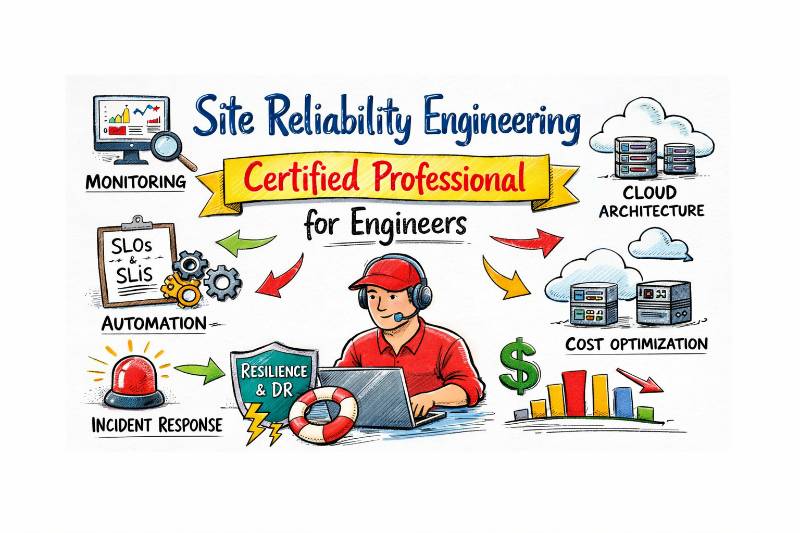
- Defining SLIs and SLOs: Learn how to measure what truly matters to your users.
- Managing Error Budgets: Understand how much “unreliability” you can afford to speed up development.
- Toil Reduction: Master the art of identifying manual, repetitive tasks and automating them.
- Advanced Monitoring: Go beyond simple “up/down” checks and build deep observability into your systems.
- Incident Management: Learn how to handle outages calmly and conduct blameless post-mortems.
- Automation: Use code to manage infrastructure, ensuring that your environment is always consistent.
Real-world projects you should be able to do
- Build an SLO Dashboard: Create a tool that shows real-time health against reliability targets.
- Automate Incident Alerts: Design a system that automatically notifies the right people during a failure.
- Chaos Engineering Experiment: Conduct a controlled test to see if your system can survive a server crash.
- Toil Audit: Audit a team’s weekly work to find manual tasks and write scripts to automate them.
Preparation Plan
7–14 Days (The Expert Sprint): Focus on the core theory of SRE—SLIs, SLOs, and Error Budgets. Practice the mathematical logic behind these targets and review case studies of famous outages.
30 Days (The Professional Path): Spend the first two weeks on SRE fundamentals and monitoring tools (Prometheus). Use the second two weeks for hands-on labs involving incident response and automation with Ansible or Terraform.
60 Days (The Deep Dive): Ideal for those shifting from development or traditional ops. Spend the first month mastering Linux and basic scripting before diving into the core SRECP modules and complex multi-tool projects.
Common Mistakes
- Ignoring the Culture: SRE is not just about tools. If your company blames people for mistakes, SRE will fail.
- Aiming for 100% Reliability: No system is 100% reliable. Trying to reach that goal is too expensive and slows down innovation.
- Manual Overload: Many people start SRE but get sucked back into manual “firefighting.” You must protect time for engineering.
Next Certifications to Take
Once you have mastered the SRECP, your next move depends on your interest:
- Same Track: Certified Kubernetes Administrator (CKA) to master orchestration.
- Cross-Track: DevSecOps Certified Professional to add a security layer.
- Leadership: FinOps Practitioner to learn how to manage tech costs.
Role → Recommended Certifications Mapping
| If you are a… | Focus on these Certifications |
| DevOps Engineer | DevOps Certified Professional, SRECP, Kubernetes |
| SRE | SRECP, Chaos Engineering, AIOps |
| Platform Engineer | SRECP, Terraform Essentials, Kubernetes |
| Cloud Engineer | AWS/Azure Professional, SRECP |
| Security Engineer | DevSecOps Certified Professional, SRECP |
| Data Engineer | DataOps Professional, MLOps |
| FinOps Practitioner | FinOps Professional, Cloud Cost Management |
| Engineering Manager | SRECP (for mindset), FinOps, Agile Leadership |
Training & Certification Support Institutions
Choosing the right partner for your SRE journey is critical. These institutions provide specialized training and support for the SRECP certification:
- DevOpsSchool: The primary provider for the SRECP. They offer live instructor-led sessions, recorded videos, and hands-on labs. They are famous for teaching real-world skills that you can use on day one of your job.
- Cotocus: Known for its intensive, lab-based training. They focus heavily on the technical tools needed for SRE, helping corporate teams transition to modern operations quickly.
- Scmgalaxy: A community-driven platform with thousands of resources. It is perfect for self-learners who want to read blogs, watch tutorials, and join study groups focused on SRE.
- BestDevOps: Focuses on simplified learning paths for busy professionals. They break down complex SRE concepts into small, easy-to-learn modules that fit into a working schedule.
- devsecopsschool: A specialized portal for security-focused reliability. They help engineers learn how to keep systems both stable and safe from external threats.
- sreschool: Dedicated entirely to the SRE discipline. This site provides deep-dives into the specific tools and cultural shifts required for successful SRE adoption.
- aiopsschool: Focuses on the future of operations. They teach how to use Artificial Intelligence to automate monitoring and predict system failures before they happen.
- dataopsschool: Best for data engineers. They show how to apply SRE principles to data pipelines, ensuring that data is always accurate and available.
- finopsschool: Teaches the financial side of cloud engineering. They help you understand how to make your reliable systems cost-effective for the business.
Frequently Asked Questions (FAQs)
General & Career Outcomes
- How difficult is the SRECP exam?
It is moderately challenging. It tests your ability to apply SRE principles to real-world scenarios, not just memorization. - How long does it take to get certified?
Most professionals complete the training and pass the exam within 30 to 45 days. - Are there any prerequisites?
Basic understanding of DevOps and cloud platforms is highly recommended to get the most out of the course. - In what sequence should I take these?
Start with DevOps, then move to SRECP, and finally specialize in DevSecOps or AIOps. - What is the value of SRECP?
SREs are among the highest-paid professionals in tech. This cert validates the skills top companies are looking for. - Will this help me get a job in India?
Yes. SRE is a global discipline, and SRECP is recognized by major tech hubs like Bangalore, Hyderabad, and Pune.
SRECP Specifics
- What is the passing score?
The passing score is typically 65%, consisting of multiple-choice and scenario-based questions. - Is the exam online?
Yes, the exam is conducted online via a proctored platform, making it accessible from anywhere. - How does SRECP differ from DevOps?
DevOps focuses on the delivery pipeline (speed), while SRECP focuses on the production environment (reliability). - Does the course include labs?
Yes, the program at DevOpsSchool includes significant hands-on lab time for monitoring and automation. - How long is it valid?
It remains relevant for 2-3 years, after which an advanced certification or refresher is recommended. - Can a manager benefit?
Absolutely. It teaches managers how to use data like Error Budgets to manage team priorities and reduce burnout.
Conclusion
The transition to Site Reliability Engineering is more than just a change in tools; it is a change in how we value stability and speed. In today’s market, being an engineer who simply “fixes things” is no longer enough. You must be an engineer who builds systems that are reliable by design.
The Site Reliability Engineering Certified Professional (SRECP) is your roadmap to this high-demand career. By choosing the right learning path and the right training partner, you are setting yourself up for long-term success. Reliability is the ultimate feature, and with this certification, you become the expert who delivers it.