Introduction
Traditional data engineering was built on batch processing—loading, transforming, and delivering data overnight in rigid schedules. But modern enterprises operate in real time. E-commerce platforms recalculate inventory instantly, fraud prevention engines score transactions as they happen, and logistics systems dynamically re-route shipments based on weather and traffic updates. This is where Event-Driven DataOps comes in. By combining the agility, automation, and continuous delivery principles of DataOps with the real-time capabilities of Event-Driven Architecture (EDA), organizations can transition from passive reporting to immediate, automated action.In this guide, we will break down the fundamentals of Event-Driven DataOps, explore its core architectural components, discuss modern tools like Apache Kafka, and show you how to implement reliable real-time data pipelines.
What is Event-Driven DataOps?
Event-Driven DataOps is an operational framework and architecture that applies automated testing, continuous integration, real-time observability, and rapid delivery principles to continuous streams of data events.
While traditional DataOps focuses on automating the end-to-end data lifecycle—from ingestion through transformation to consumption—Event-Driven DataOps applies these principles specifically to systems that react instantly to changes in state.
[ Data Source / Change ]
       │
       ▼
[ Event Capture (CDC / Webhooks) ]
       │
       ▼
[ Event Broker (Apache Kafka / Pulsar) ] ──> [ DataOps Observability & Quality Checks ]
       │
       ▼
[ Stream Processing (Flink / Spark) ]
       │
       ▼
[ Real-Time Analytics & ML Models ]
Instead of waiting for a scheduled job to pull data out of a database at midnight, an event-driven system captures state changes—such as a customer clicking a button, a payment processing, or a IoT sensor reading—the exact moment they occur.
Understanding Event-Driven Architecture (EDA)
At the heart of Event-Driven DataOps is Event-Driven Architecture (EDA). EDA is a design pattern where decoupled software components communicate asynchronously by producing, detecting, and consuming state updates called events.
An event represents a immutable record of a historical fact. It contains:
- Header / Metadata: Event ID, timestamp, schema version, event type.
- Payload: The actual data describing the occurrence (e.g.,
{"order_id": 9841, "status": "completed", "amount": 149.99}).
Because components in an EDA are loosely coupled, event producers do not need to know who is consuming their data or how that data will be transformed. This isolation allows data teams to add new analytical applications, machine learning pipelines, or storage sinks without modifying existing operational systems.
Why Event-Driven Data Processing Matters
Business requirements have shifted from historical analysis to immediate operational action. Waiting hours for batch ETL pipelines creates data latency that costs organizations millions in missed opportunities or delayed incident responses.
Batch Processing Latency:
[ Data Generated ] ── (Wait for Schedule) ──> [ Batch ETL Job ] ──> [ Analytics Dashboard ]  (Hours to Days)

Event-Driven Latency:
[ Data Generated ] ── (Instant Stream) ────> [ Event Processing ] ──> [ Real-Time Action ]   (Milliseconds to Seconds)
Event-driven processing provides critical enterprise advantages:
- Low Latency: Data is validated, enriched, and acted upon within milliseconds.
- Resource Efficiency: Compute resources scale dynamically with incoming event volume rather than spiking during heavy nightly batch runs.
- Decoupled Workflows: Independent services can listen to the same stream of events without affecting upstream source databases.
- Improved Data Quality: Schema validation and quality checks are applied at the point of ingestion, preventing bad data from entering the downstream data warehouse.
Traditional Batch Processing vs. Event-Driven DataOps
| Metric / Feature | Traditional Batch Processing | Event-Driven DataOps |
| Execution Trigger | Time-based schedules (e.g., nightly at 12 AM) | Event-based triggers (real-time state changes) |
| Data Latency | High (Hours to Days) | Sub-second to Milliseconds |
| System Coupling | Tightly coupled pipelines; failure blocks entire batch | Loosely coupled services; producers and consumers are isolated |
| Data Flow | Pull-based (queries source databases periodically) | Push-based (source systems push events as they occur) |
| Infrastructure Load | High peak loads during batch windows | Evenly distributed, streaming load scaled on demand |
| Testing & Verification | Post-hoc validation after data reaches target store | Continuous inline testing via schema registries & CI/CD |
| Primary Use Cases | End-of-month reporting, deep historical analysis | Real-time fraud detection, dynamic pricing, live dashboards |
Core Components of an Event-Driven DataOps Pipeline
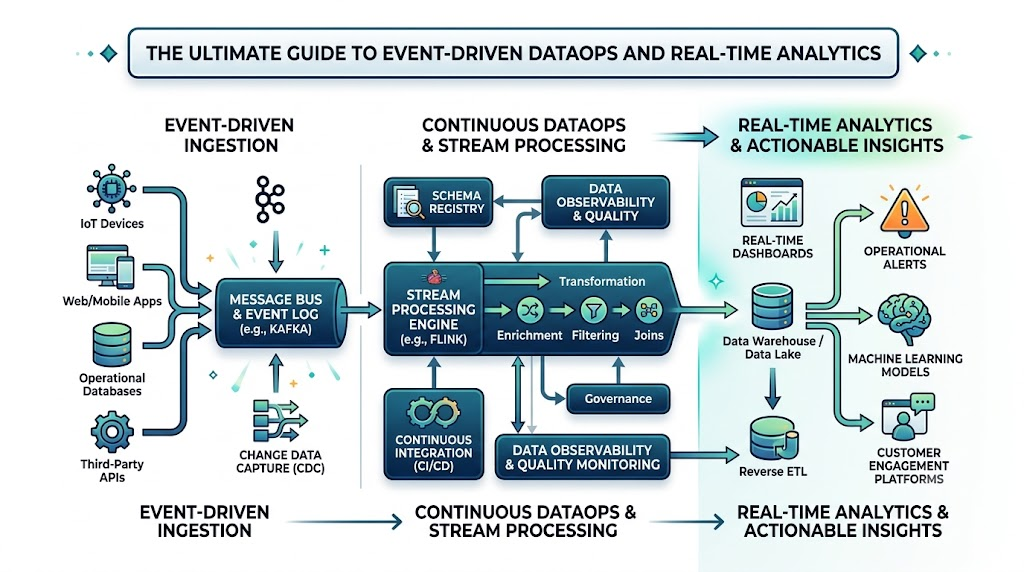
An enterprise Event-Driven DataOps pipeline consists of several interconnected layers that process data continuously while enforcing operational rigor.
┌─────────────────┐      ┌──────────────────┐      ┌────────────────────┐      ┌──────────────────┐
│ Event Producers │ ───> │   Event Broker   │ ───> │ Stream Processors  │ ───> │ Target Storage / │
│ (Apps, CDC, IoT)│      │ (Kafka, Pulsar)  │      │  (Flink, Spark)    │      │ Analytics Sinks  │
└─────────────────┘      └──────────────────┘      └────────────────────┘      └──────────────────┘
                                   │                          │
                                   ▼                          ▼
                         ┌─────────────────────────────────────────┐
                         │   DataOps Engine: Quality Checks,       │
                         │   Schema Registry, CI/CD, Observability │
                         └─────────────────────────────────────────┘
- Event Capture Layer: Uses Change Data Capture (CDC) or application webhooks to emit event payloads instantly without straining source relational databases.
- Event Ingestion & Brokerage: A scalable message bus that persists streams of events in topic partitions with configurable retention policies.
- Stream Processing & Transformation: Engine layer that cleans, joins, filters, and aggregates continuous data flows.
- DataOps Management Layer: CI/CD deployment automation, continuous testing, schema governance, and real-time observability monitors.
- Consumption Layer: Downstream analytical storage, operational microservices, and real-time dashboards.
Events, Producers, Consumers, and Event Brokers
Understanding the interaction between producers, consumers, and brokers is critical for designing streaming pipelines.
- Events: A state record represented as JSON, Avro, or Protobuf.
- Producers: Applications, IoT devices, microservices, or database log parsers that publish events to an event broker.
- Consumers: Downstream services, analytical data warehouses, or stream processors that subscribe to and process events.
- Event Brokers: Distributed, fault-tolerant messaging systems (like Apache Kafka) that accept events from producers, store them reliably, and route them to consumers.
Real-Time Data Streaming Explained
Real-Time Data Streaming is the continuous, non-stop ingestion and processing of data as it is generated.
Unlike static request-response APIs, streaming relies on a Publish/Subscribe (Pub/Sub) or Event Log model. In an event log system, incoming data streams are appended sequentially to an immutable disk log. Consumers maintain their own pointers (offsets) to track their progress through the log.
This architecture allows multiple consumers to read the exact same data stream at their own pace without interfering with each other or causing resource lockups.
Apache Kafka and Other Event Streaming Platforms
While many messaging systems exist, Apache Kafka remains the industry standard for high-throughput event streaming. However, the modern ecosystem offers several options tailored to specific infrastructure needs:
- Apache Kafka: A distributed event store and stream-processing platform capable of handling trillions of events per day with high throughput and low latency.
- Apache Pulsar: A multi-tenant, cloud-native event streaming platform featuring tiered storage that decouples compute from storage.
- AWS Kinesis & GCP Pub/Sub: Fully managed cloud streaming services designed for seamless integration with native cloud analytics stacks.
- Redpanda: A Kafka-API-compatible streaming platform built in C++ for maximum throughput and low latency without JVM overhead.
Data Ingestion in Event-Driven Systems
Ingesting event data safely requires patterns that guarantee consistency and minimal operational impact on source systems:
1. Change Data Capture (CDC)
CDC tools (like Debezium) listen directly to the write-ahead transaction logs of databases (e.g., PostgreSQL, MySQL) and convert every INSERT, UPDATE, or DELETE into a streaming event. This extracts real-time updates without impacting database query performance.
2. Direct Application Event Emitters
Microservices emit explicit business events directly to the event broker via software SDKs whenever a business workflow completes (e.g., user_signed_up, cart_abandoned).
3. Webhooks and API Gateways
External systems push incoming operational data streams into API gateways, which route them directly to event brokers for validation and queuing.
Event Processing and Data Transformation
Once data enters the event broker, it must be transformed into usable business insights. Stream processing frameworks operate on continuous data using two primary paradigms:
Stateless Transformation
Processing each event independently without needing context from past events (e.g., filtering out invalid records, masking PII data, or parsing raw JSON strings into structured columns).
Stateful Transformation
Aggregating multiple events across a specific time window or joining disparate streams together (e.g., calculating the average transaction value over a 5-minute rolling window).
Common stream processing engines include Apache Flink, Spark Streaming, and Kafka Streams.
Monitoring, Observability, and Data Quality
Data pipelines operating in real time require automated testing and observability to catch failures before corrupted data spreads downstream.
                        ┌──────────────────────────────────────┐
                        │        Schema Registry (Avro)        │
                        │ (Rejects Bad Payloads Pre-Ingestion) │
                        └──────────────────────────────────────┘
                                           │
                                           ▼
[ Raw Event Stream ] ───> [ Continuous Quality Checks ] ───> [ Validated Data Stream ]
                                           │
                                           ▼
                        ┌──────────────────────────────────────┐
                        │      Dead Letter Queue (DLQ)         │
                        │  (Quarantines Failed Records For     │
                        │        Alerting & Inspection)        │
                        └──────────────────────────────────────┘
- Schema Governance: Using Schema Registries (e.g., Confluent Schema Registry) to enforce contract versions (Avro, Protobuf) between producers and consumers. If a producer attempts to publish an event that violates the schema, the message is rejected instantly.
- Dead Letter Queues (DLQ): Messages that fail parsing or data validation are routed to a DLQ topic for isolated inspection without halting the main pipeline.
- Data Quality Assertions: Automated tests verify field completeness, value ranges, and anomaly thresholds inline as data streams through the pipeline.
- End-to-End Lineage & Metrics: Tracking consumer lag, processing latency, and stream lineage across the architecture using tools like OpenTelemetry and Grafana.
Integrating Event-Driven DataOps with Cloud Platforms
Modern Cloud Data Platforms (such as AWS, Azure, GCP, Snowflake, and Databricks) provide managed connectors and real-time streaming integrations:
- Snowflake Snowpipe Streaming: Ingests event streams directly into Snowflake tables with sub-second latency, bypassing slow file-staging steps.
- Databricks Structured Streaming: Treats real-time event streams as unbounded tables, allowing data engineers to write SQL queries over live streams seamlessly.
- AWS Streaming Architecture: Combines Amazon Kinesis/MSK with AWS Lambda, Glue Streaming, and S3 Data Lakes for serverless real-time data ingestion.
Popular Tools for Event-Driven DataOps
| Tool Name | Category | Key Features | Primary Use Cases | Key Benefits |
| Apache Kafka | Event Streaming Broker | High-throughput distributed log, partition scaling, multi-region replication | Core message backbone for streaming architecture | Extreme throughput, battle-tested reliability, massive community |
| Apache Flink | Stream Processing Engine | Stateful stream analytics, low-latency processing, exact-once semantics | Complex Event Processing (CEP), real-time aggregates | True event-at-a-time processing with state management |
| Debezium | Change Data Capture (CDC) | Log-based CDC for relational and NoSQL databases | Real-time database replication to streaming topics | Zero impact on database performance, automatic schema mapping |
| Confluent Schema Registry | Data Governance | Enforces schema rules, compatibility checks (Avro/JSON/Protobuf) | Schema evolution and contract validation in pipelines | Prevents breaking changes from corrupting downstream consumers |
| dbt (Data Build Tool) | Analytics Engineering | SQL/Python pipeline transformations, built-in testing, documentation | Micro-batch and streaming table transformations | Version-controlled modeling with native CI/CD workflows |
| Monte Carlo / Acceldata | Data Observability | Automated data lineage, schema change alerts, anomaly detection | Continuous monitoring of real-time pipeline health | Reduces data downtime and accelerates incident triage |
Real-World Use Cases Across Industries
Financial Services & Banking
- Real-Time Fraud Detection: Evaluating transactions against machine learning models as swipe events occur to block fraudulent payments in under 100 milliseconds.
- Algorithmic Trading: Ingesting market order books to execute automated trades based on dynamic price triggers.
E-Commerce & Retail
- Dynamic Personalization: Processing clickstream events to update user recommendations live while they browse.
- Inventory Synchronization: Instantly decrementing global warehouse inventory across online stores and physical outlets to prevent overselling.
Logistics & Supply Chain
- Fleet Telemetry Tracking: Monitoring location, speed, and engine metrics from thousands of IoT-equipped trucks to optimize delivery routes dynamically.
Benefits of Event-Driven DataOps
- Sub-Second Business Agility: Operational decisions are automated at the moment data is created.
- High System Resilience: Decoupled event producers and consumers ensure that a failure in downstream reporting does not bring down transactional systems.
- Automated Continuous Delivery: CI/CD pipelines allow data engineers to push new transformations and updates to production without pipeline downtime.
- Lower Infrastructure Bottlenecks: Eliminates massive nightly database batch loads, spreading processing loads smoothly over a 24-hour cycle.
Common Challenges and Limitations
- Event Ordering & Out-of-Order Delivery: Network latency can cause events to arrive out of chronological order, requiring complex windowing strategies in stream processors.
- Schema Evolution: Changing an event schema without breaking downstream microservices requires disciplined registry management.
- Debugging Complexity: Tracing asynchronous, multi-threaded event streams across distributed cloud environments requires dedicated observability tools.
- Higher Infrastructure Overhead: Running high-availability streaming clusters requires specialized engineering talent.
Best Practices for Building Event-Driven Data Pipelines
- Design Immutable Event Payloads: Never mutate an existing event. Append new events to reflect state changes.
- Enforce Schema Governance Early: Require all producers to publish using strict, versioned schemas checked by a central registry.
- Implement Idempotent Processing: Design consumers so that processing the exact same event twice produces the same system state, preventing duplicate records.
- Automate Continuous Integration / Continuous Deployment (CI/CD): Use automated testing suites to validate stream processing logic, schema compatibility, and deployment scripts.
- Monitor Consumer Lag Closely: Track consumer lag (the gap between the latest event produced and the latest event processed) as your primary pipeline health metric.
Common Mistakes Beginners Should Avoid
- Treating Streaming as Fast Batching: Simply running batch jobs every minute on a stream creates massive database lockups. Use true stream processing frameworks instead.
- Ignoring Data Quality at Ingestion: Assuming incoming event streams are clean inevitably leads to corrupted downstream dashboards and broken models.
- Over-Engineering Too Early: Don’t deploy a complex distributed streaming architecture if your business problem can be solved with standard micro-batch processing.
- Lacking a Dead Letter Queue (DLQ) Strategy: Unhandled malformed messages will freeze stream consumer offsets completely if not automatically routed to a DLQ.
Skills Required for DataOps Engineers
To build and maintain modern event-driven systems, DataOps Engineers need a balanced skill set spanning software engineering, cloud architecture, and operations:
- Streaming Architecture: In-depth knowledge of Apache Kafka, partition tuning, and consumer group balancing.
- Stream Processing Engines: Proficiency in writing transformations using Apache Flink, Spark Streaming, or SQL-based stream processors.
- Data Observability & Lineage: Hands-on experience with OpenTelemetry, Prometheus, Grafana, and data monitoring suites.
- Infrastructure as Code (IaC) & CI/CD: Expertise in Terraform, Docker, Kubernetes, and GitHub Actions to deploy reproducible data environments.
- Data Modeling & Governance: Mastery of schema design, state management, and real-time security compliance.
Career Opportunities in Event-Driven Data Engineering
As enterprises accelerate their shift toward real-time analytics, demand for professionals skilled in Event-Driven DataOps is surging.
High-Demand Roles
- DataOps Engineer: Focuses on pipeline automation, deployment pipelines, continuous testing, and data quality assurance.
- Streaming Data Engineer: Specializes in building high-throughput Kafka clusters, Flink jobs, and CDC integrations.
- Real-Time Analytics Engineer: Bridges the gap between raw data streams and business intelligence platforms using SQL streaming models.
- Data Platform Architect: Designs enterprise-wide cloud data topologies, event buses, and governance policies.
Future Trends in Real-Time Data Operations
- Serverless & Managed Streaming: Growing adoption of serverless event brokers that eliminate cluster administration completely.
- AI-Driven Data Quality & Observability: Machine learning models that continuously scan streaming data to detect and fix anomalies automatically.
- Unified Batch and Stream Architectures: Frameworks that allow developers to use identical code for both historical batch processing and real-time streaming pipelines.
- Real-Time MLOps Integration: Event-driven pipelines feeding live telemetry direct to machine learning models for instantaneous continuous learning and inference updates.
Frequently Asked Questions
What is Event-Driven DataOps?
Event-Driven DataOps is a modern operational practice that combines the automation, continuous testing, and delivery principles of DataOps with real-time Event-Driven Architecture to process, validate, and deliver data instantly as events occur.
How does Event-Driven DataOps differ from traditional DataOps?
Traditional DataOps automates end-to-end data pipelines that often operate on scheduled batch updates. Event-Driven DataOps applies these continuous delivery and testing methodologies specifically to real-time streaming architectures.
What is the role of Apache Kafka in Event-Driven DataOps?
Apache Kafka acts as the central, fault-tolerant event broker. It decouples data producers from consumers by ingesting, storing, and distributing high-throughput event streams in real time.
Is Event-Driven DataOps suitable for all data engineering use cases?
No. For static historical analysis, monthly financial audits, or simple overnight transformations, standard batch processing remains cost-effective and easier to manage. Event-driven architectures are best suited for workflows requiring sub-second to low-minute response times.
How do you handle bad data in an event-driven pipeline?
Bad data is quarantined using Schema Registries at ingestion or routed to a Dead Letter Queue (DLQ) during stream processing. This prevents invalid messages from crashing consumers or corrupting downstream analytics stores.
What is Change Data Capture (CDC) and why is it used?
CDC is a technique that monitors transaction logs in databases and immediately streams any insert, update, or delete operation as an event. It allows data engineers to extract real-time data without overloading operational databases with polling queries.
Which cloud platforms support Event-Driven DataOps?
All major public clouds offer streaming integrations, including AWS (MSK, Kinesis), Google Cloud (Pub/Sub, Dataflow), and Azure (Event Hubs, Stream Analytics), along with platforms like Snowflake and Databricks.
What are the main benefits of adopting Event-Driven DataOps?
Key benefits include reduced data latency, automated continuous testing, improved system resilience through decoupled services, lower peak compute loads, and immediate operational insights.
What tools are essential for Event-Driven DataOps observability?
Popular observability and quality monitoring tools include OpenTelemetry, Prometheus, Grafana, Monte Carlo, and Acceldata, combined with automated logging and schema management registries.
How can I start learning Event-Driven DataOps?
You can start by learning fundamental streaming tools like Apache Kafka and Docker, understanding schema management, and pursuing structured, hands-on training courses and industry certifications available on platforms like DataOpsSchool.com.
Conclusion
The shift toward real-time operations is transforming modern data engineering. Moving away from rigid, scheduled batch pipelines and embracing Event-Driven DataOps enables organizations to unlock faster decision-making, enforce robust data quality continuously, and build highly resilient, scalable data ecosystems. Mastering the combination of event-driven streaming tools, automated CI/CD workflows, and continuous observability is the single best way to future-proof your career and elevate your enterprise data platform.
