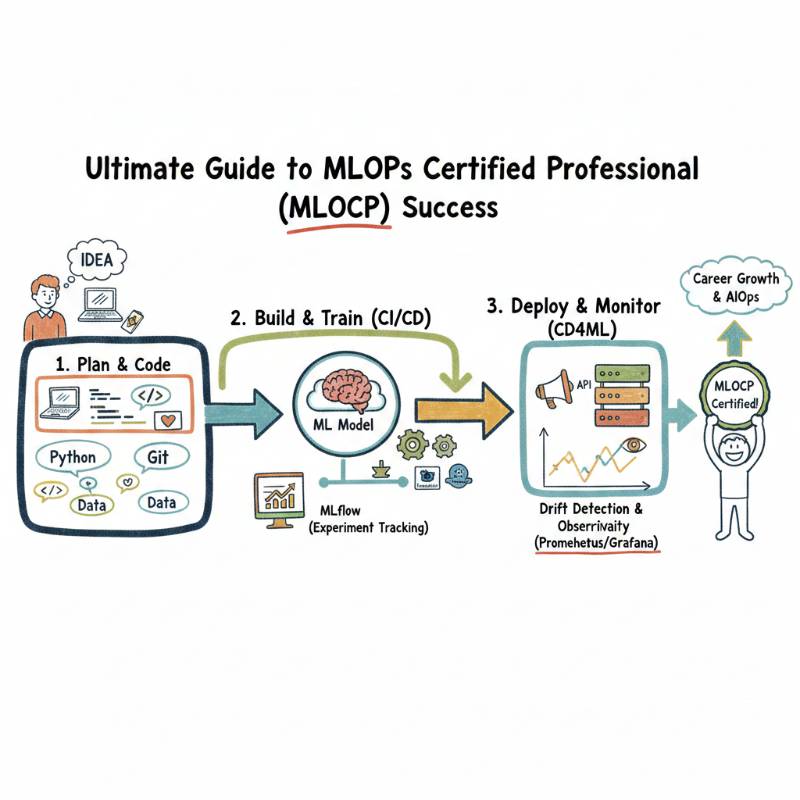
Introduction
The technology landscape has shifted beneath our feet. Over the last two decades, I have witnessed the industry move from physical servers to virtualization, and then to the cloud. But the current shift toward Artificial Intelligence is the most significant yet. In my experience, the biggest bottleneck isn’t building a Machine Learning model—it’s keeping that model alive, accurate, and scalable in a production environment. This is where MLOps (Machine Learning Operations) steps in. It is no longer acceptable to have “experimental” AI that lives only on a data scientist’s laptop. We need engineering rigor. The MLOps Certified Professional (MLOCP) program is the definitive blueprint for this transition. Whether you are an engineer looking to future-proof your career or a manager trying to stabilize your AI delivery, this guide will provide the deep technical and strategic insights you need to master the MLOps lifecycle.
Master Certification Comparison Table
| Track | Level | Who it’s for | Prerequisites | Skills Covered | Recommended Order |
| MLOps (MLOCP) | Professional | SREs, ML Engineers, Managers | Basic Python, DevOps Basics | CI/CD for ML, MLflow, Kubernetes, Drift Monitoring | After SRE or DevOps Professional |
| DevOps (DCP) | Professional | Developers, SysAdmins, Build Engineers | SDLC knowledge | Jenkins, CI/CD, Infrastructure as Code | 1st in the journey |
| SRE (SRECP) | Professional | SREs, Platform Engineers, Ops Lead | Linux, Monitoring basics | SLOs, SLIs, Toil Reduction, Incident Management | 2nd in the journey |
| DevSecOps (DSOCP) | Professional | Security Pros, Cloud Engineers | Basic CI/CD | Security Automation, DAST/SAST, Compliance | 2nd or 3rd in journey |
| DataOps (DOCP) | Professional | Data Engineers, Analytics Managers | SQL, Data Pipeline basics | Data Versioning, Pipeline Testing, Data Governance | Parallel to MLOps |
| AIOps (AIOCP) | Professional | SREs, IT Ops Managers | Monitoring basics | AI for IT Ops, Root Cause Analysis | After SRECP |
A Deep Dive into MLOps Certified Professional (MLOCP)
What it is
The MLOps Certified Professional (MLOCP) is an elite certification that validates your ability to treat machine learning as a first-class citizen in the software engineering world. It goes beyond the “what” of AI and dives deep into the “how”—specifically, how to automate the training, deployment, and management of models at scale using modern DevOps principles tailored for data-heavy environments.
Who should take it
- Software Engineers: Those looking to transition into AI infrastructure and platform engineering.
- DevOps/SRE Professionals: Engineers tasked with supporting data science teams who need to understand the unique requirements of ML workloads.
- Data Engineers: Who want to move from just building pipelines to managing the end-to-end model lifecycle.
- Engineering Managers: Leaders who need to build a “culture of automation” within their AI departments.
Skills you’ll gain
- End-to-End Pipeline Automation: Learning to build CT (Continuous Training) pipelines alongside traditional CI/CD.
- Reproducibility with Data Versioning: Mastering tools like DVC to ensure that a model built today can be perfectly recreated a year from now.
- Model Governance & Tracking: Using MLflow to track every hyperparameter, metric, and artifact in a centralized registry.
- Kubernetes for AI: Orchestrating complex ML workloads, including GPU management and auto-scaling inference services.
- Drift Detection & Observability: Building sophisticated monitoring systems that alert you when a model’s real-world performance begins to decay (Model Drift).
Real-world projects you should be able to do after it
- Self-Healing AI Systems: Design a pipeline that detects when a model’s accuracy drops below a threshold and automatically triggers a retraining job on new data.
- Multi-Cloud Inference Engine: Deploy a production-grade API that serves thousands of predictions per second across different cloud regions.
- ML Dashboarding: Create real-time Grafana dashboards that show not just system health (CPU/RAM), but also “model health” (F1 score, precision, recall).
- Automated Security Scans for Models: Integrate security checks into the ML pipeline to prevent data poisoning or model theft.
Detailed Preparation Plan
- 7–14 Days (The Sprint): Focus on the theoretical core. Understand the “MLOps Manifesto,” learn the differences between DevOps and MLOps, and familiarize yourself with the MLOps maturity model.
- 30 Days (The Practitioner Path): The “hands-on” phase. Build 3 complete pipelines using Docker, Jenkins, and MLflow. Practice deploying a simple model to a Kubernetes cluster.
- 60 Days (The Master Level): Focus on advanced edge cases. Learn how to manage high-cost GPU resources (FinOps for ML), handle massive datasets (DataOps), and secure your pipelines (MLSecOps).
Common Mistakes to Avoid
- Treating Data as Code: Data changes silently and constantly; code changes only when you commit. Forgetting this leads to “silent failures.”
- Ignoring Monitoring: A model that works today might be useless in 48 hours due to a change in consumer behavior. Monitoring is not optional.
- The “Manual” Trap: Many teams still “throw the model over the wall” from data science to IT. MLOCP teaches you how to remove this friction through total automation.
Best Next Certification after this
Once you have mastered the delivery of ML models, the natural evolution is AIOps Certified Professional. This allows you to apply your ML knowledge back to the infrastructure, using AI to predict and prevent system outages before they happen.
Choose Your Path: 6 Strategic Learning Journeys
- DevOps Path: Focuses on the “Velocity” of software. It is the foundation for all other paths.
- DevSecOps Path: Focuses on the “Safety” of the pipeline. Essential for highly regulated industries like Banking and Healthcare.
- SRE Path: Focuses on the “Reliability” of systems. It teaches you how to keep the lights on while moving fast.
- AIOps/MLOps Path: Focuses on the “Intelligence” of the platform. This is the cutting edge of current tech careers.
- DataOps Path: Focuses on the “Quality” of the data. Without good DataOps, your MLOps will fail.
- FinOps Path: Focuses on the “Economy” of the cloud. Critical for managing the high costs associated with AI and GPUs.
Role-Based Certification Mapping
| If your role is… | Your journey should be… |
| DevOps Engineer | DCP → MLOCP → DevSecOps |
| Site Reliability Engineer (SRE) | SRECP → MLOCP → AIOps |
| Platform Engineer | DCP → Kubernetes Certified → MLOCP |
| Cloud Architect | Cloud Expert → MLOCP → FinOps |
| Security Engineer | DSOCP → MLOCP → Security Architect |
| Data Engineer | DOCP → MLOCP → Data Architect |
| Engineering Manager | CDM (Management) → MLOCP → Digital Transformation Lead |
Next Certifications to Take
- Same Track (Vertical): AIOps Certified Professional. This is for those who want to reach the absolute peak of the AI infrastructure career ladder.
- Cross-Track (Horizontal): DevSecOps Certified Professional (DSOCP). As AI becomes more critical, the security of ML pipelines (protecting against “Prompt Injection” or “Data Poisoning”) is becoming a top-tier skill.
- Leadership Track: Certified DevOps Manager (CDM). This is for the veteran who wants to stop being a “doer” and start being a “leader” who designs entire engineering cultures.
Top Institutions for Training & Certification
Selecting the right training partner is a critical career decision. Based on current industry standards, these institutions provide the most comprehensive support:
DevOpsSchool As the primary provider for the MLOCP, DevOpsSchool offers an exhaustive, tool-driven curriculum that covers the entire ML lifecycle. They provide participants with live instructor-led sessions, a robust cloud-based sandbox for hands-on practice, and lifetime access to high-quality learning materials and community support.
Cotocus Cotocus is a leading choice for corporate teams and Global Capability Centers (GCCs) looking to fast-track their MLOps adoption. They specialize in high-intensity, project-based workshops that focus on solving real-world production bottlenecks, making them ideal for organizations transitioning to automated AI delivery.
Scmgalaxy Functioning as a massive community hub, Scmgalaxy provides a unique blend of certification support and a vast library of free technical resources. It is an excellent platform for engineers to stay updated on the latest MLOps trends, tools, and best practices through thousands of tutorials and active community forums.
BestDevOps BestDevOps focuses on high-impact, result-oriented training designed for busy professionals who need to become “job-ready” quickly. Their streamlined modules emphasize the most in-demand tools like MLflow and Kubernetes, ensuring students can implement production-grade MLOps pipelines immediately after certification.
DevSecOpsSchool This institution is the definitive authority for those wanting to integrate security into the heart of the AI lifecycle. They provide specialized training on “MLSecOps,” teaching professionals how to protect models from emerging threats like data poisoning, model inversion, and prompt injection.
Sreschool Sreschool bridges the gap between software delivery and system reliability, specifically for AI workloads. Their training ensures that MLOps professionals master the SRE principles—such as error budgets and observability—required to keep large-scale machine learning models stable and performant 24/7.
AIOpsSchool AIOpsSchool focuses on the next frontier of automation: using artificial intelligence to manage and optimize IT operations. Their specialized courses help engineers move beyond manual monitoring by leveraging ML algorithms to predict outages and automate root cause analysis across global infrastructures.
DataOpsSchool Since high-quality data is the fuel for any ML model, DataOpsSchool provides the essential training needed to manage the data supply chain. They focus on data versioning, automated testing of data pipelines, and ensuring the speed and reliability of data delivery to ML environments.
FinOpsSchool With the rising costs of GPUs and cloud resources, FinOpsSchool offers critical training on the financial management of AI projects. They teach engineers and managers how to track, optimize, and forecast cloud spending, ensuring that MLOps initiatives remain cost-effective and provide maximum ROI.
General Engineering FAQs
- Why is MLOps getting so much attention now? Because companies have realized that 80% of ML projects fail to reach production due to operational hurdles. MLOps is the solution to that failure.
- Is MLOps just “DevOps for Data”? No. It includes everything in DevOps but adds the complexity of “Data Drift” and “Model Versioning,” which doesn’t exist in traditional software.
- How long does a typical certification take? Around 4-6 weeks of dedicated part-time study is the average for a working professional.
- Do I need a high-end laptop for the labs? No. Most top institutions like DevOpsSchool provide cloud-based lab environments that you can access via a browser.
- Is Python the only language used? While others exist, Python is the industry standard. A basic understanding is mandatory.
- Will this certification help me in India? India is currently the world’s largest hub for “Managed Services” and “GCCs.” There is a massive talent shortage for MLOps engineers here, leading to very high salary offers.
- What is the passing score? Typically, you need a 70% or higher to demonstrate professional competence.
- Can I take the exam multiple times? Most programs allow a retake, though policies vary by institution.
- Do these certifications expire? Yes, usually after 2-3 years, as the technology stack (like LLMs and Vector Databases) evolves so rapidly.
- Is MLOps useful for managers? Absolutely. Managers who don’t understand the MLOps lifecycle often set unrealistic deadlines and hire the wrong people.
- Do I need to know math? You need to understand the concepts of how a model works (like precision/recall), but you don’t need to do manual calculus.
- Are these certifications recognized in the US/Europe? Yes, the MLOCP and SRECP programs follow global standards recognized by major tech firms.
MLOCP Specific FAQs
- What is the official URL for MLOCP?
You can find the full details MLOps Certified Professional (MLOCP). - Who is the main provider? The certification is provided by DevOpsSchool.
- Does the course cover Generative AI and LLMs? Yes, the modern MLOCP curriculum includes “LLMOps,” focusing on how to deploy and manage large language models.
- What tools will I learn? You will master MLflow, DVC, Kubernetes, Docker, Jenkins, and various monitoring stacks like Prometheus/Grafana.
- Is there a focus on specific clouds? The course is designed to be cloud-agnostic, meaning the skills apply to AWS, Azure, and Google Cloud equally.
- What is the biggest challenge in the exam? The lab portion. You must demonstrate that you can actually build a pipeline, not just talk about it.
- Is there mentorship available? Yes, institutions like DevOpsSchool provide instructor-led sessions where you get direct feedback.
- Can I transition from a non-tech role? It is difficult. We recommend starting with the DevOps (DCP) foundation before jumping into MLOps.
Final Thoughts
After watching the industry transition from legacy systems to the cloud, it is clear that we are now at a defining moment where Machine Learning must meet engineering excellence to truly deliver value. The MLOps Certified Professional (MLOCP) program is the definitive answer to this challenge, providing the structure and automation needed to turn experimental models into reliable, high-performing production assets. This journey is about more than just mastering tools like MLflow or Kubernetes; it is about adopting a mindset that prioritizes scalability, security, and continuous improvement across the entire AI lifecycle. For engineers and managers alike, this certification is the most strategic investment you can make to lead the next wave of technological innovation, ensuring your systems are not just “smart,” but robust enough to power the future of global enterprise.