Introduction
The Certified Site Reliability Architect is an advanced professional credential designed for engineers who want to master the intersection of high-scale system design and operational excellence. This guide serves as a comprehensive resource for professionals navigating the complexities of modern cloud-native ecosystems, platform engineering, and high-availability systems. By focusing on architectural resilience and data-driven reliability, this program provides the technical depth required to manage enterprise-grade infrastructures effectively. Whether you are looking to advance your career through training at Sreschool or aiming to implement better engineering practices, this guide helps you make the right decisions for your professional growth.
What is the Certified Site Reliability Architect?
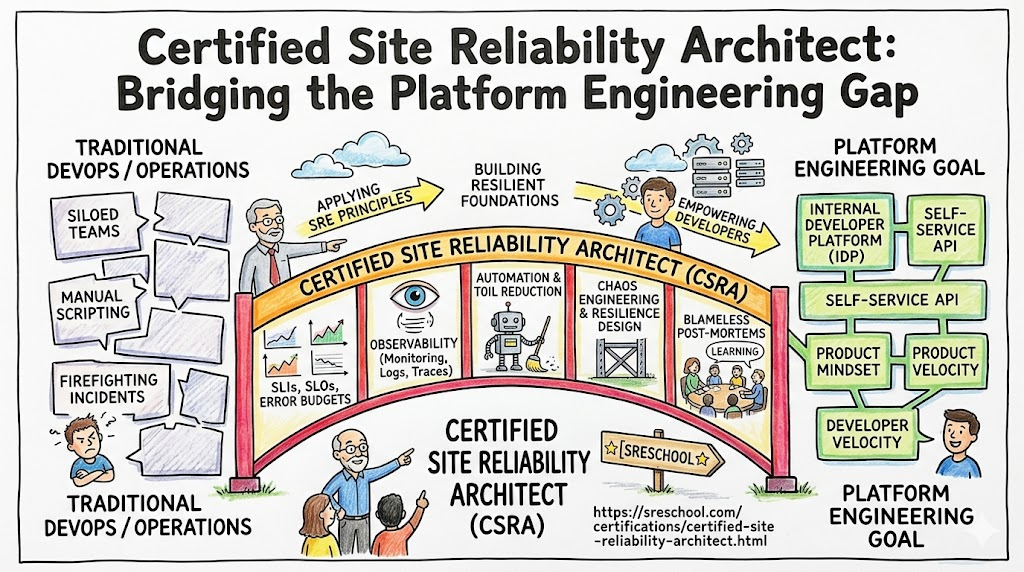
The Certified Site Reliability Architect is a specialized program that shifts the focus from day-to-day firefighting to the strategic design of self-healing and resilient systems. It represents a commitment to the philosophy that operations is a software engineering problem, emphasizing the creation of frameworks that minimize human intervention. This certification exists to bridge the gap between theoretical SRE concepts and the practical, production-focused challenges found in modern enterprise environments. By prioritizing production-grade learning, it aligns with current industry workflows where stability is treated as the most critical feature of any distributed system.
Who Should Pursue Certified Site Reliability Architect?
This certification is specifically tailored for mid-to-senior software engineers, system architects, and dedicated SREs who are responsible for the performance of large-scale applications. It is equally valuable for cloud engineers and security professionals who need to understand how reliability and architecture impact their specific domains. Beginners can use the foundational tracks to build a structured career path, while engineering managers gain the vocabulary and strategic insight needed to lead reliability-focused teams. The program has significant global relevance, addressing the high demand for architectural talent in tech hubs across India and the international market.
Why Certified Site Reliability Architect is Valuable and Beyond
In an increasingly digital world, system downtime is no longer just a technical glitch but a significant business risk that can lead to massive financial loss. The Certified Site Reliability Architect provides long-term value by teaching core architectural principles that remain relevant even as specific tools and cloud providers evolve. It empowers professionals to stay ahead of the curve in a competitive job market by focusing on enduring concepts like observability, error budgeting, and capacity planning. Investing in this certification ensures that an engineer can deliver a high return on investment for their organization by maintaining a competitive edge in system stability.
Certified Site Reliability Architect Certification Overview
The Certified Site Reliability Architect program is delivered via the official training portal and is hosted on the Sreschool platform. It is structured into a logical sequence of tiers that move candidates from basic reliability vocabulary to complex, multi-tiered architectural simulations. The assessment approach is purely practical, utilizing scenario-based evaluations to ensure that candidates can apply their knowledge to real-world production challenges. This comprehensive ownership of the reliability lifecycle ensures that every certified professional is capable of managing the tension between rapid feature deployment and system uptime.
Certified Site Reliability Architect Certification Tracks & Levels
The program is organized into three primary levels: Foundation, Professional, and Advanced, allowing for a natural progression of expertise over time. The Foundation level focuses on building a strong conceptual baseline, including metrics like SLIs and SLOs, while the Professional level dives deep into the implementation of automated monitoring and toil reduction. The Advanced level is reserved for architects who design global-scale systems and manage organization-wide reliability policies. These tracks allow engineers to specialize in areas like FinOps, AI-driven operations, or secure reliability architecture as they progress toward leadership roles.
Complete Certified Site Reliability Architect Certification Table
| Track | Level | Who it’s for | Prerequisites | Skills Covered | Recommended Order |
| Core Reliability | Foundation | Junior Engineers | Basic Linux | SLOs, SLIs, Toil | Step 1 |
| Systems Design | Professional | SREs, DevOps | Foundation | Automation, HA | Step 2 |
| Strategic Arch | Advanced | Senior Architects | Professional | AIOps, Governance | Step 3 |
| Leadership | Expert | Principal Leads | Advanced | Strategy, Culture | Final |
Detailed Guide for Each Certified Site Reliability Architect Certification
Certified Site Reliability Architect – Foundation
What it is
This certification validates a professional’s understanding of the fundamental principles of Site Reliability Engineering and the metrics used to measure system health. It ensures the candidate can distinguish between traditional IT operations and the engineering-led approach to reliability.
Who should take it
It is suitable for software developers, system administrators, and recent graduates who want to enter the SRE field and build a strong conceptual baseline.
Skills you’ll gain
- Defining Service Level Indicators (SLIs) and Service Level Objectives (SLOs).
- Identifying and reducing operational toil through automation.
- Understanding the lifecycle of an incident and basic post-mortem analysis.
Real-world projects you should be able to do
- Create a reliability dashboard for a simple web application.
- Draft a basic Service Level Objective document for a production service.
- Identify a manual, repetitive task and draft an automation plan.
Preparation plan
- 7–14 days: Focused review of core terminology and the SRE Handbook.
- 30 days: Implementation of basic monitoring and alerting in a local lab.
- 60 days: Full immersion into case studies and mock foundational exams.
Common mistakes
- Confusing Service Level Agreements (SLAs) with Service Level Objectives (SLOs).
- Focusing purely on tools while neglecting the cultural shift required for SRE.
Best next certification after this
- Same-track option: Certified Site Reliability Architect – Professional
- Cross-track option: Cloud Practitioner Certification
- Leadership option: Junior Team Lead Essentials
Certified Site Reliability Architect – Professional
What it is
This level validates the ability to implement SRE practices using modern toolchains and complex automation strategies. It focuses on the practical application of reliability patterns to ensure that systems scale predictably and efficiently.
Who should take it
Experienced DevOps engineers and mid-level SREs who are responsible for maintaining the health and performance of critical production environments.
Skills you’ll gain
- Managing Error Budgets to balance feature velocity and stability.
- Implementing full-stack observability and distributed tracing.
- Automating incident response and building self-healing systems.
Real-world projects you should be able to do
- Design an automated canary deployment pipeline with rollback triggers.
- Build a comprehensive monitoring stack for a multi-microservice ecosystem.
- Automate complex infrastructure provisioning using Infrastructure as Code.
Preparation plan
- 7–14 days: Deep dive into architectural patterns and observability frameworks.
- 30 days: Hands-on labs involving Kubernetes and cloud-native automation.
- 60 days: Conduct practice simulations for complex system failures and recovery.
Common mistakes
- Underestimating the complexity of managing stateful applications in distributed systems.
- Neglecting the importance of capacity planning during the design phase.
Best next certification after this
- Same-track option: Certified Site Reliability Architect – Advanced
- Cross-track option: DevSecOps Professional
- Leadership option: Technical Project Management
Certified Site Reliability Architect – Advanced
What it is
This is the pinnacle of the track, focusing on systemic architecture, organizational reliability strategy, and long-term planning. It validates the ability to lead reliability efforts across multiple teams and design global-scale, resilient frameworks.
Who should take it
Senior SREs, Principal Engineers, and Aspiring Architects who need to drive technical strategy and foster a blameless engineering culture across an enterprise.
Skills you’ll gain
- Designing for high availability across multi-cloud and hybrid environments.
- Establishing organizational standards for engineering excellence and governance.
- Implementing advanced Chaos Engineering and resilience testing techniques.
Real-world projects you should be able to do
- Develop a comprehensive global reliability strategy for a hypothetical enterprise.
- Lead an organization-wide migration to a cost-aware reliability framework.
- Design a cell-based architecture to minimize blast radius during failures.
Preparation plan
- 7–14 days: Study complex architectural patterns and governance models.
- 30 days: Analyze large-scale system designs from top-tier technology companies.
- 60 days: Develop and present a complete architectural reliability proposal.
Common mistakes
- Focusing too much on technical minutiae and losing sight of business objectives.
- Failing to effectively communicate the value of reliability to non-technical stakeholders.
Best next certification after this
- Same-track option: Industry-specific Specialized Architecture
- Cross-track option: DataOps Architect
- Leadership option: CTO or VP of Engineering tracks
Choose Your Learning Path
DevOps Path
The DevOps path focuses on the seamless integration of development and operations through automated delivery pipelines. In this track, the Certified Site Reliability Architect curriculum helps engineers build pipelines that are not just fast, but inherently resilient. It emphasizes the balance between agility and stability, ensuring that high-speed deployments do not compromise the user experience. This path is ideal for those moving from traditional software development into more infrastructure-focused roles.
DevSecOps Path
This path emphasizes that reliability is impossible without robust security measures being integrated from the start. It teaches practitioners how to automate security scanning and compliance checks directly within the reliability lifecycle. Engineers on this path learn to build systems that are secure by design, preventing outages caused by vulnerabilities or unauthorized access. This is a critical track for those working in highly regulated industries where data integrity is paramount.
SRE Path
The pure SRE path is dedicated to the science of system availability, performance, and latency. It treats operations as a software problem, focusing heavily on observability, incident management, and performance tuning at scale. This path is the gold standard for engineers who want to manage complex distributed systems that serve millions of users. It prepares professionals to handle high-stakes on-call rotations and drive systemic improvements in production health.
AIOps Path
The AIOps path explores the use of machine learning to enhance system reliability and automate complex decision-making. Professionals learn how to use AI to predict potential outages, automate root cause analysis, and manage massive volumes of telemetry data. This forward-looking track is perfect for engineers who want to stay at the cutting edge of proactive operations. It focuses on reducing mean time to recovery by leveraging intelligent automation and predictive insights.
MLOps Path
Focusing on the reliability of machine learning pipelines, this path ensures that AI models are deployed and monitored with the same rigor as standard software. It addresses the unique challenges of model drift, data versioning, and automated retraining loops in production. Engineers learn how to build resilient infrastructures that support the lifecycle of data science models at scale. This path is essential for organizations where machine learning is a core part of the product offering.
DataOps Path
The DataOps path applies SRE principles to the reliability and quality of large-scale data processing systems. Reliability in this context means data integrity, high availability, and low latency for analytical and transactional workloads. Architects on this path learn to design data platforms that are resilient to schema changes and processing spikes. It is a vital track for data engineers moving into architectural roles within data-heavy organizations.
FinOps Path
This path combines financial accountability with technical reliability to ensure that cloud infrastructure is both stable and cost-effective. It teaches engineers how to balance the cost of reliability against the business value of uptime. Professionals learn to use architectural patterns that optimize resource consumption without sacrificing system performance. This path is increasingly important as cloud budgets become a major focus for executive leadership.
Role → Recommended Certified Site Reliability Certifications
| Role | Recommended Certifications |
| DevOps Engineer | Foundation, Professional |
| SRE | Professional, Advanced |
| Platform Engineer | Professional, Advanced |
| Cloud Engineer | Foundation, Professional |
| Security Engineer | Professional (Security focus) |
| Data Engineer | Professional (Data focus) |
| FinOps Practitioner | Professional (Cost focus) |
| Engineering Manager | Foundation, Advanced |
Next Certifications to Take After Certified Site Reliability Architect
Same Track Progression
Deep specialization within the reliability track involves pursuing advanced designations in areas like chaos engineering or niche cloud platform internals. Once you have mastered the site reliability architect curriculum, the next step is often a deep dive into the unique constraints of specific cloud providers. This allows you to apply generic SRE principles to the proprietary tools offered by major vendors. Staying on this track ensures you remain a recognized subject matter expert in the mechanics of stability.
Cross-Track Expansion
Broadening your skill set involves moving into adjacent fields such as DevSecOps or DataOps to understand the broader technical ecosystem. By gaining certifications in security architecture or data engineering, a site reliability architect can provide more holistic value to their organization. This expansion makes you a versatile leader who can bridge the gap between different technical silos. It is a strategic move for those who wish to remain technical leaders while influencing broad standards.
Leadership & Management Track
For those looking to transition into executive roles, the leadership track focuses on team building, budget management, and strategic alignment. These programs prepare a site reliability architect to move from individual contributor roles to positions like Director of Infrastructure or VP of Engineering. You will learn to manage massive complexity and drive cultural shifts toward reliability across entire enterprises. This track is designed for those who want to influence the long-term technical direction of their organization.
Training & Certification Support Providers for Certified Site Reliability Architect
DevOpsSchool
DevOpsSchool stands as a cornerstone in the technical training landscape, providing exhaustive resources for engineers aiming to master the SRE domain. Their curriculum is meticulously crafted to cover the entire spectrum of site reliability engineering, from foundational metrics to advanced architectural patterns. They offer a blend of instructor-led sessions and hands-on lab exercises that simulate real-world production environments. This practical approach ensures that students do not just learn definitions but gain the confidence to handle live system failures. Their global reach and experienced faculty make them a top choice for professionals seeking structured career advancement.
Cotocus
Cotocus specializes in delivering high-impact technical training and consultancy services that help organizations adopt modern engineering practices. Their training programs for site reliability architects are designed to be intensive and results-oriented, focusing on the latest automation and observability tools. They provide a supportive learning environment where students can engage in deep-dive discussions on complex architectural challenges. By bridging the gap between theoretical knowledge and enterprise implementation, Cotocus prepares its learners for the rigors of high-stakes production roles. Their commitment to personalized mentorship helps students navigate their unique career paths with clarity and expert guidance.
Scmgalaxy
Scmgalaxy is a premier community-driven platform that offers a wealth of training materials, tutorials, and certification support for SRE professionals. Their training modules are highly accessible and focus on the practical application of software engineering principles to operations. They maintain a vast repository of resources that allow students to stay updated on the latest trends in the cloud-native ecosystem. By fostering a strong community of practitioners, Scmgalaxy enables peer-to-peer learning and networking opportunities that are invaluable for career growth. Their programs are designed to be flexible, making them ideal for working professionals who need to upskill.
BestDevOps
BestDevOps is dedicated to providing top-tier training for the most in-demand certifications in the DevOps and reliability engineering space. Their courses are structured to provide a deep understanding of the SRE mindset, focusing on how to build systems that are inherently stable. They emphasize the importance of data-driven decision-making, teaching students how to use metrics like error budgets to guide technical strategy. With a team of expert instructors who have decades of industry experience, BestDevOps offers insights that go beyond standard textbooks. Their graduates are highly sought after by enterprise organizations for their practical problem-solving skills.
devsecopsschool.com
DevSecOpsSchool is a specialized training provider that focuses on the critical intersection of security, development, and reliability. Their curriculum ensures that site reliability architects understand how to bake security into every layer of their infrastructure. They offer advanced courses on automated security testing, container hardening, and compliance as code within the SRE workflow. By treating security as a fundamental component of reliability, they prepare engineers for the complexities of modern, zero-trust environments. Their practical, project-based learning approach ensures that graduates can implement robust security protocols without sacrificing system agility.
sreschool.com
Sreschool is a dedicated educational platform focused exclusively on the discipline of site reliability engineering and architecture. As the primary host for the Certified Site Reliability Architect program, they offer unparalleled depth in their training modules. Their platform is designed to provide a comprehensive roadmap for engineers, moving from core concepts to advanced architectural simulations. They provide a wide range of hands-on labs that allow students to practice incident response and performance tuning in a safe environment. Sreschool is the go-to destination for anyone looking for a focused and rigorous path to mastering SRE.
aiopsschool.com
AIOpsSchool is at the forefront of teaching how artificial intelligence and machine learning can be leveraged to revolutionize IT operations. Their training programs focus on the development of predictive monitoring systems and automated root cause analysis tools. They help site reliability architects transition from reactive troubleshooting to proactive, AI-driven system management. The curriculum covers the management of massive telemetry data and the implementation of intelligent automation frameworks. By mastering these cutting-edge techniques, students can significantly reduce downtime and improve the overall efficiency of their infrastructure.
dataopsschool.com
DataOpsSchool provides specialized training for professionals who want to apply the principles of SRE to complex data pipelines and platforms. Their courses focus on ensuring the reliability, integrity, and availability of data across large-scale distributed systems. They teach architects how to design data infrastructures that can handle varying loads and schema evolutions without compromising performance. DataOpsSchool bridges the gap between data engineering and operational excellence, providing the tools needed to manage high-traffic data environments. Their practical approach ensures that students can implement data-centric reliability strategies that drive business value.
finopsschool.com
FinOpsSchool addresses the critical need for financial accountability within the technical landscape of cloud-native engineering. Their training programs teach site reliability architects how to optimize cloud resource consumption while maintaining peak performance and stability. They focus on the cultural and technical shifts required to align engineering decisions with organizational financial goals. Students learn to use cost-management tools and architectural patterns that ensure a high return on cloud investment. FinOpsSchool is essential for technical leaders who need to manage the “cost of reliability” in an increasingly budget-conscious enterprise environment.
Frequently Asked Questions (General)
1. How difficult is the certification exam?
The difficulty depends on your experience, but the Professional and Advanced levels are considered challenging due to their focus on practical scenarios.
2. How long does it take to prepare for the certification?
Most professionals with a technical background require 30 to 60 days of consistent study and hands-on practice to feel fully prepared.
3. Are there any mandatory prerequisites for the Foundation level?
There are no hard prerequisites for the Foundation level, although a basic understanding of Linux and cloud concepts is highly recommended.
4. What is the return on investment for this certification?
SREs are among the highest-paid professionals in tech, and this certification often leads to significant premiums in salary and senior roles.
5. Is the certification recognized globally?
Yes, the principles taught are based on global standards used by major tech firms, making the credential highly portable across borders.
6. Can I skip the Foundation level and go straight to Professional?
It is generally not recommended unless you have significant verifiable experience working as an SRE in a large-scale production environment.
7. Is there a focus on specific cloud providers?
While the principles are vendor-neutral, most training and labs utilize AWS, Azure, or GCP to demonstrate the practical application of concepts.
8. How does this differ from a standard DevOps certification?
DevOps focuses on the delivery pipeline and culture, while SRE provides specific engineering practices and metrics to manage live reliability.
9. What kind of jobs can I get with this certification?
Common titles include Site Reliability Engineer, Platform Engineer, Cloud Architect, Systems Engineer, and Infrastructure Architect.
10. Are there hands-on labs involved in the training?
Yes, the training and assessment include significant hands-on components where you must solve real production issues in a simulated environment.
11. Does the certification expire?
Professional certifications in this field typically require renewal or continuing education every two to three years to ensure skills remain current.
12. Is this certification suitable for fresh graduates?
While challenging, motivated freshers can start with the Foundation level to gain a competitive edge in the entry-level DevOps or SRE job market.
FAQs on Certified Site Reliability Architect
1. What is the primary focus of the Certified Site Reliability Architect (CSRA) program?
The CSRA focuses on the high-level design and strategic implementation of resilient, self-healing systems. It bridges the gap between software engineering and operational excellence by treating infrastructure as a software problem that requires architectural precision.
2. Who is the ideal candidate for this certification?
This program is specifically designed for senior software engineers, system architects, and DevOps leads. It is intended for professionals responsible for the uptime, performance, and scalability of large-scale distributed applications in enterprise environments.
3. What are the key prerequisites for the Architect level?
While there are no mandatory barriers for the foundation tier, the Architect level typically requires 5+ years of experience in systems engineering. Candidates should have a strong grasp of Linux, networking, and cloud-native infrastructure before attempting the advanced modules.
4. What core skills are validated through this certification?
The certification validates expertise in defining SLIs/SLOs, managing error budgets, and implementing advanced observability. It also confirms a professional’s ability to reduce operational toil through strategic automation and lead blameless post-mortem cultures.
5. How is the CSRA exam typically structured?
The assessment moves beyond basic multiple-choice questions to include scenario-based evaluations and project-based tasks. It tests real-world decision-making by simulating production outages and scaling challenges that mirror actual enterprise environments.
6. What is the validity period of the certification?
The certification is generally valid for two to three years. To maintain the credential, professionals are encouraged to engage in continuous learning or recertification to stay updated with the rapidly evolving SRE tools and methodologies.
7. How does an “Architect” level differ from an “Engineer” level?
While an SRE Engineer focuses on daily implementation, monitoring, and troubleshooting, the Architect level is strategic. Architects design the global-scale systems, set reliability policies across multiple teams, and lead the long-term infrastructure roadmap.
8. What is the career impact and ROI of becoming a Certified Architect?
Certified architects often see a significant increase in market value, with many reporting higher salary brackets and access to leadership roles like Principal SRE or Director of Engineering. It provides technical authority during digital transformation projects.
Conclusion
Throughout my years in the industry, I have seen that the most successful engineers are those who understand that reliability is not an afterthought, but a core architectural requirement. The Certified Site Reliability Architect is absolutely worth the investment because it provides a structured framework for mastering the complexities of modern systems. It moves you beyond being a tool specialist and transforms you into a strategic leader capable of driving technical excellence. If you are looking to secure your future in an era of high-scale digital services, this path offers the clarity and depth you need. It is a commitment to the highest standards of our craft.
