Introduction
In the rapidly evolving landscape of cloud-native engineering, the Certified Site Reliability Professional stands as a definitive benchmark for operational excellence. This guide is crafted for engineers and technical leaders who recognize that building software is only half the battle; the real challenge lies in keeping it resilient, scalable, and efficient under production pressure. As organizations shift from traditional sysadmin roles to platform engineering, understanding the core tenets of SRE becomes a non-negotiable career requirement. By exploring the Certified Site Reliability Professional curriculum, professionals can gain the clarity needed to navigate the complex intersection of development and operations. This roadmap is hosted by Sreschool, providing a structured path for those aiming to master the metrics and mindsets that drive modern digital reliability.
What is the Certified Site Reliability Professional?
The Certified Site Reliability Professional is a specialized credential that validates an engineer’s ability to apply software engineering practices to infrastructure and operations. It represents a shift away from manual “firefighting” toward automated, data-driven system management. The program exists to standardize the high-level skills required to manage distributed systems at scale, ensuring that practitioners can handle everything from incident response to long-term capacity planning.
Rather than focusing solely on theoretical models, this certification emphasizes real-world, production-focused learning. It aligns with modern engineering workflows by treating infrastructure as code and utilizing service level objectives to balance innovation with stability. For enterprises, this certification ensures that their engineering teams are equipped with the technical depth and cultural framework necessary to maintain high-availability services in a cloud-first world.
Who Should Pursue Certified Site Reliability Professional?
This certification is designed for a broad spectrum of technical professionals, ranging from backend software engineers to cloud architects and security specialists. It is particularly beneficial for DevOps engineers looking to deepen their operational expertise and for current SREs who want to formalize their experience with an industry-recognized credential. Security and data professionals also benefit, as reliability is the foundation upon which secure and data-intensive applications are built.
The program caters to various career stages, offering entry points for beginners who need a solid foundation and advanced modules for experienced engineers and managers. In a globalized market, particularly within India’s massive tech sector, this certification provides a competitive edge by demonstrating a mastery of high-demand reliability principles. It serves as a clear signal to employers that the professional can handle the complexities of enterprise-grade production environments.
Why Certified Site Reliability Professional is Valuable and Beyond
The demand for site reliability expertise is at an all-time high as businesses realize that downtime is not just a technical failure, but a significant financial risk. This certification offers immense longevity because it focuses on core principles like observability, automation, and toil reduction, which remain relevant regardless of which cloud provider or tool is currently in vogue. It provides a strategic advantage for professionals who want to move into high-impact roles within platform engineering teams.
By investing in this certification, engineers ensure they stay relevant in an era where automated systems are replacing manual operations. The enterprise adoption of SRE practices continues to grow, making this credential a future-proof asset. Ultimately, the return on time and career investment is reflected in the ability to command higher salaries, lead critical technical initiatives, and drive significant architectural improvements within any organization.
Certified Site Reliability Professional Certification Overview
The Certified Site Reliability Professional program is delivered via the official Certified Site Reliability Professional and is hosted on the sreschool website. It is structured into multiple tiers to accommodate different levels of expertise, ranging from foundational concepts to expert-level architecture. The assessment approach is practical, often requiring candidates to demonstrate their skills through scenario-based evaluations and hands-on exercises.
The program is owned and curated by industry veterans who understand the nuances of production-grade environments. In practical terms, the structure is designed to move a candidate from understanding the “what” of reliability to mastering the “how” and “why” of complex system management. This comprehensive overview ensures that every certified professional possesses a consistent and high-quality skill set that meets the rigorous demands of modern technical organizations.
Certified Site Reliability Professional Certification Tracks & Levels
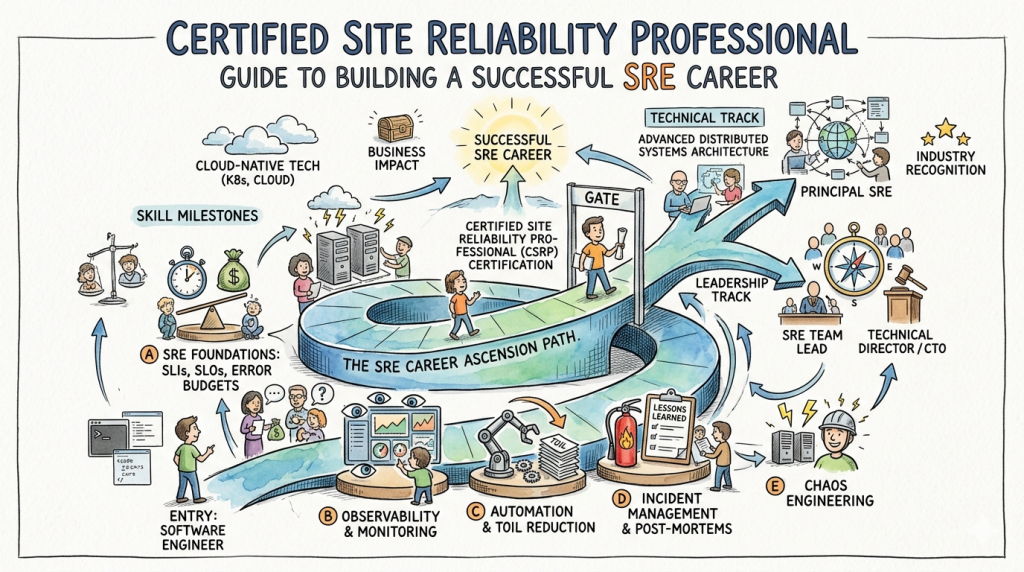
The certification is organized into three primary levels: Foundation, Professional, and Advanced. The Foundation level introduces the essential vocabulary of SRE, such as error budgets and burn rates, making it ideal for those new to the field. The Professional level dives deeper into the technical implementation of observability and automation frameworks. The Advanced level is reserved for senior practitioners who are responsible for the reliability of entire organizational ecosystems.
In addition to these levels, the program offers specialized tracks that allow engineers to align their learning with specific career goals. These tracks include SRE for DevOps, Cloud Operations, and even cost-aware FinOps roles. This alignment ensures that as an engineer progresses through their career, they can choose a path that complements their specific interests while maintaining a core focus on system reliability and performance.
Complete Certified Site Reliability Professional Certification Table
| Track | Level | Who it’s for | Prerequisites | Skills Covered | Recommended Order |
| Core SRE | Foundation | Junior Engineers | Basic Linux | SLOs, SLIs, Toil | 1 |
| Core SRE | Professional | Mid-level SREs | 2+ Years Exp | Observability, Incidents | 2 |
| Core SRE | Advanced | Senior Architects | 5+ Years Exp | Chaos Eng, Scaling | 3 |
| Dev + SRE | Professional | DevOps Engineers | CI/CD Knowledge | Release Engineering | 4 |
| Cloud Ops | Professional | Cloud Engineers | Cloud Basics | Infrastructure as Code | 5 |
| FinOps | Professional | FinOps Leads | Cloud Billing | Cost-Aware Reliability | 6 |
Detailed Guide for Each Certified Site Reliability Professional Certification
Certified Site Reliability Professional – Foundation
What it is
This certification validates a candidate’s understanding of the core concepts that define Site Reliability Engineering. It ensures that the professional can distinguish between traditional operations and the engineering-led approach of SRE.
Who should take it
This is suitable for junior developers, system administrators, and technical project managers. It is designed for those who want to understand the fundamental language of reliability without necessarily having years of production experience.
Skills you’ll gain
- Defining Service Level Indicators (SLIs) and Objectives (SLOs).
- Calculating and managing Error Budgets.
- Identifying and eliminating operational Toil.
- Basic understanding of the SRE monitoring stack.
Real-world projects you should be able to do
- Draft a basic SLO document for a web service.
- Perform a toil audit on a set of manual deployment tasks.
- Configure a basic uptime monitoring dashboard.
Preparation plan
- 7–14 days: Read the fundamental SRE handbooks and memorize key terminology.
- 30 days: Participate in introductory labs to see metrics in action.
- 60 days: Engage in peer discussions and review case studies of famous outages.
Common mistakes
- Confusing Service Level Agreements (SLAs) with internal SLOs.
- Over-complicating the initial monitoring metrics.
Best next certification after this
- Same-track option: Certified Site Reliability Professional – Professional
- Cross-track option: Certified DevOps Professional
- Leadership option: Technical Team Lead Certification
Certified Site Reliability Professional – Professional
What it is
This level validates the ability to implement and manage SRE practices in a live, complex production environment. It proves that the candidate can build the automation and observability systems required for high-scale operations.
Who should take it
Mid-level engineers with at least two years of experience in DevOps or systems engineering. It is intended for those who are responsible for the day-to-day uptime and performance of critical services.
Skills you’ll gain
- Implementing advanced observability with Prometheus and Grafana.
- Automating incident response and alerting workflows.
- Managing complex infrastructure as code using Terraform.
- Analyzing performance bottlenecks in distributed systems.
Real-world projects you should be able to do
- Set up an automated incident alerting system with multi-stage escalation.
- Implement a full-stack observability pipeline for a microservices application.
- Automate a database failover process using scripting and cloud tools.
Preparation plan
- 7–14 days: Review deep-dive technical documentation for monitoring tools.
- 30 days: Build a multi-tier application and implement SRE principles in a lab.
- 60 days: Conduct mock incident drills and practice post-mortem writing.
Common mistakes
- Neglecting the post-mortem process after an incident.
- Relying too heavily on manual interventions during outages.
Best next certification after this
- Same-track option: Certified Site Reliability Professional – Advanced
- Cross-track option: Certified DevSecOps Professional
- Leadership option: SRE Manager Certification
Choose Your Learning Path
DevOps Path
The DevOps path focuses on the integration of development cycles with operational stability. For a Certified Site Reliability Professional, this means ensuring that the CI/CD pipeline is not just fast, but resilient. You will learn how to implement automated testing and canary deployments that protect the production environment. This path is ideal for those who want to bridge the gap between shipping code and maintaining uptime.
DevSecOps Path
The DevSecOps path emphasizes that reliability cannot exist without security. This involves integrating automated security scans and compliance checks directly into the SRE workflow. You will learn how to manage secrets securely and build infrastructure that can withstand both traffic surges and security threats. It is a critical path for engineers working in highly regulated industries like finance or healthcare.
SRE Path
The pure SRE path is the most direct route to becoming a specialist in high-availability systems. It focuses deeply on the engineering aspects of operations, such as building internal tools to automate away manual tasks. You will master the art of observability and chaos engineering, learning how to break systems on purpose to make them stronger. This is the gold standard for anyone aiming to work at a major tech firm.
AIOps Path
The AIOps path explores the intersection of artificial intelligence and operations management. As systems become more complex, manual monitoring is no longer sufficient, requiring AI to detect anomalies. You will learn how to use machine learning models to predict potential failures before they impact the user. This path is perfect for engineers who want to stay at the cutting edge of automated operations.
MLOps Path
The MLOps path is tailored for professionals supporting machine learning models in a production environment. Reliability for ML involves monitoring for data drift and ensuring that inference services remain performant under load. You will learn how to build robust pipelines that manage the unique lifecycle of machine learning models. This is an essential path for companies that are increasingly reliant on AI-driven features.
DataOps Path
The DataOps path applies SRE principles to the massive data pipelines that power modern analytics. Reliability in this context means ensuring data integrity, freshness, and availability for downstream consumers. You will learn how to manage distributed databases and stream processing systems with the same rigor as web applications. This is a high-demand path for organizations with significant data infrastructure.
FinOps Path
The FinOps path focuses on the relationship between system reliability and cloud expenditures. An SRE must be able to scale a system efficiently without ballooning the company’s cloud bill. You will learn about resource rightsizing, spot instance orchestration, and architectural cost-optimization. This path is highly valued by engineering leaders who need to justify their infrastructure spend to the business.
Role → Recommended Certified Site Reliability Professional Certifications
| Role | Recommended Certifications |
| DevOps Engineer | SRE Foundation + Professional DevOps Track |
| SRE | SRE Foundation + Professional + Advanced |
| Platform Engineer | SRE Professional + Advanced SRE |
| Cloud Engineer | SRE Foundation + Cloud Ops Track |
| Security Engineer | SRE Foundation + DevSecOps Track |
| Data Engineer | SRE Professional + DataOps Track |
| FinOps Practitioner | SRE Foundation + FinOps Track |
| Engineering Manager | SRE Foundation + Leadership Track |
Next Certifications to Take After Certified Site Reliability Professional
Same Track Progression
Once you have achieved the professional level, the logical progression is toward the Advanced level. This involves a shift from managing individual services to designing the reliability architecture for an entire organization. Deep specialization in areas like Chaos Engineering or Performance Tuning allows you to become a recognized expert in the field. This progression is essential for reaching Principal SRE or Reliability Architect positions.
Cross-Track Expansion
For those who want to become multi-disciplinary, expanding into DevSecOps or AIOps is a powerful move. Understanding how security impacts reliability, or how AI can automate incident response, makes you a much more versatile engineer. This broadening of skills ensures that you can lead complex projects that span multiple domains, making you an invaluable asset to any high-growth technical team.
Leadership & Management Track
If your goal is to lead teams, transitioning to the leadership track is the next step. This involves moving from “doing” SRE to “leading” SRE, focusing on building a culture of reliability. You will learn how to negotiate SLOs with business stakeholders and how to manage the human elements of on-call rotations and incident stress. This track prepares you for roles like SRE Manager or Director of Platform Engineering.
Training & Certification Support Providers for Certified Site Reliability Professional
DevOpsSchool
This provider is a leader in technical training, offering a wide range of courses that cover the entire DevOps and SRE spectrum. They focus on providing hands-on experience through extensive lab work and real-world projects. Their curriculum is updated frequently to ensure it reflects the latest industry trends and toolsets. With a strong presence in India and globally, they offer flexible learning options for working professionals. Their instructors are experienced practitioners who provide practical insights that go beyond what is found in standard textbooks. This makes them a reliable choice for teams looking to standardize their engineering practices across the board.
Cotocus
Cotocus specializes in providing high-impact training for advanced engineering roles, with a particular focus on cloud-native technologies. They are known for their deep-dive workshops on containerization, orchestration, and infrastructure as code. Their training philosophy emphasizes “learning by doing,” ensuring that students can immediately apply their new skills to their daily work. They cater to both individual learners and corporate teams, providing tailored content that addresses specific organizational challenges. For those aiming for the Certified Site Reliability Professional, Cotocus offers the technical depth required to master the Professional and Advanced levels of the certification. Their reputation for quality makes them a top contender in the training space.
Scmgalaxy
As a community-driven training platform, Scmgalaxy offers a vast repository of resources for software configuration management and DevOps professionals. They provide a unique blend of formal training and community support, allowing students to learn from a wide network of experts. Their courses are designed to be practical and accessible, focusing on the tools and techniques that drive modern software delivery. They have a long-standing history in the Indian tech ecosystem, making them a well-recognized name for local professionals. Their commitment to sharing knowledge through blogs, forums, and tutorials makes them an excellent resource for continuous learning after the certification is achieved.
BestDevOps
This provider focuses on simplifying the complex world of DevOps and SRE for professionals at all levels. They offer structured learning paths that guide students from foundational concepts to advanced implementation. Their training is characterized by clear explanations and high-quality instructional materials. BestDevOps is particularly effective for those who prefer a step-by-step approach to learning complex technical subjects. They offer a variety of certification support programs that help candidates prepare effectively for their exams. By focusing on the most relevant industry skills, they ensure that their students are well-prepared for the demands of the current job market.
devsecopsschool.com
This platform is dedicated to the integration of security into the development and operations lifecycle. For an SRE, this provider offers essential training on how to build resilient and secure systems. Their courses cover everything from automated security testing to secure infrastructure design. They recognize that in the modern world, reliability and security are two sides of the same coin. By providing specialized training in DevSecOps, they help professionals broaden their impact and handle more complex responsibilities. Their focus on practical security automation is a perfect complement to the Certified Site Reliability Professional curriculum.
As the primary host for the Certified Site Reliability Professional, this site offers the most direct and relevant training for the certification. It is a specialized platform that lives and breathes SRE principles. The courses here are designed to be rigorous and are built specifically to align with the certification requirements. They provide a comprehensive suite of learning tools, including video lectures, interactive labs, and practice exams. For anyone serious about mastering SRE, this is the definitive starting point. The platform’s focus on the actual day-to-day tasks of an SRE ensures that the learning is always relevant and immediately applicable.
aiopsschool.com
This provider is at the forefront of the shift toward AI-driven operations. They offer specialized training for engineers who want to use machine learning to manage massive infrastructure. Their curriculum covers the basics of data science for operations and the implementation of AIOps platforms. As systems grow beyond human scale, the skills taught here become increasingly vital for SREs. They provide a forward-looking perspective that helps professionals stay ahead of the curve. For those looking to specialize in the AIOps track, this school offers the most comprehensive and modern training available in the industry today.
dataopsschool.com
Focusing on the unique challenges of data infrastructure, this provider helps engineers apply SRE principles to data pipelines. They offer courses on data reliability engineering, covering everything from database performance to data quality automation. As organizations become more data-dependent, the role of a DataOps professional becomes critical. This school provides the specialized knowledge needed to ensure that data flows are as reliable as the applications that consume them. Their training is highly relevant for SREs working in data-heavy industries like fintech or e-commerce. They bridge the gap between traditional software reliability and modern data management.
finopsschool.com
This provider addresses the critical intersection of cloud architecture and financial management. They teach engineers how to build reliable systems that are also cost-effective. Their training covers cloud billing models, resource optimization strategies, and the cultural aspects of FinOps. For an SRE, understanding the cost implications of architectural decisions is a senior-level skill. This school provides the tools and frameworks needed to drive financial accountability within engineering teams. By mastering FinOps, SREs can demonstrate their value to the business side of the organization, making them better candidates for leadership positions.
Frequently Asked Questions (General)
- Is the Certified Site Reliability Professional exam difficult for beginners?
The difficulty is relative to your experience. The Foundation level is designed to be accessible for those with basic IT knowledge, but the Professional level is quite challenging and requires hands-on experience with production systems.
- How much time should I dedicate to studying for the certification?
For the Foundation level, 20-30 hours of study is usually sufficient. For the Professional level, you should plan for at least 60-80 hours of study combined with practical lab work to ensure you understand the implementation details.
- Are there any prerequisites for taking the Foundation exam?
There are no strict formal prerequisites for the Foundation level, although a basic understanding of the software development lifecycle and cloud computing concepts is highly recommended to help you grasp the material faster.
- What is the return on investment for this certification?
The ROI is high, as SRE is one of the highest-paying roles in the tech industry. It provides you with a specialized skill set that is in constant demand, leading to better job security and career growth.
- Can I take the exam online?
Yes, the certification is designed to be accessible globally, and the exams are typically proctored online, allowing you to take them from the comfort of your home or office.
- Does the certification cover specific cloud providers like AWS or Azure?
While the principles are universal, the practical labs often use common cloud providers to demonstrate concepts. However, the goal is to make you a proficient SRE regardless of the underlying platform you use.
- How long is the certification valid?
The certification is usually valid for two years. Because the field of SRE evolves quickly, recertification ensures that your skills remain sharp and up-to-date with the latest industry standards.
- Is this certification recognized by major tech companies?
Yes, the curriculum is based on the SRE standards pioneered by companies like Google and Netflix, making it highly recognized and respected by top-tier engineering organizations worldwide.
- What kind of hands-on projects are included in the training?
Projects typically include setting up monitoring dashboards, writing automated incident response scripts, and conducting performance tuning on distributed microservices.
- Is there a community for certified professionals?
Yes, being certified usually grants you access to an exclusive community of practitioners where you can network, share knowledge, and find career opportunities.
- Do I need to be a developer to become a Site Reliability Professional?
While you don’t need to be a full-stack developer, a basic proficiency in coding and scripting (like Python or Go) is essential for the automation tasks that define the SRE role.
- How does this differ from a standard DevOps certification?
A standard DevOps certification often focuses on the CI/CD pipeline and culture, whereas the SRE certification focuses specifically on the “operations” side of the house using engineering principles to ensure reliability.
FAQs on Certified Site Reliability Professional
- Why should I choose Certified Site Reliability Professional over other reliability certifications?
This program is uniquely production-focused, meaning it skips the fluff and goes straight to the skills you actually use in a high-stakes environment. It is designed by practitioners for practitioners, ensuring that every module has a direct application in a real-world enterprise setting.
- How does the Certified Site Reliability Professional align with modern SRE practices?
The certification is built around the “Golden Signals” of monitoring and the concept of “error budgets,” which are the industry standards for reliability management today. It ensures that you are learning the exact methodologies used by the world’s most successful tech companies.
- Is the Certified Site Reliability Professional suitable for managers who don’t code?
Yes, the Foundation level is excellent for managers who need to understand the metrics and culture of SRE to lead their teams effectively. It provides them with the vocabulary needed to bridge the gap between engineering and business stakeholders.
- What is the pass rate for the Professional level exam?
The pass rate is designed to be rigorous to maintain the value of the credential. Candidates who complete the recommended lab work and have a few years of industry experience generally have a high success rate on their first attempt.
- Are the labs for Certified Site Reliability Professional included in the course fee?
Typically, the official training programs hosted on the Sreschool website include access to the necessary lab environments, ensuring you have a safe place to practice your skills without incurring additional cloud costs.
- Does this certification help in transitioning from a traditional SysAdmin role?
Absolutely. It is one of the most effective ways to modernize your skill set, moving from manual server management to automated platform engineering. It provides the structured path needed to make that transition successfully.
- Can I apply the skills from Certified Site Reliability Professional to on-premise environments?
Yes, while the certification is cloud-native in its approach, the core principles of observability, incident management, and toil reduction are just as applicable to on-premise data centers as they are to the cloud.
- Is there a focus on cost-optimization in the Certified Site Reliability Professional?
Yes, particularly in the Professional and specialization tracks, there is a strong emphasis on building reliable systems that are also efficient, ensuring that you can manage performance without wasting organizational resources.
Conclusion
In my two decades of experience as a principal engineer, I have seen many trends come and go, but the need for reliable systems is a constant that only grows more critical over time. The Certified Site Reliability Professional is not just another line on a resume; it is a comprehensive mental framework for solving one of the hardest problems in tech: keeping complex systems running smoothly while moving fast.
It gives you the tools to engineer your way out of manual labor and toward a more strategic, impactful role. My mentor-level advice is to ignore the hype and focus on the practical skills this program offers. If you want to be the person who can walk into a crisis and lead the team toward a data-driven solution, then this certification is absolutely worth your time.
