Introduction
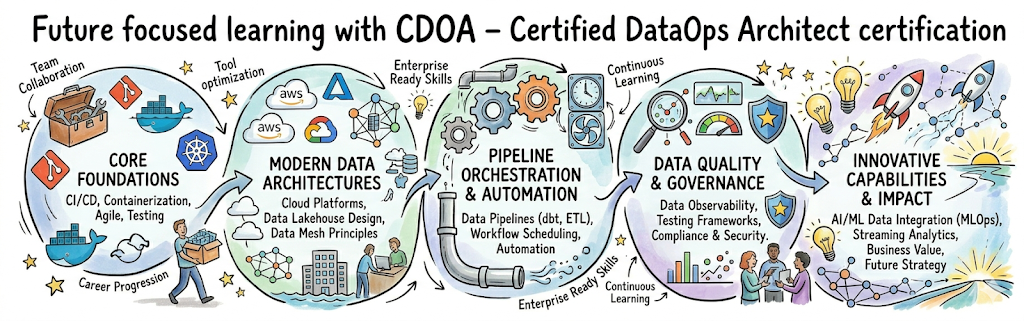
The CDOA – Certified DataOps Architect is a professional designed to bridge the gap between data engineering and operational excellence. This guide is written for engineers and managers who want to understand how to apply DevOps principles to the data lifecycle to ensure high-quality, automated, and scalable data delivery. As data becomes the primary asset for modern enterprises, the need for a structured DataOps approach has become a critical component of platform engineering and cloud-native strategies.
By following this guide, professionals can gain a clear understanding of the certification landscape and how it fits into a broader career in software engineering or data management. Whether you are looking to pivot from traditional DevOps or seeking to specialize as a data architect, this roadmap provides the clarity needed to make informed career decisions. You can find more details about the program on the DataOpsSchool website or explore the official certification paths to begin your journey.
What is the CDOA – Certified DataOps Architect?
The CDOA – Certified DataOps Architect represents a shift from manual, siloed data management to a collaborative and automated framework. It exists to address the common bottlenecks in data pipelines, such as slow deployment cycles, poor data quality, and lack of version control. Unlike theoretical academic courses, this certification focuses on production-ready skills that can be immediately applied to enterprise environments.
It aligns perfectly with modern engineering workflows by treating data pipelines as code. This means applying continuous integration, continuous delivery, and proactive monitoring to data workflows. By earning this certification, you demonstrate an ability to build systems that allow data scientists and analysts to access reliable data without the traditional friction associated with legacy infrastructure.
Who Should Pursue CDOA – Certified DataOps Architect?
This certification is highly beneficial for data engineers, DevOps engineers, and Site Reliability Engineers (SREs) who are increasingly tasked with managing data-intensive applications. Cloud professionals and security specialists will also find value in learning how to secure and scale data transit across distributed systems. It serves as a bridge for professionals who want to master the operational side of data science and machine learning.
For beginners, it provides a structured entry point into a specialized field, while experienced engineers can use it to validate their expertise in modern automation tools. Managers and technical leaders who oversee data teams will benefit from the strategic overview, helping them build more efficient departments. Given the rapid digital transformation in India and global technology hubs, this expertise is globally relevant and highly sought after by enterprise employers.
Why CDOA – Certified DataOps Architect is Valuable in the Future
The demand for DataOps expertise is growing as enterprises realize that simply having data is not enough; they must be able to move and process it reliably. As toolsets evolve, the core principles of DataOps remain constant, providing professionals with long-term career longevity. Organizations are moving away from monolithic data warehouses toward distributed, real-time data meshes that require the architectural skills taught in this program.
This certification helps professionals stay relevant even as specific database or cloud vendors change. It emphasizes the “how” and “why” of data orchestration, making you an asset to any team looking to reduce technical debt in their data stack. Ultimately, the return on career investment is significant, as it positions you at the intersection of three high-growth fields: cloud computing, data engineering, and automation.
CDOA – Certified DataOps Architect Certification Overview
The program is delivered via the official curriculum and is hosted on the DataOpsSchool platform. The certification is structured to provide a logical progression from foundational concepts to advanced architectural design. It uses a performance-based assessment approach, ensuring that candidates are tested on their ability to solve real-world problems rather than just memorizing definitions.
Ownership of the certification remains with the hosting provider, which ensures the content is updated regularly to reflect changes in the industry. The structure includes various modules covering pipeline orchestration, data quality automation, and infrastructure as code for data platforms. This practical focus ensures that upon completion, you possess a portfolio of skills that are directly applicable to enterprise-grade data projects.
CDOA – Certified DataOps Architect Certification Tracks & Levels
The certification is divided into three primary levels: Foundation, Professional, and Advanced. The Foundation level introduces the core philosophy and basic tooling required to participate in a DataOps environment. It is the entry point for those new to the field or coming from a non-engineering background.
The Professional level dives deeper into specialization tracks such as DevOps for Data, SRE for Data, and FinOps for Data. These tracks allow you to align your certification with your current job role or future career goals. The Advanced (Architect) level is designed for those who wish to lead large-scale transformations, focusing on strategy, governance, and complex system design within the data ecosystem.
Complete CDOA – Certified DataOps Architect Certification Table
| Track | Level | Who it’s for | Prerequisites | Skills Covered | Recommended Order |
| Core DataOps | Foundation | Beginners, Managers | Basic IT Knowledge | DataOps Philosophy, CI/CD Basics | 1st |
| Data Engineering | Professional | Data Engineers | Foundation Cert | ETL Automation, Pipeline Monitoring | 2nd |
| Infrastructure | Professional | SRE / DevOps | Foundation Cert | IaC for Data, Scalable Storage | 2nd |
| Security | Professional | Security Engineers | Foundation Cert | Data Masking, Access Governance | 3rd |
| Architecture | Advanced | Senior Engineers | Professional Cert | Strategic Design, Multi-cloud Data | 4th |
Detailed Guide for Each CDOA – Certified DataOps Architect Certification
CDOA – Certified DataOps Architect – Foundation
What it is
This entry-level certification validates a basic understanding of the DataOps methodology and its role in modern software development. It covers the fundamental concepts of bringing agility to data management.
Who should take it
This is suitable for junior engineers, project managers, and business analysts who want to speak the language of modern data teams. No deep technical background is required to start.
Skills you’ll gain
- Understanding the DataOps lifecycle and feedback loops.
- Basic knowledge of version control for data projects.
- Familiarity with the concepts of data quality and testing.
- Knowledge of how DataOps integrates with DevOps teams.
Real-world projects you should be able to do
- Creating a basic automated data validation script.
- Mapping a manual data process to a DataOps workflow.
- Setting up a simple Git repository for data documentation.
Preparation plan
- 7–14 days: Focus on understanding the core manifesto and terminology.
- 30 days: Complete all foundational modules and take practice quizzes.
- 60 days: Engage in community forums and review basic case studies of data failures.
Common mistakes
- Ignoring the cultural aspect of DataOps in favor of only learning tools.
- Skipping the fundamentals of version control.
Best next certification after this
- Same-track option: CDOA Professional – Data Engineering.
- Cross-track option: SRE Foundation.
- Leadership option: Digital Transformation Manager.
CDOA – Certified DataOps Architect – Professional
What it is
This certification validates the ability to implement and manage complex data pipelines using industry-standard automation tools. It focuses on the technical execution of DataOps strategies.
Who should take it
Experienced data engineers and DevOps practitioners who are responsible for building and maintaining data infrastructure. It requires a solid grasp of scripting and cloud environments.
Skills you’ll gain
- Advanced pipeline orchestration using tools like Airflow or Prefect.
- Implementing automated testing for large datasets.
- Containerization of data workloads using Kubernetes.
- Continuous monitoring and alerting for data health.
Real-world projects you should be able to do
- Building a multi-stage CI/CD pipeline for a data warehouse.
- Automating data quality checks that halt pipelines on failure.
- Deploying a scalable data processing cluster using Terraform.
Preparation plan
- 7–14 days: Deep dive into specific orchestration and automation tools.
- 30 days: Build three distinct hands-on projects involving data pipelines.
- 60 days: Review enterprise security patterns and performance tuning.
Common mistakes
- Not spending enough time on error handling and rollback strategies.
- Over-complicating the toolchain for simple data tasks.
Best next certification after this
- Same-track option: CDOA Advanced Architect.
- Cross-track option: Certified DevSecOps Professional.
- Leadership option: Engineering Team Lead.
CDOA – Certified DataOps Architect – Advanced (Architect)
What it is
The Architect level validates the expertise required to design, govern, and scale entire data organizations. It focuses on high-level strategy and technical leadership.
Who should take it
Senior engineers, principal architects, and technical directors who make decisions about the long-term data strategy of an enterprise.
Skills you’ll gain
- Designing multi-region and multi-cloud data architectures.
- Establishing organizational data governance and compliance.
- Cost optimization and FinOps for large-scale data platforms.
- Leading cultural change and cross-functional team alignment.
Real-world projects you should be able to do
- Creating a global data mesh architecture for a multinational firm.
- Developing a comprehensive data disaster recovery and business continuity plan.
- Implementing a cost-governance framework for cloud data spend.
Preparation plan
- 7–14 days: Review case studies of large-scale enterprise data failures.
- 30 days: Draft architectural diagrams for complex, hypothetical scenarios.
- 60 days: Focus on the business impact and ROI of architectural decisions.
Common mistakes
- Focusing too much on technical details and losing sight of business goals.
- Neglecting the legal and compliance aspects of global data residency.
Best next certification after this
- Same-track option: Specialized Industry Data Architect.
- Cross-track option: Certified Cloud Security Architect.
- Leadership option: CTO / Head of Engineering.
Choose Your Learning Path
DevOps Path
This path focuses on applying standard DevOps practices like version control, CI/CD, and automated testing to the world of data. It is ideal for traditional DevOps engineers who want to manage data infrastructure with the same rigor they apply to application code. You will learn how to treat data pipelines as first-class citizens in the development lifecycle.
DevSecOps Path
The DevSecOps path emphasizes the security and compliance aspects of the data lifecycle. You will learn how to implement automated security scanning for data pipelines and manage sensitive information using encryption and masking techniques. This is essential for professionals working in highly regulated industries where data privacy is paramount.
SRE Path
The SRE path focuses on the reliability, availability, and performance of data systems. You will learn how to apply Site Reliability Engineering principles, such as Error Budgets and Service Level Objectives (SLOs), to data delivery. This path is perfect for those who want to ensure that data platforms are resilient to failures and can scale to meet enterprise demands.
AIOps Path
The AIOps path is designed for those looking to use artificial intelligence to enhance IT operations, specifically around data monitoring. You will learn how to implement machine learning models that can predict pipeline failures or detect anomalies in data flow automatically. This path bridges the gap between operational data and intelligent automation.
MLOps Path
The MLOps path focuses specifically on the lifecycle of machine learning models. You will learn how to manage the data used for training, the versioning of models, and the automated deployment of ML workloads. This path is critical for organizations that want to move their machine learning projects from experimental environments to production-grade systems.
DataOps Path
This is the core path that focuses purely on the flow of data from source to consumption. It covers the orchestration of ETL/ELT processes, data quality management, and collaborative data development. It is the primary route for data engineers who want to become specialists in the modern data ecosystem.
FinOps Path
The FinOps path addresses the financial management of data infrastructure in the cloud. You will learn how to monitor data processing costs, identify wasteful resource consumption, and optimize the storage of large datasets. This is a vital skill set for engineers and managers who need to balance high-performance data delivery with budget constraints.
Role → Recommended CDOA – Certified DataOps Architect Certifications
| Role | Recommended Certifications |
| DevOps Engineer | CDOA Foundation, CDOA Professional (Infra) |
| SRE | CDOA Professional (SRE), CDOA Advanced Architect |
| Platform Engineer | CDOA Foundation, CDOA Professional (Data Eng) |
| Cloud Engineer | CDOA Foundation, CDOA Professional (Infra) |
| Security Engineer | CDOA Professional (Security) |
| Data Engineer | CDOA Foundation, CDOA Professional (Data Eng) |
| FinOps Practitioner | CDOA Foundation, CDOA Professional (FinOps) |
| Engineering Manager | CDOA Foundation, CDOA Advanced Architect |
Next Certifications to Take After CDOA – Certified DataOps Architect
Same Track Progression
Once you have achieved the Architect level, the next logical step is to dive into niche specializations within the data world. This might include deep-dive certifications in specific big data technologies or real-time streaming platforms. The goal here is to become the go-to expert for high-complexity data problems that require years of hands-on experience and theoretical knowledge.
Cross-Track Expansion
If you want to broaden your skill set, consider moving into related fields like DevSecOps or AIOps. By combining DataOps with Security or AI, you create a unique professional profile that is highly valuable in the job market. This approach allows you to work across different departments and lead multidisciplinary teams that handle the entire spectrum of modern technology stacks.
Leadership & Management Track
For those interested in moving away from day-to-day engineering, a leadership track is a logical progression. This involves focusing on management certifications that emphasize team building, strategic planning, and financial oversight. Understanding DataOps gives you a massive advantage as a leader because you understand the technical challenges of the most critical part of the modern business: the data.
Training & Certification Support Providers for CDOA – Certified DataOps Architect
DevOpsSchool
DevOpsSchool is a leading global community and training provider that focuses on the entire spectrum of DevOps and DataOps methodologies. They offer a deep repository of technical content, including recorded sessions, live workshops, and comprehensive study materials. Their approach is heavily centered on community learning and mentor-led guidance, making them a preferred choice for professionals looking to upskill. With a strong presence in the Indian market and an expanding global footprint, they provide the necessary resources to help students clear certifications and apply those skills in real-world engineering environments.
Cotocus
Cotocus is a specialized technical training organization that emphasizes hands-on, lab-based learning experiences. They provide a practical environment where students can experiment with real-world scenarios, which is essential for mastering complex topics like DataOps. Their curriculum is designed to be lean and high-impact, focusing on the specific tools and workflows used by top-tier tech companies. By providing access to specialized infrastructure and expert trainers, Cotocus ensures that candidates are not just certified but are truly capable of handling production-grade data challenges in their professional careers.
Scmgalaxy
Scmgalaxy serves as one of the largest knowledge hubs for software configuration management, DevOps, and automation professionals. It is a massive resource for technical blogs, troubleshooting guides, and certification preparation articles. For someone pursuing the CDOA certification, Scmgalaxy offers the foundational knowledge and industry insights required to understand how DataOps fits into the broader software delivery lifecycle. Their extensive archive of technical discussions and community-contributed content makes it an invaluable research tool for engineers who need to stay updated on the latest industry trends and best practices.
BestDevOps
BestDevOps focuses on providing clear, career-oriented training paths for professionals transitioning into automation and cloud roles. Their training programs are structured to be accessible yet rigorous, ensuring that students from various backgrounds can find a starting point. They prioritize the human element of technology, offering mentorship and career guidance alongside technical lessons. For DataOps candidates, BestDevOps provides a supportive environment to learn the complexities of data orchestration and pipeline management, helping them build the confidence needed to succeed in high-pressure technical roles in the global tech market.
Devsecopsschool.com
Devsecopsschool.com is dedicated to the integration of security into every phase of the development and data lifecycle. As data privacy and security become increasingly regulated, this provider offers essential training on how to build secure data pipelines. They cover critical topics like automated compliance, vulnerability scanning, and secure access management. For a DataOps professional, learning from this institution is vital for understanding how to protect sensitive organizational data without slowing down the speed of delivery, ensuring that automation and security work hand-in-hand.
Sreschool.com
Sreschool.com specializes in the principles of Site Reliability Engineering, focusing on building systems that are both scalable and highly reliable. Their training is crucial for DataOps professionals who need to manage the uptime and performance of critical data platforms. By teaching concepts such as Service Level Objectives (SLOs) and incident management, Sreschool.com helps engineers move beyond simple automation to true system resilience. This is particularly important for large-scale data operations where downtime can result in significant financial loss and operational disruption for an enterprise.
Aiopsschool.com
Aiopsschool.com sits at the intersection of artificial intelligence and IT operations. They provide cutting-edge training on how to use machine learning and data analytics to improve the efficiency of technology stacks. For those pursuing a DataOps career, this provider offers insights into how automated monitoring and anomaly detection can be applied to data pipelines. By learning AIOps principles, professionals can transition from reactive troubleshooting to proactive system optimization, utilizing the very data they manage to make their operational workflows smarter and more autonomous.
Dataopsschool.com
Dataopsschool.com is the primary authority and hosting site for the CDOA certification programs. They focus exclusively on the DataOps movement, providing the most up-to-date and authoritative curriculum available. Their courses are designed by industry veterans who have spent years solving data bottlenecks in complex enterprise environments. Because they are specialists in this specific domain, their training is highly focused, avoiding the fluff found in more general IT courses. It is the definitive starting point for anyone serious about becoming a certified expert in the field of DataOps.
Finopsschool.com
Finopsschool.com addresses the critical need for financial accountability in cloud and data management. As organizations move large amounts of data to the cloud, costs can quickly spiral out of control. This provider teaches engineers and managers how to monitor, analyze, and optimize their cloud spend. For a DataOps architect, understanding the financial impact of their infrastructure choices is a key requirement. Finopsschool.com provides the frameworks and tools needed to ensure that data platforms remain cost-effective while delivering the high performance required by modern business applications.
Frequently Asked Questions (General)
- How difficult is the CDOA – Certified DataOps Architect exam?The exam is considered moderately difficult because it focuses on practical application rather than just theory. If you have hands-on experience with pipelines, it is very manageable.
- How much time should I dedicate to studying for the certification?Most professionals spend between 30 and 60 days preparing, depending on their existing experience with automation tools and data engineering concepts.
- Are there any prerequisites for taking the Foundation exam?There are no formal prerequisites for the Foundation level, although a basic understanding of IT infrastructure and the software development lifecycle is helpful.
- Will this certification help me get a job in India?Yes, the demand for DataOps professionals in India’s booming tech sector is very high, especially within the banking, retail, and telecommunications industries.
- Is the certification recognized globally?Yes, the principles taught in the CDOA program are based on global industry standards, making the certification valuable in any major technology hub worldwide.
- Does the certification expire?Most certifications in this track are valid for two to three years, after which you may need to recertify or progress to a higher level to stay current.
- What is the return on investment for this certification?The ROI is high, as certified professionals often see significant salary increases and gain access to more senior roles in platform and data engineering.
- Do I need to know how to code to pass the exam?For the Professional and Architect levels, basic scripting knowledge (like Python or Bash) is highly recommended as the focus is on automation.
- Can I take the exam online?Yes, the certification exams are typically delivered through an online proctored platform, allowing you to take them from the comfort of your home or office.
- What tools should I be familiar with?Knowledge of Git, Docker, Kubernetes, and orchestration tools like Airflow will give you a significant advantage during the certification process.
- Is there a community for certified professionals?Yes, becoming certified gives you access to an exclusive community of DataOps experts where you can share knowledge, find jobs, and collaborate on projects.
- How does DataOps differ from regular DevOps?While DevOps focuses on application code, DataOps focuses specifically on the unique challenges of data, such as volume, variety, quality, and state management.
FAQs on CDOA – Certified DataOps Architect
- What are the core pillars of the CDOA curriculum?The curriculum is built on automation, collaboration, and continuous improvement. It focuses on breaking down silos between data teams and ensuring that data is treated as code.
- Can a manager benefit from this technical certification?Absolutely. Managers gain a strategic framework for building more efficient data teams and understanding the technical requirements of modern data infrastructure.
- How does the CDOA handle data security?Security is integrated into the “DevSecOps for Data” track, teaching candidates how to automate security checks and maintain compliance throughout the entire data pipeline.
- Is the training purely tool-based?No, while tools are used for demonstrations, the focus is on the underlying methodologies and architectural principles that can be applied to any technology stack.
- What makes CDOA unique compared to other data certifications?CDOA focuses specifically on the “Ops” side of data—the delivery and reliability—rather than just the analysis or the science, filling a major gap in the industry.
- Is there a focus on cloud-specific providers?The program is cloud-agnostic, meaning the skills you learn can be applied to AWS, Azure, Google Cloud, or even on-premise and hybrid data environments.
- How are the practical assessments conducted?Candidates are often given a scenario or a broken pipeline and are required to fix it or optimize it within a controlled environment to demonstrate competence.
- What is the biggest challenge for new DataOps students?The biggest challenge is often shifting the mindset from manual data management to a fully automated approach, which requires unlearning some traditional habits.
Final Thoughts: Is CDOA – Certified DataOps Architect Worth It?
From a career perspective, the CDOA – Certified DataOps Architect is a solid investment for anyone working in the modern data and cloud ecosystem. It addresses a specific, growing pain point in the industry: the inability of organizations to deliver high-quality data at the speed of business. By earning this certification, you are not just adding a badge to your profile; you are acquiring a framework for solving one of the most complex technical challenges of the current era.
As a mentor, my advice is to look beyond the certificate itself. Focus on the labs, the community, and the shift in mindset that this program requires. If you want to move from being an engineer who just “manages data” to an architect who “designs delivery systems,” then this path is the right choice. It is a practical, rigorous, and highly relevant program that will serve you well for many years to come in your professional journey.
