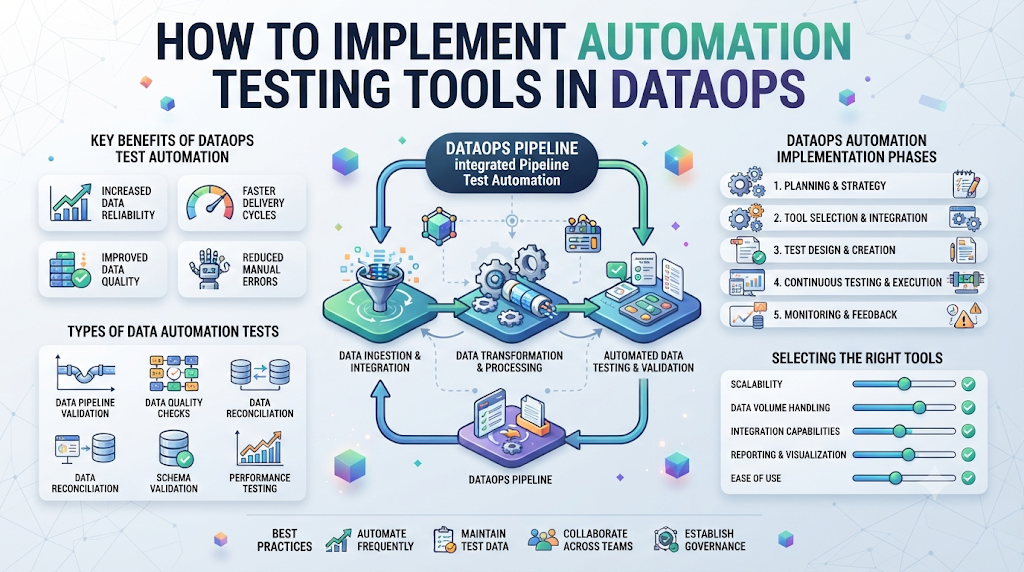
Data pipelines are the backbone of modern analytics, machine learning, and business intelligence. Yet, unlike traditional software engineering, data engineering has historically lacked rigorous, automated testing frameworks. Pipelines break silently when upstream schemas change, null values cascade into data warehouses, or upstream sources alter data types without warning.
Implementing automation testing tools in a DataOps framework shifts data engineering from a reactive posture—where broken dashboards are discovered by executives—to a proactive posture where data defects are intercepted before they reach production. This guide outlines how to select, integrate, and operationalize automated testing tools within a DataOps pipeline.
What Is DataOps Testing and Why It Matters
DataOps applies DevOps principles—such as continuous integration, continuous delivery, and automated testing—to data pipelines. While traditional software tests check functions, methods, and UI components, DataOps testing validates data assets, transformations, and operational infrastructure.
The Shift from Reactive to Proactive
In an untested pipeline, bugs propagate downstream. A missing column in an ingestion job breaks a dbt model, which invalidates a machine learning feature store, which eventually corrupts executive financial reporting. Automated testing inserts automated quality gates at every stage of the data lifecycle:
- Ingestion: Validates incoming file formats, schema definitions, and row counts.
- Transformation: Ensures business logic transformations preserve referential integrity and handle edge cases.
- Storage/Serving: Verifies data freshness, uniqueness, and distribution constraints before business users query the warehouse.
Core Categories of Data Testing Tools
Before choosing a tool, you must understand the four primary pillars of automated data testing. A robust DataOps implementation typically incorporates tools across multiple categories.
1. Data Quality and Schema Testing
These tools execute assertions directly against databases or data lakes to check for nulls, uniqueness, accepted values, and custom SQL queries.
- Primary Examples: Great Expectations, Soda, dbt Tests.
- Use Case: Validating that a primary key column has zero null values and 100% uniqueness before a downstream transformation runs.
2. Pipeline Observability and Lineage Tools
These tools monitor metadata, job run durations, schema drift, and data volume anomalies without necessarily executing explicit row-level assertions.
- Primary Examples: Monte Carlo, Datadog Data Pipeline Monitoring, Acceldata.
- Use Case: Detecting that a daily data volume dropped by 45% compared to the 30-day moving average.
3. Data Integration and Unit Testing Frameworks
These tools test the code and transformation logic of data pipelines (such as Python scripts, Spark jobs, or SQL queries) before deployment.
- Primary Examples: pytest, Great Expectations’ Checkpoints, dbt-unit-testing.
- Use Case: Running mock data through a complex data cleaning function to verify that edge cases (like leap years or negative currency values) are handled correctly.
Step-by-Step Implementation Guide
Implementing test automation requires a phased approach to prevent alert fatigue and pipeline gridlock.
Step 1: Define Baseline Data Contracts and Assertions
Do not attempt to test every single column and row across your entire enterprise data warehouse on day one. Start with critical path datasets—those tied to regulatory reporting, billing, or core executive dashboards.
- Identify critical tables and columns.
- Establish business invariants (e.g.,
order_total > 0,customer_id IS NOT NULL). - Define freshness SLAs (e.g., table must be updated daily by 6:00 AM UTC).
Step 2: Integrate Testing into the CI/CD Pipeline
Automated tests must run automatically during two distinct phases:
- Pull Request (CI) Phase: When data engineers modify transformation code (e.g., dbt models or SQL scripts), run unit tests and integration tests against a small sample or sandbox database.
- Production Orchestration (CD) Phase: When orchestrators (such as Apache Airflow, Prefect, or Dagster) execute production pipelines, insert testing tasks immediately after ingestion and transformation steps.
YAML
# Conceptual Airflow task dependency for automated data testing
ingest_data >> run_transformations >> run_data_quality_tests >> downstream_analytics
Step 3: Implement Incident Routing and Alerting
An automated test is useless if failures are buried in log files. Route test failures to the appropriate communication channels (such as PagerDuty or Slack) with clear context:
- The name of the failed assertion.
- The specific dataset and column involved.
- A runbook link or suggested remediation steps.
Decision Guidance: Choosing the Right Tooling Approach
| Approach | Best Suited For | Key Trade-Offs |
| Native dbt Tests | Teams heavily invested in the modern data stack using dbt for transformations. | Limited to data stored in the warehouse; minimal support for raw file ingestion validation. |
| Open-Source Frameworks (Great Expectations, Soda) | Organizations requiring customized testing across diverse environments (S3, Snowflake, Spark). | Requires infrastructure maintenance, Python knowledge, and team operational overhead. |
| Enterprise Data Observability Platforms (Monte Carlo, etc.) | Large-scale enterprises needing automated anomaly detection and end-to-end lineage. | Significant software licensing costs; can produce initial alert noise requiring fine-tuning. |
Risks and Failure Modes in Data Test Automation
Implementing automation introduces unique failure modes that can derail a DataOps initiative.
- Alert Fatigue: If tests throw false positives constantly, engineers begin ignoring them. Prevention: Start with warning-level alerts rather than hard failures, and tune thresholds based on historical variance rather than static limits.
- Testing Production Data Directly: Running heavy validation queries against large production tables can consume expensive warehouse compute credits and slow down queries. Prevention: Run heavy tests on clones, materialized views, or during off-peak hours, or use sampling strategies.
- Rigid Schemas vs. Evolving Data: Overly strict tests break pipelines whenever a legitimate downstream schema change occurs. Prevention: Implement data contracts upstream and coordinate schema evolution via CI/CD pipelines.
How to Verify Your Testing Implementation Works
To ensure your automated testing framework is adding value rather than friction, track these validation metrics:
- Time-to-Detection (TTD): Measure how quickly data quality issues are discovered. Effective automation should surface pipeline breaks within minutes of job completion, rather than days later when reported by business users.
- Test Coverage Ratio: Calculate the percentage of critical data assets covered by automated schema, freshness, and distribution tests.
- False Positive Rate: Track the proportion of test alerts that did not require engineering intervention. Aim to keep this below 10%.
Frequently Asked Questions
Q1. What is the difference between data testing and data observability? Data testing involves running explicit, pre-defined assertions and checks against data assets (such as verifying row counts or checking for nulls). Data observability is a broader discipline that uses machine learning and metadata analysis to automatically detect anomalies, track lineage, and monitor pipeline health without requiring manual rule creation for every field.
Q2. Should data tests block pipeline execution or just send warnings? It depends on the criticality of the data. For core business metrics, financial reporting, and compliance data, tests should block downstream execution to prevent bad data from reaching users. For exploratory or auxiliary datasets, warning-level alerts are usually sufficient.
Q3. How do we handle test execution costs in cloud data warehouses like Snowflake or BigQuery? Running extensive SQL assertions across massive tables can incur significant compute costs. Mitigate this by utilizing table sampling, incremental testing (only testing newly loaded partitions), and leveraging native data warehouse caching where appropriate.
Q4. Can data tests be written by non-technical business analysts? Yes, modern testing tools often provide YAML-based configurations or low-code user interfaces. While complex data transformations require engineering oversight, business stakeholders can easily define business rules, accepted value lists, and expected ranges.
Q5. How often should automated data tests be executed? Tests should be executed immediately following every data pipeline run or scheduled ingestion batch. For streaming data, continuous or micro-batch validation checks are necessary to catch pipeline failures in real time.
Q6. What is a data contract, and how does it relate to testing? A data contract is an agreement between data producers and consumers regarding the schema, semantics, and SLA of a dataset. Implementing data contracts acts as an upstream preventive test, stopping bad data at the source before it ever enters ingestion pipelines.
Q7. How do we test machine learning feature stores differently from traditional data pipelines? Feature stores require specialized testing focused on data drift, concept drift, feature distribution changes, and training-serving skew (ensuring features computed during training match those computed at inference time).
Q8. Where should data quality tests live in our repository structure? Tests should live alongside your transformation code within your version control system (Git). For dbt, tests reside in the same project directory as your models; for Python-based frameworks, they are stored in dedicated test directories alongside ingestion scripts.
Q9. What are the common signs that a data team is experiencing alert fatigue? Common indicators include engineers muting alert channels, long response times to actual production failures, an increasing number of unaddressed test failures, and a general lack of trust in the testing suite.
Q10. How do we measure the ROI of implementing DataOps testing? ROI is measured by tracking reductions in data downtime, decreases in incident resolution time, fewer emergency hotfixes in production, and an increase in trust from business stakeholders relying on data products.
Conclusion
Implementing automation testing tools in DataOps transforms data engineering from a fragile script-running exercise into a reliable, enterprise-grade discipline. By defining clear assertions, integrating testing into CI/CD workflows, and continuously tuning alert thresholds, data teams can catch anomalies before they impact business value. Start small with critical path datasets, scale your test coverage incrementally, and treat data quality as code.
