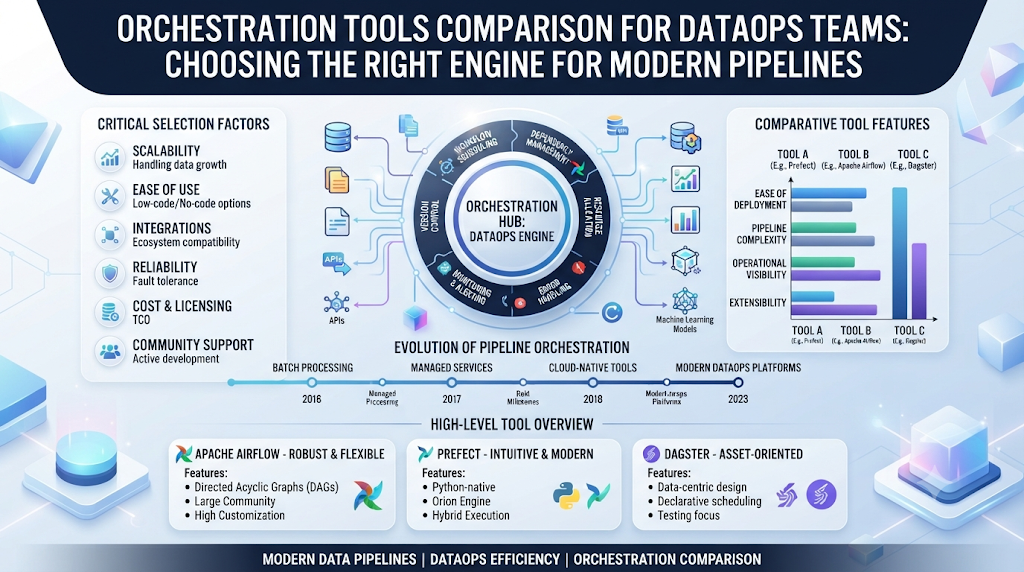
Data pipelines are the backbone of modern data architecture. As data volumes surge and organizations demand faster time-to-insight, the responsibility of DataOps teams has shifted from simply moving data to ensuring high reliability, fast iteration cycles, and seamless observability. At the center of this stack lies the orchestration engine.
Choosing the right orchestration tool is no longer just about scheduling a cron job. It is about selecting a foundational platform that dictates developer velocity, operational overhead, cost efficiency, and failure recovery. This guide compares the leading orchestration tools available for DataOps teams, analyzing their trade-offs, architecture styles, and real-world failure modes.
The Shift in Data Orchestration: Code-as-Configuration vs. Drag-and-Drop
Traditional data orchestration relied heavily on static, monolithic GUI-based tools. While accessible, these tools struggled with version control, automated testing, and CI/CD integration. Modern DataOps principles demand that orchestration tools treat pipelines as code (PaC).
Today’s landscape is dominated by two primary paradigms:
- Python-First Frameworks: Pipelines are defined entirely in code (typically Python), allowing developers to leverage software engineering best practices, modular functions, and dynamic graph generation.
- Configuration-First & Declarative Engines: Pipelines are declared via YAML, JSON, or visual configurations, separating orchestration logic from execution code and often relying on centralized control planes.
Evaluating an orchestrator requires looking past marketing claims and assessing how the tool handles state management, dynamic scaling, multi-environment deployments, and operational debugging during a production failure at 3:00 AM.
Core Evaluation Criteria for DataOps Teams
When comparing orchestrators, DataOps teams should evaluate tools against four foundational pillars:
- Developer Experience (DevEx): How easy is it to write, test locally, and deploy pipelines? Does the framework support local debugging without spinning up a massive cluster?
- Dynamic vs. Static DAGs: Can the orchestrator handle Directed Acyclic Graphs (DAGs) that change dynamically based on runtime parameters (e.g., discovering new tables dynamically), or must the graph be strictly defined beforehand?
- Operational Overhead: What are the infrastructure and maintenance costs? Does the tool require heavy database tuning, worker scaling, and cluster management?
- Observability & Alerting: How quickly can an engineer trace a failure down to a specific task instance, view logs, and rerun upstream/downstream dependencies?
Detailed Tool Comparison
1. Apache Airflow
Apache Airflow remains the industry standard for Python-based data orchestration. It pioneered the concept of workflows-as-code, allowing developers to define DAGs using Python scripts.
- Architecture: Master-worker architecture backed by a metadata database (PostgreSQL/MySQL) and a scheduler that continuously evaluates DAG files.
- Strengths:
- Massive ecosystem with pre-built operators for virtually every modern data store and cloud service.
- Dynamic DAG generation enables complex, parameter-driven workflows.
- Strong community support, enterprise backing (via Astronomer), and extensive documentation.
- Limitations:
- Historically struggled with dynamic task mapping and complex data-aware scheduling (though modern versions have significantly improved this).
- The scheduler can become a performance bottleneck if metadata database tuning and configuration are neglected.
- Local testing can be cumbersome without Docker-compose setups.
- When to Use: Broad enterprise data stacks requiring integration with a wide variety of third-party tools, legacy systems, and hybrid environments.
2. Prefect
Prefect was built from the ground up to address the perceived friction points of legacy orchestration, focusing on a modern Python-first experience with hybrid execution models.
- Architecture: Prefect Orion/Cloud control plane communicating with lightweight execution environments via API calls, shifting focus from static schedule-driven execution to event-driven dataflows.
- Strengths:
- Exceptional developer experience; standard Python functions turn into orchestrated tasks with simple decorators (
@task,@flow). - Native support for hybrid execution, allowing orchestration metadata to live in the cloud while code executes securely within private VPCs.
- Robust dynamic mapping and reactive workflow orchestration based on runtime states.
- Exceptional developer experience; standard Python functions turn into orchestrated tasks with simple decorators (
- Limitations:
- Smaller ecosystem of pre-built operators compared to Airflow, requiring more custom Python code for niche integrations.
- Transitioning existing legacy Airflow codebases requires a complete rewrite.
- When to Use: Modern, cloud-native data teams prioritizing developer velocity, rapid local testing, and Python-centric data engineering practices.
3. Dagster
Dagster approaches orchestration through the lens of data assets rather than just task execution. It introduces an asset-centric model where pipelines are defined by what data they produce rather than how steps execute sequentially.
- Architecture: Declarative framework featuring a software-defined asset (SDA) model, coupled with a central web UI (Dagster Dagit) and flexible execution backends (Kubernetes, Celery, Docker).
- Strengths:
- Asset-based lineage tracking provides out-of-the-box data observability and impact analysis.
- Excellent local development environment with
dagster dev, allowing full pipeline simulation locally. - Strong type-checking and data validation integration via partitions, asset checks, and metadata logging.
- Limitations:
- Steeper learning curve for teams accustomed to traditional task-based procedural orchestrators.
- Requires refactoring mental models away from “run this script then that script” toward “define these assets and their dependencies.”
- When to Use: Data platforms focused on data mesh architectures, rigorous data quality governance, and comprehensive asset lineage tracking.
4. Mage
Mage is a newer open-source data pipeline orchestration tool designed to combine the modularity of notebook environments with production-grade orchestration capabilities.
- Architecture: Interactive development environments built directly into the orchestrator, integrating block-based code execution (Python, SQL, R) with native transformation workflows.
- Strengths:
- Outstanding user interface that blurs the line between interactive exploration (like Jupyter) and production orchestration.
- Built-in data quality checks, profiling, and documentation generation per block.
- Fast setup and low initial friction for building lightweight ETL pipelines.
- Limitations:
- Smaller enterprise adoption track record compared to Airflow or Prefect.
- Complex multi-tenant enterprise configurations and custom security governance models require more hands-on validation.
- When to Use: Lean data teams, startups, and agile analytics engineering groups looking to build, test, and deploy pipelines rapidly with built-in data quality controls.
Summary Matrix
| Feature / Criteria | Apache Airflow | Prefect | Dagster | Mage |
| Paradigm | Task-based (Python) | Workflow-based (Python) | Asset-based (Declarative) | Block-based (Interactive) |
| Ecosystem & Integrations | Massive / Mature | Growing / Modern | Expanding / Focused | Rapidly Growing |
| Local Testing | Moderate (Docker needed) | Excellent | Excellent | Excellent (UI-driven) |
| Lineage & Observability | Basic (Add-on dependent) | Good (Event logs) | Native (Asset graph) | Good (Block-level) |
| Learning Curve | Moderate to Steep | Low to Moderate | Steep | Low |
Risks, Failure Modes, and Operational Pitfalls
No matter which orchestrator you choose, DataOps teams frequently encounter specific failure patterns:
- Monolithic DAG Bloat: Engineers pack hundreds of unrelated tasks into a single DAG file. When one task fails, parsing delays and scheduler congestion impact unrelated workflows. Prevention: Keep DAGs modular; use trigger rules and external triggers to decouple business domains.
- Hardcoded Configurations: Environment-specific connection strings or file paths hardcoded into orchestration tasks lead to deployment failures across staging and production. Prevention: Enforce strict separation of configuration via environment variables and secret managers.
- Inadequate Retry Logic and Idempotency: If a pipeline fails midway and retries without being idempotent, downstream tables can receive duplicate records or corrupted states. Prevention: Design all tasks to be safely re-runnable (upserts, partition overwrites).
How to Verify Your Orchestrator Setup Works
Before deploying an orchestration stack to production, run the following verification checks:
- Failure Simulation: Intentionally kill a worker node mid-task and verify that the scheduler correctly detects the failure, fires alerts, and retries or quarantines the run.
- CI/CD Integration Test: Push a syntax error in a pipeline branch and confirm that automated unit/integration tests catch the failure in the pull request phase before merging to main.
- Backfill Stress Test: Trigger a multi-month historical backfill and monitor memory leaks, database connection pool exhaustion, and resource throttling.
1. Frequently Asked Questions
Q1. Can I use multiple orchestrators within the same enterprise data stack? While possible, running multiple orchestrators increases operational overhead, fractures monitoring, and complicates lineage tracking. Most organizations standardize on a single orchestrator per environment unless distinct business units have completely isolated infrastructure requirements.
Q2. How do orchestrators integrate with dbt (data build tool)? Modern orchestrators like Airflow, Prefect, Dagster, and Mage all provide dedicated plugins, libraries, or native integrations to trigger dbt runs, parse dbt manifests, and map model-level lineage directly into the orchestration UI.
Q3. Are GUI-based orchestrators completely dead for DataOps teams? Purely visual, non-code drag-and-drop tools are largely abandoned by mature DataOps teams because they fail version control and CI/CD standards. However, modern orchestrators provide rich UIs backed by code repositories, combining visual monitoring with code-as-configuration principles.
Q4. What is the biggest hidden cost when scaling Apache Airflow? The metadata database (PostgreSQL/MySQL) often becomes the primary scaling bottleneck. As task instances multiply, table bloat, slow query performance on the DAG run state tables, and connection pooling issues require active database tuning and regular log/history pruning.
Q5. Is Dagster only useful if I am using software-defined assets? While asset-based orchestration is Dagster’s core differentiator, the tool also fully supports traditional task-based orchestration for workloads that are purely operational (e.g., sending emails, invoking external APIs) rather than asset-producing.
Q6. How do I handle secrets management securely in my orchestrator? Production orchestrators should never store plaintext credentials in code repositories or config files. Integrate your orchestrator with secure secret stores such as AWS Secrets Manager, HashiCorp Vault, or Kubernetes Secrets, pulling credentials dynamically at runtime.
Q7. Can data orchestration tools replace data catalog and lineage tools? Orchestrators provide pipeline and execution lineage, showing how data moves from Source A to Destination B. However, they do not replace dedicated data catalogs (like DataHub or Alation) which handle governance, compliance, business glossaries, and cross-system data discovery.
Q8. How do I test my orchestration pipelines locally before pushing to production? Most modern tools provide CLI commands or Python testing utilities (like Pytest fixtures for Airflow/Dagster/Prefect) that mock out external connections and validate DAG structure, syntax, and task dependency logic inside a local virtual environment.
Q9. What causes “scheduler heartbeat lost” errors in Airflow? This typically occurs when the Airflow scheduler process is starved of CPU/memory resources, or when the metadata database experiences high connection contention or lock contention during peak load periods.
Q10. What is the best way to migrate from legacy cron jobs to a modern orchestrator? Start by auditing all existing cron scripts, identifying dependencies and execution schedules. Migrate workflows domain by domain, beginning with non-critical analytical pipelines, and run them in parallel with existing cron jobs for a validation period before decommissioning legacy scripts.
Conclusion
Selecting an orchestration tool requires balancing your team’s programming proficiency, infrastructure maturity, and data governance needs. Prioritize code maintainability, robust error handling, and clear asset lineage over sheer feature counts. Establish modular pipeline designs early, test rigorously in staging environments, and choose the tool that empowers your engineers to ship reliable data with confidence.
