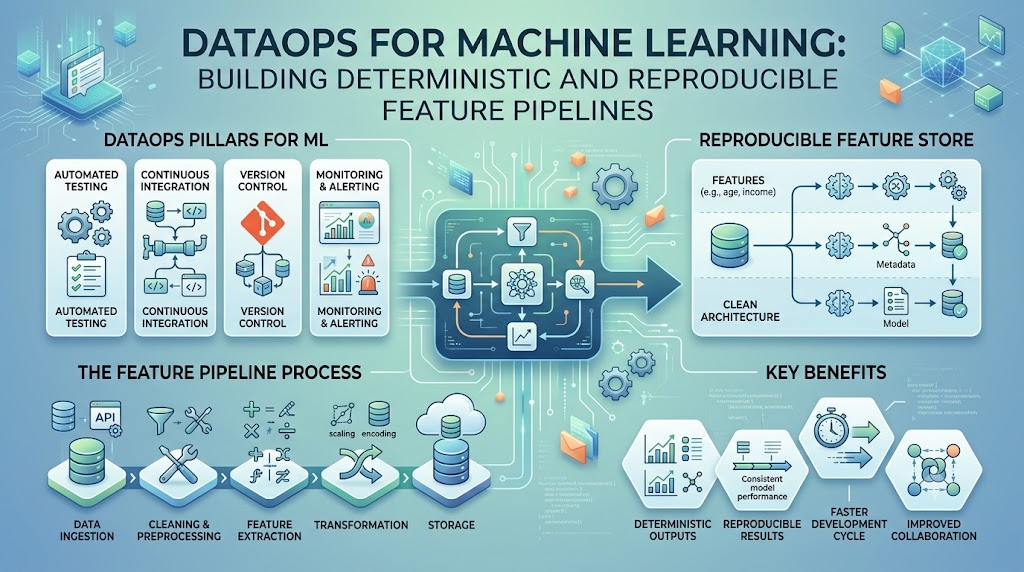
For educational and technical documentation on this architecture, visit DataOpsSchool.com. Most machine learning initiatives do not fail due to algorithm selection, hyperparameter tuning, or model capacity. They fail because the data feeding them is brittle, unversioned, silent in failure, and decoupled from the operational lifecycle of software systems. While MLOps concentrates on model registries, experiment tracking, feature stores, and inference serving, it routinely assumes an idealized upstream state: clean, timely, and semantically consistent data. In production, this assumption collapses. Upstream schema changes break feature transformations, silent distribution drift passes downstream pipelines undetected, and training-serving skew corrupts inference. DataOps provides the engineering discipline, automation, and architectural guardrails required to turn unstable data inputs into deterministic, observable, and reproducible ML pipelines.
The Boundary Problem: DataOps vs. MLOps
Treating MLOps as a self-contained discipline creates an artificial operational boundary. A machine learning model is an artifact derived from code and state, where the state is an immutable slice of data.
+-------------------------------------------------------------------------+
|                                 DATAOPS                                 |
|  Source Systems -> Ingestion -> Contract Tests -> Transforms -> Lineage |
+-------------------------------------------------------------------------+
                                     |
                          Deterministic Datasets
                          & Verified Feature Sets
                                     v
+-------------------------------------------------------------------------+
|                                  MLOPS                                  |
|  Training -> Eval -> Registry -> Deployment -> Serving -> Inference Mon |
+-------------------------------------------------------------------------+
| Dimension | DataOps Domain | MLOps Domain |
| Primary Unit of Delivery | Data products, verified tables, governed pipelines | Model artifacts, inference endpoints, container images |
| Feedback Metric | SLA/SLO adherence, freshness, schema validity, data quality scores | Latency, throughput, F1/AUC, concept drift, business outcome metrics |
| Failure Mode | Null bursts, schema mismatches, volume anomalies, stale partitions | Model degradation, feature attribution shift, prediction drift |
| Core Cadence | Continuous batch/event-driven ingestion | Periodic retraining, event-driven retraining, real-time inference |
Without DataOps primitives upstream, MLOps platforms spend engineering effort retrofitting defensive checks into training and serving scripts. DataOps absorbs this complexity at the infrastructure level.
Architectural Touchpoints: Integrating DataOps into the ML Lifecycle
Machine learning integration occurs across five discrete operational touchpoints where DataOps practices prevent production failure.
1. Upstream Data Contracts and Schema Evolution
Upstream software engineers frequently alter transactional database schemas (e.g., dropping a column, changing an integer type to a string, or renaming status fields) without realizing that downstream feature extraction relies on them.
DataOps implements strict data contracts at the boundary between operational systems and the analytical/ML storage tier. A contract enforces schema constraints, acceptable null thresholds, and range invariants via pipeline CI/CD.
YAML
# Example: Upstream Data Contract Definition (YAML)
version: 1.0.0
dataset: core_banking.transactions
owner: transactional-payments-team
sla:
  freshness_hours: 1
  availability_pct: 99.9
schema:
  - column: transaction_id
    type: string
    tests:
      - not_null
      - unique
  - column: amount_usd
    type: decimal(18,4)
    tests:
      - not_null
      - range: { min: 0.01, max: 10000000.00 }
  - column: payment_type
    type: string
    tests:
      - accepted_values: ['ACH', 'WIRE', 'P2P', 'POS']
When an upstream pull request modifies a schema or breaks an invariant, the DataOps validation suite runs in the operational repo’s CI/CD pipeline, failing before the change deploys to production databases.
2. Immutable Data Versioning and Training Reproducibility
A common operational issue occurs when a model retrained on “last month’s data” yields performance metrics that cannot be replicated two weeks later. This happens when pipelines overwrite partitions or apply non-deterministic transforms (such as timezone-blind timestamps or dynamic system clock references).
DataOps enforces immutable, point-in-time data versioning through storage layer mechanics:
- Time-Travel Table Formats: Adopting formats like Apache Iceberg, Delta Lake, or Apache Hudi allows the ML pipeline to register not just a path (
s3://data/gold/features/), but a deterministic snapshot ID (snapshot_id=849204928402948). - Environment Parity via Ephemeral Clones: Modern DataOps tooling uses zero-copy cloning to spin up isolated, production-identical data environments for model validation pipelines without duplicating cloud storage footprints.
3. Pipeline Orchestration with Integrated Quality Gates
Traditional schedulers (e.g., standard cron jobs) operate on the assumption of elapsed time rather than data readiness. A step executes at 02:00 AM regardless of whether upstream files arrived completely or passed basic validation checks.
DataOps transforms ML orchestrators (such as Dagster, Apache Airflow, or Prefect) into asset-based, test-driven pipelines:
- Source Ingestion: Ingest raw payloads into a landing zone.
- Pre-Transform Profiling: Run automated statistical profiling (e.g., Great Expectations, Soda Core) to verify null ratios, variance, and record counts.
- Execution Circuit Breaker: If data validation fails, trigger a circuit breaker. Halt downstream transformations and the model retraining trigger immediately.
- Transform and Publish: Apply deterministic business logic only to validated inputs.
4. Preventing Training-Serving Skew via Shared Feature Logic
Training-serving skew occurs when feature extraction code written in Python for training differs mathematically or contextually from the production inference service code (often rewritten in Go, Java, or SQL for low-latency streaming).
DataOps mitigates this by maintaining feature pipelines as single-source-of-truth code artifacts:
- Declarative Transformation Code: Transformations are defined once and deployed to an underlying computation engine capable of both batch and streaming evaluation (e.g., dbt for scheduled batch features, PySpark, or Apache Flink for real-time aggregation).
- Automated Sync to Feature Stores: The DataOps pipeline manages materialized batch tables in the data lakehouse while continuously orchestrating push syncs to low-latency key-value stores (e.g., Redis, DynamoDB, Feast, Tecton) used during online inference.
5. Unified Lineage from Raw Byte to Model Endpoint
When a computer vision or tabular fraud detection model outputs anomalous predictions in production, teams often face a debugging deadlock: the data science team blames the feature pipeline, and the data engineers blame the source system.
End-to-end lineage (conforming to specifications like OpenLineage) connects:
- Source table mutation (Git commit hash of the database migration)
- Pipeline transformation job (Git commit hash of the dbt/Spark code)
- Physical dataset snapshot (Iceberg/Delta snapshot ID)
- Training run identifier (MLflow/Weights & Biases run ID)
- Model registry version and serving container tag
Reference Architecture: Production DataOps-ML Pipeline
The following design isolates transformations, automates validation, and prevents unverified data from triggering model retraining or batch inference.
+---------------------------------------------------------------------------------------+
| INGESTION & CONTRACT LAYER                                                            |
| Operational DBs / Kafka -> Data Contract Gate -> Landing Bucket (Bronze)              |
+---------------------------------------------------------------------------------------+
                                           |
                                           v
+---------------------------------------------------------------------------------------+
| TRANSFORMATION & TEST LAYER                                                           |
| Delta Lake / Iceberg (Silver) <-> Automated Great Expectations / dbt Tests             |
|                                         |                                             |
|                     [Circuit Breaker / Alert on Failure]                              |
+---------------------------------------------------------------------------------------+
                                           | Passes Tests
                                           v
+---------------------------------------------------------------------------------------+
| FEATURE PREPARATION (GOLD)                                                            |
| Materialized Feature Views -> Batch Store (Parquet/Iceberg) + Online Store (Redis)    |
+---------------------------------------------------------------------------------------+
                                           |
                   +-----------------------+-----------------------+
                   |                                               |
                   v                                               v
+------------------------------------+           +------------------------------------+
| MLOps Retraining Trigger           |           | MLOps Batch Inference Pipeline     |
| - Registers Snapshot ID            |           | - Validates Inference Input Schema |
| - Pulls Deterministic Training Set |           | - Reads Pre-computed Features      |
| - Runs Training in Isolated Pod    |           | - Scores Model & Monitors Drift    |
+------------------------------------+           +------------------------------------+
Component Breakdown
- Landing / Bronze Tier: Ephemeral or append-only raw storage. No ML process reads directly from this layer.
- Silver Tier (Validated Core): Cleansed and conformed data. Every table mutation must pass automated constraints: completeness, unicity, referential integrity, and expected categorical distributions.
- Gold Tier (Feature Assets): Fully engineered feature sets, time-travel enabled, tagged with semantic versioning.
- Serving / Retraining Consumables: Downstream ML systems consume exclusively from the Gold Tier, referencing immutable snapshot hashes stored in their experiment metadata.
Critical Failure Modes and Practical Solutions
Failure Mode 1: Silent Upstream Categorical Drift
- The Problem: An e-commerce system introduces a new payment provider code (
APPLE_PAY_V2). Upstream pipelines do not crash because the column remains a string. However, one-hot encoding or categorical embedding models omit the token or map it to an out-of-vocabulary/unknown bucket, quietly degrading conversion predictions. - The DataOps Mitigation: Implement automated cardinality and distribution tracking at the ingestion gate. The pipeline asserts that the categorical distribution matches expected distributions within a bounded Earth Mover’s Distance or Chi-square threshold. Any novel categorical values exceeding a 0.5% presence trigger an automated pipeline quarantine.
Failure Mode 2: Lookahead Bias in Feature Pipelines
- The Problem: When constructing historical training data, an engineer writes a join that matches events to user profiles using current customer attributes rather than the attribute state at the exact time the event occurred. The model demonstrates high accuracy during offline training, but performs poorly in production.
- The DataOps Mitigation: Implement Point-in-Time (PIT) joins natively inside the feature transformation framework. Combine this with automated automated data leakage regression tests, which inject deliberate delays and verify that feature calculation results remain constant regardless of execution time.
Failure Mode 3: Silent Failure Cascades Across Autonomous Teams
- The Problem: The data engineering team experiences a transient pipeline failure, causing morning ingestion to finish with an empty partition or partial data. Downstream daily model retraining runs on schedule using the incomplete dataset, overwriting production model weights with a degraded artifact.
- The DataOps Mitigation: Enforce hard semantic dependencies over time-based execution. Pipeline DAGs must define data assets rather than tasks. If the upstream asset
gold.daily_featuresfails its row-count anomaly check (e.g., falling outside 3 standard deviations of a 30-day moving average), downstream training triggers are automatically canceled, and on-call engineers are paged.
Operational Readiness Checklist for Data-to-Model Pipelines
- Data Contracts in Source Systems: Are schema modifications in transactional databases tested against downstream analytics requirements before production deployment?
- Immutable Snapshots: Does every model experiment run log an immutable snapshot identifier (e.g., Iceberg snapshot ID, Delta commit version) rather than an unversioned URI?
- Automated Data Validation: Do ingestion pipelines evaluate null counts, uniqueness, distribution shifts, and range constraints before writing to feature tables?
- Circuit Breakers Enabled: Does a data quality failure automatically prevent downstream retraining jobs from triggering?
- Point-in-Time Join Integrity: Are time-dependent features constructed using event-time temporal joins to prevent lookahead bias?
- Parity Verification: Are transformations written in a unified framework, or covered by cross-language unit tests to ensure offline/online calculation consistency?
- End-to-End Lineage Tracking: Can engineers trace an anomalous production prediction directly back to the specific batch or stream run that produced its input features?
Frequently Asked Questions
1. How does DataOps directly reduce machine learning project failure rates?
Most ML models fail in production due to silent data decay rather than faulty algorithms. DataOps enforces automated quality assertions, schema validation, and volume tracking at ingestion boundaries. By halting pipelines before corrupt or incomplete records enter feature stores or retraining jobs, DataOps ensures models are trained and evaluated exclusively on verified datasets.
2. Where does DataOps end and MLOps begin?
DataOps governs the data lifecycle: ingestion, schema enforcement, transformations, pipeline orchestration, and feature asset generation. MLOps takes over once feature assets exist, managing experiment tracking, hyperparameter optimization, model registry, artifact packaging, deployment, and inference monitoring. DataOps delivers the reliable input; MLOps governs the model lifecycle derived from that input.
3. Why are traditional data warehouses insufficient for ML feature management?
Standard warehouses often allow in-place mutations, unversioned schema migrations, and point-in-time state overwrites. Machine learning requires strict determinism: the ability to reconstruct training datasets exactly as they appeared at a specific moment in time. Without time-travel storage formats and semantic versioning, traditional warehouses introduce lookahead bias and make historical model reproducibility impossible.
4. How does a DataOps approach solve training-serving skew?
Training-serving skew occurs when data scientists build feature extraction routines in one language (like Python/Pandas) for training, while production teams build real-time streaming transforms in another (like SQL or Java). DataOps treats transformations as single-source-of-truth code artifacts deployed across unified batch and streaming engines, ensuring identical mathematical feature computation across both offline and online systems.
5. What is the difference between data drift and concept drift?
Data drift refers to changes in the statistical properties of the input features $P(X)$ over time without changing the underlying relationships, such as seasonal shifts in user demographics. Concept drift refers to changes in the statistical relationship between the inputs and the target variable $P(Y\vert{}X)$, such as consumer purchase habits altering abruptly during an economic downturn. DataOps catches data drift at the ingestion and feature transformation layers, whereas MLOps flags concept drift by evaluating model prediction performance.
6. What role do data contracts play in automated ML retraining?
Data contracts define a formal agreement between upstream transactional systems and downstream data consumers regarding schema structure, acceptable ranges, and SLA parameters. In automated retraining workflows, data contracts act as deployment gates: if an upstream transactional microservice alters a field format without updating the contract, the change is blocked in CI/CD, preventing corrupted records from triggering faulty retrains.
7. How do circuit breakers function in an ML data pipeline?
Circuit breakers are automated checkpoints evaluated after data transformations but before consumption tiers. If an upstream dataset exhibits anomalies—such as a 30% drop in row count, unexpected null values, or missing foreign keys—the circuit breaker halts pipeline execution immediately. It quarantines the partition and pages the on-call engineer, preventing downstream model retraining or batch scoring from running against corrupted inputs.
8. Can feature stores replace the need for an upstream DataOps architecture?
No. A feature store is a dual-interface storage system (batch and low-latency key-value) that stores and serves pre-computed feature values. It does not handle upstream raw data extraction, contract enforcement, or raw pipeline orchestration. Without upstream DataOps practices, a feature store simply serves poor-quality, unmonitored data to inference engines more rapidly.
9. How does DataOps handle data leakage in temporal feature sets?
Data leakage occurs when future information inadvertently leaks into historical training sets, frequently caused by naive SQL table joins. DataOps frameworks mitigate this by enforcing native Point-in-Time (PIT) joins and temporal windowing inside declarative transformation layers. Automated pipeline integration tests inject artificial timestamp delays to confirm that feature outputs remain invariant to extraction times.
10. How do DataOps pipelines prevent training-serving skew?
DataOps pipelines prevent skew by treating feature transformations as versioned code artifacts that feed both offline feature stores (for training) and online feature stores (for inference) from identical logic. Additionally, DataOps pipelines incorporate integration tests that pass identical inputs through both batch and real-time paths to confirm that the output feature vectors match down to the float precision.
Conclusion
Production machine learning initiatives rarely collapse from algorithmic deficiency; they fail because the underlying data supply chain is treated as a secondary concern. High-performing models require deterministic inputs, immutable state versioning, and rigorous quality enforcement. By implementing data contracts, automated validation circuit breakers, point-in-time feature logic, and end-to-end lineage, DataOps transforms fragile data transformations into dependable operational infrastructure. This foundation allows MLOps workflows to scale with reliable, repeatable, and audit-ready data delivery
