Introduction
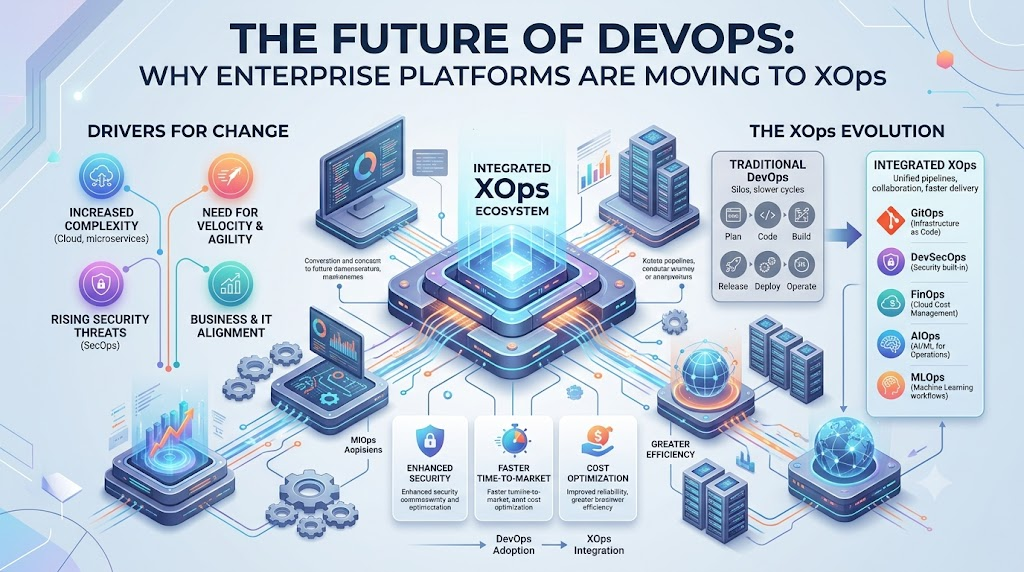
Engineering organizations rarely run on a single operational methodology anymore. Over the past decade, IT teams adopted DevOps to accelerate software delivery, spun up DataOps to stabilize analytical pipelines, established MLOps to deploy machine learning models, and integrated SecOps and FinOps to govern security policies and cloud expenses. XOps addresses this fragmentation directly. Rather than treating software engineering, data management, model training, and infrastructure scaling as disconnected functional silos, XOps acts as an overarching operational framework designed to harmonize automation, governance, observability, and delivery pipelines across every technical domain. For teams navigating complex multi-cloud ecosystems and distributed workloads, learning platforms such as XOpsSchool provide structured curricula, foundational patterns, and hands-on guidance to align these interconnected operational disciplines under a unified practice. Understanding what XOps represents—and how its constituent operational models integrate—is essential for engineering leaders and practitioners building resilient, maintainable production systems.
What Is XOps?
XOps represents an operational philosophy and organizational strategy that standardizes practices, automation, and governance across all “Ops” methodologies. The “X” functions as a variable that encompasses development (DevOps), data engineering (DataOps), machine learning (MLOps), artificial intelligence (AIOps), platform engineering, security (SecOps), cloud management (CloudOps), and financial operations (FinOps).
At its core, XOps is not a single tool, commercial product, or standalone role. It is an engineering discipline focused on establishing common pipelines, shared telemetry formats, unified security guardrails, and repeatable automation patterns. Instead of maintaining five distinct deployment platforms and observability dashboards for application developers, data engineers, and data scientists, an XOps framework builds shared platform capabilities that serve all three groups consistently.
How Does XOps Work? The Operational Lifecycle
XOps works by abstracting operational commonalities into self-service internal developer platforms (IDPs), standardized CI/CD pipelines, and centralized observability planes.
+-------------------------------------------------------------------------+
|                              Unified XOps Core                          |
|         Governance  |  Observability  |  Automation  |  Security        |
+-------------------------------------------------------------------------+
       |                     |                     |               |
       v                     v                     v               v
+--------------+      +--------------+      +--------------+  +-----------+
|    DevOps    |      |   DataOps    |      |    MLOps     |  |  FinOps   |
| Code -> Test |      | Ingest->ETL  |      | Train->Serve |  | Cost Alloc|
| Deploy->Run  |      | Quality->DW  |      | Drift Monitor|  | Optimization
+--------------+      +--------------+      +--------------+  +-----------+
The underlying lifecycle consists of four primary stages:
- Declarative Definition: Infrastructure, pipelines, security boundaries, and data contracts are defined declaratively as code (Infrastructure as Code and Policy as Code).
- Standardized Delivery: Changes—whether application logic, data ingestion configurations, or trained model artifacts—move through automated testing and validation gates before hitting production clusters.
- Continuous Telemetry & Feedback: Metrics, logs, traces, and operational metadata feed into a centralized analytics plane. Operational intelligence engines identify regressions, pipeline failures, or abnormal cloud spending.
- Adaptive Remediation: Automated feedback loops execute rollbacks, autoscale compute clusters, quarantine faulty data partitions, or alert on-call platform engineers based on clear Service Level Objectives (SLOs).
The Core Disciplines of the XOps Ecosystem
To implement XOps effectively, organizations must understand how each specialized discipline fits into the broader operational puzzle.
DevOps
DevOps remains the baseline foundation of the XOps framework. It standardizes continuous integration, continuous delivery (CI/CD), source control management, and declarative infrastructure provisioning. DevOps establishes the delivery speed and stability that other disciplines build upon.
DataOps
DataOps adapts agile delivery and automated testing to data engineering. It focuses on reducing data pipeline cycle times, validating schema migrations, automating ETL/ELT pipelines, and ensuring data quality before downstream analytical ingestion.
MLOps
MLOps focuses on operationalizing data science workflows. It bridges the gap between static model development and reliable production inference by managing experiment tracking, feature stores, automated retraining triggers, model registries, and drift detection.
AIOps
AIOps injects machine learning, natural language processing, and statistical pattern recognition into operational monitoring. It correlates events across distributed systems, filters out noise from alerting streams, detects anomalous spikes in CPU or memory, and speeds up root cause analysis during production incidents.
SecOps (DevSecOps)
SecOps embeds security analysis directly into CI/CD pipelines rather than auditing artifacts manually before deployment. It automates software composition analysis (SCA), static application security testing (SAST), secrets detection, and container image scanning.
FinOps
FinOps introduces financial accountability to cloud infrastructure. By tracking resource usage patterns, cloud cost metrics, and pod-level resource consumption, FinOps allows engineering teams to optimize workloads based on business value and unit economics.
Comparing the Pillars of XOps
The table below outlines the primary focus, core activities, typical technologies, and target deliverables for each foundational operational discipline within an XOps ecosystem:
| Discipline | Primary Focus | Core Activities | Common Technologies | Target Deliverables |
| DevOps | Application delivery & infrastructure | CI/CD, IaC, container orchestration, microservice deployments | Kubernetes, Terraform, GitHub Actions, Docker, Helm | Reliable software deployments, low lead time for changes |
| DataOps | Data flow reliability & quality | Automated data testing, ETL orchestration, schema governance | Apache Airflow, dbt, Apache Kafka, Snowflake | Verified datasets, production data pipelines |
| MLOps | ML model lifecycle management | Model packaging, experiment tracking, feature validation, drift analysis | Kubeflow, MLflow, Feast, Triton Inference Server | Production inference APIs, compliant model registries |
| AIOps | Operational telemetry & intelligence | Alert correlation, anomaly detection, incident root cause clustering | Prometheus, Grafana, OpenTelemetry, Datadog | Reduced mean time to resolution (MTTR), noise suppression |
| SecOps | Continuous security & compliance | Static/dynamic scanning, policy as code, vulnerability triage | Trivy, OPA/Gatekeeper, SonarQube, Falco | Compliant build artifacts, zero high-severity CVEs |
| FinOps | Cloud financial management | Cost allocation, rightsizing compute, budget threshold alerting | Kubecost, AWS Cost Explorer, OpenCost | Transparent cloud spending, optimized unit costs |
Practical Architectural Example: End-to-End Enterprise Scenario
Consider a digital healthcare platform that uses an intelligent triage engine. Delivering this service requires three distinct engineering groups:
- The Application Team writes Go microservices for patient scheduling.
- The Data Engineering Team cleans, aggregates, and stores incoming telemetry from connected health monitors.
- The Machine Learning Team trains predictive models that assess patient risk scores.
Without XOps, each team sets up independent tooling:
- The application team deploys to Kubernetes using GitHub Actions.
- The data team writes manual cron jobs and pushes custom Python code to individual virtual machines.
- The ML team runs notebooks manually, serializes
.pklfiles, and sends them via object storage to developers without version control.
The XOps Approach
Under an integrated XOps model:
- Unified Platform Engineering: The platform team supplies a hardened Kubernetes cluster managed via GitOps patterns using ArgoCD or Flux.
- Shared Delivery Patterns: All teams run their workloads through standardized CI/CD pipelines. The ML team’s pipeline triggers model evaluation checks, the data team’s pipeline runs automated data validation tests via dbt, and the application team runs standard unit and integration tests.
- Standardized Observability: Application metrics, ETL processing lag, and ML model inference latency are all exported via OpenTelemetry collectors into Prometheus and Grafana. An AIOps engine correlates sudden data pipeline lag with downstream inference inaccuracies, instantly alerting the on-call engineer to the upstream schema mismatch rather than triggering false-positive alerts across ten separate dashboards.
- Policy Enforcement: Open Policy Agent (OPA) validates that every deployed container image—whether microservice, data pipeline worker, or model serving proxy—has been scanned for vulnerabilities and complies with organizational resource quotas.
Practical Benefits of Adopting XOps
- Reduced Toolchain Sprawl: Instead of funding and maintaining separate deployment, security, and observability tools for each business unit, organizations consolidate their operational stack onto reusable platform primitives.
- Shorter Mean Time to Detection and Resolution: Cross-functional telemetry enables engineers to trace production anomalies across the entire stack—from UI microservices down to underlying database partitions and ML prediction drift.
- Consistent Governance and Compliance: Standardized pipelines enforce security scanning, provenance tracking, and data access controls automatically across code, data, and models.
- Improved Resource Utilization: Unifying FinOps practices with platform engineering prevents over-provisioning across development clusters, sandbox environments, and heavy GPU-backed compute nodes.
Implementation Challenges and Limitations
Adopting XOps is not a simple matter of installing software. Organizations often encounter several practical hurdles:
- Organizational Silos and Culture: Data scientists, application developers, and operations teams have distinct working habits, terminology, and priorities. Convincing data teams to adopt strict version control, code review standards, and automated testing often requires cultural change and hands-on enablement.
- Tooling Incompatibility: Open-source and commercial tools built exclusively for DevOps do not always handle large binary datasets, model lineage requirements, or non-deterministic ML workflows cleanly.
- Skills Deficits: True XOps practitioners must understand container orchestration, cloud-native storage, data pipelines, and security controls. Finding or training engineers with this broad multidisciplinary background requires dedicated investment.
- Initial Setup Complexity: Building internal platform interfaces and consolidating telemetry across distinct engineering domains requires significant upfront platform engineering effort.
Implementation Steps: How to Adopt XOps
- Map Existing Operational Workflows: Identify the distinct tools, deployment patterns, and monitoring dashboards currently used across your software, data, and machine learning teams.
- Establish Common Platform Standards: Standardize runtime environments on containerized workloads (such as Kubernetes) and declare infrastructure through code (such as Terraform).
- Consolidate CI/CD Foundations: Implement shared CI/CD runners and template libraries that support application testing, data schema validation, and model evaluation within the same workflow ecosystem.
- Unify the Observability Architecture: Deploy OpenTelemetry across all systems to standardize logs, metrics, and distributed tracing formats. Route data through a centralized observability platform to eliminate blind spots.
- Codify Security and Governance: Implement automated policy engines (such as Open Policy Agent or Kyverno) to enforce container provenance, secrets handling, and network isolation across all workloads.
- Iterate with an Internal Developer Platform (IDP): Provide development and data teams with declarative, self-service portals that hide baseline cloud complexity while guaranteeing that deployments adhere to corporate security and operational baselines.
Best Practices for Long-Term Success
- Focus on Platform Usability: Do not impose complex operational tools on developers and data scientists without providing clear abstraction layers. Build self-service workflows that simplify daily tasks.
- Treat Pipelines as Production Code: Write automated tests for infrastructure configurations, data ingestion jobs, and model training definitions. Subject all pipeline modifications to peer reviews.
- Define Actionable SLOs Across All Systems: Measure application availability, data freshness, pipeline latency, and model accuracy using standardized Service Level Indicators (SLIs) and SLOs.
- Start Small: Do not attempt to unify every operational discipline simultaneously. Begin by integrating DevOps and SecOps, extend those pipelines to DataOps, and gradually incorporate MLOps and FinOps as your platform matures.
Frequently Asked Questions
Q1: What does the “X” stand for in XOps?
The “X” represents a variable placeholder that encompasses any operational discipline, including DevOps, DataOps, MLOps, AIOps, SecOps, FinOps, and CloudOps.
Q2: Is XOps meant to replace DevOps?
No. XOps does not replace DevOps; it builds upon DevOps principles and extends those same automation, versioning, and continuous delivery concepts to data, artificial intelligence, and platform operations.
Q3: How does XOps relate to Platform Engineering?
Platform engineering provides the technical foundation for XOps. Platform teams build the shared developer platforms, CI/CD templates, and infrastructure abstractions that enable XOps practices across different teams.
Q4: What is the primary difference between DataOps and MLOps within an XOps framework?
DataOps focuses on the extraction, transformation, quality, and delivery of raw and structured data, while MLOps focuses specifically on training, versioning, deploying, monitoring, and maintaining machine learning models.
Q5: Why is AIOps an essential component of XOps?
As architectures grow more distributed, the volume of logs and metrics exceeds human analysis capacity. AIOps applies automated analytics and pattern recognition to filter alert noise and pinpoint root causes across diverse operational systems.
Q6: What tools are commonly used when implementing an XOps strategy?
Core tools include Kubernetes for container orchestration, Terraform for infrastructure provisioning, GitHub Actions or GitLab for CI/CD, dbt and Apache Airflow for data pipelines, MLflow for model tracking, and Prometheus, Grafana, and OpenTelemetry for observability.
Q7: Can small startups benefit from XOps, or is it strictly for enterprises?
While enterprises experience the pain of fragmented operational silos most acutely, startups benefit from establishing shared pipeline standards and infrastructure-as-code patterns early to prevent tool sprawl and technical debt as they scale.
Q8: What skills should an engineer learn to work effectively in an XOps environment?
Engineers should master containerization (Docker, Kubernetes), declarative infrastructure (Terraform), continuous integration workflows, basic data pipeline design, distributed observability (OpenTelemetry), and core security scanning practices.
Q9: How does FinOps integrate into an XOps pipeline?
FinOps brings real-time cost visibility into delivery pipelines by measuring the resource consumption of microservices, data queries, and model training jobs, allowing teams to rightsize infrastructure before bills accumulate.
Q10: What is the biggest operational mistake teams make when transitioning to XOps?
The most common mistake is focusing exclusively on purchasing or installing new tools while ignoring the cultural, structural, and process changes required to make software engineers, data professionals, and operations specialists collaborate effectively.
Conclusion
Modern technology organizations can no longer afford to manage software engineering, data systems, and machine learning models in isolated operational vacuums. Disconnected delivery mechanisms increase operational overhead, complicate incident triage, and weaken security postures across enterprise environments. XOps offers a structured path forward. By taking the battle-tested disciplines of continuous delivery, declarative automation, and automated testing pioneered by DevOps and applying them across data, machine learning, cloud financial management, and security, organizations can build predictable, highly observable, and resilient digital platforms. Successful XOps adoption requires patient cultural alignment, deliberate platform engineering, and a focus on self-service developer experiences, creating a cohesive operational foundation that scales smoothly alongside expanding business demands.
