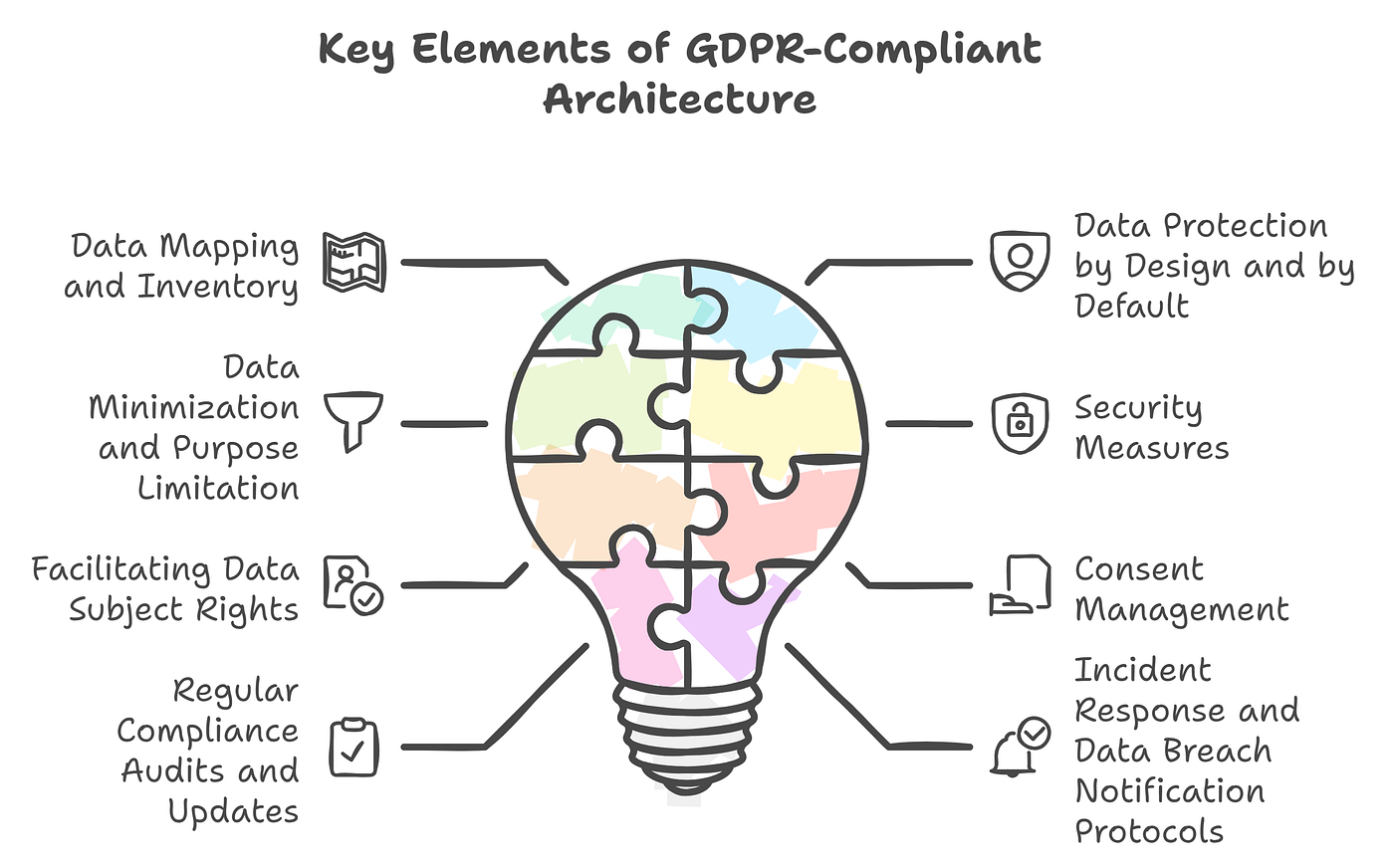
✅ GDPR in DevSecOps

1. Introduction & Overview

🔍 What is GDPR?

The General Data Protection Regulation (GDPR) is a European Union (EU) law that governs how personal data of individuals in the EU should be collected, processed, and stored. Enforced since May 25, 2018, it sets strict requirements on data privacy, transparency, and user consent.

📜 History & Background

  • Adopted: April 14, 2016
  • Enforced: May 25, 2018
  • Replaces: The Data Protection Directive 95/46/EC
  • Scope: Applies to any organization that handles EU citizen data, regardless of location

🔗 Why is it Relevant in DevSecOps?

GDPR isn’t just a legal requirement—it’s an essential part of “security by design and default” in modern software practices. DevSecOps, which integrates security early in the DevOps lifecycle, is the perfect framework to bake GDPR compliance into CI/CD pipelines and cloud deployments.


2. Core Concepts & Terminology

📘 Key Terms & Definitions

TermDescription
Data SubjectIndividual whose data is collected
Data ControllerEntity determining how data is processed
Data ProcessorEntity processing data on behalf of the controller
Personal DataAny information relating to an identifiable individual
ConsentFreely given, specific, informed indication of the subject’s agreement
Right to be ForgottenData subjects can request deletion of their data

🔄 How It Fits into the DevSecOps Lifecycle

DevSecOps PhaseGDPR Integration
PlanIdentify personal data use and define security/compliance policies
DevelopUse secure coding practices and pseudonymization
BuildIntegrate static analysis tools to catch PII leakage
TestRun data protection unit tests
ReleaseEnsure releases follow compliance checklists
DeployEnforce role-based access, encryption
OperateMonitor and log access to personal data
MonitorReal-time alerting on privacy violations or breaches

3. Architecture & How It Works

⚙️ Components of GDPR Compliance in DevSecOps

  • Data Classification Engine: Tags sensitive data types (e.g., names, emails)
  • Consent Management System: Captures and manages user consents
  • Anonymization/Pseudonymization Tools: Remove direct identifiers in lower environments
  • Audit & Logging System: Maintains immutable logs for accountability
  • Access Controls & IAM: Implements RBAC/ABAC for data handlers

🏗️ Architecture Diagram (Described)

+------------------+        +---------------------+
|  Source Code     |------->|  Static Code Scans  |
+------------------+        +---------------------+
                                     |
                                     v
+------------------+        +----------------------+
| GDPR Libraries   |<------>|  Consent Management  |
+------------------+        +----------------------+
                                     |
                                     v
+------------------+        +----------------------+
| App Deployments  |------->|  Anonymized Logging  |
+------------------+        +----------------------+

🔌 Integration Points with CI/CD or Cloud Tools

ToolGDPR Integration
GitHub/GitLabStatic analysis tools to scan for PII
JenkinsAutomate data masking during builds
TerraformEnforce encryption/storage policies
AWS/GCP/AzureUse services like AWS Macie or GCP DLP to detect personal data

4. Installation & Getting Started

🔧 Basic Setup or Prerequisites

  • Familiarity with CI/CD tools like GitHub Actions, Jenkins
  • Docker and Kubernetes (optional for deployment testing)
  • Python/Node.js (for GDPR compliance libraries)

👣 Hands-on: Beginner-Friendly Setup Guide

Step 1: Add GDPR scanning tool (e.g., PIICatcher)

pip install piicatcher

Step 2: Scan your PostgreSQL/MySQL DB for PII

piicatcher --connection "postgresql://user:password@localhost:5432/mydb"

Step 3: Add consent tracking logic in app

# Example in Django
from consent.models import Consent

def record_consent(user, purpose):
    Consent.objects.create(user=user, purpose=purpose)

Step 4: Integrate in CI Pipeline (GitHub Actions)

jobs:
  scan:
    runs-on: ubuntu-latest
    steps:
      - name: Run PII Scanner
        run: |
          pip install piicatcher
          piicatcher --connection ${{ secrets.DB_CONN }}

5. Real-World Use Cases

🏥 Healthcare Industry

  • Use Case: A hospital DevOps team scans patient record access logs automatically and anonymizes names in logs.
  • Tooling: AWS Macie + custom Lambda to auto-mask names

🛍️ E-Commerce Platform

  • Use Case: Deletes customer data after 2 years of inactivity
  • Tooling: Python cron jobs + PostgreSQL GDPR plugin

📱 Mobile App Startup

  • Use Case: Shows consent prompts on first launch and stores consent version with user metadata
  • Tooling: React Native + Firebase Firestore + Consent SDK

🏦 Fintech SaaS

  • Use Case: Uses GitHub Actions to run PII data scans before every deployment
  • Tooling: GitHub Actions + piicatcher + PostgreSQL

6. Benefits & Limitations

✅ Key Advantages

  • Enhances user trust and transparency
  • Reduces risk of hefty penalties (up to €20M or 4% global revenue)
  • Promotes secure-by-default architecture

⚠️ Limitations & Challenges

  • Requires significant cultural and process change
  • Tools may flag false positives (e.g., “email” in test datasets)
  • Difficulty in real-time monitoring across microservices

7. Best Practices & Recommendations

🔐 Security & Compliance Tips

  • Use data minimization: Collect only what’s needed
  • Enforce encryption at rest and in transit
  • Use audit trails to prove compliance during audits

⚙️ Performance & Maintenance

  • Run PII scans during off-peak hours
  • Regularly update consent versions
  • Document your data flow maps for visibility

🤖 Automation Ideas

  • Use cron jobs to delete expired user data
  • Integrate consent banners with Terraform + CDN deployment
  • Auto-generate DPIA (Data Protection Impact Assessment) reports

8. Comparison with Alternatives

RegulationScopeDevSecOps IntegrationStrengths
GDPREUVery HighMost mature, consent-driven
CCPACaliforniaMediumFocus on selling/sharing data
HIPAAUS HealthcareMediumHealthcare-specific
PIPEDACanadaLowLimited automation support

🔎 When to Choose GDPR-focused Solutions

  • Your product serves EU customers
  • You want robust consent tracking
  • You prioritize data governance and privacy engineering

9. Conclusion

GDPR is more than a compliance checkbox—it’s a catalyst for secure, ethical software delivery. Integrating GDPR into the DevSecOps pipeline ensures your product is resilient, transparent, and legally compliant by design.

🚀 Future Trends

  • More automated compliance-as-code tooling
  • AI-driven privacy monitoring
  • Cross-border regulatory convergence (e.g., UK-GDPR, India DPDP Bill)

🔗 Useful Links


Related Posts

Modernizing AppSec: The Role of DevSecOps Consulting Services

Modern engineering teams deliver software faster than ever, releasing code multiple times a day across complex multi-cloud environments. However, rapid release cycles often create significant security challenges…

Read More

A Complete Overview of DevOps Support Services and Their Business Value

Introduction Running a modern software environment involves much more than writing code and releasing applications. Engineering teams must continuously manage cloud resources, deployment pipelines, containers, security controls,…

Read More

A Practical Guide to Evaluating DevOps Trainers and Training Programs

Introduction DevOps has changed considerably from being mainly associated with deployment automation and collaboration between development and operations teams. Today, engineering organizations work across cloud platforms, containers,…

Read More

Essential DataOps Testing Techniques for Reliable Modern Pipelines

Introduction The ingestion job extracted raw files and loaded them without crashing, but an upstream application updated its checkout flow. You must verify both the pipeline code…

Read More

How DataOps Improves Collaboration Across Teams in Modern Organizations

Introduction In modern organizations, data is often called the most valuable asset. Yet, the teams responsible for gathering, processing, analyzing, and acting on that data frequently operate…

Read More

Best Countries for Dental Tourism: Comparing Costs, Safety, and Quality Care

Navigating the world of international healthcare can feel overwhelming, especially when facing extensive dental work or rising domestic treatment costs. Millions of patients worldwide actively research cross-border…

Read More

Leave a Reply