Introduction
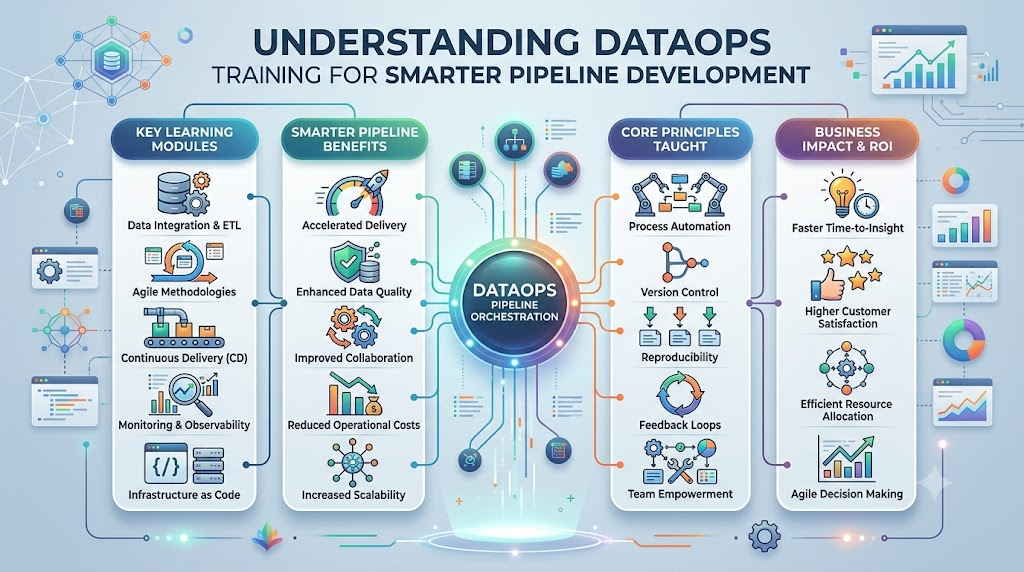
Enterprise organizations spend millions of dollars modernizing their cloud data stacks, hiring talented data scientists, and investing in advanced business intelligence tooling. Yet, Chief Data Officers, VPs of Engineering, and analytics directors face the exact same frustrating boardroom scenario: executive leadership questions the validity of core reporting numbers, product launches stall due to missing metrics, and high-salaried data engineers spend more than half their week debugging broken pipelines. Solving this challenge requires moving beyond reactive fixes and treating data delivery as a disciplined manufacturing process. Applying strategic DataOps best practices bridges the operational divide between development velocity, platform stability, and enterprise trust. By instilling agile principles, continuous integration and delivery (CI/CD), proactive automated validation, and comprehensive telemetry, leadership can transform unpredictable data projects into dependable business engines. Leveraging structured DataOps Training allows modern engineering organizations to build the baseline automation and cultural discipline required to safeguard data value at enterprise scale.
Main Article
The Executive Problem: The Hidden Cost of Data Downtime
Data downtime—the periods during which data is missing, erroneous, or delayed—is one of the most expensive hidden liabilities in modern digital business. When a pipeline fails silently, the damage ripples far beyond the engineering department:
- Erosion of Executive Trust: When two departments present conflicting revenue numbers in a quarterly business review, leadership loses faith in analytical reporting and reverts to intuition-based decision-making.
- Wasted Engineering Capital: High-value machine learning engineers and analytics specialists spend their time triaging broken cron jobs, hunting down schema alterations, and answering support tickets rather than building revenue-generating products.
- Opportunity Loss: Slower development cycles mean that launching a new predictive model or customer segmentation pipeline takes months instead of days.
Addressing these systemic liabilities requires leadership to reframe analytical delivery around established software engineering methodologies adapted specifically to data environments.
[Ad-Hoc Data Project Model]                  [Strategic DataOps Operating Model]
• High data downtime & firefighting           • Predictable delivery via automated CI/CD
• Unplanned, reactive incident resolution     • Proactive quarantine of erroneous records
• Decreasing stakeholder trust                • Verifiable data quality SLAs and SLOs
• High engineering turnover & burnout         • High-velocity innovation & self-service
Architectural Guardrails: Designing for Resilience and Predictability
Executive leaders must establish architectural standards that balance rapid experimentation with organizational reliability. A resilient platform enforces clear boundaries across data domains.
Source Systems ──► Enterprise Ingestion ──► Transactional Lakehouse ──► Automated Quality Gates ──► Certified Business Assets
      │                       │                         │                          │                         │
      ▼                       ▼                         ▼                          ▼                         ▼
[Upstream Feeds]     [Declarative Extract]     [ACID Snapshot Storage]    [Automated Regression]     [High-Trust Decisions]
1. Ingestion Standardization
Pipelines should pull data through standardized, automated connectors that log metadata, handle schema evolution gracefully, and preserve an unmodified record of raw inputs for compliance and auditability.
2. Transactional Lakehouse Foundations
Modern data architectures rely on transactional engines such as Snowflake, Google BigQuery, or open lakehouse formats like Apache Iceberg and Delta Lake. These technologies provide snapshot isolation, zero-copy cloning, and time-travel capabilities, enabling zero-downtime deployments and rapid disaster recovery.
3. Automated Quality Gates
Data validation must operate as an automated gatekeeper. Bad records must be caught and quarantined before they reach customer-facing reporting or feeding predictive algorithms.
4. Certified Business Asset Layer
End-user reporting tools should query only audited, certified dimensional models. By separating exploratory sandbox models from official corporate reporting, teams preserve platform flexibility without risking corporate reporting accuracy.
Strategic DataOps Best Practices for Leadership
Achieving operational excellence requires engineering leaders to enforce specific operational standards across their development teams.
Treat Data Workflows as Version-Controlled Software Assets
A common failure mode in growing companies is allowing analysts to execute direct modifications against production databases or manually manipulate scheduled tasks.
- Mandate Version Control for All Transformations: Every transformation script, pipeline configuration, and orchestration DAG must live in a Git repository governed by branch protection policies.
- Eliminate Manual Deployments with CI/CD: Changes to production models should be deployed exclusively through automated continuous integration and continuous deployment pipelines.
- Isolate Pull Request Testing in Disposable Environments: Using storage-level zero-copy cloning, continuous integration pipelines should automatically spin up isolated, cost-effective staging schemas to validate query logic against realistic data structures before merging code.
Institute Proactive, Multi-Tier Quality Thresholds
Relying on end consumers to report data inaccuracies is an organizational failure. Leadership must mandate automated quality testing throughout the data lifecycle:
| Stage | Business Risk Addressed | Automated Practice |
|---|---|---|
| Ingestion Perimeter | Unexpected source schema changes breaking downstream pipelines | Upstream data contracts, JSON Schema and Protobuf assertions |
| Staging Tier | Duplicate transaction records distorting financial metrics | Primary key uniqueness tests, not-null constraints |
| Intermediate Tier | Inconsistent business logic across organizational silos | Referential integrity validations, foreign key lookup checks |
| Consumer Tier | Silent volume drops or abnormal metrics reaching executive dashboards | Statistical anomaly detection, moving-average volume alerts |
When data fails an assertion, the system should quarantine malformed records into dedicated error tables rather than crashing the pipeline completely, preserving downstream reporting continuity whenever possible.
Require Idempotency to Control Remediation Costs
Pipeline failures are an inevitable reality of cloud computing. The true measure of a robust data platform is not whether a transient network error occurs, but how quickly and safely the system recovers.
Engineering leaders must mandate that all pipeline operations be idempotent: executing a job multiple times across a specific data partition must always yield the exact same end state without creating duplicate records or corrupting historical summaries.
SQL
-- Pattern for deterministic, idempotent partition loading
MERGE INTO corporate_reporting.fact_daily_revenue AS target
USING staging.stg_transactions AS source
ON target.transaction_id = source.transaction_id
AND target.transaction_date = source.transaction_date
WHEN MATCHED THEN
  UPDATE SET
    target.gross_amount = source.gross_amount,
    target.discount_amount = source.discount_amount,
    target.net_amount = source.net_amount,
    target.last_modified_timestamp = CURRENT_TIMESTAMP()
WHEN NOT MATCHED THEN
  INSERT (transaction_id, customer_id, transaction_date, gross_amount, discount_amount, net_amount, last_modified_timestamp)
  VALUES (source.transaction_id, source.customer_id, source.transaction_date, source.gross_amount, source.discount_amount, source.net_amount, CURRENT_TIMESTAMP());
Enforcing idempotent designs ensures that when an overnight run fails due to external API throttling, support personnel can trigger a clean re-run with a single click—eliminating hours of manual data patching.
Implement Comprehensive Data Observability and SLOs
Infrastructure uptime metrics—such as compute cluster availability—are insufficient for evaluating analytical operations. A data platform can maintain 99.9% uptime while serving stale, inaccurate data.
Leadership should implement observability frameworks tracking the five core indicators of data health:
- Freshness: Are operational tables updating within established Service Level Objectives (SLOs)?
- Volume: Did daily ingestion deliver significantly fewer or more records than expected historical ranges?
- Schema Evolution: Have upstream engineers dropped, altered, or renamed fields without formal notification?
- Data Lineage: When a source dataset is delayed, which executive reports, customer dashboards, and ML models are downstream?
- Distribution Health: Have critical metrics (such as average order value or churn percentage) shifted outside typical statistical tolerances?
Publishing these metrics internally builds transparency and holds data teams accountable to agreed-upon operational standards.
Tooling Strategy: Avoiding the Monolithic Vendor Trap
Successful leaders assemble a modern data platform using modular, interoperable components rather than purchasing closed proprietary systems that create vendor lock-in.
       [ Orchestration & Governance: Apache Airflow, Dagster ]
                                  │
       ┌──────────────────────────┼──────────────────────────┐
       ▼                          ▼                          ▼
[ Ingestion Layer ]      [ Cloud Data Engine ]     [ Transformation & Testing ]
  • Airbyte                • Snowflake               • dbt Core
  • Fivetran               • BigQuery                • SQLMesh
  • Apache Kafka           • Databricks Lakehouse    • Great Expectations
       │                          │                          │
       └──────────────────────────┼──────────────────────────┘
                                  │
       ┌──────────────────────────┴──────────────────────────┐
       ▼                                                     ▼
[ Telemetry & Observability ]                         [ Infrastructure as Code ]
  • Monte Carlo / DataHub                              • Terraform
  • OpenLineage Integration                            • GitHub Actions CI/CD
Transformation and Modeling
Modern transformation engines such as dbt and SQLMesh allow data teams to apply software engineering rigor to SQL development. They compile dependency graphs automatically, isolate testing environments, and maintain living documentation as code.
Orchestration Engines
Orchestrators such as Apache Airflow, Dagster, and Prefect coordinate tasks across complex platforms. Modern asset-centric orchestrators schedule transformations based on the freshness state of underlying datasets rather than arbitrary clock times, reducing compute waste.
Infrastructure as Code (IaC)
Managing cloud data platform resources through Terraform ensures that virtual warehouses, cloud storage buckets, and security permissions are version-controlled, auditable, and reproducible across development, staging, and production tiers.
Organizational Antipatterns That Undermine Platform ROI
Engineering leaders must actively guard against common anti-patterns that diminish the business impact of data platforms.
The “Tools Solve Everything” Fallacy
Purchasing expensive observability platforms or lakehouse engines without enforcing engineering discipline will not stabilize a data team. If underlying SQL queries are brittle, non-idempotent, and untested, modern tools only help teams observe failures more rapidly. Process and standards must precede tooling investments.
The Central Data Team Bottleneck
Centralizing all data pipeline development within a single platform team creates delivery backlogs. Domain-specific teams should own their analytical transformations, while the central platform team focuses on delivering self-service infrastructure, automated CI/CD templates, and platform-wide quality guardrails.
Alert Fatigue and Unclear Ownership
Broadcasting every minor pipeline warning into shared communication channels causes engineers to ignore alerts. Notifications should be routed strictly based on model ownership, and critical alarms should fire only when user-facing SLAs or business-critical data contracts are breached.
The Strategic Path: Maturing the Data Organization
Transitioning to an automated data operating model requires phased, structured execution:
Version Control Everything ──► Automated Smoke Testing ──► CI/CD Staging Sandboxes ──► Proactive Observability
- Enforce Version Control Hygiene: Ensure all data transformations and orchestration scripts are tracked in Git with protected main branches.
- Establish Baseline Smoke Tests: Mandate that all business-critical tables include basic automated tests for uniqueness, nullability, and primary key integrity.
- Automate CI/CD Sandboxes: Implement continuous integration workflows that automatically validate code changes inside isolated database clones before merging.
- Deploy Enterprise Observability: Implement automated freshness and volume tracking to detect pipeline anomalies before they impact business consumers.
Developing Internal Capabilities: Engineering, Architecture, and Advisory
Scaling an enterprise data platform requires investing in specialized technical capabilities:
- Certified DataOps Engineer: Focuses on the mechanical execution of pipelines. They build automated CI/CD deployment routines, maintain testing suites, optimize orchestration graphs, and resolve operational pipeline failures.
- Certified DataOps Architect: Leads strategic platform design. They establish enterprise data contract frameworks, define cloud security boundaries, manage infrastructure costs, and ensure architectural patterns scale across multiple business domains.
- DataOps Consulting and Advisory Engagements: For organizations facing deep technical debt or executing complex cloud migrations, external advisory services provide proven implementation frameworks that modernize delivery pipelines without disrupting active business operations.
Practical Tips
- Enforce Version Control Universally: No transformation code should ever be deployed to production without an audited, reviewed pull request.
- Make Task Idempotency Non-Negotiable: Ensure every pipeline step can be safely re-run over a specific data partition without creating duplicate records or requiring manual cleanup.
- Quarantine Errors Automatically: Direct malformed data into isolated error tables so clean records can continue flowing to downstream business consumers.
- Tie Alerts to Business Impact: Configure high-priority notifications only for issues that breach customer-facing data contracts or operational SLAs.
- Test in Ephemeral Sandboxes: Use zero-copy database cloning in CI pipelines to validate transformations against production-like structures prior to merging.
FAQs
What is DataOps?
DataOps is an automated, quality-driven operational methodology that brings agile development, continuous integration, and site reliability engineering to data workflows. It shortens analytical development cycles, prevents data downtime, and ensures high platform reliability.
How does DataOps provide a return on investment (ROI)?
DataOps delivers measurable ROI by eliminating data downtime, reducing engineering hours spent on manual debugging, accelerating the delivery of new data models, and preventing costly business errors caused by inaccurate reporting.
What are the core DataOps best practices?
Key best practices include tracking all code and configurations in version control, automating testing inside isolated CI sandboxes, enforcing pipeline idempotency, shifting quality assertions upstream, and monitoring data health across freshness, volume, schema, and lineage.
Why is pipeline idempotency critical for business continuity?
An idempotent task produces the exact same result regardless of how many times it executes across a specific input partition. This guarantees that recovering from cloud infrastructure failures or network timeouts will never duplicate transaction figures or corrupt corporate metrics.
What is data downtime?
Data downtime refers to periods when analytical data is missing, erroneous, delayed, or incomplete. Like application downtime, it directly disrupts operations, halts business decision-making, and reduces organizational trust in data products.
Which tools are standard in a modern DataOps stack?
Modern platforms use Git for version control, orchestration engines like Apache Airflow and Dagster, transformation frameworks like dbt, automated testing libraries like Great Expectations and Soda, and cloud infrastructure automation via Terraform.
How does DataOps prevent silent data corruption?
DataOps incorporates automated assertions directly into the transformation lifecycle. By verifying schema contracts, primary key uniqueness, and statistical distribution boundaries before tables update, the platform quarantines bad records before they reach executive dashboards.
What does a Certified DataOps Engineer do?
A Certified DataOps Engineer designs, automates, and maintains delivery pipelines. They configure automated CI/CD workflows, build comprehensive test suites, optimize orchestration graphs, and implement monitoring to ensure dependable data delivery.
What is the role of a Certified DataOps Architect?
A Certified DataOps Architect designs the overarching platform strategy. They define security guardrails, establish data contract frameworks, select platform technologies, manage cloud compute costs, and ensure systems scale reliably across diverse business units.
When should an enterprise leadership team invest in DataOps?
Leadership should invest in DataOps when data platform instability begins delaying business initiatives, when analytics engineers spend more time debugging issues than building features, or when business stakeholders lose confidence in core reporting metrics.
Conclusion
Transforming unstable data workflows into a high-value corporate asset requires adopting disciplined DataOps best practices. By embedding automated continuous integration, proactive quality assertions, strictly idempotent pipeline designs, and comprehensive data observability into daily operations, organizations eliminate the risk of silent data downtime. These engineering principles safeguard platform integrity, control infrastructure expenses, and restore executive confidence in corporate data. Investing in structured skills development and modern operational frameworks through DataOpsSchool.com empowers data engineering teams to transition away from reactive firefighting and build dependable, enterprise-scale platforms that drive measurable business growth.
