Introduction
Imagine a small team setting up a quick data pipeline using a few simple scripts and manual steps. For an early-stage project, this lightweight setup works well enough. It moves data from source to destination without unnecessary complexity. However, as the business grows, things change quickly. More data sources are added, transformations become more complex, and multiple people start modifying the code. Manual fixes increase, documentation becomes outdated, and one small change unexpectedly breaks downstream analytics. This scenario illustrates how data pipeline technical debt gradually accumulates. When teams prioritize speed over maintainability, they create a maintenance burden that slows down future development. To explore more educational resources and structured programs on modern data engineering frameworks, you can visit DataOpsSchool. This article explains what technical debt means in data pipelines and shows how DataOps applies automation, testing, version control, observability, collaboration, and continuous improvement to manage and reduce that burden.
What Is Technical Debt in Data Pipelines?
Technical debt in data pipelines refers to the accumulated maintenance burden created when teams choose quick, fragile, manual, undocumented, duplicated, or poorly tested solutions instead of maintainable engineering practices.
It is important to understand that technical debt is not necessarily “bad code.” It often results from tight business deadlines, rapid growth, temporary workarounds, legacy architecture, or evolving data sources.
Teams often encounter two main categories of technical debt:
- Intentional Technical Debt: Accepted consciously to meet a critical deadline, with a clear plan to refactor later.
- Accidental Technical Debt: Accumulated unintentionally through lack of standards, poor design, or insufficient engineering experience.
Some technical debt can be reasonable in the short term if recognized and eventually addressed. However, unmanaged debt continuously slows down analytics and data engineering teams.
Common Sources of Technical Debt in Data Pipelines
Technical debt can manifest in several distinct ways across data workflows:
- Manual Processes: Manually running jobs, copying files, or fixing records increases operational dependency on individuals.
- Hard-Coded Logic: Hard-coded paths, table names, or business rules make pipelines difficult to modify when requirements change.
- Duplicate Transformations: Multiple teams implementing the same business logic differently create data inconsistency and maintenance overhead.
- Missing Automated Tests: Pipelines without automated tests allow silent data defects to reach production unhindered.
- Poor Documentation: Undocumented pipeline logic creates heavy dependency on individual engineers.
- Weak Monitoring: Teams often discover failures only after end users notice incorrect or missing dashboard metrics.
- Schema Drift: Upstream schema changes can break downstream transformations without warning.
- Unclear Dependencies: Hidden downstream and upstream dependencies make impact analysis difficult.
- Legacy Tools and Scripts: Older systems lacking modern APIs, testing capabilities, or version control become difficult to maintain over time.
How DataOps Helps Reduce Technical Debt
DataOps turns pipeline maintenance from reactive firefighting into a structured, repeatable engineering process. By combining agile principles, DevOps practices, and statistical process control, DataOps targets the root causes of technical debt.
DataOps does not magically eliminate all debt overnight. Instead, it provides a disciplined framework to Prevent, Detect, Control, Prioritize, and Reduce technical debt continuously.
Automation Reduces Manual Technical Debt
Repetitive manual work keeps engineers trapped in maintenance cycles. Automation replaces these manual steps with reliable, machine-executed workflows.
Key areas for automation include:
- Automated pipeline execution and scheduling
- Automated build and deployment processes
- Automated data validation checks
- Automated operational alerts
- Automated environment provisioning
Automation reduces human error and dependency on individual team members, though human oversight remains essential for system design and complex troubleshooting.
Version Control Makes Pipeline Changes Manageable
Pipeline code, SQL transformations, infrastructure configurations, and orchestration definitions should always be managed within version control systems.
Version control provides:
- A transparent history of modifications
- Structured code review processes
- Feature branching for safe experimentation
- Simple rollback capabilities for bad releases
- Clear accountability regarding who changed what, when, and why
CI/CD Prevents Debt from Growing
Continuous Integration and Continuous Deployment (CI/CD) bring software engineering rigor to data workflows. A standard data CI/CD workflow follows a reliable path:
$$\text{Code Change} \rightarrow \text{Build} \rightarrow \text{Test} \rightarrow \text{Validate} \rightarrow \text{Review} \rightarrow \text{Deploy} \rightarrow \text{Monitor}$$
CI/CD catches configuration and code issues before they reach production. Smaller, controlled changes are significantly easier to review, test, and maintain than large, infrequent releases.
Automated Testing Reduces Hidden Debt
Testing is critical for protecting data reliability. Comprehensive testing strategies cover multiple layers:
- Schema Tests: Verify expected table structures and data types.
- Data Quality Tests: Check for null values, duplicates, unexpected value ranges, and completeness.
- Transformation Tests: Validate business logic and aggregation accuracy.
- Integration Tests: Ensure different pipeline components work together correctly.
- Regression Tests: Verify that existing pipeline behavior remains intact after code changes.
Automated tests embedded directly into the pipeline catch defects early before they corrupt downstream analytics.
Data Contracts and Schema Management
A data contract defines explicit expectations and agreements between data producers and consumers. It typically covers expected fields, data types, required attributes, allowed changes, and validation rules.
Data contracts help reduce unexpected downstream pipeline failures caused by unannounced upstream schema modifications.
Observability Reduces Troubleshooting Debt
Data observability provides deep visibility into pipeline health and data states. Key monitoring signals include:
- Data freshness and arrival time
- Dataset completeness and volume metrics
- Schema change tracking
- Pipeline execution failures and processing latency
- Custom data quality check results
Observability significantly reduces the time engineers spend searching for the root cause of pipeline failures.
Data Lineage Reduces Dependency Debt
Data lineage maps how data flows from its origin to consumption points:
$$\text{Source} \rightarrow \text{Ingestion} \rightarrow \text{Transformation} \rightarrow \text{Dataset} \rightarrow \text{Dashboard}$$
Lineage helps teams identify upstream dependencies, downstream impacts, and affected dashboards before modifying or retiring legacy pipelines.
Reusable Components Reduce Duplication
Reusable templates and shared modules prevent teams from reinventing the wheel. Examples include standard ingestion patterns, shared transformation libraries, reusable validation functions, and common pipeline templates.
Reuse minimizes duplicated code and makes long-term maintenance much simpler.
Standardization and Documentation
Standardizing naming conventions, folder structures, testing frameworks, and logging practices creates consistency across teams.
At the same time, documentation should cover pipeline purpose, data sources, business rules, SLAs, ownership, and recovery procedures. Maintaining documentation as part of the standard engineering workflow prevents knowledge silos.
How DataOps Reduces Operational Toil
Operational toil involves repetitive, manual work that provides little lasting value, such as repeatedly fixing the same schema failure or manually restarting failed jobs.
When teams encounter recurring issues, DataOps encourages investigating root causes rather than applying temporary patches. Automating these manual fixes reduces operational toil and frees up time for engineering innovation.
Practical Example
Before DataOps
A company relies on a daily customer data pipeline that uses manual shell scripts, lacks automated tests, and features hard-coded transformation logic. Ownership is unclear, and monitoring is minimal. When the source system changes its schema, the pipeline breaks, requiring manual investigation and ad-hoc SQL repairs. Over time, the pipeline becomes fragile and difficult to maintain.
After DataOps Practices
The team introduces Git version control, CI/CD pipelines, automated schema testing, data quality validations, pipeline observability, and clear ownership. When upstream schema changes occur, automated tests catch the issue immediately, and version control allows safe, reviewable updates. While technical debt does not vanish instantly, the maintenance burden decreases substantially.
Measuring Technical Debt Reduction
Technical debt reduction should be measured using objective operational indicators rather than vague estimates:
- Number of manual interventions required per month
- Frequency of recurring pipeline incidents
- Mean Time to Repair (MTTR) failures
- Test coverage percentage across transformation models
- Deployment frequency and rollback frequency
- Number of undocumented or orphaned pipelines
- Volume of recurring data quality failures
These indicators should always be evaluated in their proper operational context.
Challenges in Reducing Technical Debt
Addressing technical debt comes with realistic challenges:
- Interacting with fragile legacy pipelines
- Managing migration risks without disrupting business users
- Balancing limited engineering resources between new features and debt reduction
- Overcoming team resistance to new processes and tools
- Untangling complex multi-system dependencies and data silos
Recognizing that debt reduction is an ongoing journey helps teams set realistic expectations.
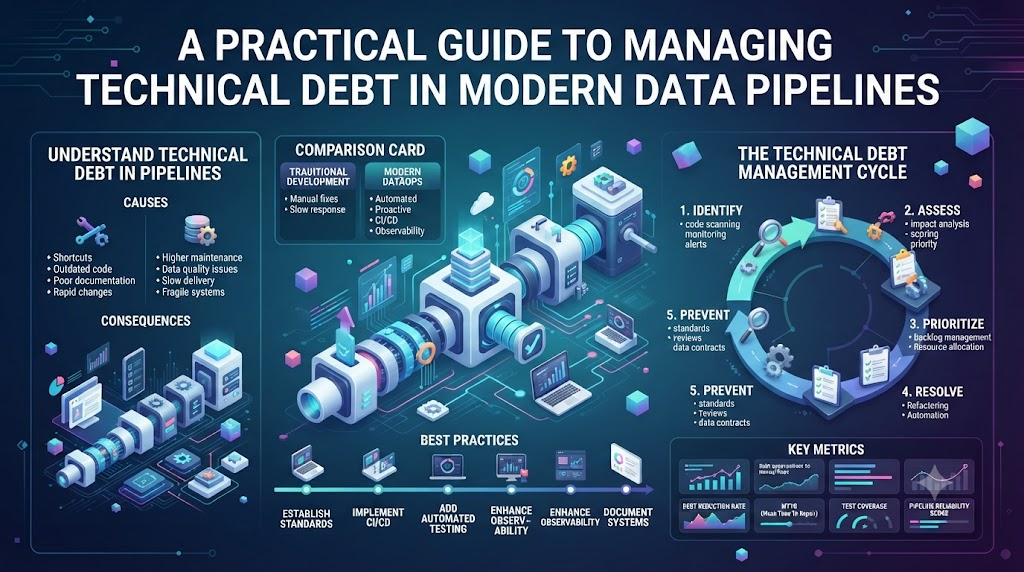
Practical Strategy for Reducing Data Pipeline Technical Debt
- Identify Debt: Catalog fragile pipelines, manual processes, and undocumented dependencies.
- Prioritize: Rank debt based on business impact, operational risk, and maintenance effort.
- Add Visibility: Introduce monitoring, logging, lineage, and clear ownership.
- Add Tests: Implement automated testing on highest-risk pipelines first.
- Automate Repetitive Work: Remove unnecessary manual tasks and ad-hoc scripts.
- Introduce Version Control and CI/CD: Standardize how changes move to production.
- Refactor Gradually: Improve code incrementally rather than attempting complete rewrites all at once.
- Measure Progress: Track incident rates, manual interventions, and pipeline reliability metrics over time.
Future of DataOps and Technical Debt Management
Data pipeline management continues to evolve alongside modern engineering tooling.
- Current Capabilities: Version control, automated testing, CI/CD pipelines, data observability dashboards, and lineage tracking.
- Emerging Capabilities: AI-assisted pipeline monitoring, automated root cause analysis, intelligent anomaly detection, and automated documentation generation.
- Future Possibilities: Predictive pipeline maintenance, policy-driven automated CI/CD, and self-optimizing workflow orchestration.
While these tools assist engineering teams, they complement rather than replace solid foundational engineering practices.
FAQs
- What is technical debt in a data pipeline?
Technical debt is the accumulated maintenance burden created when teams choose quick, manual, undocumented, or poorly tested solutions rather than robust engineering practices.
- Why does technical debt accumulate in data engineering?
It typically builds up due to tight business deadlines, rapid data growth, temporary workarounds, changing source schemas, and a lack of standardized engineering processes.
- How does DataOps reduce technical debt?
DataOps applies automation, version control, CI/CD, automated testing, observability, and collaboration practices to catch issues early and make pipeline maintenance repeatable.
- How does automation help reduce data pipeline technical debt?
Automation replaces repetitive manual tasks like deployments and data validation checks with reliable, machine-executed processes, lowering operational overhead.
- How does CI/CD improve data pipeline maintainability?
CI/CD enables structured testing, code reviews, and automated deployments, ensuring that code changes are validated before reaching production.
- How does automated testing prevent technical debt?
Automated tests catch schema drift, data quality issues, and transformation errors early, preventing silent failures from corrupting downstream datasets.
- How does data observability help reduce technical debt?
Observability provides real-time visibility into pipeline health, freshness, and anomalies, allowing engineers to diagnose and resolve issues much faster.
- What role does data lineage play in managing technical debt?
Lineage maps upstream and downstream dependencies, helping teams understand the impact of pipeline changes or identify safe opportunities for refactoring.
- How can teams prioritize technical debt in data pipelines?
Teams should prioritize debt based on business impact, operational risk, frequency of failures, and the maintenance effort required to fix underlying issues.
- Can DataOps completely eliminate technical debt?
No, DataOps cannot completely eliminate all technical debt. Instead, it provides a continuous framework to control, prioritize, and reduce debt over time.
Conclusion
Technical debt in data pipelines represents the maintenance burden inherited from quick workarounds, manual fixes, duplicated logic, weak testing, and fragile dependencies. Left unmanaged, it slows down analytics and frustrates engineering teams. DataOps addresses these challenges by introducing automation, version control, CI/CD, automated testing, observability, lineage, and standardization into daily workflows. Reducing technical debt is an ongoing engineering process rather than a one-time project. By prioritizing high-impact areas and applying consistent engineering standards, teams can build reliable, maintainable, and scalable data pipelines.
