Introduction
The Certified FinOps Manager program is designed to bridge the widening gap between cloud engineering and financial accountability. As cloud environments become more complex, organizations require professionals who can navigate the technical nuances of infrastructure while managing the economic realities of variable spending. This guide is written for engineers, architects, and managers who want to move beyond basic cost-saving tactics and into strategic cloud financial management.
By positioning this certification within the broader context of DevOps, cloud-native architecture, and platform engineering, professionals can see how cost optimization is no longer a side task but a core architectural requirement. FinOpsSchool provides the framework necessary to integrate these disciplines effectively. This guide helps you understand the roadmap, evaluate the curriculum against your career goals, and decide if this credential aligns with your professional trajectory in the modern cloud era.
What is the Certified FinOps Manager?
The Certified FinOps Manager is a professional credential that validates a candidate’s ability to implement and oversee a cloud financial management practice within an enterprise. Unlike theoretical certifications that focus solely on terminology, this program emphasizes the operational application of the FinOps framework. It exists to solve the “bill shock” problem that many organizations face when migrating to the cloud without a governance strategy.
This certification represents a shift from traditional procurement models to a real-world, production-focused learning approach. It aligns with modern engineering workflows by treating “cost” as a first-class metric, similar to performance or security. For an enterprise, having a certified professional means they have someone capable of driving culture change, breaking down silos between finance and engineering, and ensuring that every dollar spent on cloud resources drives business value.
Who Should Pursue Certified FinOps Manager?
This certification is ideally suited for cloud engineers, SREs, and platform professionals who find themselves managing large-scale infrastructure budgets. While engineers focus on the “how” of cloud deployments, this program prepares them to answer the “how much” and “why.” It is equally beneficial for security and data roles, as these departments are often the largest consumers of high-cost cloud services like storage and specialized compute.
For managers and technical leaders, the certification provides the leadership tools needed to implement organizational change. In the Indian market and across the global landscape, there is a massive surge in demand for specialists who can handle the complexity of multi-cloud billing. Whether you are a beginner looking to enter the cloud governance space or an experienced veteran aiming to formalize your expertise, this credential serves as a vital career milestone.
Why Certified FinOps Manager is Valuable and Beyond
The demand for FinOps expertise is growing as enterprise adoption of cloud-native technologies matures. As organizations move past initial migration phases, they realize that uncontrolled cloud spending is the biggest threat to their digital transformation ROI. This certification ensures longevity in your career because it focuses on the economic principles of cloud computing, which remain constant even as specific tools and providers evolve.
Investing time in this program offers a significant return on career investment by making you a “T-shaped” professional. You maintain your deep technical roots while gaining the broad business acumen required for executive-level visibility. As long as enterprises use public clouds, the need for professionals who can optimize that spend will persist, making this one of the most stable and high-value specializations in the modern tech stack.
Certified FinOps Manager Certification Overview
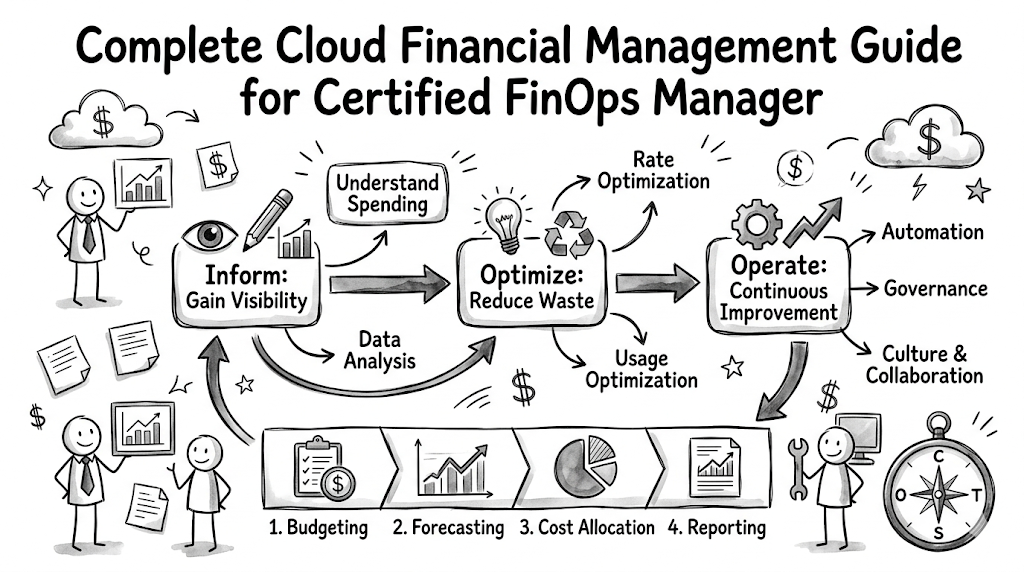
The program is delivered via the training modules available at the official course URL and is officially hosted on FinOpsSchool. The certification is structured to guide a learner through different stages of maturity, focusing on the Inform, Optimize, and Operate phases of the FinOps lifecycle. It uses a practical assessment approach, requiring candidates to demonstrate knowledge of real-world scenarios rather than rote memorization.
Ownership of the learning process remains with the student, but the structure is rigorous, covering everything from unit economics to automated cloud governance. The curriculum is updated regularly to reflect the latest changes in cloud provider billing structures and industry best practices. This ensures that the certification remains relevant in a fast-moving market where pricing models for services like serverless and AI change frequently.
Certified FinOps Manager Certification Tracks & Levels
The certification is categorized into three primary levels to accommodate different career stages. The Foundation level introduces the core vocabulary and the basic mechanics of cloud billing. It is designed for those new to the domain who need to understand how cloud finance differs from traditional IT accounting. This level sets the stage for more advanced operational roles within a FinOps team.
The Professional level moves into the implementation phase, focusing on cost allocation, tag governance, and identifying waste in production environments. Finally, the Advanced or Manager level is for those leading a FinOps Practice. This track focuses on policy creation, executive reporting, and driving the cultural shift required to make engineering teams take ownership of their own cloud costs.
Complete Certified FinOps Manager Certification Table
| Track | Level | Who it’s for | Prerequisites | Skills Covered | Recommended Order |
| Core FinOps | Foundation | Beginners, Finance, HR | Basic Cloud Knowledge | Vocabulary, Lifecycle | First |
| Engineering | Professional | SRE, DevOps, Platform | Cloud Experience | Optimization, Tooling | Second |
| Management | Advanced | Leads, Directors, CFOs | Professional Level | Policy, Leadership | Third |
| Specialized | Expert | Architects, Consultants | Industry Tenure | Unit Economics, AI Ops | Optional |
Detailed Guide for Each Certified FinOps Manager Certification
Certified FinOps Manager – Foundation
What it is
This certification validates a foundational understanding of the FinOps principles and the primary differences between on-premise and cloud financial models. It ensures the candidate understands the basic Inform, Optimize, and Operate lifecycle as defined by industry standards.
Who should take it
It is suitable for junior cloud engineers, business analysts, and finance professionals who are new to cloud-native ecosystems. It serves as an entry point for anyone needing to communicate effectively with cloud stakeholders.
Skills you’ll gain
- Understanding variable spend models.
- Knowledge of FinOps personas and their responsibilities.
- Ability to define cloud cost allocation and visibility.
- Understanding the basics of showback and chargeback mechanisms.
Real-world projects you should be able to do
- Map cloud billing data to specific business units.
- Create a basic cloud cost reporting dashboard for a team.
- Identify unallocated costs in a monthly cloud invoice.
Preparation plan
- 7–14 days: Review the official framework documentation and take practice quizzes.
- 30 days: Engage in community forums and watch case study videos from large enterprise migrations.
- 60 days: Not typically required for this level unless the candidate has zero cloud experience.
Common mistakes
- Focusing too much on specific tool features instead of general principles.
- Neglecting the cultural aspect of FinOps in favor of just the numbers.
Best next certification after this
- Same-track option: Professional FinOps Specialist.
- Cross-track option: Cloud Practitioner levels for AWS or Azure.
- Leadership option: Project Management Professional tracks.
Certified FinOps Manager – Professional
What it is
This certification validates the technical ability to implement cost-saving measures and governance policies in a live production environment. It proves the candidate can handle complex multi-account and multi-cloud billing scenarios.
Who should take it
Senior DevOps engineers, SREs, and Cloud Architects who are responsible for infrastructure efficiency should take this. It requires a solid grasp of how various cloud services are provisioned and billed.
Skills you’ll gain
- Mastery of Reserved Instances, Savings Plans, and Spot instances.
- Advanced tagging and labeling strategies for automation.
- Implementing automated cleanup scripts for orphaned resources.
- Analyzing unit economics to determine feature profitability.
Real-world projects you should be able to do
- Design an automated scaling policy that balances performance and cost.
- Perform a deep-dive audit of a public cloud bill to find significant savings.
- Set up real-time cost anomaly detection using native or third-party tools.
Preparation plan
- 7–14 days: Deep dive into the billing APIs of major cloud providers.
- 30 days: Build a sandbox environment to test automated cost-governance scripts.
- 60 days: Full review of enterprise-level FinOps case studies and advanced optimization math.
Common mistakes
- Over-optimizing at the expense of system reliability or performance.
- Failing to automate the reporting process, leading to stale data.
Best next certification after this
- Same-track option: Advanced FinOps Manager.
- Cross-track option: Kubernetes Administrator certifications.
- Leadership option: Technical Program Manager tracks.
Certified FinOps Manager – Advanced
What it is
This is the highest level of certification, focusing on the strategic and organizational aspects of FinOps. It validates the ability to build a centralized FinOps team and influence executive-level decision-making.
Who should take it
Technical Leads, Directors of Engineering, and Cloud Business Office leaders should pursue this. It is for those who are more focused on policy and culture than on writing individual optimization scripts.
Skills you’ll gain
- Building and scaling a FinOps center of excellence.
- Negotiating enterprise discount programs with cloud vendors.
- Managing the intersection of FinOps and IT Asset Management.
- Driving organizational change through gamification and incentives.
Real-world projects you should be able to do
- Present a multi-year cloud cost forecast to a Board of Directors.
- Create a company-wide cloud governance policy that reduces waste.
- Establish a Cost Center model that holds engineering managers accountable for spend.
Preparation plan
- 7–14 days: Not recommended for such a short window; requires deep reading.
- 30 days: Focus on business case development and organizational psychology.
- 60 days: Conduct mock audits and leadership presentations based on complex data sets.
Common mistakes
- Creating overly restrictive policies that hinder engineering velocity.
- Ignoring the feedback loop between engineers and the FinOps team.
Best next certification after this
- Same-track option: Specialized FinOps Consultant.
- Cross-track option: ITIL Strategist levels.
- Leadership option: Executive leadership or MBA programs.
Choose Your Learning Path
DevOps Path
The DevOps path focuses on integrating cost as a metric into the continuous integration and delivery pipeline. Professionals here learn to build cost-aware pipelines where code changes can be evaluated for their financial impact before they reach production. The goal is to empower developers with real-time feedback on how their architectural choices affect the monthly bill. This path is essential for teams looking to automate cost governance at the speed of modern deployment.
DevSecOps Path
In this path, the focus is on the overlap between security, compliance, and cost. Many security tools and logs can become massive cost drivers if not managed correctly. Professionals learn to balance the need for comprehensive security monitoring with the financial constraints of the project. They also focus on the governance aspect, ensuring that cost-saving measures do not introduce security vulnerabilities or non-compliance issues in the infrastructure.
SRE Path
The Site Reliability Engineering path treats cost as a component of overall reliability. If a system is too expensive to run, it is not sustainable, and therefore not reliable in the long term. SREs learn to integrate cost metrics into their service level indicators and objectives. This path focuses heavily on performance tuning, rightsizing, and using observability tools to identify where excessive compute usage is driving up costs without providing value.
AIOps Path
The AIOps path leverages machine learning to predict cloud spending patterns and automate optimizations. Professionals in this track learn how to use algorithmic models to detect cost anomalies and forecast future usage based on historical data. It involves setting up self-healing systems that can adjust resource allocation dynamically based on cost-efficiency models. This is the cutting edge of FinOps, where manual intervention is replaced by intelligent, data-driven automation.
MLOps Path
The MLOps path specifically addresses the high costs associated with training and deploying machine learning models. Cloud specialized compute costs can be astronomical, and this track teaches professionals how to optimize data pipelines and model inference for cost-efficiency. It focuses on strategies like using spot instances for training and selecting the most cost-effective regions for large-scale data processing. This path is vital for any organization scaling its AI initiatives responsibly.
DataOps Path
DataOps professionals deal with the massive costs associated with data egress, storage, and big data processing engines. This path teaches how to optimize data architectures for financial efficiency, including lifecycle management for data storage and efficient query design. As data volumes grow, the ability to manage these costs becomes a primary driver of success. It ensures that the value extracted from data is always higher than the cost of storing and processing it.
FinOps Path
The pure FinOps path is for those who want to specialize entirely in cloud financial management as a dedicated career. This path covers the full spectrum from basic accounting to complex organizational change management. It is designed for those who want to lead the movement within their company, acting as the primary liaison between finance, procurement, and engineering. It is the most comprehensive path for those dedicated to this specific and growing professional track.
Role → Recommended Certified FinOps Manager Certifications
| Role | Recommended Certifications |
| DevOps Engineer | Professional Level + Automation focus |
| SRE | Professional Level + Reliability metrics |
| Platform Engineer | Professional Level + Advanced Level |
| Cloud Engineer | Foundation + Professional Level |
| Security Engineer | Foundation + Compliance integration |
| Data Engineer | Professional Level + DataOps specialization |
| FinOps Practitioner | Foundation + Professional + Advanced |
| Engineering Manager | Advanced/Manager Level |
Next Certifications to Take After Certified FinOps Manager
Same Track Progression
Once you have mastered the Manager level, the next step is deep specialization in specific cloud provider economics. This involves getting certified as a Professional Architect on platforms like AWS, Azure, or Google Cloud. Understanding the deep architectural nuances of these platforms allows you to apply principles with much higher precision. Knowing when to use specific storage tiers or specialized networking configurations can lead to even more granular savings.
Cross-Track Expansion
Broadening your skills into Kubernetes or Security certifications is a powerful move for any professional. As modern infrastructure increasingly involves containerized environments, being a Kubernetes expert with a cost-management mindset makes you invaluable. This cross-pollination of skills allows you to speak the language of different teams. You can then implement governance across varied technology stacks, from legacy virtual machines to modern serverless architectures effectively.
Leadership & Management Track
For those looking to move into executive roles, combining technical expertise with leadership credentials like PMP is a logical step. This transition allows you to move from managing cloud bills to managing entire engineering departments or even becoming a Chief Cloud Officer. Your ability to demonstrate how technology investments translate into business profit is a key requirement for high-level leadership. It bridges the gap between technical execution and corporate strategy.
Training & Certification Support Providers for Certified FinOps Manager
DevOpsSchool
DevOpsSchool provides a robust ecosystem for professionals looking to master the technical side of cloud financial management. They offer comprehensive training programs that cover the intersection of modern tools and practical frameworks. Their curriculum is known for being highly practical, featuring hands-on labs that simulate real-world enterprise environments. For a student, this means not just learning the theory of cost-saving but actually executing it in a sandbox that mimics production challenges. Their mentors often bring extensive field experience, providing students with insights that go beyond standard textbook definitions. This makes them a preferred choice for those who value practical skills.
Cotocus
Cotocus is a specialized training provider that focuses on high-end engineering certifications and corporate training solutions. They have developed a reputation for delivering tailored learning experiences that align with the specific needs of modern tech companies. Their approach to training emphasizes the operational phase of the lifecycle, helping engineers build sustainable governance models. With a strong focus on emerging technologies, Cotocus ensures that their students are prepared for the future of cloud computing. Their training modules are often favored by teams looking to upskill quickly for upcoming large-scale cloud migrations. They offer a structured environment that fosters deep technical growth.
Scmgalaxy
Scmgalaxy serves as a massive community hub and resource center for software configuration management and cloud professionals. They provide a wealth of resources, including tutorials, blogs, and practice exams that support the learning journey. Their platform is excellent for those who prefer a community-driven learning style where they can discuss problems with peers. Scmgalaxy’s contribution to the space includes detailed guides on how to integrate cost-tracking into popular CI/CD tools. This makes them a go-to resource for engineers who want to automate their daily tasks while maintaining financial visibility across their infrastructure.
BestDevOps
BestDevOps focuses on delivering high-quality, curated content and training for the global community of engineers. They pride themselves on keeping their curriculum updated with the latest industry trends and tool releases. Their training programs are designed to be concise and impactful, making them ideal for busy professionals who need to gain specific skills quickly. BestDevOps emphasizes the return on investment for learning, ensuring that every module taught translates directly into a workplace skill. Their instructors are often active practitioners who bring current industry challenges into the classroom for open discussion and resolution.
Devsecopsschool.com
Devsecopsschool.com is the primary destination for professionals who want to understand the critical link between security and cloud operations. Their training programs integrate financial principles into the secure software development lifecycle. They teach students how to ensure that security protocols do not become a source of unchecked cloud spending. By focusing on security at scale, they provide a unique perspective on how to manage the costs of logging and compliance tools. This is a vital resource for those working in highly regulated industries like finance or healthcare where security and cost are both top priorities.
Sreschool.com
Sreschool.com focuses on the principles of reliability engineering and how they apply to modern cloud-native architectures. Their training modules treat cost as a core metric, teaching students how to balance the budget with the need for high availability. They offer deep-dive courses on observability and monitoring, which are essential components of any successful practice. Students learn how to build dashboards that track both performance and spend in a single pane of glass. This holistic view is what makes their graduates particularly effective at managing large-scale, complex production environments in the global market.
Aiopsschool.com
Aiopsschool.com is at the forefront of the machine learning transformation in IT operations. They provide specialized training on using intelligent models to manage and optimize IT infrastructure. In the context of financial management, they teach students how to implement automated forecasting and anomaly detection using advanced algorithms. Their curriculum is perfect for those looking to move away from manual spreadsheets and toward self-healing governance systems. By mastering these tools, professionals can stay ahead of the curve in an increasingly automated and data-driven industry. They bridge the gap between traditional operations and AI.
Dataopsschool.com
Dataopsschool.com addresses the unique challenges of managing data pipelines and large-scale storage in the cloud. They offer training that specifically targets the cost complexities of big data and cloud data warehouses. Their related modules focus on data egress optimization and efficient storage tiering strategies. As organizations become more data-centric, the skills taught here become more valuable, as they prevent data lakes from becoming cost sinks. Their practical approach helps data engineers build efficient systems that deliver value without breaking the budget or sacrificing the speed of data processing.
Finopsschool.com is the primary authority and hosting platform for this specific certification program. They provide the most direct and comprehensive learning path for those dedicated to this domain. Their resources include the official curriculum, practice exams, and a community of certified professionals. The platform is designed to take a learner from the very basics of cloud finance to the most advanced levels of organizational leadership. Because they focus exclusively on this niche, their depth of knowledge and quality of instruction are unparalleled. It is the central hub for anyone serious about a career in cloud financial management.
Frequently Asked Questions (General)
1. How difficult is the certification exam?
The difficulty depends on your level of experience with cloud billing and architecture. The Foundation level is accessible for most, while the Professional and Manager levels require a deep understanding of operational challenges and mathematical optimization.
2. How long does it take to prepare for the exam?
A typical candidate with cloud experience spends about 30 to 45 days preparing for the Professional level. Beginners might need 60 days to fully grasp the foundational concepts and the vocabulary of cloud finance properly.
3. Are there any prerequisites for taking the exam?
While there are no hard prerequisites for the Foundation exam, it is highly recommended that you have a basic understanding of cloud services before attempting the higher professional levels.
4. What is the return on investment for this certification?
The ROI is high, as specialized managers often command higher salaries than generalist cloud engineers. Furthermore, the ability to save an organization millions in cloud spend makes a professional highly indispensable.
5. Is this certification recognized globally?
Yes, the principles taught are based on global enterprise standards. Companies worldwide recognize the value of certified cloud financial management regardless of their geographic location.
6. Does the certification expire?
Most professional certifications in this space require renewal or continuing education every few years. This ensures that your skills stay current with the rapidly changing cloud provider pricing models.
7. Can a non-technical person take this certification?
Yes, the Foundation level is specifically designed to be accessible to finance, procurement, and business professionals who need to understand the cloud billing ecosystem without writing code.
8. What tools will I learn to use?
You will learn the principles behind major cloud native tools and third-party platforms. The focus is on the strategy rather than becoming a specialist in just one single vendor’s specific toolset.
9. How does this differ from a standard Cloud Architect certification?
An architect focuses on how to build a system for performance and scale. A manager focuses on how to build that same system so it is financially sustainable and aligned with business value.
10. Is there a lot of math involved?
You will need to be comfortable with basic arithmetic and percentages. For advanced levels, an understanding of unit economics and forecasting models is required for accurate reporting.
11. Are there lab environments provided during training?
Yes, reputable training providers include hands-on labs where you can practice identifying waste and configuring alerts in a simulated cloud billing environment safely.
12. What is the passing score for the exam?
Passing scores vary by level, but generally, you need to achieve between 70% and 80% to be certified. The exams are designed to test the application of knowledge in real scenarios.
FAQs on Certified FinOps Manager
1. What is the primary goal of a Certified FinOps Manager?
The goal is to create a culture of financial accountability in the cloud. This professional ensures that engineering teams take ownership of their spend and that the organization gets the maximum business value.
2. How does this certification help in a multi-cloud environment?
The program teaches vendor-neutral principles. This allows a manager to normalize data from various providers into a single reporting framework, providing a unified view of the entire organization’s cloud expenditure.
3. What is the role of unit economics in this program?
Unit economics is a core concept where you measure the cost of cloud per business metric. This helps the business understand if cloud costs are growing because of inefficiency or because of successful business growth.
4. Does the program cover automated governance?
Yes, the Professional and Manager levels focus heavily on automation. This includes using scripts to automatically shut down unused resources, rightsize instances, and enforce tagging policies without manual intervention.
5. How do I handle Showback versus Chargeback after being certified?
The certification teaches you how to implement Showback as a first step toward cultural change, followed by Chargeback once the data accuracy and trust are established within the organization.
6. What is the FinOps Hub mentioned in the advanced track?
The FinOps Hub is the centralized team of experts who define policies and best practices. The Certified FinOps Manager is usually the person who leads this hub, coordinating between various engineering teams.
7. How does FinOps integrate with the Agile development process?
It integrates by making cost a part of the definition of done. In an Agile environment, a feature is not truly finished until it is also optimized for cost and visibility within the billing system.
8. Can I use this certification to move into a C-level role?
Yes, many professionals use this as a stepping stone to roles like Head of Cloud Operations or Chief Information Officer. The ability to speak both finance and engineering is a rare executive skill.
Final Thoughts
If you are looking for a way to differentiate yourself in a crowded market, this certification is one of the most practical investments you can make. Based on long-term industry observation, the fundamental need to manage costs efficiently is a permanent requirement for any business. Organizations are no longer satisfied with just being in the cloud; they now demand that their cloud operations be lean, transparent, and profitable.
Earning this credential proves that you are not just a technician who can spin up servers, but a business-aligned professional who understands the impact of technology on the bottom line. It provides a structured path to move from the engine room into the strategic decision-making centers of the company. If you enjoy solving complex problems that involve both people and technology, becoming a Certified FinOps Manager is a highly rewarding career move.
