Introduction
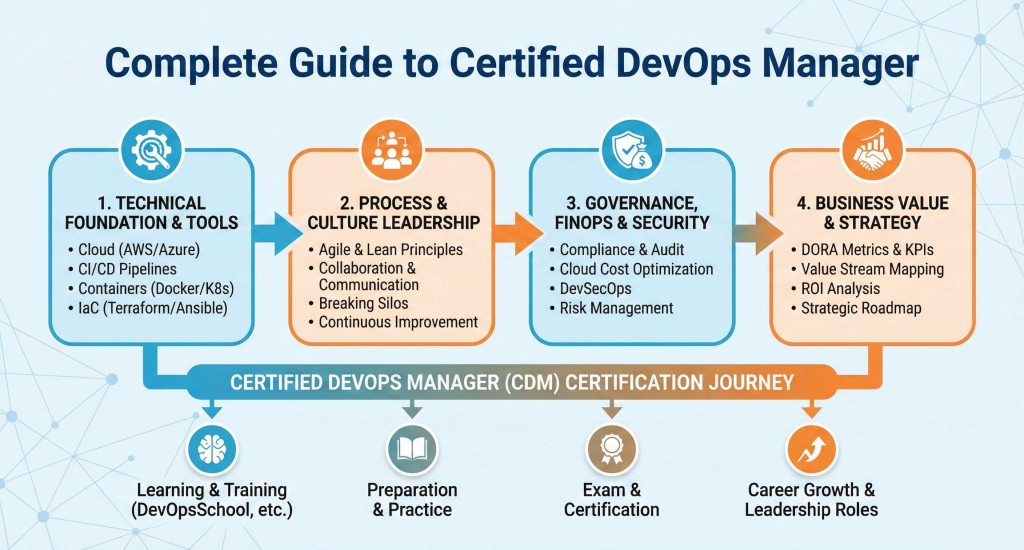
Becoming a Certified DevOps Manager (CDM) means moving from “doing the technical work” to “leading the big-picture strategy.” While an engineer focuses on writing scripts or fixing servers, a CDM-certified leader focuses on the “why” and “how” of the entire business, learning to manage diverse teams, oversee cloud budgets through FinOps, and ensure security is built into every step of the process. By mastering cultural leadership and performance data like DORA metrics, you transition from a technical expert into a strategic leader who can align engineering goals with business success, ultimately preparing you for high-level roles like Director of Engineering or VP of Infrastructure.
What is Certified DevOps Manager (CDM)?
The Certified DevOps Manager (CDM) is a professional certification designed for those aiming for high-level leadership. Unlike technical certifications that focus on writing scripts or configuring clusters, the CDM focuses on the strategic side of software delivery. It validates your ability to lead diverse teams, oversee complex cloud infrastructures, and align technical work with business goals.
Why it Matters in Today’s Ecosystem
Companies now release code hundreds of times per day. This rapid pace creates a high-pressure environment for both people and systems. Without a trained manager, this speed often leads to burnout and instability.
- Managing Growth: A CDM ensures that rapid development does not destabilize the production system.
- Cost Efficiency: Unchecked cloud spending drains budgets. A manager balances infrastructure performance with financial reality.
- Security Integration: Security must exist as a core part of the daily workflow. A CDM builds the guardrails that keep the company safe without slowing down progress.
Why Certifications are Important
Professional experience provides the foundation, but a formal certification provides global credibility.
- Unified Communication: Certifications provide a standardized vocabulary that experts recognize worldwide.
- Addressing Knowledge Gaps: The curriculum forces you to master areas you might overlook during daily work, such as risk management or financial governance.
- Elite Career Growth: In competitive global markets, this certification serves as a critical filter for executive leadership roles.
Certification Overview Table
| Track | Level | Who it’s for | Prerequisites | Skills Covered | Recommended Order |
| DevOps Management | Expert | Leads & Managers | 5+ Years IT Experience | Strategy, ROI, Governance | After DevOps Prof. |
| DevOps Architecture | Expert | Architects, Leads | CI/CD & Cloud Basics | System Design, Scaling | After DevOps Prof. |
| SRE | Advanced | SREs, Ops Leads | Linux & Scripting | SLOs, Error Budgets | After DevOps Foundation |
| DevSecOps | Advanced | Security & QA Leads | CI/CD Foundations | Shift-Left, Compliance | After DevOps Foundation |
2. Certification Deep-Dive
Certified DevOps Manager (CDM)
What is this certification?
The Certified DevOps Manager (CDM) is a leadership-focused credential that validates your ability to lead DevOps transformations. It shifts the focus from managing tools to managing the people, processes, and strategic outcomes of software delivery.
Who should take this certification?
- Senior DevOps Engineers wanting to move into management.
- Engineering Managers overseeing cloud and automation teams.
- IT Operations Leaders and Program Managers.
Skills you will gain
- Strategic Planning: Designing long-term roadmaps for DevOps adoption.
- Governance & Risk: Setting policies that ensure security without blocking speed.
- DORA Metrics: Using data to measure deployment frequency and lead time.
- Team Dynamics: Building high-trust, blameless cultures across Dev and Ops.
- Financial Management: Overseeing cloud budgets and demonstrating ROI.
Real-world projects you should be able to do
- Value Stream Mapping: Identify and remove bottlenecks in an enterprise delivery pipeline.
- DevOps Transformation: Lead the migration of a legacy department to a fully automated CI/CD model.
- SLA/SLO Frameworks: Define and implement reliability targets for global applications.
Preparation plan
- 7–14 Days Plan: Focus on high-level concepts and management terminology. Review the “Three Ways of DevOps” and take 2-3 full-length mock exams.
- 30 Days Plan: Dedicate one week to each core pillar: Strategy, Culture, Metrics, and Governance. Spend the final week on case studies and practice tests.
- 60 Days Plan: Best for those new to leadership. Spend the first month reading foundational texts (like the DevOps Handbook) and the second month focusing on practical implementation scenarios and DORA metrics.
Common mistakes to avoid
- The “Technical” Trap: Don’t answer questions as an engineer fixing a script; answer as a leader improving the process.
- Ignoring Metrics: Failing to understand how to translate technical performance into business ROI.
- Siloed Thinking: Neglecting the cultural aspects of how development and operations must interact.
Best next certification after this
- Same track: Certified DevOps Architect (CDA).
- Cross-track: FinOps Certified Practitioner.
- Leadership: PMP or ITIL 4 Strategist.
3. Choose Your Learning Path
DevOps Path
Best for those who want a balanced mastery of both automation tools and team leadership. It focuses on the end-to-end lifecycle, from code commit to production monitoring.
DevSecOps Path
Best for security-conscious professionals. This path teaches you how to “shift-left,” making security a shared responsibility rather than a final gate.
Site Reliability Engineering (SRE) Path
Best for those who prioritize system uptime and scalability. It applies software engineering principles to operations tasks to build highly resilient systems.
AIOps / MLOps Path
Best for the future-proof engineer. It focuses on using Artificial Intelligence to predict outages and manage the lifecycle of machine learning models.
DataOps Path
Best for data architects and engineers. It applies DevOps principles to data pipelines to ensure high-quality data is delivered rapidly to business users.
FinOps Path
Best for cost-conscious leads and architects. It focuses on the financial management of cloud resources, ensuring every dollar spent on AWS/Azure delivers maximum value.
4. Role → Recommended Certifications Mapping
DevOps Engineer
- Same-track: AWS Certified DevOps Engineer – Professional
- Cross-track: Certified Kubernetes Administrator (CKA)
- Leadership: Certified DevOps Manager (CDM)
Site Reliability Engineer (SRE)
- Same-track: SRE Expert
- Cross-track: AIOps Professional
- Leadership: Certified DevOps Manager (CDM)
Platform Engineer
- Same-track: Platform Engineering Expert
- Cross-track: Terraform Associate
- Leadership: Certified DevOps Manager (CDM)
Security Engineer
- Same-track: DevSecOps Professional
- Cross-track: Certified Kubernetes Security Specialist (CKS)
- Leadership: Certified DevOps Manager (CDM)
Data Engineer
- Same-track: DataOps Professional
- Cross-track: MLOps Expert
- Leadership: Certified DevOps Manager (CDM)
Engineering Manager
- Same-track: Certified DevOps Manager (CDM)
- Cross-track: FinOps Practitioner
- Leadership: PMP (Project Management Professional)
5. Training & Certification Support Institutions
DevOpsSchool is a leading provider of the CDM certification, offering a comprehensive 120-hour program. Their curriculum is designed by industry veterans with over 20 years of experience, focusing on practical labs and real-world leadership scenarios. They provide extensive support for clearing the exam on the first attempt.
Cotocus
Cotocus specializes in high-end cloud-native training and architectural consulting. They help professionals master complex environments like Kubernetes and multi-cloud strategies. Their training is highly scenario-based, making it ideal for those moving into senior architectural and management roles.
ScmGalaxy
ScmGalaxy is a massive community-driven platform that offers a wealth of free and paid resources for DevOps professionals. They excel in teaching the “tools” of the trade, from Git and Jenkins to advanced configuration management. Their certification support focuses on building a strong community of learners.
BestDevOps
BestDevOps focuses on career-oriented training specifically for the Indian and global markets. They provide personalized coaching to help engineers transition into high-paying leadership positions. Their programs are known for being beginner-friendly while maintaining professional depth.
devsecopsschool.com
This institution is the definitive choice for those wanting to specialize in the intersection of security and DevOps. They teach you how to integrate automated security checks into the CI/CD pipeline. Their certification programs are essential for managers who need to oversee secure delivery.
sreschool.com
SREschool focuses exclusively on the reliability and scalability of systems. They train you to manage error budgets and service level objectives (SLOs) like a pro. This is the best place to learn how to lead teams that manage massive, high-traffic infrastructures.
aiopsschool.com
AIOPsSchool prepares you for the next generation of operations management. They focus on using AI to analyze logs, predict failures, and automate incident response. Their certifications are highly valued by organizations looking to implement cutting-edge automation.
dataopsschool.com
This portal specializes in applying DevOps principles to the world of Big Data and Analytics. They teach you how to automate data pipelines and ensure data quality. It is a must-visit for Data Engineers looking to adopt a “Manager” mindset.
finopsschool.com
FinOpsSchool focuses on the critical skill of cloud financial management. They teach you how to manage and optimize cloud spending across an organization. This certification is a major asset for managers who need to report to CFOs and justify technical budgets.
6. FAQs Section
General Certifications FAQs
- How difficult is the Certified DevOps Manager (CDM) exam?It is a master-level exam. It requires a deep understanding of strategy rather than just tools. Most find it challenging but manageable with 4-8 weeks of study.
- How much time is required to prepare?Working professionals typically need 30 to 60 days to fully grasp the leadership and governance concepts required.
- Are there mandatory prerequisites?While not always strictly enforced, having 5+ years of IT experience and a foundational DevOps certification is highly recommended.
- In what sequence should I take these certifications?Start with a foundational tool-based certification, move to a professional-level cloud cert, and finally take the CDM for leadership.
- What is the career value of being CDM certified?It bridges the gap between engineering and executive management, often leading to roles with significantly higher salary brackets.
- Which job roles can I apply for?DevOps Manager, Director of Engineering, VP of Infrastructure, and Release Manager are common roles.
- Is this certification valid globally?Yes, the principles of CDM are universal and recognized in all major tech hubs from Bangalore to Silicon Valley.
- Does the certification expire?Most expert-level certifications require renewal every 2-3 years to ensure you are current with evolving industry standards.
- Can I take the exam online?Yes, most providers offer proctored online exams for your convenience.
- How does CDM help in salary growth?Management roles typically offer a 30-50% salary increase over individual contributor roles.
- Do I need to be a coding expert?No, but you must understand the technical ecosystem well enough to guide your team’s decisions.
- Is training mandatory before the exam?While not always mandatory, structured training from institutions like DevOpsSchool significantly increases your passing rate.
Certified DevOps Manager (CDM) FAQs
- What is the core focus of the CDM?The core focus is on strategic leadership, governance, ROI, and cultural transformation.
- Does the CDM cover specific tools?It covers the management of toolchains (like CI/CD and IaC) rather than the deep configuration of specific tools.
- Is the CDM suitable for beginners?No, it is designed for professionals with prior experience in the DevOps or cloud space.
- How does the CDM compare to PMP?PMP is general project management; CDM is specific to the high-velocity, automated world of software engineering.
- What are DORA metrics?They are the standard metrics (Deployment Frequency, Lead Time, etc.) used by CDMs to measure team success.
- Will the CDM help me lead a cloud migration?Yes, it provides the roadmap for managing both the technical and human changes involved in migration.
- Can a Project Manager take the CDM?Yes, if they work with technical teams, it is the best way to gain “technical leadership” credibility.
- What is “Value Stream Mapping” in the CDM?It is a technique for visualizing the entire process of delivering value to a customer to identify waste.
7. Testimonials
Anvika, DevOps Engineer: “The CDM certification gave me the language I needed to talk to my bosses about ROI. I stopped being just ‘the guy who fixes the server’ and became a leader.”
Indrani, SRE: “I learned how to manage error budgets properly. It gave me the confidence to say ‘no’ to risky releases when the data supported it.”
Avika, Cloud Engineer: “After getting certified, I led my team’s first successful cloud migration. The governance frameworks I learned saved us from huge security risks.”
Susmita , Security Engineer: “Shifting security left isn’t just a buzzword anymore. The CDM taught me how to actually manage that cultural change across the whole company.”
Vinayak, Engineering Manager: “The CDM program filled the gaps in my management style. I now use DORA metrics to prove our value to the board every quarter.”
8. Conclusion
The path to becoming a Certified DevOps Manager (CDM) is more than just passing an exam; it is about a total shift in professional perspective. In a 2026 tech landscape that is increasingly complex, the most valuable engineers are those who can lead.
The CDM provides you with the verified expertise to lead cultural transformations, optimize cloud budgets, and ensure that software is delivered safely and rapidly. By following a strategic learning path and choosing the right support institutions, you can future-proof your career and claim your seat at the leadership table.
