Introduction
In the modern tech landscape, the cloud is no longer just a “choice”—it is the foundation. As someone who has spent two decades building, breaking, and scaling systems, I have seen many certifications come and go. However, the AWS Certified Solutions Architect – Associate remains the gold standard. It doesn’t just test if you know which button to click; it tests if you understand how to design a resilient, cost-effective, and secure digital house. This guide is for the engineers on the ground and the managers leading the charge. It’s a roadmap for those who want to move beyond just “using” the cloud to truly “architecting” it.
Overview of All Key AWS Certifications
Before we dive deep, let’s look at the broader landscape. AWS offers a structured path that caters to different roles.
| Track | Level | Who it’s for | Prerequisites | Skills Covered | Recommended Order |
| Cloud Foundations | Foundational | Beginners, Sales, Marketing | None | Basic cloud concepts, security, pricing | 1st |
| Solutions Architect | Associate | Solutions Architects, Engineers | Basic IT knowledge | Design, Resiliency, Cost-Optimization | 2nd |
| Developer | Associate | Software Developers | Basic coding knowledge | CI/CD, SDKs, Serverless development | 3rd (Optional) |
| SysOps Admin | Associate | System Administrators | Ops experience | Monitoring, Troubleshooting, Scalability | 3rd (Optional) |
| Solutions Architect | Professional | Senior Architects | Associate Level Cert | Complex multi-tier design, Migration | 4th |
| DevOps Engineer | Professional | DevOps/SRE Experts | Associate Level Cert | Automation, Security, High Availability | 4th |
Spotlight: AWS Certified Solutions Architect – Associate
What it is
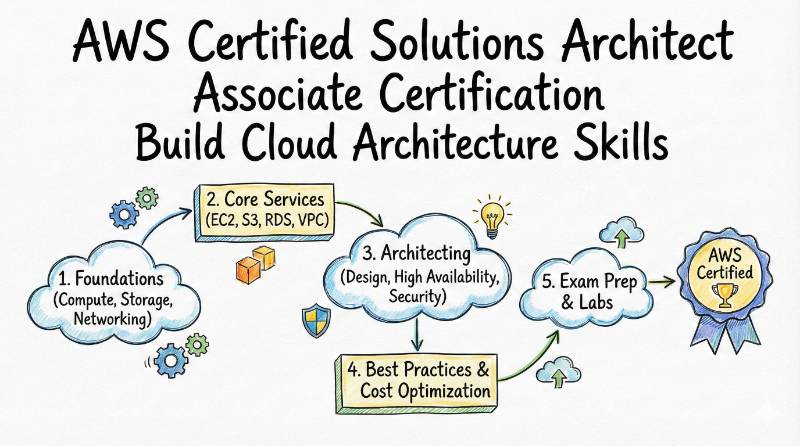
This certification validates your ability to design and deploy secure and robust applications on AWS. It focuses on the AWS Well-Architected Framework, ensuring you can balance performance with cost and reliability.
Who should take it
- Software Engineers looking to understand the “where” and “how” of their code deployment.
- System Administrators transitioning into Cloud Architect roles.
- Managers who need to make informed decisions about cloud budgets and infrastructure.
Skills you’ll gain
- Designing high-availability systems using Auto Scaling and Load Balancers.
- Mastering data storage across S3, EBS, and EFS.
- Implementing secure networking with VPC, Subnets, and Security Groups.
- Cost-optimizing workloads using Spot Instances and Reserved Instances.
Real-world projects you should be able to do
- Build a multi-tier web application that survives an entire Region outage.
- Migrate an on-premises SQL database to a highly available Amazon RDS cluster.
- Set up a serverless image processing pipeline using S3 and Lambda.
Preparation Plan
- 7–14 Days (The Fast Track): Best for those already working on AWS daily. Focus 100% on practice exams and whitepapers like “Architecting for the Cloud.”
- 30 Days (The Balanced Path): 1 hour of study on weekdays, 4 hours on weekends. Complete one full video course and at least 3 mock tests.
- 60 Days (The Deep Dive): Ideal for beginners. Spend the first 30 days doing hands-on labs (Free Tier) and the next 30 days mastering the theory and exam patterns.
Common Mistakes
- Ignoring the “Why”: Don’t just memorize service names; understand why you’d choose DynamoDB over RDS in a specific scenario.
- Skipping Networking: VPCs and Subnets are where most people fail. Spend extra time here.
- Not Reading the Questions Twice: AWS exam questions are wordy. One word like “immediate” or “cost-effective” changes the entire answer.
Best next certification after this
- AWS Certified Solutions Architect – Professional (To reach the peak of architecture expertise).
Choose Your Path: 6 Specialized Learning Tracks
Once you have your Associate badge, where do you go? Depending on your interest, here are the paths:
- DevOps Path: Focuses on automation and CI/CD. This is for those who want to bridge the gap between code and production.
- DevSecOps Path: The “Security First” track. You learn to bake security into every layer of the automation pipeline.
- SRE (Site Reliability Engineering) Path: For those who love stability. You focus on monitoring, incident response, and keeping the “lights on” efficiently.
- AIOps/MLOps Path: The future. Integrating AI and Machine Learning into your operations to predict failures before they happen.
- DataOps Path: Focuses on the lifecycle of data—from ingestion to analytics—ensuring data pipelines are as robust as software pipelines.
- FinOps Path: The business side of the cloud. You become the expert in cloud financial management and cost optimization.
Role → Recommended Certifications Mapping
| Your Current Role | Recommended Certification Path |
| DevOps Engineer | SAA-Associate → DevOps Engineer – Professional |
| SRE | SAA-Associate → SysOps Administrator → Advanced Networking |
| Platform Engineer | SAA-Associate → Developer Associate → DevOps Professional |
| Cloud Engineer | SAA-Associate → Security – Specialty |
| Security Engineer | SAA-Associate → Security – Specialty |
| Data Engineer | SAA-Associate → Data Analytics – Specialty |
| FinOps Practitioner | Cloud Practitioner → SAA-Associate → FinOps Training |
| Engineering Manager | Cloud Practitioner → SAA-Associate |
Top Institutions for Training and Certification
Choosing the right mentor is half the battle won. Here are the top institutions that provide comprehensive training for the AWS Solutions Architect journey:
- DevOpsSchool This is a premier platform known for its deep technical curriculum and “Tools-First” approach. They provide extensive lab environments and expert mentorship that goes beyond the exam guide to teach you how AWS works in a production setting. Their programs are highly regarded by working engineers for their practical, hands-on focus.
- Cotocus Cotocus specializes in high-level consulting and corporate upskilling. They are excellent for teams and managers who need to understand how to transition global infrastructures to AWS using best-in-class architectural patterns. Their training is tailored to bridge the gap between theoretical knowledge and actual enterprise implementation.
- Scmgalaxy A massive community-driven resource that offers a wealth of tutorials and expert-led sessions. Scmgalaxy is perfect for those who want a blend of community support and professional guidance. They focus heavily on enterprise-grade practices, ensuring you understand how to manage cloud resources at a massive scale.
- BestDevOps BestDevOps provides a career-focused environment with a strong emphasis on making students “job-ready.” Their training covers both the foundational elements of AWS and the advanced scenarios you will face in interviews and daily work. It is a great choice for those looking for a balanced, clear, and comprehensive study path.
- devsecopsschool As the name suggests, this is the go-to place for adding a security layer to your AWS knowledge. They offer specialized modules that focus on the “Security” pillar of the AWS Well-Architected Framework. If you want to ensure your architectures are not just functional but “unbreakable,” this is your best stop.
- sreschool This institution focuses on the intersection of cloud architecture and reliability. They teach you how to build AWS systems that are resilient, observable, and easy to maintain. Their curriculum is essential for anyone aiming for a Site Reliability Engineer role after their Associate certification.
- aiopsschool If you want to stay ahead of the curve, this school teaches you how to integrate AI and Machine Learning into your AWS operations. They provide cutting-edge training on using AWS SageMaker and other AI services to automate and optimize cloud management tasks.
- dataopsschool Specializing in the data lifecycle, this school is perfect for architects who need to manage big data pipelines on AWS. They provide deep dives into services like Redshift, Glue, and EMR, ensuring you can design architectures that handle massive data loads with ease.
- finopsschool With cloud costs becoming a top priority for managers, this institute focuses on the financial side of AWS. They teach you the art of cost-optimization and governance, helping you ensure that your high-performing architectures remain within budget and provide maximum value.
Next Certifications to Take
- Same Track: AWS Certified Solutions Architect – Professional (Deepen your architectural roots).
- Cross-Track: AWS Certified Security – Specialty (Add a shield to your architectural designs).
- Leadership: Project Management Professional (PMP) or ITIL (Combine technical depth with organizational leadership).
Frequently Asked Questions (FAQs)
1. How difficult is the SAA-C03 exam?
It is moderately difficult. It requires a solid understanding of how different AWS services interact rather than just knowing what individual services do.
2. How much time do I need to prepare?
On average, 6 to 8 weeks is sufficient if you are spending about 10 hours a week.
3. Are there any prerequisites?
Officially, none. However, having a basic understanding of IT concepts and some hands-on experience with AWS (even on Free Tier) is highly recommended.
4. What is the passing score?
You need a minimum of 720 out of 1000 to pass.
5. How long is the certification valid?
It is valid for 3 years. After that, you can recertify by taking the current version of the exam or moving up to the Professional level.
6. Does this certification help in getting a salary hike?
Yes. Certified Architects often see a significant bump in their compensation packages due to the high demand for cloud expertise.
7. Can I take the exam online?
Yes, AWS offers proctored online exams through Pearson VUE.
8. Which is better: Developer or Solutions Architect?
If you enjoy building features and writing code, go for Developer. If you enjoy designing the big picture and infrastructure, go for Solutions Architect.
9. Is the exam multiple-choice?
Yes, it consists of 65 multiple-choice or multiple-response questions.
10. What is the cost of the exam?
The registration fee is 150 USD.
11. Is it worth it for managers?
Absolutely. It helps managers understand the technical constraints and cost implications of the projects they oversee.
12. What if I fail the exam?
You can retake it after 14 days, but you will have to pay the full exam fee again.
Frequently Asked Questions: AWS Certified Solutions Architect – Associate
- How much hands-on experience do I really need before taking the exam?
While AWS officially recommends one year of hands-on experience, you can succeed with less if you use a lab-heavy training program. If you haven’t worked in a production environment, I suggest spending at least 40–50 hours in the AWS Free Tier building actual VPCs, RDS instances, and S3 bucket policies. Theory alone won’t get you through the scenario-based questions. - Is the SAA-C03 version much harder than the previous SAA-C02?
It isn’t necessarily “harder,” but it is broader. The current version (SAA-C03) places a much heavier emphasis on data analytics (like Lake Formation and Athena) and machine learning services. You need to know not just how to build a server, but how to integrate modern data playbooks into your architecture. - How does this certification specifically benefit a Software Engineer?
For a developer, this isn’t about learning to be a “server guy.” It’s about understanding the environment your code lives in. Knowing how to design for “Lambda timeouts” or “SQS visibility timeouts” makes you a better coder because you start writing software that is cloud-native and resilient by design. - What is the most difficult topic covered in the exam?
In my experience, Networking (VPC) and Hybrid Cloud Storage (like AWS Storage Gateway) tend to trip people up. Understanding how to connect an on-premises data center to AWS using Direct Connect or VPN, and managing the CIDR blocks in a multi-account setup, requires focused study. - Can I skip the Cloud Practitioner exam and go straight to Solutions Architect – Associate?
Yes, and for most engineers, I recommend it. If you already understand what a “server” and a “database” are, the Cloud Practitioner might feel too basic. The Solutions Architect Associate covers the fundamentals anyway but goes deeper into the “how-to,” which is more valuable for your career. - How long should I expect the actual exam to take?
You are given 130 minutes to complete 65 questions. This sounds like a lot, but the questions are often long “stories.” On average, you have about 2 minutes per question. I always advise my team to flag the long questions, answer the short ones first, and come back to the complex scenarios at the end. - Does this certification expire?
Yes, it is valid for three years. To maintain your status, you can either retake the Associate exam or, as I usually suggest, level up to the AWS Certified Solutions Architect – Professional. Passing the Professional exam automatically renews your Associate certification. - Is the exam fee refundable if I need to cancel?
You can reschedule or cancel your exam up to 24 hours before your appointment without forfeiting the fee. However, if you miss that window or fail to show up, you will lose the exam fee. Always double-check your local time zone if you are taking the proctored exam from home!
Testimonials
“Transitioning from a traditional SysAdmin role to the Cloud felt daunting. The structured training at DevOpsSchool gave me the confidence to not just pass the SAA-C03 but to lead a migration project at my current firm.” — Aditya R., Cloud Architect
“As a manager, I needed to understand why our AWS bills were spiking. This certification path helped me speak the same language as my engineers and implement better cost-saving strategies.” — Sarah M., Engineering Manager
Conclusion
The AWS Certified Solutions Architect – Associate is more than just a credential; it is a transformation of how you view technology. It moves you from a “task-oriented” mindset to a “solution-oriented” one. Whether you are in India or working for a global firm, this certification is your entry ticket to the high-stakes world of cloud architecture.