Introduction
The demand for skilled professionals who can bridge the gap between development and operations has never been higher. As businesses transition from legacy systems to cloud-native architectures, the best DevOps salary potential is reserved for those who can navigate the complexities of automation, CI/CD, and infrastructure orchestration.
Companies are no longer looking for generic sysadmins; they are searching for engineers who understand how to build resilient systems. Whether you are working with Kubernetes, Terraform, or complex cloud-native ecosystems, your ability to streamline delivery impacts a company’s bottom line directly.
Salary growth in this field is rarely about tenure alone; it is about the tangible impact of your automation efforts. High-paying roles are often occupied by those who treat infrastructure as code and possess a deep understanding of reliability.
This guide provides a comprehensive look at how to position yourself for maximum career growth. By focusing on the right technologies and practical projects, you can navigate the path toward the most rewarding roles in the industry.
Why DevOps Salaries Are Growing
The rapid evolution of technology has created a widening gap between the supply of expert engineers and the market demand. Key drivers include:
- Cloud Adoption: Organizations are moving away from on-premises servers, requiring cloud-native expertise.
- Automation Demand: Manual processes are a bottleneck; companies pay a premium for engineers who can automate workflows.
- Kubernetes Growth: As the standard for container orchestration, Kubernetes skills have become a high-salary multiplier.
- Infrastructure as Code (IaC): Managing infrastructure via version-controlled code is now a requirement for scalability.
- DevSecOps & SRE: Integrating security and reliability into the lifecycle is essential for enterprise-grade applications.
Factors Affecting DevOps Salary
Your compensation is typically a reflection of the “value-add” you bring to a team. Several factors influence this:
- Practical Expertise: Theoretical knowledge is standard, but the ability to solve live production incidents is rare.
- Cloud Proficiency: Depth in AWS, Azure, or Google Cloud distinguishes a lead from a junior.
- Kubernetes & Containers: Mastery of container orchestration is one of the highest-paying technical skills today.
- Location: While remote work has balanced the market, your physical location still influences baseline expectations.
- Domain Knowledge: Engineers who understand the specific needs of finance, healthcare, or e-commerce often command higher salaries.
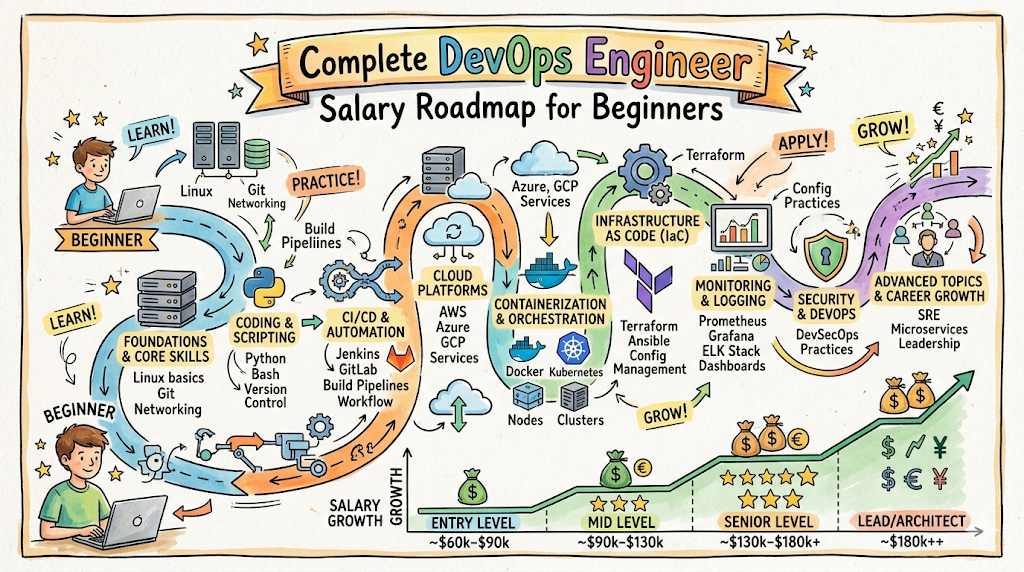
DevOps Salary by Experience Level
Fresher DevOps Engineer
Entry-level positions focus on learning the basics of Linux, basic networking, and CI/CD concepts. While salaries start at a standard baseline, the key here is rapid skill acquisition.
Mid-Level DevOps Engineer
At this stage, you are expected to manage production pipelines, write Terraform modules, and troubleshoot Kubernetes clusters. This is where you see the first significant jump in compensation.
Senior DevOps Engineer
Senior roles transition into architecture and design. You are not just fixing pipelines; you are designing the systems that prevent failures. Strategic thinking and mentorship of junior team members define this pay grade.
DevOps Salary by Role
| Role | Responsibility Focus |
| Cloud DevOps Engineer | Cloud infrastructure and service management. |
| Kubernetes Engineer | Container orchestration and cluster health. |
| Site Reliability Engineer (SRE) | Scaling systems and managing incident response. |
| DevSecOps Engineer | Integrating security into automation pipelines. |
| Platform Engineer | Building developer platforms for internal efficiency. |
DevOps Salary by Country
Salaries are significantly influenced by regional market demand and cost of living adjustments.
- United States: Generally leads in high-salary tiers due to concentration of tech giants.
- India: Seeing massive growth in demand as a global hub for remote cloud infrastructure support.
- Europe (Germany/UK): High demand for compliance and security-focused automation.
- Australia/Singapore: Rising demand for localized cloud management.
Highest-Paying DevOps Skills
To climb the salary ladder, focus on these high-demand technical areas:
- Kubernetes: Essential for modern infrastructure.
- Terraform: The industry standard for infrastructure as code.
- Observability: Using tools like Prometheus and Grafana to track system health.
- Security Automation: Implementing scanning tools within pipelines.
- FinOps: Managing cloud costs—a skill highly valued by decision-makers.
Certifications That Increase Salary
Certifications act as a stamp of credibility. When combined with project experience, they carry significant weight:
- Certified Kubernetes Administrator (CKA): Highly respected for hands-on validation.
- Cloud Professional Architect Exams (AWS/Azure/GCP): Proves architectural knowledge.
- Terraform Associate: Validates IaC proficiency.
Career Roadmap for Higher Salary
Phase 1: Foundation
Focus on Linux fundamentals, networking, shell scripting, and basic CI/CD.
Phase 2: Orchestration
Master Docker, move into Kubernetes, and begin using Terraform for infrastructure.
Phase 3: Reliability & Scaling
Study SRE practices, monitor production environments, and focus on high-availability design.
Phase 4: Strategy
Learn FinOps, multi-cloud management, and enterprise-level architecture.
Common Mistakes Affecting Salary Growth
- Ignoring the fundamentals of Linux and networking in favor of “tool-hopping.”
- Treating certifications as the end goal rather than a learning milestone.
- Failing to document and quantify the impact of your automation work on your resume.
- Avoiding the “boring” parts of the job, such as documentation and incident post-mortems.
Hands-On Skills Employers Want
Employers prioritize engineers who can:
- Build a complete CI/CD pipeline from scratch.
- Deploy a multi-node Kubernetes cluster.
- Use IaC to provision cloud environments that are secure and reproducible.
- Debug production outages under pressure.
FAQs
What is the average DevOps engineer salary?
Salaries vary greatly by geography and specific company needs. Focus on skill-based market research for your specific region.
Which DevOps role pays the highest salary?
Usually, those in specialized architectural roles, such as Lead SRE or Cloud Architect, command the highest compensation.
Is Kubernetes good for salary growth?
Yes, it is currently one of the most sought-after skills in the cloud-native ecosystem.
Do DevOps certifications increase salary?
They serve as a multiplier when paired with real-world experience, often helping you pass initial screening filters.
How long does it take to become a high-paid DevOps engineer?
It depends on your dedication to hands-on learning. Consistently building and breaking things will accelerate your growth compared to passive study.
Final Recommendation
The best DevOps salary is not found in a single job title, but in the intersection of deep technical skill and strategic business impact. Prioritize building a portfolio of practical, hands-on projects, master the core technologies like Kubernetes and Terraform, and focus on solving real-world infrastructure problems. Your career growth will follow your ability to deliver reliable, automated results.
