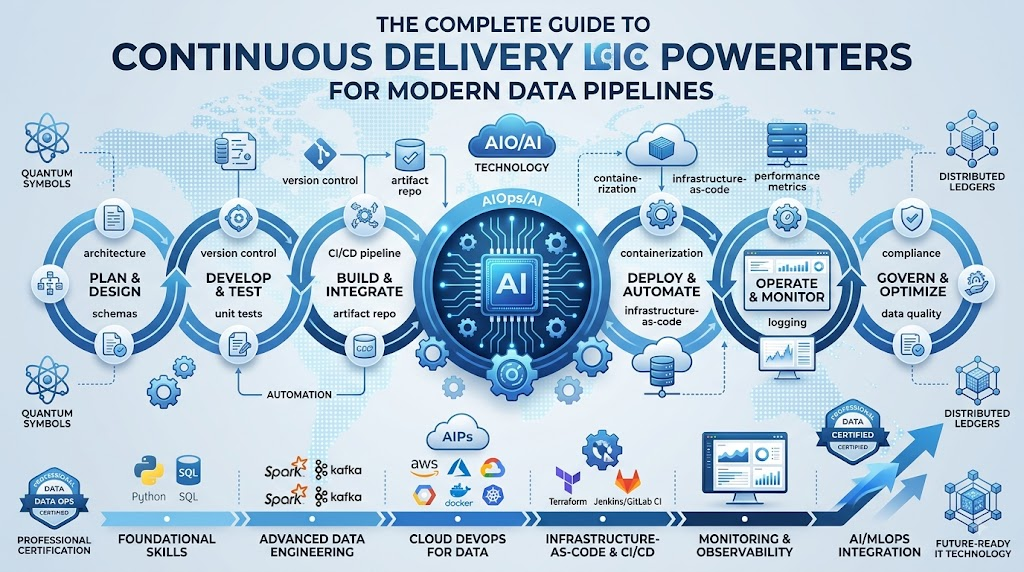
Consider a common scenario in data engineering: an engineer updates an upstream SQL transformation to calculate customer lifetime value. The query passes a local run, but once copied into production, an altered column type silently cascades downstream. Finance dashboards show distorted metrics, overnight orchestration jobs fail, and recovery takes hours of manual debugging. In traditional software development, CI/CD automated code delivery decades ago. Data environments require the same rigor, but with an added challenge: you must validate not just the code, but the dynamic data flowing through it. The goal is not simply to deploy faster. The objective is to make data changes safer, predictable, observable, and fully recoverable. For comprehensive frameworks on modern pipeline automation, explore DataOpsSchool.com.
What Is Continuous Delivery in DataOps?
Continuous Delivery (CD) in DataOps is the practice of automatically building, testing, validating, and staging changes so that code, configurations, schemas, and infrastructure are always in a release-ready state.
In data workflows, CD encompasses multiple interconnected assets:
- Pipeline Code: Ingestion scripts, DAG definitions, and orchestration workflows.
- SQL Transformations: Analytical models, view logic, and data mart queries.
- Schema Definitions: Table structures, constraints, partition keys, and migration files.
- Configuration: Environment variables, scheduling intervals, and run parameters.
- Infrastructure as Code (IaC): Cloud resource definitions, compute clusters, and storage buckets.
- Data Quality Rules: Semantic constraints, boundary checks, and profiling rules.
       CONTINUOUS INTEGRATION (CI)                   CONTINUOUS DELIVERY (CD)
┌───────────────────────────────────────┐   ┌─────────────────────────────────────────┐
│ Code -> Lint -> Unit Tests -> Schema  │ → │ Build Artifacts -> Staging -> Approvals │ → Production
└───────────────────────────────────────┘   └─────────────────────────────────────────┘
Continuous Delivery vs. Continuous Deployment
While often used interchangeably, these practices differ in their final deployment step:
- Continuous Delivery: Every validated change reaches a deployable state and is promoted through staging. Deployment to production can include a manual, risk-based approval gate.
- Continuous Deployment: Every change that passes automated tests is deployed to production automatically, with no human intervention.
Most data organizations utilize Continuous Delivery to maintain controlled oversight over critical financial, regulatory, and customer-facing data pipelines.
Why Continuous Delivery Matters in DataOps
As data platforms expand, manual deployments introduce significant operational overhead. Organizations encounter complex ecosystems with compounding risk factors:
- Hundreds of interdependent pipelines and DAGs.
- Fragmented, multi-source ingestion systems.
- Cross-functional dependencies between data engineering, analytics, and business intelligence.
- Frequent upstream schema modifications.
Without automation, deployments turn into fragile, high-stress events. Continuous Delivery provides essential structural improvements across several areas:
- Deployment Consistency: Eliminates manual human error in moving code between environments.
- Traceability: Maps every production asset to a specific commit hash and test execution record.
- Team Collaboration: Enables analytics and data engineers to work concurrently without overwriting files.
- Risk Reduction: Catches regressions in staging using production-like testing schemas.
- Rapid Recovery: Provides verified, reproducible rollback artifacts when unexpected anomalies emerge.
Note: Continuous Delivery dramatically reduces human error, but it does not guarantee zero runtime defects or eliminate the need for ongoing data observability.
Continuous Delivery vs. Traditional Data Deployment
| Factor | Traditional Data Deployment | Continuous Delivery in DataOps |
| Deployment Process | Manual scripts, ad-hoc UI edits, manual file transfers | Fully automated pipelines triggered by Git actions |
| Testing Scope | Manual spot-checks on production queries | Automated unit, integration, and data-quality test suites |
| Version Control | Scripts saved locally or untracked in production | Git-backed repositories for code, DAGs, and schemas |
| Environment Management | Shared, static environments prone to configuration drift | Isolated, reproducible Dev, Test, Staging, and Prod |
| Approvals | Informal email or chat approvals | Integrated Git pull requests and policy-based stage gates |
| Rollback Strategy | Manual script rollbacks or point-in-time database backups | Automated rollback to previous immutable release artifacts |
| Monitoring | Reactive, user-reported downstream errors | Proactive data observability and automated anomaly alerts |
| Repeatability | Low; dependent on individual tribal knowledge | High; fully documented, versioned, and programmatic |
| Auditability | Difficult to trace who deployed changes and when | Complete audit trail connecting commits to deployments |
Continuous Integration vs. Continuous Delivery
Continuous Integration (CI) and Continuous Delivery (CD) are two halves of an automated deployment lifecycle.
┌────────────────────────────────────────────────────────────────────────┐
│                        THE COMPLETE CI/CD CHAIN                        │
├───────────────────────────────────┬────────────────────────────────────┤
│     Continuous Integration (CI)   │      Continuous Delivery (CD)      │
├───────────────────────────────────┼────────────────────────────────────┤
│ • SQL linting and syntax checks   │ • Versioned artifact packaging     │
│ • Isolated unit testing           │ • Automated staging deployment     │
│ • Schema compatibility validation │ • End-to-end integration runs      │
│ • Static code analysis            │ • Gated production promotion       │
│ • Transformation mock testing     │ • Post-deployment monitoring       │
└───────────────────────────────────┴────────────────────────────────────┘
Continuous Integration ensures that code contributions are validated against syntax, unit tests, and structural integrity before they merge into the main branch.
Continuous Delivery takes those merged, validated changes and handles artifact generation, staging deployments, integration verifications, and controlled production releases.
The DataOps Continuous Delivery Lifecycle
The DataOps delivery lifecycle forms a closed-loop engineering feedback system:
[ Plan ] ──> [ Code ] ──> [ Commit ] ──> [ CI Tests ] ──> [ Build ]
                                                                │
[ Improve ] <── [ Monitor ] <── [ Deploy ] <── [ Approve ] <── [ Stage ]
- Plan: Define transformations, schemas, SLA targets, and test criteria.
- Code: Develop pipeline logic, SQL queries, and infrastructure definitions locally.
- Commit: Push code to Git branches for team review and collaboration.
- CI Tests: Automatically execute linters, unit tests, and static checks.
- Build: Package immutable deployment artifacts (containers, dbt packages, wheel files).
- Validate: Test artifacts against pre-production schemas and mock datasets.
- Stage: Deploy artifacts to a realistic staging environment.
- Approve: Trigger risk-based reviews for critical changes.
- Deploy: Programmatically roll out changes into production.
- Monitor: Continuously track pipeline execution, data SLAs, and data quality.
- Improve: Feed runtime alerts and operational insights back into development planning.
12 Steps to Implement Continuous Delivery in DataOps
┌────────────────────────────────────────────────────────────────────────┐
│               12 STEPS TO DATAOPS CONTINUOUS DELIVERY                  │
├───────────────────────────────────┬────────────────────────────────────┤
│ 1. Git Version Control            │ 7. Staging Deployment Validation   │
│ 2. Environment Isolation          │ 8. Policy-Based Approval Gates     │
│ 3. Automated CI Pipelines         │ 9. Safe Production Rollout         │
│ 4. Comprehensive Data Testing     │ 10. Post-Deployment Validation     │
│ 5. Immutable Artifact Packaging   │ 11. Structured Rollback Mechanisms │
│ 6. Automated Staging Promotion    │ 12. Full Data Observability        │
└───────────────────────────────────┴────────────────────────────────────┘
Step 1: Put All Data Assets Under Version Control
Version control is the non-negotiable foundation of DataOps CD. Every operational asset must reside in a Git repository:
- Orchestration DAGs (Airflow, Dagster, Prefect)
- SQL transformation logic and semantic models
- Database migration scripts and DDL files
- Environment configurations and dependency lockfiles
- Infrastructure code (Terraform templates)
- Data quality assertions and schema contracts
Direct modifications made inside production databases or web UIs bypass testing controls and break rollback capabilities.
Step 2: Define and Isolate Deployment Environments
Separate environments to prevent unverified changes from impacting production data:
$$\text{Development} \longrightarrow \text{Testing / QA} \longrightarrow \text{Staging} \longrightarrow \text{Production}$$
- Development: Sandboxes where engineers build queries using synthetic or masked data.
- Testing / QA: Automated test runners execute isolated unit and regression checks.
- Staging: A production-like environment with real schemas and representative data volumes.
- Production: Live production warehouses, data lakes, and streaming platforms.
Never store access keys or database credentials in Git repositories. Inject secrets dynamically using secret managers and environment variables.
Step 3: Build Automated CI Checks
Trigger automated validation on every Pull Request (PR):
- Syntax & Formatting: Run tools like
sqlflufforblackto enforce styling and syntax standards. - Unit Testing: Validate individual transformation functions using static input/output fixtures.
- Static Schema Validation: Check modified queries against target warehouse schemas to ensure column names and types match.
If any check fails, the pipeline immediately blocks the PR from merging.
Step 4: Add Data-Quality Testing Gates
Testing code syntax alone is insufficient for data pipelines. A query can be syntactically valid yet produce empty or incorrect results.
Automate assertions across key data dimensions:
- Completeness: Ensure non-null constraints hold across critical IDs.
- Uniqueness: Verify primary keys contain no duplicate records.
- Validity: Ensure values fall within expected domains (e.g., valid country codes).
- Freshness: Assert that ingestion timestamps fall within SLA limits.
- Volume Anomalies: Detect unexpected surges or drops in row counts.
       PULL REQUEST CREATED
                 │
        [ Code Syntax Check ]
                 │
       [ Transformation Tests ]
                 │
       [ Data Quality Checks ]
         ├── Primary Key Unique?
         ├── Non-Null Values?
         └── Accepted Domain?
                 │
       ┌─────────┴─────────┐
     Passed              Failed
       │                   │
  [ Merge PR ]      [ Block Release ]
Step 5: Build and Version Deployment Artifacts
Package code into immutable, versioned artifacts tied directly to specific Git commits:
- Docker images for pipeline execution tasks.
- Compiled transformation manifests (e.g.,
manifest.jsonfor dbt projects). - Versioned Python packages (
.whlfiles) for Spark jobs. - Bundled migration packages for database engines.
Git Commit (sha: a1b2c3d) ──> Build Process ──> Release Artifact (v1.4.2) ──> Deployment Pipeline
Step 6: Deploy Automatically to Staging
Once a pull request merges into the release branch, the CD pipeline automatically deploys artifacts to staging. Staging environments should mirror production configurations, access policies, and schema structures. This allows teams to test schema migrations and pipeline logic against realistic data volumes before touching production systems.
Step 7: Validate the Staging Deployment
Run end-to-end integration tests in staging:
- Execute pipeline DAGs to verify scheduling and dependency resolution.
- Run data transformations on sample source tables.
- Execute automated data assertions to verify outputs match business rules.
- Check query execution times against performance baselines.
Step 8: Add Risk-Based Approval Gates
Not every deployment requires human intervention, but business-critical pipelines often need formal approval. Use policy-based controls:
- Low-Risk Changes (Automated): Documentation updates, minor SQL query optimizations, or non-breaking view additions.
- High-Risk Changes (Manual Approval): Core financial models, regulatory reporting tables, and wide schema modifications.
Approvals should be recorded directly inside CI/CD tools or change management systems for auditable tracking.
Step 9: Deploy to Production
Execute production rollouts using repeatable automation scripts:
- Deploy updated transformation models and DAG definitions.
- Apply backward-compatible database schema migrations.
- Execute smoke tests to verify infrastructure connectivity and task initialization.
- Maintain scheduled maintenance or release windows for complex, multi-system migrations.
Step 10: Add Post-Deployment Validation
A successful deployment status in your CI/CD runner does not guarantee pipeline health. Verify runtime operations immediately post-release:
- Confirm DAG execution statuses in the orchestrator.
- Monitor source-to-target row counts and pipeline latencies.
- Validate query error rates and execution times in the data warehouse.
- Alert engineering teams if downstream data freshness lags behind defined SLAs.
Step 11: Implement Rollback Strategies
Every Continuous Delivery workflow requires a documented recovery strategy:
- Code Reverts: Re-deploy the previously tagged immutable artifact via the CI/CD pipeline.
- View Swapping: Build new transformation versions in isolated tables and swap pointer views to switch traffic instantly.
- Database Snapshots: Take point-in-time warehouse backups before executing complex structural migrations.
- Blue/Green Environments: Deploy changes into a parallel environment before redirecting production consumers.
Note: Database modifications involving dropped columns or destructive table truncations cannot always be undone instantly. Emphasize non-destructive, additive migrations.
Step 12: Add Continuous Data Observability
Complete the delivery loop with end-to-end data observability. Monitor data health across five core pillars:
$$\text{Data Observability} = \text{Freshness} + \text{Volume} + \text{Distribution} + \text{Schema} + \text{Lineage}$$
- Freshness: Is data landing on time according to SLA targets?
- Volume: Did ingestion capture the expected number of records?
- Distribution: Are value ranges, null percentages, and statistical distributions normal?
- Schema: Have upstream producers altered column types or field names?
- Lineage: Which downstream dashboards, models, or ML pipelines depend on the changed table?
Example DataOps Continuous Delivery Pipeline
The following educational walkthrough illustrates a typical deployment workflow for a customer transformation model:
[ Developer updates customer_metrics.sql ]
                     │
         [ Opens Pull Request ]
                     │
          [ Automated CI Trigger ]
                     │
        ┌────────────┴────────────┐
   [ SQL Linter ]         [ Unit Tests ]
 (Syntax & Style)        (Mock SQL Run)
        └────────────┬────────────┘
                     │
          [ Data Quality Gate ]
       (Validate Schema & Checks)
                     │
            [ Code Review & Merge ]
                     │
        [ Build Versioned Artifact ]
         (Package manifest & image)
                     │
        [ Auto-Deploy to Staging ]
                     │
         [ Run Staging Integration ]
                     │
        [ Production Approval Gate ]
         (Sign-off on high-risk DAG)
                     │
       [ Auto-Deploy to Production ]
                     │
       [ Post-Deploy Observability ]
     (Monitor freshness & error rates)
- Code Change: An analytics engineer modifies
models/customer_metrics.sqlto add a new segmentation metric. - Pull Request: The engineer pushes changes to a feature branch and opens a PR in GitHub.
- Automated CI: GitHub Actions triggers a workflow that runs
sqlflufffor syntax formatting and tests SQL logic using mock data. - Data-Quality Gate: The CI runner validates that primary keys remain unique and no non-null assertions fail.
- Review & Merge: A peer reviews the code and merges the branch into
main. - Artifact Build: The pipeline packages a versioned container image and compiles the transformation project manifest.
- Staging Promotion: The artifact deploys automatically to a staging database.
- Staging Validation: Orchestration tests execute against staging tables, verifying runtime performance and schema compatibility.
- Approval Gate: The data platform architect reviews the staging validation logs and approves the production rollout.
- Production Deployment: The CI/CD engine pushes the new model to the production warehouse.
- Observability: Lineage monitors confirm downstream BI dashboards refresh properly, with normal query execution times and data freshness.
Tooling Used in DataOps Continuous Delivery
| Category | Example Tools | Purpose in DataOps Continuous Delivery |
| Version Control | Git, GitHub, GitLab | Central repository for pipeline code, SQL models, DAGs, and IaC definitions |
| CI/CD Engines | GitHub Actions, GitLab CI, Jenkins | Automates test execution, artifact builds, and environment deployments |
| Orchestration | Apache Airflow, Dagster, Prefect | Schedules, manages, and executes complex data pipeline DAGs |
| Transformation | dbt (data build tool), SQLMesh | Compiles, tests, and runs SQL transformation models inside data platforms |
| Containers & Packaging | Docker, Kubernetes | Packages dependencies and execution environments into immutable images |
| Infrastructure as Code | Terraform, Pulumi | Provisions and manages cloud data infrastructure programmatically |
| Data-Quality Testing | Great Expectations, Soda, dbt-expectations | Runs automated data profiling, schema assertions, and boundary checks |
| Cloud Data Platforms | Snowflake, BigQuery, Databricks, Redshift | Provides scalable compute, storage, and modern staging features (e.g., zero-copy cloning) |
| Data Observability | Monte Carlo, Datafold, Elementary | Tracks end-to-end lineage, runtime anomalies, freshness SLAs, and schema drift |
Tooling choices depend on team size, cloud architecture, and pipeline complexity. Build workflows around shared operational standards rather than specific vendor platforms.
Continuous Delivery Across Data Workflows
┌────────────────────────────────────────────────────────────────────────┐
│                   CD ACROSS DIFFERENT DATA DOMAINS                     │
├───────────────────┬────────────────────────────────────────────────────┤
│ ETL / ELT         │ Test ingestion connectors, parsing, and schedules │
│ Data Warehouses   │ Safe DDL migrations, zero-copy clones, view swaps  │
│ Analytics & BI    │ Version-controlled metric layers and dashboards    │
│ Machine Learning  │ Feature store validations and model lineage checks │
└───────────────────┴────────────────────────────────────────────────────┘
1. ETL and ELT Pipelines
ETL and ELT pipelines frequently break due to unexpected changes in raw ingestion payloads. Continuous Delivery ensures that source connector updates, data parsing logic, and loading jobs are tested against schema changes and realistic volume thresholds before reaching production.
2. Data Warehouses & Database Migrations
Warehouse updates frequently involve DDL migrations (e.g., ALTER TABLE, adding foreign keys). CD pipelines help teams:
- Validate backward compatibility before altering base tables.
- Leverage platform features (like Snowflake Zero-Copy Cloning or BigQuery table copies) to spin up instant, isolated staging environments.
- Use non-destructive, additive schema migration patterns.
3. Analytics Engineering & BI Layers
Modern analytics engineering treats BI dashboards and metric layers as code. Continuous Delivery enables teams to version-control semantic models, validate metric definitions before publishing them to BI platforms, and prevent broken dashboard calculations.
4. Machine Learning Workflows
In machine learning pipelines, DataOps CD works alongside MLOps practices. Continuous Delivery manages feature engineering code, training pipeline configurations, and data preprocessing steps. MLOps then builds upon these validated data inputs to handle model evaluation, experiment tracking, and model artifact serving.
Security and Compliance in DataOps CD
Security must be integrated directly into automated deployment pipelines:
- Secret Management: Never store database passwords, API tokens, or cloud access keys in Git repositories. Inject credentials securely using secret vaults or identity federation (e.g., OIDC).
- Least Privilege Access: Ensure CI/CD runner service accounts have permissions limited strictly to deployment tasks, preventing broad administrative access.
- Environment Isolation: Maintain strict network and credential separation between production data warehouses and lower development sandboxes.
- Data Masking: Anonymize or generate synthetic records for staging and testing environments to maintain compliance with privacy regulations (GDPR, HIPAA, CCPA).
- Audit Trails: Retain immutable logs of every deployment, code change, test result, and production approval.
Common Challenges and Mitigations
- 1. Legacy Monolithic Pipelines
- Challenge: Tightly coupled, complex legacy scripts make isolated testing difficult.
- Mitigation: Incrementally refactor monolithic scripts into modular transformations with well-defined inputs and outputs.
- 2. Untracked Production Changes
- Challenge: Engineers make quick, manual SQL edits directly in production databases.
- Mitigation: Restrict write access to production environments, enforcing that all changes pass through version-controlled Git workflows.
- 3. Insufficient Test Coverage
- Challenge: Teams lack automated tests and rely entirely on manual spot-checking.
- Mitigation: Start small by adding basic schema assertions and primary-key checks on core tables before expanding test suites.
- 4. Upstream Schema Drift
- Challenge: Third-party sources or application databases alter column types without warning.
- Mitigation: Implement data contracts and automated schema-validation checks at ingestion boundaries.
- 5. Long Deployment Cycles
- Challenge: Manual reviews and fragmented steps delay releases for weeks.
- Mitigation: Automate CI checks and create targeted, small-batch pull requests to streamline reviews.
- 6. Disparate Tooling Ecosystems
- Challenge: Connecting diverse orchestrators, warehouses, and transformation frameworks is complex.
- Mitigation: Standardize deployment workflows using unified CI/CD runners (like GitHub Actions or GitLab CI) and containerized tasks.
- 7. Skill Gaps in Engineering Teams
- Challenge: Analysts and data engineers may have limited experience with Git, CI/CD, or IaC.
- Mitigation: Provide internal training, reusable deployment templates, and centralized DataOps documentation.
- 8. Staging Environment Costs
- Challenge: Maintaining a permanent, fully mirrored production environment can be expensive.
- Mitigation: Use ephemeral staging environments, cloud zero-copy clones, or small, representative synthetic datasets.
- 9. Fragile Rollback Procedures
- Challenge: Teams cannot cleanly revert destructive database alterations.
- Mitigation: Adopt additive, non-destructive migration patterns and build view-swapping deployment paths.
- 10. Alert Fatigue from False Positives
- Challenge: Overly sensitive quality checks trigger constant, non-critical alerts.
- Mitigation: Tune anomaly detection thresholds to reflect normal business volatility and seasonal variance.
- 11. Inadequate Staging Data Quality
- Challenge: Staging tests pass on empty tables, only to fail on messy production data.
- Mitigation: Populate staging environments with realistic, masked data that accurately reflects production edge cases.
- 12. Organizational Resistance to Process
- Challenge: Teams view CI/CD workflows as unnecessary operational friction.
- Mitigation: Demonstrate how automated testing eliminates late-night firefighting and unplanned outages.
Common Mistakes to Avoid
- Deploying Directly to Production: Bypassing CI checks to push hotfixes directly to production creates untracked drift.
- Testing Only Syntax, Not Data Quality: Verifying SQL compile success without validating output records leads to silent data corruption.
- Committing Secrets to Source Control: Hardcoding database passwords or cloud credentials into Git repositories creates serious security vulnerabilities.
- Ignoring Backward Compatibility: Altering column types or deleting fields without coordinating with downstream consumers breaks dependencies.
- Skipping Post-Deployment Observability: Assuming a completed CI/CD job means data is healthy without verifying pipeline runs and data freshness.
- Building Complex, Rigid Approval Chains: Requiring five manual sign-offs for routine, minor updates slows delivery without reducing risk.
- Treating CI as Complete Delivery: Assuming that passing local tests removes the need for staging validation and rollback planning.
- Replicating Full Production Data Unnecessarily: Duplicating multi-terabyte production databases for minor staging tests inflates cloud infrastructure costs.
- Deploying Large, Infrequent Batches: Bundling weeks of changes into a single release makes identifying root causes difficult when failures occur.
- Lacking a Clear Rollback Plan: Deploying structural changes without a verified recovery path risks prolonged operational downtime.
Best Practices for DataOps Continuous Delivery
- Maintain Everything in Git: Store all pipeline code, SQL models, orchestrator DAGs, configurations, and schemas in version-controlled repositories.
- Adopt Small, Frequent Releases: Ship small, modular updates to make changes easier to review, test, deploy, and troubleshoot.
- Enforce Two-Layer Testing: Combine code testing (syntax, unit checks) with data-quality testing (uniqueness, completeness, freshness).
- Automate Staging Promotions: Ensure changes deploy to staging automatically upon pull request merge.
- Package Immutable Artifacts: Use container images or version-tagged packages to ensure the exact code tested in staging reaches production.
- Isolate Secrets and Credentials: Use centralized secret managers and environment variables for all sensitive connection strings.
- Design Non-Destructive Migrations: Avoid direct
DROP COLUMNoperations; use deprecation phases and additive updates instead. - Define Risk-Based Approval Gates: Automate routine releases while reserving manual approvals for core models and high-impact changes.
- Implement Automated Rollback Strategies: Prepare reproducible rollbacks using previous release tags, view swaps, or database snapshots.
- Monitor Beyond Pipeline Completion: Track data freshness, row count volumes, distribution anomalies, and query performance in production.
- Conduct Blameless Post-Mortems: Review deployment failures to identify gaps in automated test suites and refine CI/CD gates.
- Continuously Improve the Delivery Pipeline: Regularly evaluate deployment metrics to identify bottlenecks and optimize release workflows.
Beginner Implementation Roadmap
┌────────────────────────────────────────────────────────────────────────┐
│                 CONTINUOUS DELIVERY MATURITY ROADMAP                   │
├───────────────────────────────────┬────────────────────────────────────┤
│ Level 1: Basic                    │ Level 2: Automated CI              │
│ • Git version control for all code│ • Automated linting and unit tests │
│ • Pull request reviews            │ • Automated staging deployments    │
│ • Manual production deployments   │ • Basic data-quality assertions    │
├───────────────────────────────────┼────────────────────────────────────┤
│ Level 3: Controlled Delivery      │ Level 4: Advanced DataOps          │
│ • Immutable artifact versioning   │ • Full data observability & alerts │
│ • Automated production promotion  │ • Ephemeral staging environments   │
│ • Documented rollback procedures  │ • Automated policy-as-code gates   │
└───────────────────────────────────┴────────────────────────────────────┘
Level 1: Basic (Foundational Version Control)
- Move all SQL models, pipeline code, and DAGs into Git.
- Establish team branching standards and enforce code reviews on pull requests.
- Maintain separate development and production database environments.
Level 2: Automated (Continuous Integration)
- Set up automated CI workflows (e.g., GitHub Actions) to run SQL linters and unit tests.
- Add automated data-quality assertions (e.g., primary key uniqueness, non-null checks).
- Automate deployments into a shared staging environment.
Level 3: Controlled Delivery (Structured Release Pipelines)
- Package code into immutable, versioned artifacts tied to Git commits.
- Automate deployments to production with policy-based approval gates for high-risk assets.
- Establish documented, reproducible rollback strategies for all core pipelines.
Level 4: Advanced DataOps (Full Observability & Governance)
- Implement automated end-to-end data observability (freshness, volume, schema drift).
- Spin up ephemeral, isolated staging environments dynamically during CI runs.
- Enforce automated policy-as-code governance checks and automated anomaly detection.
Key Metrics for Continuous Delivery in DataOps
| Metric | What It Measures | Target Direction |
| Deployment Frequency | How often changes are deployed to staging/production | Higher (smaller, frequent releases) |
| Lead Time for Changes | Time taken from code commit to running in production | Lower (faster delivery cycles) |
| Change Failure Rate | Percentage of deployments that cause pipeline or data failures | Lower (higher release stability) |
| Mean Time to Recovery (MTTR) | Average time required to restore service after a failure | Lower (faster incident recovery) |
| Data Quality Test Failure Rate | Frequency of automated test failures in CI/CD stages | Balanced (indicates effective test catch rate) |
| Rollback Frequency | How often releases must be reverted in production | Lower (better pre-production validation) |
| Data Freshness SLA Adherence | Percentage of pipelines meeting downstream freshness targets | Higher (reliable operational performance) |
| Pipeline Availability | Total uptime and successful run percentage of core DAGs | Higher (system reliability) |
Emerging Trends in DataOps Continuous Delivery
- Current Practices (Established): Git-backed pipeline repositories, automated CI/CD runners (GitHub Actions, GitLab CI), modular SQL transformations (dbt), and automated data assertions (Great Expectations, Soda).
- Emerging Capabilities (Rapidly Growing):
- Data Contracts: Formal, versioned agreements between upstream software engineers and downstream data teams to prevent breaking schema changes.
- Policy-as-Code: Programmatic enforcement of security, privacy, and governance standards inside CI/CD pipelines.
- Ephemeral Staging Environments: Instantaneous creation and teardown of staging schemas using cloud storage cloning features.
- Future Possibilities (Early Evolution):
- AI-Assisted Test Generation: Intelligent analysis of query logic to recommend edge-case unit and data-quality tests.
- Automated Deployment Risk Scoring: Machine learning models evaluating pull request size, historical failure rates, and asset centrality to assign risk scores.
- Autonomous Rollback and Healing: Observability systems detecting downstream data distribution anomalies and safely triggering view swaps to restore previous states.
Learning DataOps with DataOpsSchool.com
Building reliable Continuous Delivery pipelines requires cross-functional expertise across data engineering, cloud platforms, automated testing, and CI/CD operations. As organizations shift from ad-hoc data scripts to mature data products, mastering these deployment practices has become an essential engineering skill.
DataOpsSchool.com provides structured educational resources designed to help engineers and architects master modern data platform practices. The curriculum focuses on practical implementation topics, including:
- Core DataOps fundamentals and lifecycle principles.
- Building CI/CD pipelines for data transformations and orchestration engines.
- Implementing automated data quality, schema validation, and testing frameworks.
- Structuring Git-based branching strategies and environment isolation models.
- Designing data observability, monitoring, and automated incident recovery workflows.
Whether you are transitioning from manual deployments or scaling an enterprise data platform, DataOpsSchool.com offers the conceptual frameworks and practical guides needed to build robust, production-grade delivery systems.
Frequently Asked Questions
What is Continuous Delivery in DataOps?
Continuous Delivery in DataOps is the practice of automating the build, testing, validation, and staging of data pipeline changes, ensuring that verified transformations, schemas, and configurations remain deployable to production.
How does Continuous Delivery work in DataOps?
CD automates the journey of code changes from a Git pull request through linting, unit testing, schema validation, staging promotion, risk-based approvals, production deployment, and runtime observability.
What is the difference between CI and CD in DataOps?
Continuous Integration (CI) validates code syntax, unit tests, and schema integrity during pull requests. Continuous Delivery (CD) takes those validated changes and manages artifact packaging, staging validation, approvals, and production releases.
Why is Continuous Delivery important for data pipelines?
Manual data deployments often lead to production downtime, silent data corruption, and broken dashboards. Continuous Delivery makes pipeline releases repeatable, auditable, predictable, and easier to recover.
What tests should be included in a DataOps CD pipeline?
A robust CD pipeline includes code syntax checks, SQL unit tests, schema compatibility checks, and data-quality assertions such as uniqueness, completeness, validity, and freshness.
How does Continuous Delivery improve data quality?
CD introduces automated quality gates into the deployment path, blocking broken transformation queries, missing columns, or invalid schemas from reaching production data models.
What tools are commonly used for DataOps CI/CD?
Common tools include Git (GitHub, GitLab), CI/CD runners (GitHub Actions, GitLab CI), orchestration engines (Airflow, Dagster), transformation tools (dbt, SQLMesh), and testing frameworks (Great Expectations, Soda).
How can teams safely deploy database changes?
Teams should use additive, non-destructive schema migrations, validate changes against production-like staging environments, and use isolated table builds with view swaps for zero-downtime releases.
Why is rollback important in DataOps?
Even thoroughly tested pipelines can encounter unexpected data anomalies. A well-defined rollback strategy—using previous release tags, view swaps, or database snapshots—minimizes recovery time during production incidents.
How can beginners learn Continuous Delivery for DataOps?
Beginners can start by putting SQL scripts and DAGs into Git, configuring simple automated CI checks with GitHub Actions, and exploring structured educational resources at DataOpsSchool.com.
Conclusion
Implementing Continuous Delivery in DataOps transforms data engineering from a fragile, manual task into a reliable, automated discipline by combining Git version control, automated CI, data-quality testing, staging validation, and continuous observability. Rather than simply accelerating release speed, a mature delivery pipeline ensures every schema change, SQL transformation, and orchestration update is thoroughly tested, traceable, and easily recoverable when anomalies occur. By adopting small, frequent deployments and disciplined recovery strategies, organizations can deliver trustworthy data faster while maintaining platform stability—and you can explore structured guides, best practices, and learning paths for every stage of this journey at DataOpsSchool.com.
