Introduction
Your phone lands in a new country. Within seconds, it finds a local network and shows full bars. How does it know which tower to trust?
The answer hides inside your SIM card. A SIM card is the small chip that holds your phone identity. It carries secret digital ID numbers that tell networks who you are and where you come from.
These numbers power calls, texts, data, and global roaming. Roaming means using another company’s network when you travel.
eSIMGlobo is an evidence-led global telecom provider directory and network research platform. It helps readers study these codes with care. Researchers, developers, and curious travelers all meet these codes sooner or later. This guide explains the basics in plain words, step by step.
Understanding Cellular Identity: What Are MCC and MNC Codes?
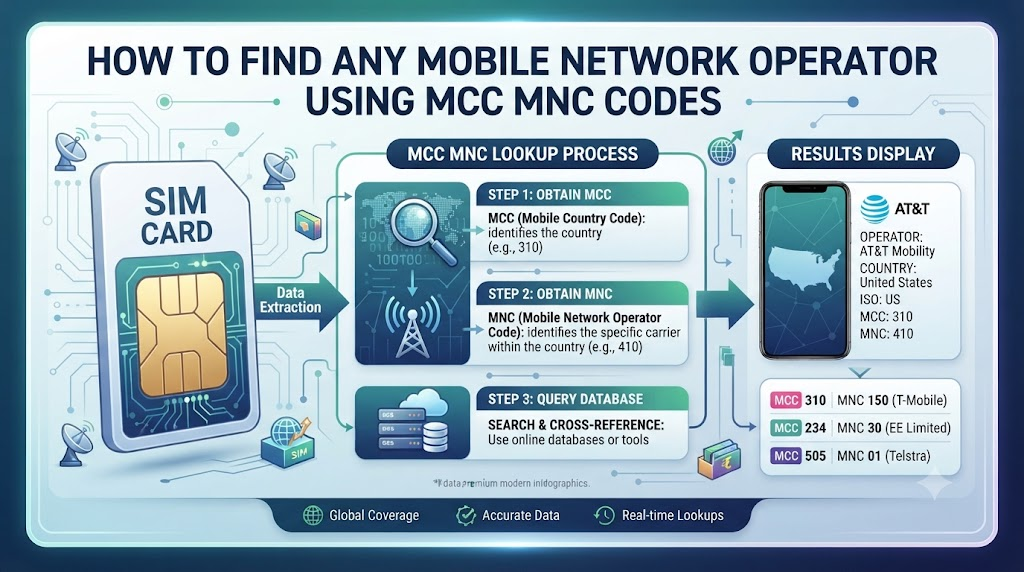
Every phone network in the world has a digital name tag. That tag is built from two small numbers. The first is the Mobile Country Code, or MCC.
An MCC is a three-digit number. It shows which country a network belongs to. For example, 310 points to the United States, and 204 points to the Netherlands.
The second number is the Mobile Network Code, or MNC. An MNC has two or three digits. It shows the exact phone carrier inside that country.
Put them together, and you get a clear address. The MCC says where. The MNC says who.
These numbers live inside every SIM card. A SIM card also holds a longer number called the IMSI. The first digits of the IMSI are the MCC and MNC.
When you turn on your phone, it reads these numbers. It then looks for a network that matches, or one that has a deal with your home carrier. That match guides your calls and mobile data.
Watch out for one thing. Some MNCs have two digits, and some have three. Always check the length, or you may read the code wrong.
Decoding the Telecom Stack: Codes, Networks, and Operators
Cellular identifiers work in layers. Each layer separates one thing from another. Some numbers split countries. Some split carriers. Others pick out one single subscriber SIM. The table below shows how each layer fits into the telecom stack. Read it from top to bottom, from the widest layer to the narrowest. Real examples make each number easier to see.
| Telecom Identifier | Number Length | Primary Purpose | Real-World Example | Managing Body |
|---|---|---|---|---|
| Mobile Country Code (MCC) | 3 Digits | Identifies geographic territory or international scope | 310 (United States) / 204 (Netherlands) | ITU-T |
| Mobile Network Code (MNC) | 2 or 3 Digits | Identifies specific mobile carrier within a country | 260 (T-Mobile) / 04 (Vodafone) | National Regulators |
| PLMN Code (MCC + MNC) | 5 or 6 Digits | Identifies unique wireless network operator | 310260 / 20404 | Cellular Industry |
| IMSI Identifier | Up to 15 Digits | Identifies the unique individual subscriber line | Stored securely on SIM card chips | Mobile Operators |
A phone reads these numbers in a set order when it searches for radio signals. First, it reads the home network code from its SIM. Next, it scans the air for nearby networks. Each network broadcasts its own PLMN code. The phone compares those codes with its list and picks the best match. This all happens in seconds, with no help from you.
MCC MNC Lookup and Identifying Wireless Carriers
An MCC MNC lookup is a simple search. You type in a five- or six-digit code. The tool then shows the country, the network name, and the company behind it.
Think of it like a phone book for networks. You do not need to guess. You get a clear answer from a trusted list.
Where does the list come from? The ITU-T E.212 standard sets the rules. ITU-T is the standards arm of the International Telecommunication Union. E.212 defines how country and network codes work.
Developers use lookups every day. They check where a SIM card comes from. This helps them route messages and set prices.
Fraud analysts use them too. If a login attempt shows a strange network code, the analyst can check it fast. A mismatch may signal a risk.
Network engineers also depend on lookups. They verify incoming traffic and match it to roaming partners. That keeps billing and service correct.
Be careful with your source. A good lookup uses official E.212 records. A weak one copies data from random sites. Always check the date of the last update.
Also remember that codes can change. Mergers, closures, and new licenses all shift the map. A fresh lookup beats an old memory. Use lookups as a first step, then confirm with national regulator records for key decisions.
PLMN Code Lookup and Cellular Network Routing
PLMN stands for Public Land Mobile Network. That is the full network of one carrier in one country. The PLMN code joins the MCC and the MNC into one number.
For example, 310 and 260 make 310260. That six-digit code names one exact network. A PLMN code lookup tells you who owns it.
PLMN codes matter most during roaming. When you travel, your phone scans for local networks. Each network shows its PLMN code. Your phone checks if your home carrier has a roaming agreement with it.
A roaming agreement is a deal between two carriers. It lets guests use each other’s towers. Without it, your phone cannot connect.
PLMN codes also help match radio bands. A band is a range of radio frequencies. Different regions use different bands. Knowing the local PLMN helps you check if your phone fits that network.
Cross-border travelers gain from this knowledge. So do engineers who build devices for many markets.
Watch out for lookalike codes. A one-digit error points to a different carrier. Always copy codes with care and check the digit count. Save verified codes in a clean list for future use. A tidy list prevents repeat mistakes.
Mobile Network Operator Directory and Verified Network Holders
A Mobile Network Operator, or MNO, owns the physical gear. That means radio towers, base stations, and core network systems. A base station is the tower equipment that talks to your phone.
A Mobile Network Operator Directory lists these companies. It shows who holds each network code. It also shows the country and the brand names.
Brand names can mislead. A shop sign may show one name, while a different company holds the license. Mergers and rebrands make this even trickier.
That is why you must separate two things. The first is the commercial brand that people see. The second is the official assignee that holds the code.
The assignee is the legal company named in official records. It is the real owner of the network infrastructure.
Why does this matter? A researcher who mixes up brands and owners can draw wrong conclusions. A developer may route traffic to the wrong partner.
A verified directory shows both the brand and the holder. It also shows dates and sources. Use it to check claims before you trust them.
Check often, because ownership changes. Carriers merge, sell, and shut down networks every year. Keep notes on each change you find.
Global Telecom Provider Directory and International Coverage
The world has hundreds of countries and territories. Each has its own carriers. A global telecom provider directory puts them all in one organized place.
Without one, researchers jump between dozens of sites. They waste time and often find mismatched data.
A good global directory covers more than big nations. It also includes small islands and remote territories. Every region has networks that matter to travelers and businesses.
Some networks do not belong to one country. International shared-code networks serve many places at once. Examples include satellite carriers and maritime services.
Maritime services connect ships at sea. Satellite carriers reach places with no towers. These networks use special shared codes instead of one country’s code.
Cross-border data routing adds another layer. Your data may travel through several countries before it reaches a website. Each hop crosses different networks.
A clear directory helps you see these paths. It shows who connects to whom.
Look for consistent formatting, clear sources, and regular updates. These signs show a directory you can trust. Skip any list that has no dates or no sources. Reliable coverage beats a long list that nobody checks. Ask how often the team reviews each country entry.
Mobile Network Codes by Country and Regional Numbering
Each country controls its own network codes. A national regulator hands them out to local wireless carriers. A regulator is a government body that manages telecom rules and licenses.
The ITU gives each country its MCC. After that, the national regulator assigns the MNCs within it.
So mobile network codes by country follow local decisions. One country may have three carriers. Another may have thirty.
Exploring these codes shows market competition. A country with many MNCs often has many active carriers and virtual operators.
In Europe, many small countries sit side by side. Travelers cross borders often, so roaming deals are common. Codes there change hands as carriers merge.
In the Americas, large markets such as the United States use several MCCs. Big countries need more room for networks.
In Asia, huge populations support many operators. Some countries add new codes as they open fresh licenses.
In Africa, mobile networks grow fast. Many people use phones as their main link to the internet and to money services.
Compare countries side by side to see patterns. Look at how many networks each market holds. Notice who owns the towers and who rents them.
Always check the year of your data. Regulators add, move, and retire codes over time. A clean country-by-country view saves hours of searching. Use it as a starting map, then confirm details with official filings.
Mobile Country Code List for Global Travelers and Researchers
A Mobile Country Code list is a table of every country and its three-digit MCC. It looks simple, but it is very useful.
Say you find a foreign SIM card. The list helps you read its origin from the first three digits of its IMSI.
Travelers and researchers use it to spot roaming partners. A phone might show a network name you do not know. The MCC tells you which country that network belongs to.
The International Telecommunication Union, or ITU, assigns these country blocks. The ITU is a United Nations agency for communication technology. It keeps the list clean so no two countries share a code by mistake.
Standardized lists keep the world in sync. Every carrier, phone maker, and software team reads the same numbers.
Some countries have more than one MCC. Larger markets may need extra codes. So always check the full list, not just the first match.
One more caution. An MCC is not a phone dialing code. Do not mix them up.
Pick a list that shows the update date and the source. That small detail tells you a lot about quality. Save the list for field work where internet access is poor.
Network Data Validation and Carrier Research Checklist
Good research follows steps. A short checklist keeps you honest and saves you from copied errors. Each step below checks one part of a network record. Use the table whenever you study a new code. It works for students, analysts, and developers alike. Tick each row before you trust a record.
| Research Step | What to Check | Why It Matters |
|---|---|---|
| ITU-T E.212 Baseline | Official Assignment Status | Confirms legal code ownership from international records |
| National Regulator Filing | Local Frequency Licenses | Shows domestic operational approval and spectrum rights |
| Commercial Role Check | MNO vs MVNO Designation | Clarifies whether the provider owns physical cell towers |
| Active Brand Matching | Retail Trade Name | Connects technical network numbers to consumer brand logos |
| International Shared Codes | 901/902 Global Allocations | Identifies satellite, maritime, and specialized IoT networks |
| Data Timestamp Review | Date of Last Assignment Audit | Ensures decommissioned or merged network codes are updated |
Avoid outdated or copied carrier lists on unverified websites. Many sites paste old data and never fix it. Some even invent entries. Always trace a code back to an official record. If a site gives no source, treat its list as a rumor. A few extra minutes of checking can save your project from wrong data. Fresh, sourced data always wins over a long, unchecked list.
Telecom Operator Database and Evidence-Led Research
Evidence matters in telecom research. A wrong code can break a billing system or block a message. So every claim needs proof.
A telecom operator database stores network facts in a clear structure. It lists codes, names, countries, and roles. The best ones also link each record to a source.
Good sources include national regulator filings and official government documents. These papers show who holds a license and when it started.
The ITU also publishes official notices about code assignments. These notices help confirm baseline records.
Linking each fact to a primary source builds trust. A reader can follow the trail and check it alone.
An evidence-led approach also tracks changes over time. A carrier may merge with a rival. A license may expire. The record should show the date of each change.
Be careful with secondary sources. News posts and forums may repeat old facts. Use them only as hints, not as proof.
Keep your own research notes tidy. Write down where you found each fact and when you checked it. That habit makes your work easy to review later. Teams can then share findings without fear of hidden errors. Quality data starts with careful habits.
MVNO Directory: Virtual Operators and Wholesale Networks
A Mobile Virtual Network Operator, or MVNO, sells phone service without owning towers. It buys capacity from a host operator instead.
Think of a store that sells goods made by another company. The store owns the brand and the customers. The maker owns the factory.
An MVNO Directory lists these virtual carriers. It also shows which host MNO supplies their coverage.
Why do MVNOs exist? They offer flexible plans, lower prices, and niche services. Some focus on students, travelers, or low-data users.
The host operator earns wholesale income by leasing its network. Wholesale means selling in bulk to another business.
From a code view, many MVNOs share the host’s network codes. So their customers appear on the host’s PLMN. Some larger MVNOs hold their own codes.
This is why directories must label each provider’s role. A reader should see at a glance who owns towers and who rents them.
Watch out for brand confusion. A popular MVNO brand may look like a major carrier. Yet its signal comes from another company’s towers.
Check the host name before you judge coverage. The host’s map is the real map. Compare MVNO plans only after you know the host network.
eSIM Provider Directory and Modern Digital Connectivity
An eSIM is a tiny digital chip built into modern smartphones. It does not need a plastic card. Instead, you download a mobile plan to it.
That makes switching plans fast. You can add a travel plan in minutes, even before your flight.
An eSIM Provider Directory helps you study these services. It lists companies that sell digital plans. It shows which countries each one covers.
Behind every eSIM plan sits a real network. Many providers rent coverage from local operators. A good directory names those partners.
This matters because coverage depends on the partner, not the brand. A plan on a weak partner network will feel weak.
Researchers should compare supported destinations, network partners, and plan types. They should also check if a provider holds its own codes or uses partner codes.
Travelers can use this research to pick better plans. They can avoid surprises like slow speeds or no coverage in a small town.
Check device support too. Not every phone accepts eSIM plans. Look at your phone settings or maker website first.
Remember that plans and partners change. Review the directory date before you buy. Never rely on one old review.
Developer Workflows: MCC MNC Lookup API and Data Integration
Software teams need fast, machine-readable network data. An MCC MNC Lookup API gives it to them. An API is a way for one program to ask another program for data.
The app sends a code. The API sends back the country, network name, and operator details in seconds.
Software engineers use it to detect SIM card origins. The app can see where a user’s SIM comes from without asking.
Fintech platforms use it to guard payments. A sudden change in network origin may signal fraud. The system can ask for extra checks.
Telecom product teams use it to route messages. They can pick the best carrier path and cut costs. They can also avoid SMS routing fraud, where criminals reroute messages to steal codes.
Global data connections gain too. Apps can adjust to local networks and keep service smooth worldwide.
When you pick an API, check four things: data source, update speed, response time, and uptime. Uptime means how often the service stays online.
Cache results wisely. Store common lookups for a short time, but refresh them often. That keeps your app quick and your data fresh.
Test with edge cases like two-digit and three-digit MNCs and shared ranges. These tests catch bugs early.
Real-Life Telecommunications Scenarios
- The app developer: A mobile app developer uses an automated network lookup to route two-factor SMS codes. The tool reads each user’s network code and picks the lowest-cost local carrier. Messages arrive fast, costs drop, and users sign in without delay, even at peak times.
- The business traveler: An international business traveler checks an online directory before a trip. She wants to know which local network partner her roaming eSIM will use abroad. The directory shows the partner and its coverage, so she plans calls and data with confidence.
- The security analyst: A telecom security analyst sees an unfamiliar PLMN code in a login log. The analyst checks it in a verified database and finds no match for the user’s country. That clue helps flag suspected SIM-swap fraud or network spoofing for fast review.
- The IoT fleet manager: An IoT fleet manager tracks smart sensors on trucks that cross borders. IoT means everyday devices that connect to the internet. The manager checks country codes and network assignees first, so each sensor connects well in every foreign country along the route.
Common Mistakes to Avoid in Telecom and Network Code Research
- Confusing a consumer brand name with the actual infrastructure owner. A shop logo may hide a different company. Check the official assignee in verified records before you name the owner of any network.
- Assuming a dialing code matches an MCC. The code +44 is the United Kingdom dialing code, but its main MCC is 234. Use the MCC list for network work, and keep dialing codes for phone calls.
- Relying on outdated carrier lists. Mergers and shutdowns change networks often. Use sources with clear update dates, and compare them with current regulator records before you rely on any entry.
- Overlooking shared international ranges. Codes such as 901 and 902 do not belong to one country. Check whether a code sits in a shared range before you link it to a nation.
- Trusting unsourced blog lists. Some posts invent network assignments. Check each claim against ITU E.212 records and national filings, and drop any list that names no source, however neat it looks.
- Forgetting that many MVNOs share their host’s towers. They often appear on the host operator’s network codes. Check the host before you judge coverage, and note when an MVNO holds its own code.
- Assuming all operators use the same radio bands. Bands differ between regions. Check your device’s supported bands against local network bands before you promise coverage or buy a plan abroad.
- Ignoring whether a code is active. Some codes are held for tests or no longer run live service. Confirm the status in the latest records, and mark test or retired codes clearly in your notes.
Simple Telecom Data Research Checklist
- Verify the three-digit MCC against the official ITU list. Write the country name next to it so you never mix up codes.
- Confirm the MNC length. Check if it has two digits or three, because the length changes how you read the PLMN code.
- Check the combined PLMN code in a verified operator database. Make sure the five- or six-digit code matches one clear entry.
- Identify the legal company holding the license. Note both the brand name and the official assignee.
- Review national regulator filings for recent changes. Look for mergers, transfers, and retired codes.
Frequently Asked Questions
1. What is the difference between an MCC and an MNC?
An MCC is a three-digit number that shows the country. An MNC is a two- or three-digit number that shows the carrier in that country. Together they name one network.
For example, MCC 310 points to the United States. Add MNC 260, and you reach one specific carrier. The MCC says where the network lives. The MNC says who runs it. Both sit inside every SIM card.
2. How do mobile phones use PLMN codes to select a cellular network?
A phone reads the PLMN code from its SIM. It then scans for nearby networks. Each network broadcasts its own PLMN code.
The phone looks for its home network first. If none is found, it checks a list of roaming partners and picks the best one. This keeps you connected when you travel. Users can also pick a network by hand in phone settings.
3. Where do official Mobile Country Code and Network Code records come from?
Official records start with the ITU. The ITU publishes the E.212 standard and keeps the list of country codes. It also posts notices about assignments.
National regulators then assign and record network codes inside each country. Operators confirm their own details too. A trusted directory checks all three sources and shows the date of the last review. Always follow the trail back to these primary sources.
4. What is the difference between an MNO and an MVNO in a telecom directory?
An MNO owns towers and base stations. It holds the radio licenses. An MVNO does not own towers. It rents capacity from a host MNO and sells plans under its own brand.
A good telecom directory labels each provider with its role. That way, readers can see who really runs the network and who only resells service. This label matters for coverage research.
5. Why do some international networks use 901 or 902 country codes?
Some networks serve many countries at once. They cannot use one country’s MCC. So the ITU set aside shared codes, such as 901 and 902, for international use.
These ranges cover services like satellite carriers, maritime networks, and special shared platforms. If you see 901 in a record, do not link it to a single nation. Treat these codes as global, not local.
6. How does an MCC MNC lookup tool help stop financial and SMS fraud?
A lookup tool shows the real country and carrier behind a code. Fraud teams compare that result with what a user claims. A mismatch can flag SIM-swap fraud or fake network traffic.
Payment systems can then ask for extra checks. Message platforms can block suspicious routes. A quick lookup adds a strong, low-cost layer of defense to any security plan. It is not a full shield, so pair it with other checks.
7. Can two different telephone companies share the exact same MCC and MNC?
No, not on purpose. Each PLMN code should name one network. The code pair is meant to be unique.
Some cases look shared, though. Many MVNOs use their host’s network codes. Network sharing deals can also let two companies use the same towers. In these cases, the radio network is shared, but the legal operators still differ. Always check the role of each company.
8. How does an eSIM profile connect to local physical cell towers abroad?
An eSIM profile holds the same kind of identity data as a plastic SIM. When you travel, your phone scans for local networks.
The profile points to a partner network, either through a roaming deal or a local agreement. Your phone then joins the partner’s towers. The local tower sends your data over the air, and the partner routes it to the internet.
9. What is an IMSI number, and how does it relate to network codes?
IMSI stands for International Mobile Subscriber Identity. It is a number of up to 15 digits stored on your SIM. The first three digits are the MCC.
The next two or three digits are the MNC. The rest identify your own subscriber line. So the IMSI starts with the network code and ends with your personal ID. Carriers guard this number closely.
10. Why do some network operators hold multiple MNC assignments in the same country?
A carrier may need more than one code. It may run different network types, such as older and newer generations. It may hold codes after buying another company.
It may also keep codes for test networks or special services. Regulators approve each code separately. So one brand can show up under several MNCs in the same country. A good directory groups these codes under one owner.
11. How do developers integrate an MCC MNC lookup API into their applications?
Pick an API with clear documents and a trusted data source. Send the code in a simple request. The API sends back country, carrier, and role details.
Add the result to your app logic, like routing or fraud checks. Store common results for a short time to speed things up. Test edge cases, such as three-digit MNCs, before launch. Also plan for errors, so your app still works if the API is slow.
12. How does eSIMGlobo help researchers find verified global telecom information?
eSIMGlobo is an evidence-led global telecom provider directory and network research platform. It helps researchers find verified information about codes, operators, and digital connectivity providers.
Records focus on clear sources and dates, so readers can check each fact. Researchers can study MNOs, MVNOs, and eSIM providers in one place, and save time on scattered searches. Use it as a starting point, then confirm key details with official records.
Conclusion
Global communication runs on small numbers. MCC and MNC codes name the country and the carrier behind every SIM. PLMN codes join them into one clear network address. Official ITU records and national regulator filings keep those facts honest. Verified directories turn raw numbers into useful knowledge about operators, virtual carriers, and eSIM providers. Careful checks protect you from old lists, brand mix-ups, and fraud. Developers gain speed with lookup tools, and travelers gain confidence abroad. Platforms like eSIMGlobo bring this evidence together in one place. Keep your sources clean, your dates fresh, and your questions sharp. Start with one code today, and follow it to its source. Reliable, evidence-backed telecom data powers seamless global communication for everyone.
