Introduction
The world of IT Operations never stands still. I have watched the industry evolve from the days of manual server checks and pagers to the high-speed world of DevOps automation. And now, we are facing the next massive shift: Artificial Intelligence for IT Operations (AIOps). If you are working as a DevOps Engineer, SRE, or IT Manager today, you know the struggle. You have microservices, containers, and cloud infrastructure generating millions of logs every hour. Traditional monitoring tools just cannot keep up. You get flooded with alerts, and 90% of them are just noise.That is exactly why the AiOps Certified Professional (AIOCP) is becoming the standard for modern engineering leaders. It is the bridge between “keeping the lights on” and “building a system that fixes itself.”This guide covers everything you need to know about the AIOCP. I have written this based on real-world industry demands, breaking down the skills, the strategy, and the career path you need to master this technology.
Program Overview: AiOps Certified Professional (AIOCP)
The AiOps Certified Professional (AIOCP) is not just a tool training course. It is a methodology program. It teaches you how to stop reacting to fires and start predicting them using data.
It bridges the gap between IT Operations and Data Science. You do not need to be a mathematician, but you do need to learn how to apply Machine Learning concepts to your infrastructure data.
| Feature | Details |
|---|---|
| Certification Name | AiOps Certified Professional (AIOCP) |
| Track | AIOps / MLOps / IT Operations |
| Level | Professional (Intermediate to Advanced) |
| Who it’s for | DevOps Engineers, SREs, IT Managers, Cloud Engineers |
| Prerequisites | Understanding of Linux, Cloud (AWS/Azure), and DevOps |
| Skills Covered | Anomaly Detection, Event Correlation, RCA Automation, Python/Bash, Prometheus, ELK |
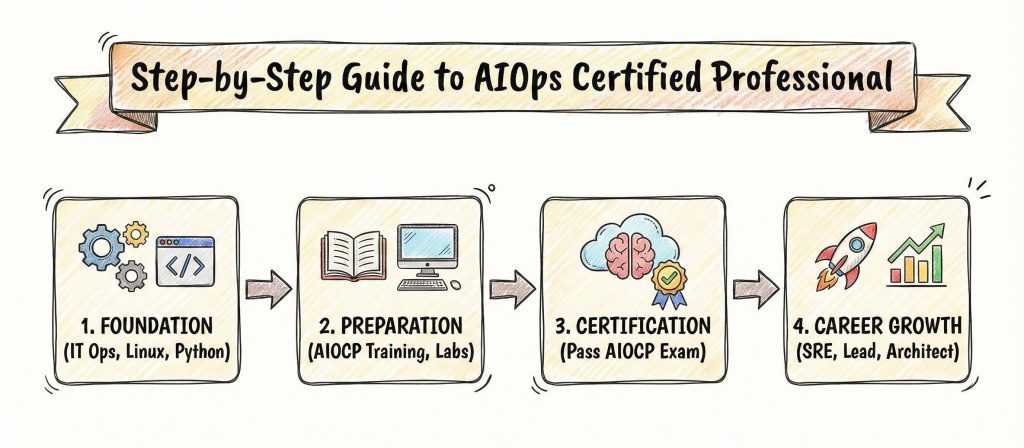
| Recommended Order | Linux -> AWS -> DevOps -> AIOCP |
Why This Certification Matters
What it is
The AIOCP is a comprehensive program that teaches you how to build “Self-Healing” systems. It focuses on using Big Data and Machine Learning to enhance IT operations. Instead of a human staring at a dashboard, AIOps systems detect patterns to find problems before they impact users.
Who should take it
- Site Reliability Engineers (SREs): If you want to eliminate “alert fatigue.” This course teaches you how to suppress noise so you only wake up for real problems.
- DevOps Engineers: If you want to use data to make your CI/CD pipelines smarter (e.g., automatically stopping a deployment if error rates trend up).
- IT Managers: If you need to reduce Mean Time To Resolution (MTTR). AIOps helps your team find the “needle in the haystack” faster.
- Data Engineers: If you want to apply ML skills specifically to IT infrastructure data (logs, metrics, and traces).
Skills you’ll gain
- Automated Root Cause Analysis (RCA): You will learn to pinpoint exactly why a system failed in seconds, rather than spending hours guessing.
- Anomaly Detection: You will master identifying “weird” behavior—like a slow memory leak—that traditional static thresholds miss.
- Event Correlation: You will learn how to take 5,000 raw alerts and group them into 5 meaningful “Incidents,” filtering out the noise.
- Tool Proficiency: You will get hands-on mastery of tools like Moogsoft, Prometheus, Grafana, and the ELK Stack.
- Predictive Analytics: You will learn to forecast resource needs, such as predicting when a disk will fill up weeks in advance.
Real-world projects you will do
- Build a Self-Healing System: Create a script that detects a “High CPU” alert and automatically adds a new server to the cluster.
- Design a Unified Dashboard: Pull data from AWS, Kubernetes, and Jenkins into a single Grafana dashboard to correlate deployments with error rates.
- Implement Smart Alerting: Configure an AIOps platform to group related alerts (e.g., “Database Down” + “Web Timeout”) into a single ticket.
Your Preparation Plan
Getting certified requires a structured approach. I have seen many engineers try to rush this and fail because they skipped the basics. Choose the plan that fits your current level.
1. The “Sprint” Plan (7–14 Days)
- Who: Experienced SREs or DevOps leads who use Prometheus/Grafana daily.
- Focus: Review AIOps specific theory (algorithms, event correlation) and fill gaps in ML concepts.
- Daily: 2-3 hours of intense lab practice on specific tools like Moogsoft or PagerDuty.
2. The “Standard” Plan (30 Days)
- Who: Working DevOps engineers familiar with cloud but new to AI/ML.
- Weeks 1-2: Master prerequisites: Python scripting, Linux internals, and AWS basics.
- Weeks 3-4: Dive into the AIOCP curriculum. Focus on “Data Ingestion” and “Machine Learning for Ops.”
3. The “Deep Dive” Plan (60 Days)
- Who: Junior engineers or those transitioning from non-technical roles.
- Focus: Build a strong foundation. Spend the first 3 weeks just on Linux and Python.
- Strategy: Take the course modules slowly. Replicate every lab exercise in your own free-tier account.
Common Mistakes to Avoid
- Ignoring Prerequisites: Do not skip Linux or Python basics. You cannot automate what you do not understand.
- Over-focusing on Theory: AIOps is practical. If you cannot configure an alert in the real tool, the theory is useless.
- Neglecting Data Quality: “Garbage in, garbage out.” Learn how to clean your logs before feeding them into an AI tool.
Career Paths & Next Steps
Choose Your Path
The IT landscape is vast. Here is where the AIOCP fits into the bigger picture of specialized career tracks.
Role → Recommended Certifications Mapping
| Current Role | Recommended Path | Why? |
|---|---|---|
| DevOps Engineer | AIOCP + Certified Kubernetes Administrator (CKA) | To manage complex container clusters intelligently. |
| SRE | AIOCP + Certified SRE Professional | To automate reliability and incident response. |
| Platform Engineer | AIOCP + AWS Solution Architect | To build self-service, self-healing internal platforms. |
| Security Engineer | AIOCP + Certified DevSecOps Professional | To detect security anomalies (threats) using AI. |
| Data Engineer | AIOCP + Certified DataOps Professional | To manage pipelines that feed AIOps models. |
| Engineering Manager | AIOCP + Certified Agile DevOps Practitioner | To lead teams building next-gen operations centers. |
Best Next Certifications
Once you have passed the AiOps Certified Professional (AIOCP), you have a powerful skill set. But in IT, we never stop learning. Depending on where you want your career to go next, here are the three best paths to take.
1. The Specialist Path: Certified Kubernetes Administrator (CKA)
- Why take this? Most modern AIOps tools (like Prometheus or ELK) run inside Kubernetes. If you don’t understand how a container works, you cannot effectively monitor it.
- What you will learn: Deep container orchestration, how to troubleshoot a crashed pod, and how to manage the infrastructure where your AI tools live.
- Verdict: Essential if you want to be a “Hands-on Technical Expert.”
2. The Security Path: Certified DevSecOps Professional (CDP)
- Why take this? Security tools generate the most noise. A huge part of AIOps is filtering out false security alarms. Combining AIOps with Security makes you a “DevSecOps” expert, which is one of the highest-paying roles in the industry.
- What you will learn: How to automate security scans, how to detect hackers using data patterns, and how to secure your pipelines.
- Verdict: Best for engineers who want to specialize in Cyber Security automation.
3. The Leadership Path: Master in DevOps Engineering (MDE)
- Why take this? If your goal is to become an Architect, a Director, or a CTO, you need to know the “Big Picture.” This certification covers everything—Cloud, DevOps, Security, and AIOps—in one massive program.
- What you will learn: How to design entire systems, how to lead teams, and how to choose the right tools for a multimillion-dollar project.
- Verdict: The ultimate goal for future leaders.
Top Institutions for Training & Certification
Choosing where to learn is just as important as what to learn. I have worked with many training providers, and here is my honest breakdown of the top players in this space.
1. DevOpsSchool
DevOpsSchool is the premier provider for the AIOCP certification and is widely recognized as the “Gold Standard” in the industry. Their program is famous for being incredibly hands-on, providing students with real-world lab environments where they can practice solving actual infrastructure problems. They also offer lifetime access to their Learning Management System (LMS) and community support, ensuring you have a mentor even after the course ends.
2. Cotocus
Cotocus is a top-tier choice for corporate and team training. They excel at customizing their curriculum to fit the specific tools and cloud platforms (like AWS, Azure, or GCP) that a company is already using. Their trainers are often practicing consultants, meaning they bring deep, practical “war room” experience into the classroom, helping teams understand how AIOps works in large-scale enterprise environments.
3. ScmGalaxy
ScmGalaxy is a massive community hub that is excellent for self-learners and those looking for peer support. While they offer training, their biggest strength lies in their vast library of free tutorials, reference architectures, and community forums where engineers help each other debug issues. It is a fantastic resource for finding quick answers and connecting with other DevOps professionals globally.
4. BestDevOps
BestDevOps is known for its focused, crash-course style training modules that are perfect for professionals in a hurry. They strip away the fluff and focus purely on the core tools and concepts needed to pass the certification and get the job done. If you need to get up to speed on AIOps tools like Prometheus or ELK in a short amount of time, this is a great option.
5. devsecopsschool
As the name suggests, this institution is the go-to place if you want to blend AIOps with Security. Their training emphasizes the “Security” aspect of operations, teaching you how to use AI to detect threats, automate security patching, and analyze audit logs. It is the ideal choice for engineers who want to specialize in the high-demand field of DevSecOps.
6. sreschool
sreschool is highly specialized for Site Reliability Engineers (SREs). Their curriculum focuses heavily on SRE concepts like Service Level Objectives (SLOs), Error Budgets, and Incident Management. If your goal is to become a reliability expert who uses AIOps to keep systems running 24/7, their targeted approach is exactly what you need.
7. aiopsschool
This is a niche provider that focuses exclusively on the Artificial Intelligence and Data Science aspect of IT operations. Their courses dive deeper into the algorithms and machine learning models behind the tools than most other generalist providers. It is a fantastic choice for engineers who really want to understand the “math and magic” behind anomaly detection and predictive analytics.
8. dataopsschool
dataopsschool is designed for Data Engineers who are moving into the operational space. Their training bridges the gap between managing data pipelines and managing infrastructure, teaching you how to apply AIOps principles to Big Data workloads. If you manage large Hadoop, Spark, or Kafka clusters, their curriculum is tailored to your specific challenges.
9. finopsschool
finopsschool focuses on the financial side of operations, known as “Cloud Cost Optimization.” They teach you how to use AIOps tools not just to fix servers, but to predict cloud bills and spot wasteful spending automatically. This is an excellent choice for managers or senior engineers who are responsible for keeping cloud budgets under control.
Frequently Asked Questions (FAQs)
I get asked these questions all the time by students and junior engineers. Here are the honest answers.
1. Is the AIOCP difficult for beginners?
Answer: Yes, if you are a total beginner. It is an intermediate certification. You cannot automate a server if you don’t know what a server is.
- My Advice: If you are new, start with “Linux Fundamentals” and “AWS Basics” first. Once you are comfortable with the command line, then come to AIOps.
2. How long does it take to complete?
Answer: For a working professional, it usually takes 4 to 6 weeks.
- Breakdown: The training is often 30-40 hours. You will need another 20 hours for homework and lab practice. Do not try to rush it in one weekend; the concepts need time to sink in.
3. Do I need to be a Python expert?
Answer: No. You are not building the next Facebook. You are writing “scripts.”
- Detail: You need to know how to write simple “Glue Code”—scripts that take data from Tool A and send it to Tool B. If you can write a basic
if/elsestatement in Python, you are ready.
4. What is the value in the market?
Answer: Extremely high.
- Why? Every company is moving to the cloud. The cloud generates too much data for humans to watch. Companies are desperate for people who can set up tools to watch the data for them. It is one of the most “future-proof” skills you can have.
5. Is there coding involved?
Answer: Yes, but it is low-code automation.
- Context: You will spend more time writing YAML (configuration files) and simple Bash/Python scripts than writing complex application code.
6. Does this cover Generative AI (like ChatGPT)?
Answer: The core certification focuses on Predictive AI (numbers, metrics, graphs).
- Update: However, newer modules are starting to include “GenAI for Ops”—using tools like ChatGPT to write incident summaries or explain error logs in plain English.
7. Can I take this if I am a manager?
Answer: Absolutely.
- Why? You might not do the coding labs, but you must understand the architecture. You need to know what is possible so you can hire the right people and buy the right tools.
8. What is the exam format?
Answer: It is a mix.
- Theory: Multiple-choice questions to test if you understand the concepts (e.g., “What is the difference between Supervised and Unsupervised learning?”).
- Practical: Scenario-based questions (e.g., “The server is lagging. Which algorithm would you use to detect this?”).
9. How does AIOps differ from standard DevOps?
Answer: They are partners.
- DevOps is about Speed (Deploying code faster).
- AIOps is about Quality (Keeping that code running without crashing). You need both.
10. Do I need to know math or statistics?
Answer: You need “High School” math, not “University” math.
- Detail: You need to understand what an “Average” is and what a “Spike” (Anomaly) looks like on a graph. The software tools handle the complex calculus for you.
11. Is this certification recognized globally?
Answer: Yes.
- Context: Cloud-native companies in the US, Europe, and India recognize the practical skills taught in this program. It is less about the “paper” and more about the “skills” you can demonstrate in an interview.
12. Can I do this online?
Answer: Yes, 100%.
Detail: The training, the labs, and the final exam are all available online. You can get certified from your living room.
Testimonials
“I was skeptical about ‘AI’ in Ops. This course showed me how to actually reduce our pager alerts by 60%. The labs were a game changer.”
— Rohan M., Senior SRE, Bangalore
“Transitioning from manual SysAdmin to AIOps Professional was challenging but worth it. The mentor support helped me debug my scripts. I now lead the automation team.”
— Sarah J., Cloud Engineer, Toronto
“Finally, a course that explains the ‘Why’. Understanding data flow helped us redesign our monitoring stack to be proactive.”
— Amit K., DevOps Lead, Pune
Conclusion
The AiOps Certified Professional (AIOCP) is more than a badge; it is a signal that you are ready for the future of IT. As systems get complex, manual debugging becomes impossible. We need tools that think and react.
By mastering these skills—from Python scripting to predictive analytics—you position yourself as a leader who builds smarter, self-healing systems.
